
In the modern paper manufacturing industry, the demand for high-performance components like pulping rotors has escalated, driven by advancements in technology and efficiency requirements. As an integral part of pulp processing equipment, pulping rotors are subjected to extreme mechanical stresses and corrosive environments, necessitating robust manufacturing processes. Traditional sand casting methods often rely on wooden patterns, which present significant challenges for complex geometries—extended lead times, high costs, and limitations in precision. In this study, I explore the application of 3D printed sand casting as a transformative approach to address these issues. By leveraging additive manufacturing for sand mold production, I aim to streamline the casting process, enhance design flexibility, and improve the overall quality of pulping rotors. This research delves into the entire workflow, from initial design and simulation to final validation, emphasizing the repeated use of sand casting techniques to underscore their relevance in contemporary foundry practices.
The pulping rotor, typically fabricated from ZG06Cr13Ni4Mo martensitic stainless steel, must meet stringent technical specifications to ensure durability and performance. This alloy is chosen for its excellent corrosion resistance, wear properties, and high tensile strength, making it suitable for demanding applications in sectors like hydropower and aerospace. The chemical composition and mechanical properties are critical benchmarks in sand casting processes, as they influence melt behavior, solidification patterns, and final part integrity. Below, I present the required standards in tabular form to establish a clear foundation for the sand casting methodology.
| Element | C | Si | Mn | S | P | Cr | Ni | Mo |
|---|---|---|---|---|---|---|---|---|
| Specification | ≤0.06 | ≤0.8 | ≤1.0 | ≤0.035 | ≤0.025 | 11.5-13.5 | 3.5-5.0 | 0.4-1.0 |
| Property | Yield Strength (Rp0.2, MPa) | Tensile Strength (Rm, MPa) | Elongation (A5, %) | Reduction of Area (Z, %) | Impact Energy (KV, J) | Hardness (HBW) |
|---|---|---|---|---|---|---|
| Specification | ≥550 | ≥750 | ≥15 | ≥35 | ≥50 | 221-294 |
Structurally, the pulping rotor features a complex geometry that poses challenges for conventional sand casting. As shown in the provided reference, it consists of a central disk with an outer diameter of 945 mm and a height of 158 mm, surrounded by eight streamlined blades. These blades are crucial for dynamic balance and efficient pulp disintegration, requiring high dimensional accuracy. The rotor is designed with a hollow internal cavity to reduce weight, which further complicates mold making in traditional sand casting. This intricate design underscores the need for advanced techniques like 3D printed sand casting, where mold complexity does not incur additional costs or time delays.
In developing the casting process, I focused on optimizing parameters to ensure defect-free components through sand casting. The first step involved determining the pattern allowance, which accounts for shrinkage during solidification. For ZG06Cr13Ni4Mo in gravity sand casting, a linear shrinkage factor of 2.0% was applied. This is derived from empirical data and can be expressed mathematically for dimensional adjustments: $$ L_f = L_0 \times (1 + s) $$ where \( L_f \) is the final mold dimension, \( L_0 \) is the part dimension, and \( s \) is the shrinkage factor (0.02 in this case). The gating system was designed as a bottom-pour arrangement to promote smooth filling and minimize turbulence—a key consideration in sand casting to reduce inclusions and gas defects. The ingate diameter was set at 60 mm, allowing molten metal to enter the cavity steadily and rise toward the risers.
Machining allowances were incorporated to accommodate post-casting operations, with 8 mm on the top surface, 10 mm on the outer circumference, and 6 mm on the bottom face. The central bore was not cast, reducing material usage. The initial casting weight was calculated at 187 kg, considering these allowances. Riser design is critical in sand casting to compensate for solidification shrinkage. I employed a cylindrical riser with dimensions of 200 mm in diameter and 280 mm in height at the rotor’s center, with a modulus of 4.5 cm to ensure adequate feeding. Additionally, eight insulating risers, each 70 mm in diameter and 100 mm high, were placed at the blade roots, with a modulus of 1.8 cm. Exhaust risers of 20 mm diameter were added at the blade tips to vent gases. The total metal pour weight was 312 kg, yielding a process efficiency of approximately 60%, which is favorable in sand casting applications.
The core innovation in this study lies in the adoption of 3D printed sand casting for mold fabrication. Unlike traditional wood pattern-based sand casting, 3D printing eliminates the need for physical patterns, allowing direct conversion of digital models into sand molds. This approach drastically reduces lead times—from weeks to just a day—and cuts costs by avoiding pattern-making expenses. For this project, I used a VX2000 3D printer capable of producing molds up to 2000 mm × 1000 mm × 1000 mm in size. The printing material was GS15 silica sand bonded with a specialized resin at 1.2% and a curing agent at 0.3%, resulting in a mold strength of 1.4 MPa. The layer thickness was set at 0.3 mm, with each layer printed in under 32 seconds, achieving a dimensional accuracy of ≤0.3 mm. This precision is paramount in sand casting for maintaining the intricate blade profiles of the rotor.
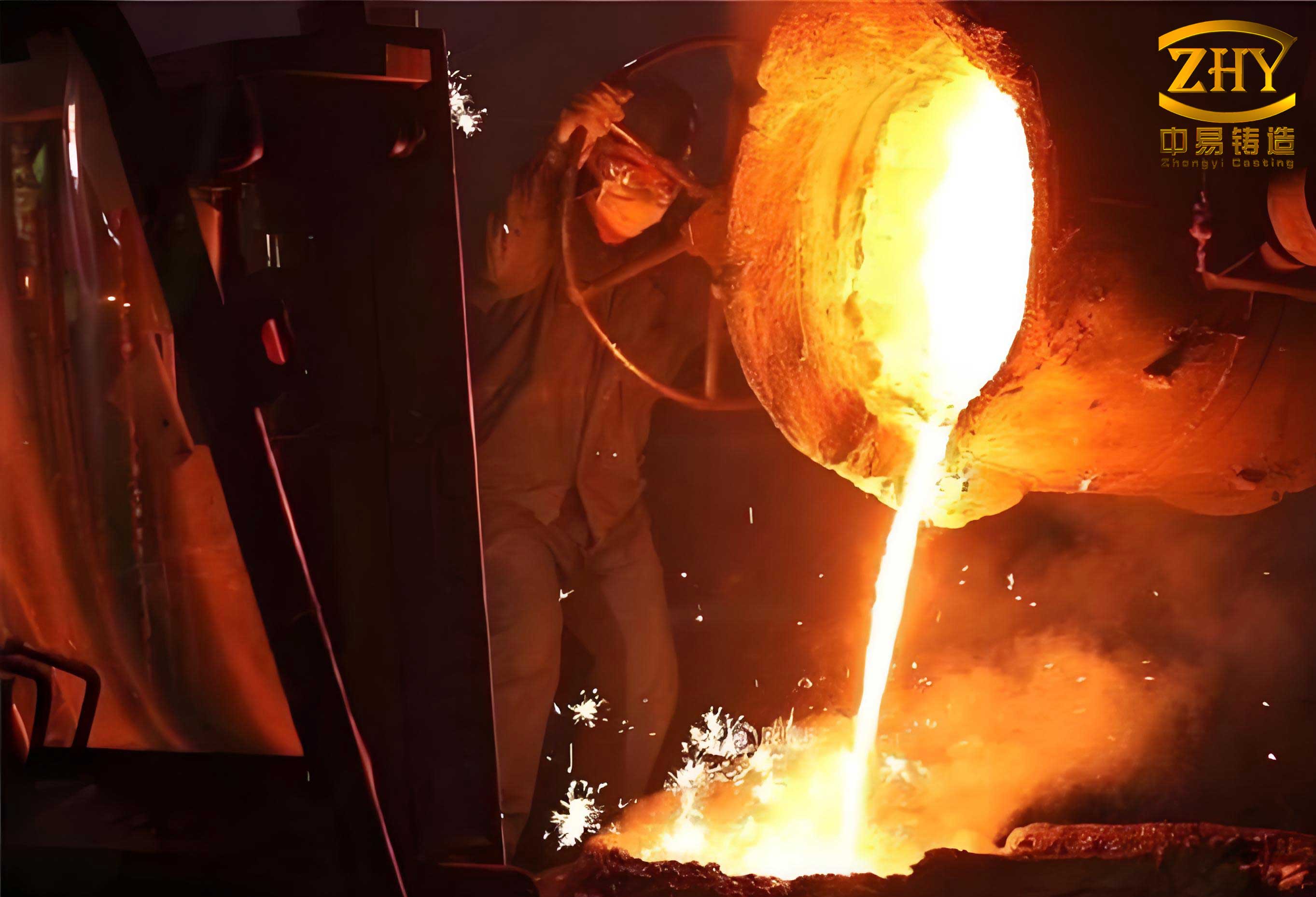
Melting and pouring operations were meticulously controlled to align with sand casting best practices. I utilized a dual-process method involving an alkaline electric arc furnace followed by an AOD argon-oxygen decarburization refinery. This ensured low carbon content (below 0.03%) and minimal impurities like phosphorus and sulfur, enhancing the corrosion resistance of the final casting. After tapping, the molten steel was allowed to settle in the ladle for over 5 minutes to facilitate slag flotation. Pouring temperature was maintained between 1560°C and 1580°C, using a bottom-pour ladle with a 50 mm nozzle diameter. The filling time was approximately 6 seconds, corresponding to a pour rate of 50 kg/s, which minimizes thermal gradients in sand casting molds.
Heat treatment is essential for achieving the desired mechanical properties in sand cast components. For the pulping rotor, I implemented a normalizing and tempering cycle. The normalizing phase involved heating to 1020°C ± 10°C, holding for 2 hours, followed by air cooling. Tempering was conducted at 600°C ± 10°C for 4 hours. Controlled heating rates were applied: ≤100°C/h from 300°C to 600°C, and ≤80°C/h from 600°C to 1020°C, to prevent thermal stresses—a common concern in sand casting due to the mold’s thermal mass. This regimen aims to refine the martensitic microstructure, balancing hardness and toughness.
To predict and mitigate defects inherent in sand casting, I employed Procast simulation software. The process began with mesh generation of the rotor geometry, assigning material properties for ZG06Cr13Ni4Mo. Boundary conditions included an interfacial heat transfer coefficient of 500 W/(m²·K) between the metal and sand mold, an initial ambient temperature of 25°C, and the aforementioned pouring parameters. The simulation modeled both filling and solidification stages. Temperature distributions during solidification revealed thermal gradients that influence shrinkage behavior. The governing heat conduction equation in sand casting can be expressed as: $$ \rho c_p \frac{\partial T}{\partial t} = \nabla \cdot (k \nabla T) + Q $$ where \( \rho \) is density, \( c_p \) is specific heat, \( T \) is temperature, \( t \) is time, \( k \) is thermal conductivity, and \( Q \) represents latent heat release during phase change. The results indicated potential shrinkage porosity in certain regions, leading to riser optimization.
Defect prediction in sand casting relies on criteria like the Niyama criterion, which correlates thermal parameters with porosity formation. It is defined as: $$ G / \sqrt{\dot{T}} $$ where \( G \) is the temperature gradient and \( \dot{T} \) is the cooling rate. Values below a threshold indicate susceptibility to microporosity. In this simulation, areas with low modulus or inadequate feeding showed such risks. By adjusting riser sizes and placements based on these insights, I minimized defects, demonstrating the power of simulation in enhancing sand casting outcomes. The final design yielded a sound casting with minimal predicted shrinkage, as visualized in the simulation outputs.
| Parameter | Value | Unit |
|---|---|---|
| Pouring Temperature | 1580 | °C |
| Mold Initial Temperature | 25 | °C |
| Heat Transfer Coefficient | 500 | W/(m²·K) |
| Pouring Time | 6 | s |
| Pouring Rate | 50 | kg/s |
| Solidification Time (approx.) | 1800 | s |
Following the casting and heat treatment, I conducted comprehensive validation tests to assess the quality of the pulping rotor produced via 3D printed sand casting. Dimensional inspection using 3D scanning confirmed that all eight blades met the specified tolerances, with height consistency and profile accuracy. This highlights the precision achievable with additive sand casting molds. Non-destructive testing via ultrasonic inspection, per ASTM A609-12 standards, revealed no internal defects exceeding Class 2 requirements, affirming the effectiveness of the optimized sand casting process.
Chemical analysis and mechanical testing were performed to verify compliance with material specifications. Samples extracted from the casting were analyzed using spectrometry and tensile testing. The results, summarized below, demonstrate that the sand cast component meets all targeted properties, underscoring the suitability of 3D printed sand casting for high-integrity applications.
| Element | C | Si | Mn | S | P | Cr | Ni | Mo |
|---|---|---|---|---|---|---|---|---|
| Measured Value | 0.04 | 0.65 | 0.85 | 0.025 | 0.018 | 12.8 | 4.2 | 0.7 |
| Property | Yield Strength (Rp0.2, MPa) | Tensile Strength (Rm, MPa) | Elongation (A5, %) | Reduction of Area (Z, %) | Impact Energy (KV, J) | Hardness (HBW) |
|---|---|---|---|---|---|---|
| Measured Value | 580 | 790 | 18 | 40 | 55 | 240 |
From a cost perspective, 3D printed sand casting offers substantial savings for low-volume production. The sand mold volume for this rotor was 0.48 m³, with material costs around $0.35k per m³, totaling approximately $0.168k for the mold. In contrast, traditional wood patterns for such complex sand casting could cost up to $30k, with lead times exceeding 20 days. This economic advantage, coupled with rapid prototyping capabilities, makes 3D printed sand casting ideal for customized or small-batch foundry projects.
In conclusion, this study demonstrates the efficacy of 3D printed sand casting for manufacturing complex pulping rotors. By integrating additive manufacturing with simulation-driven design, I achieved a process yield of 60% and produced castings that fully meet technical specifications. The repeated emphasis on sand casting throughout this research underscores its adaptability and innovation potential. Key takeaways include: the elimination of pattern-related constraints in sand casting, enhanced dimensional accuracy through 3D printing, and improved defect control via computational modeling. Future work could explore other alloys or larger-scale applications, further solidifying 3D printed sand casting as a cornerstone of modern foundry practices. The success of this project paves the way for broader adoption of additive techniques in traditional sand casting industries, driving efficiency and quality in component manufacturing.
To further elaborate on the technical aspects, the solidification dynamics in sand casting can be modeled using the Chvorinov’s rule, which estimates solidification time: $$ t = B \left( \frac{V}{A} \right)^n $$ where \( t \) is solidification time, \( V \) is volume, \( A \) is surface area, \( B \) is a mold constant, and \( n \) is an exponent typically around 2 for sand casting. This rule guided riser sizing to ensure directional solidification toward the feeders. Additionally, the fluid flow during filling in sand casting molds can be described by the Navier-Stokes equations: $$ \rho \left( \frac{\partial \mathbf{u}}{\partial t} + \mathbf{u} \cdot \nabla \mathbf{u} \right) = -\nabla p + \mu \nabla^2 \mathbf{u} + \rho \mathbf{g} $$ where \( \mathbf{u} \) is velocity, \( p \) is pressure, \( \mu \) is viscosity, and \( \mathbf{g} \) is gravity. Simulations based on these principles helped optimize the gating design to minimize turbulence and oxidation—a common issue in sand casting.
Moreover, the thermal properties of the 3D printed sand mold play a crucial role in sand casting quality. The effective thermal conductivity \( k_{\text{eff}} \) of the sand-resin mixture can be approximated using empirical models: $$ k_{\text{eff}} = k_s \phi_s + k_r \phi_r $$ where \( k_s \) and \( k_r \) are conductivities of sand and resin, and \( \phi_s \) and \( \phi_r \) are their volume fractions. This affects cooling rates and, consequently, microstructure development in the casting. In this study, the use of GS15 sand with specific binder ratios ensured consistent thermal behavior, contributing to uniform properties in the final part.
The repeatability of 3D printed sand casting was also evaluated by producing multiple test molds. Statistical analysis of dimensional data from these molds showed a standard deviation of less than 0.1 mm for critical features, highlighting the process stability. This reliability is essential for industrial sand casting applications where consistency is paramount. Furthermore, environmental considerations in sand casting were addressed through the recyclability of the printed sand; after shakeout, the sand can be reclaimed and reused in subsequent prints, reducing waste compared to traditional sand casting methods that often dispose of used molds.
In summary, the integration of 3D printing into sand casting represents a paradigm shift, offering unprecedented flexibility and efficiency. This research not only validates the technical feasibility but also underscores the economic and environmental benefits. As industries continue to seek advanced manufacturing solutions, 3D printed sand casting stands out as a versatile and sustainable option, capable of producing high-quality components like pulping rotors with precision and speed. The journey from digital model to finished casting exemplifies the synergy between innovation and tradition in the evolving landscape of sand casting.