
In the field of metal casting, particularly for high manganese steel components used under severe impact and abrasive conditions, the quality of sand castings is paramount. These sand castings, such as those employed in mining, engineering machinery, and railway transport, demand excellent surface finish and dimensional accuracy to ensure performance and longevity. However, traditional coating systems for sand molds often lead to defects like metal penetration and burn-on, compromising the integrity of sand castings. To address this, our research team embarked on developing a novel alcohol-based coating specifically designed for high manganese steel sand castings. This coating leverages magnesium olivine powder as the refractory aggregate, offering a cost-effective and high-performance solution that enhances the surface quality of sand castings through a sintered-peel-off mechanism.
The need for improved coatings stems from the widespread use of sodium silicate-bonded sand molds in producing high manganese steel sand castings. While zircon flour or magnesia powder coatings are commonly applied, their acidic or non-sintering nature can result in severe sticking and rough surfaces, especially in thick sections or hotspots of sand castings. Our approach focuses on utilizing olivine-based materials, which exhibit favorable sintering characteristics at high temperatures, forming a dense barrier that prevents metal penetration and facilitates easy removal after casting. This research details the formulation, properties, and application of this alcohol-based coating, emphasizing its rheological behavior and anti-penetration mechanisms to benefit the production of high-quality sand castings.
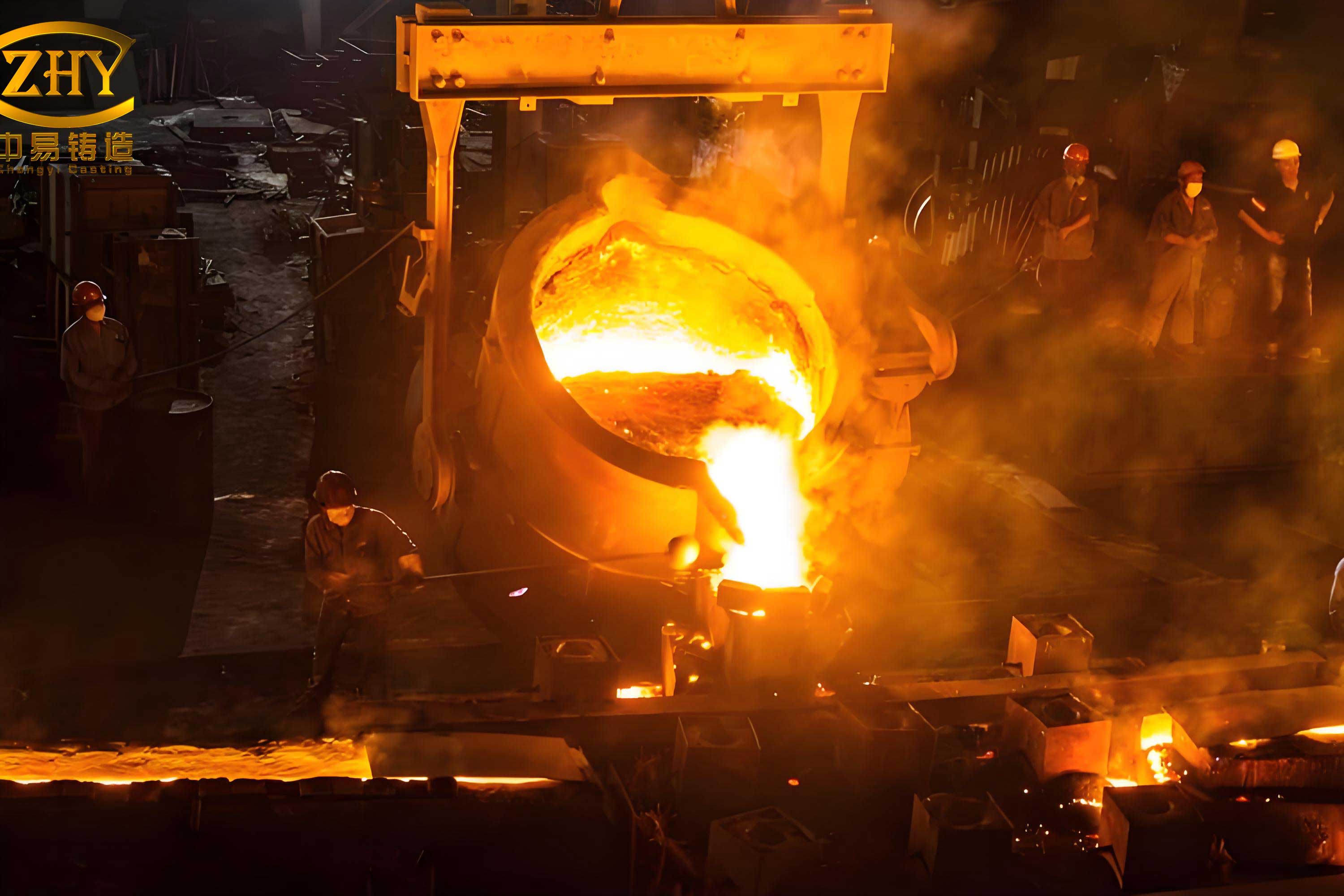
The development of this coating began with a thorough selection of raw materials, each chosen for its specific role in enhancing the performance for sand castings. The table below summarizes the key components and their functions, which are critical for ensuring the coating’s stability, adhesion, and sintering properties in sand casting processes.
| Material | Function | Key Properties | Typical Content (wt%) |
|---|---|---|---|
| Magnesium Olivine Powder | Refractory Aggregate | Density: 3.17 g/cm³, Mohs hardness: 6-7, Refractoriness: 1690-1710°C | 100 (basis) |
| Lithium-Modified Bentonite | Suspension Agent & High-Temp Binder | Swelling capacity in ethanol, improves yield value | 1.0-1.5 |
| Phenolic Resin (2123 Type) | Room-Temperature Binder | Softening point ~100°C, soluble in alcohol | 1.0-1.5 |
| Polyvinyl Butyral (PVB) | Suspension Agent & Binder | Enhances viscosity and thixotropy | 0.2-0.5 |
| High-Temperature Binder A | High-Temp Binder | Phosphate-based, forms network at high heat | 1.0-1.5 |
| Ethanol | Solvent | Purity >95%, density: 0.7939 g/cm³, flame temp: 560°C | As needed for consistency |
| Additive | Rheology Modifier | Active groups for network formation with bentonite | Trace amounts |
Olivine powder, derived from natural minerals composed of magnesium olivine (Mg₂SiO₄) and fayalite (Fe₂SiO₄), serves as the core refractory material. Its low sintering point and uniform thermal expansion make it ideal for creating a dense isolation layer during the pouring of high manganese steel sand castings. The chemical composition of olivine, as used in our study, is dominated by SiO₂ and MgO, with minor Fe₂O₃, Al₂O₃, CaO, and other oxides, contributing to its sintering behavior. The bonding agents are selected to provide strength across temperature ranges: phenolic resin offers room-temperature cohesion, while high-temperature binder A enhances resistance to molten metal erosion, crucial for maintaining coating integrity in sand castings. Suspension agents like lithium-modified bentonite and PVB ensure the coating remains homogeneous during application, preventing settling of solids that could affect the uniformity on sand mold surfaces. Ethanol, as the solvent, allows for easy ignition drying, a common practice in sand casting operations to rapidly cure coatings before metal pouring.
The preparation process for this alcohol-based coating involves a meticulous grinding sequence to achieve optimal dispersion and performance. We start by ball-milling lithium-modified bentonite with a small amount of soft water for 5 minutes to form a paste. Then, olivine powder, PVB dissolved in ethanol, phenolic resin solution, additive, and high-temperature binder A are added, followed by grinding for 1 to 1.5 hours. Finally, the remaining ethanol is incorporated, and the mixture is ground for an additional 15-20 minutes before discharge. This method ensures a fine particle size distribution and good integration of components, resulting in a coating with high suspension stability and ease of application for sand castings. The finalized formulation, derived from orthogonal experiments, balances all elements to meet the demands of high manganese steel sand casting production.
One of the most critical aspects of this coating is its rheological behavior, which directly impacts its application onto sand molds for sand castings. We characterized the thixotropy and flow properties using rotational viscometers, revealing a pseudoplastic fluid with a significant yield value. This means the coating exhibits high viscosity at rest but thins under shear, making it ideal for brushing or dipping without sagging on vertical surfaces of sand castings molds. The table below presents data from viscosity measurements under constant shear rate, showing the time-dependent decrease in apparent viscosity, a hallmark of thixotropic materials.
| Shear Time (min) | Apparent Viscosity (Pa·s) |
|---|---|
| 0 | 5.0 |
| 2 | 3.0 |
| 5 | 1.5 |
From this data, we calculated the thixotropy rate using the formula: $$ ext{Thixotropy Rate} = \frac{\eta_{0} – \eta_{5}}{\eta_{0}} $$ where $\eta_{0}$ is the initial viscosity and $\eta_{5}$ is the viscosity after 5 minutes. Substituting the values: $$ ext{Thixotropy Rate} = \frac{5.0 – 1.5}{5.0} = 0.7 ext{ or } 70\% $$ This high thixotropy rate indicates excellent shear-thinning behavior, allowing the coating to flow easily during application but quickly regain structure to prevent runoff on sand castings molds.
Further rheological analysis involved measuring shear stress at varying shear rates, both increasing and decreasing, to construct flow curves. The data, summarized in the table below, demonstrates a pronounced hysteresis loop, confirming the coating’s strong thixotropic nature essential for sand castings processes where controlled coating thickness is vital.
| Shear Rate (s⁻¹) | Shear Stress – Increasing (10⁻¹ Pa) | Shear Stress – Decreasing (10⁻¹ Pa) |
|---|---|---|
| 0 | 55.0 | 30.5 |
| 3 | 70.5 | 46.0 |
| 4 | 78.0 | 56.0 |
| 5 | 84.0 | 62.0 |
| 7 | 95.0 | 72.0 |
| 10 | 107.0 | 83.0 |
From the flow curve, we determined the yield stress $\tau_0$ as 55 Pa, where the curve intersects the shear stress axis. The rheological behavior can be modeled using the Herschel-Bulkley equation: $$ \tau = \tau_0 + k \dot{\gamma}^n $$ where $\tau$ is shear stress, $\dot{\gamma}$ is shear rate, $k$ is consistency index, and $n$ is flow index. By selecting two data points from the increasing shear rate phase, such as at $\dot{\gamma} = 3$ s⁻¹ ($\tau = 70.5 imes 10^{-1}$ Pa) and $\dot{\gamma} = 10$ s⁻¹ ($\tau = 107.0 imes 10^{-1}$ Pa), we solved for $k$ and $n$. Converting to consistent units: $\tau_0 = 55 imes 10^{-1}$ Pa, then: $$ 70.5 = 55 + k \cdot 3^n $$ $$ 107.0 = 55 + k \cdot 10^n $$ Solving these equations yields $k \approx 21$ and $n \approx 0.21$. Thus, the rheological equation for this coating is: $$ \tau = 55 + 21 \dot{\gamma}^{0.21} $$ where $\tau$ is in units of $10^{-1}$ Pa. This equation highlights the coating’s pseudoplastic nature, with a low flow index $n$ indicating significant shear-thinning, beneficial for uniform application on complex sand castings molds. The consistency index $k$ is relatively low, suggesting easy flow under shear, which enhances coating penetration into sand mold pores for better adhesion in sand castings.
In addition to rheology, other properties were evaluated to ensure coating suitability for sand castings. The pH value is 7.5, indicating neutrality, which minimizes chemical reactions with alkaline high manganese steel. Density measures 1.429 g/cm³, and viscosity using a standard cup is 8 seconds, providing good workability. Suspension stability over 24 hours exceeds 90%, preventing sedimentation during storage. Gas evolution is less than 20 mL/g, reducing the risk of blowholes in sand castings. Thermal shock resistance was tested by rapid heating to 1000°C for 2 minutes, resulting in no cracking, ensuring durability during metal pouring for sand castings.
The anti-penetration mechanism of olivine-based coatings for high manganese steel sand castings is explained by the sintering-oxidation theory. During pouring, temperatures range from 1360 to 1380°C, which surpasses the sintering point of olivine (1250-1350°C due to fayalite content). Fayalite (Fe₂SiO₄) oxidizes to form Fe₂O₃ or Fe₃O₄, generating a viscous glassy phase that fills gaps between particles. This process creates a dense, sintered layer that blocks metal penetration channels. Simultaneously, the high manganese steel melt readily oxidizes, accumulating an iron oxide layer at the interface exceeding 0.1 mm in thickness. This layer acts as a weak boundary due to its poor adhesion and the high linear shrinkage of high manganese steel (typically 2.5-3.0%). Upon cooling, shear stresses cause the sintered coating shell to peel off automatically, yielding smooth surfaces on sand castings. The chemical reactions involved can be represented as: $$ 2Fe_2SiO_4 + O_2 \rightarrow 2Fe_2O_3 + 2SiO_2 $$ $$ 3Fe_2SiO_4 + 2O_2 \rightarrow 2Fe_3O_4 + 3SiO_2 $$ These oxides form a barrier that prevents further interaction, enhancing the quality of sand castings by reducing cleaning efforts and improving surface finish.
To validate the coating’s effectiveness, we applied it in industrial settings for producing high manganese steel sand castings. Trials were conducted at multiple foundries, focusing on components like jaw plates, grate bars, liners, and frogs, with individual sand castings weighing up to 730 kg. The coatings were used on various sand mold types, including sodium silicate-bonded limestone sand and quartz sand molds cured with CO₂, as well as dried molds. The results consistently showed excellent performance: the coating exhibited high suspension stability, easy brushing without sagging, and good adhesion. After pouring, the coating sintered into a dark purple shell that readily peeled off, leaving sand castings with clean, smooth surfaces and sharp edges. Operators reported that the coating “did not settle during storage, stirred easily,” felt “smooth and non-sticky,” and “did not run on vertical surfaces,” significantly improving the efficiency and quality of sand castings production. The table below summarizes key application outcomes, demonstrating the coating’s benefits across different sand castings types.
| Application Site | Sand Castings Type | Weight Range (kg) | Observed Benefits |
|---|---|---|---|
| Foundry A | Jaw Plates, Liners | 50-730 | Automatic peeling, smooth surface, reduced cleaning time |
| Foundry B | Grate Bars, Wear Plates | 20-300 | No metal penetration, enhanced dimensional accuracy |
| Foundry C | Frogs, Track Components | 100-500 | Improved surface finish, lower defect rates |
From these applications, we conclude that the olivine alcohol-based coating offers a robust solution for high manganese steel sand castings. Its thixotropic properties ensure easy application, while the sintering mechanism provides effective metal penetration resistance. Compared to traditional zircon flour coatings, which are acidic and can react with alkaline steel, or magnesia coatings, which are non-sintering and prone to fine veining, our coating delivers superior performance at a lower cost. Olivine powder is approximately 10% the price of zircon flour, and lithium-modified bentonite replaces more expensive organic bentonites, making this coating economically attractive for large-scale sand castings production. The overall cost-benefit analysis highlights savings in material expenses and reduced labor for cleaning sand castings, contributing to higher profitability in foundry operations.
In summary, our research demonstrates that alcohol-based coatings with magnesium olivine as the refractory aggregate are highly effective for high manganese steel sand castings. The coating formulation, characterized by optimal rheology and sintering behavior, addresses common defects like sticking and rough surfaces. By leveraging the sintering-oxidation theory, it forms a dense, peelable layer that enhances the surface quality of sand castings. Future work could explore variations in olivine particle size or alternative solvents to further improve performance. However, the current system already represents a significant advancement in coating technology for sand castings, offering a balance of performance, cost, and ease of use. As the demand for durable and precise sand castings grows in industries such as mining and infrastructure, such innovations will play a crucial role in advancing casting methodologies and ensuring the reliability of high-performance components.