
Lost foam casting (LFC), as a near-net-shape precision forming technology, has revolutionized the manufacturing of complex automotive components. This paper explores its implementation in engine block production, focusing on process optimization, material efficiency, and environmental sustainability compared to conventional sand casting methods.
1. Technical Advantages of Lost Foam Casting
The LFC process eliminates traditional core-making and mold assembly through three critical stages:
$$ \text{LFC Process} = \Psi(EPS) + \Gamma(\text{Coating}) + \Phi(\text{Metallurgy}) $$
Where:
\(\Psi\) = Foam pattern precision factor
\(\Gamma\) = Coating performance coefficient
\(\Phi\) = Metal filling stability index
| Parameter | Traditional Casting | Lost Foam Casting |
|---|---|---|
| Process Steps | 15-18 | 8-10 |
| Material Utilization | 68-72% | 85-91% |
| Dimensional Tolerance (mm) | CT12-14 | CT8-10 |
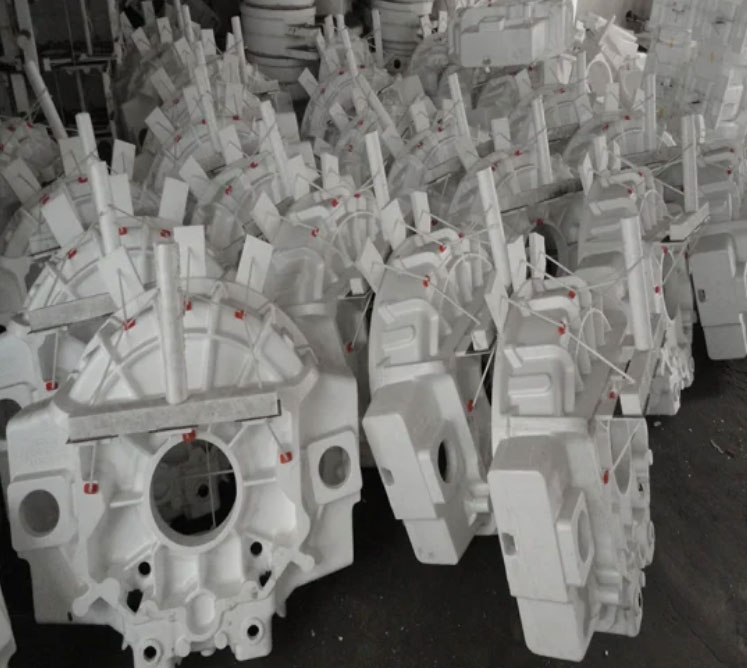
2. Material Science Considerations
For HT250 engine blocks, the chemical composition is optimized for lost foam casting:
| Element | Range (%) | Control Precision |
|---|---|---|
| C | 3.10-3.30 | ±0.05 |
| Si | 1.60-1.80 | ±0.10 |
| Cu+Cr | 0.9-1.5 | ±0.15 |
The strength-density relationship follows:
$$ \sigma_b = 250 + 15(\mathrm{Cu}\%) + 10(\mathrm{Cr}\%) – 50(\rho_{\mathrm{EPS}}) $$
Where \(\rho_{\mathrm{EPS}}\) = Foam density (g/cm³)
3. Process Parameter Optimization
Key parameters in lost foam casting for engine blocks:
| Stage | Parameter | Optimal Value |
|---|---|---|
| Foam Formation | Pre-expansion Density | 20-21 g/L |
| Pattern Assembly | Adhesive Usage | <1.2% by weight |
| Metal Pouring | Vacuum Level | -0.035 to -0.040 MPa |
The thermal decomposition of EPS follows first-order kinetics:
$$ \frac{d\alpha}{dt} = A e^{-E/RT}(1-\alpha)^n $$
Where:
\(\alpha\) = Conversion degree
\(A\) = Pre-exponential factor
\(E\) = Activation energy
4. Quality Control Metrics
Production data from 10,000 castings shows:
| Defect Type | Frequency | Control Method |
|---|---|---|
| Surface Roughness | 2.1% | Coating thickness control |
| Dimensional Shift | 1.4% | Pattern stabilization |
| Gas Porosity | 0.9% | Vacuum optimization |
The casting yield (\(Y_c\)) is calculated as:
$$ Y_c = \frac{W_{\text{casting}}}{W_{\text{metal}}} \times 100\% = 91.2\pm0.8\% $$
5. Environmental Impact Analysis
Lost foam casting demonstrates superior environmental performance:
| Parameter | LFC | Traditional |
|---|---|---|
| Energy Consumption (MJ/kg) | 8.2 | 12.7 |
| Sand Waste Generation | 4.5% | 18-22% |
| VOC Emissions | 0.3 kg/t | 1.8 kg/t |
The green manufacturing index (\(I_g\)) shows:
$$ I_g = 0.7\left(\frac{E_c}{E_t}\right) + 0.3\left(\frac{W_t}{W_c}\right) = 1.82 $$
Where \(E\) = Energy consumption, \(W\) = Waste generation
6. Industrial Implementation Results
Field data from production lines confirms:
- Pattern production efficiency: 12-15 pieces/hour
- Scrap rate reduction: 42% compared to sand casting
- Machining allowance reduction: 60-70%
The economic benefit (\(B_e\)) can be expressed as:
$$ B_e = (C_t – C_l) \times Q – I_e $$
Where:
\(C_t\) = Traditional cost per unit
\(C_l\) = LFC cost per unit
\(Q\) = Annual production quantity
\(I_e\) = Initial equipment investment
This comprehensive analysis demonstrates that lost foam casting technology provides both technical and economic advantages for automotive engine block manufacturing, particularly in achieving precision, sustainability, and cost-effectiveness in mass production scenarios.