
The pursuit of high-performance cast magnesium alloys has been a persistent theme in materials engineering. While traditional Mg-Al systems like AZ91 offer good castability, their yield strength is often a limiting factor for demanding structural applications. The Mg-Zn-Zr series, exemplified by alloys such as ZK51, provides superior strength but introduces significant challenges, including severe hot tearing, shrinkage porosity, and complexities in melting due to zirconium segregation and inclusion formation. These inclusions can degrade the strength and ductility of sand castings by more than 20%. This dichotomy led me to explore alternative alloying systems that might offer a more favorable balance of properties. Aluminum, a potent solid solution strengthener in magnesium and an element known to improve casting fluidity, is typically considered an impurity in Mg-Zn-Zr alloys. However, the Mg-Zn-Al ternary system presents an intriguing, albeit less explored, pathway. Recent investigations indicated that alloys within specific ranges of Zn and Al exhibited promising creep resistance, yet their room-temperature strength was compromised by excessive grain boundary phases. This work, therefore, was initiated to systematically investigate a specific composition within this system—Mg-5Zn-3Al-0.2Mn, designated here as ZA53—focusing on its as-cast microstructure and the transformative effects of solution heat treatment on its mechanical properties when produced via the sand casting process.
The selection of the ZA53 composition was guided by several practical considerations for sand castings. It is established that both Al and Zn contents need to exceed approximately 3% to significantly enhance the fluidity of molten magnesium, which is crucial for filling the intricate cavities of sand molds. Furthermore, binary Mg-Zn alloys with around 5% Zn are reported to possess good mechanical properties. Balancing these factors, the target composition was set within the range of 4.6–5.5% Zn and 2.6–3.5% Al, with minor additions of Mn for impurity control and Fe kept at a minimal level. The intent was to design a two-phase alloy according to the equilibrium phase diagram, potentially leveraging the strong solid solution hardening effect of both Zn and Al in magnesium while maintaining reasonable castability for complex sand castings.
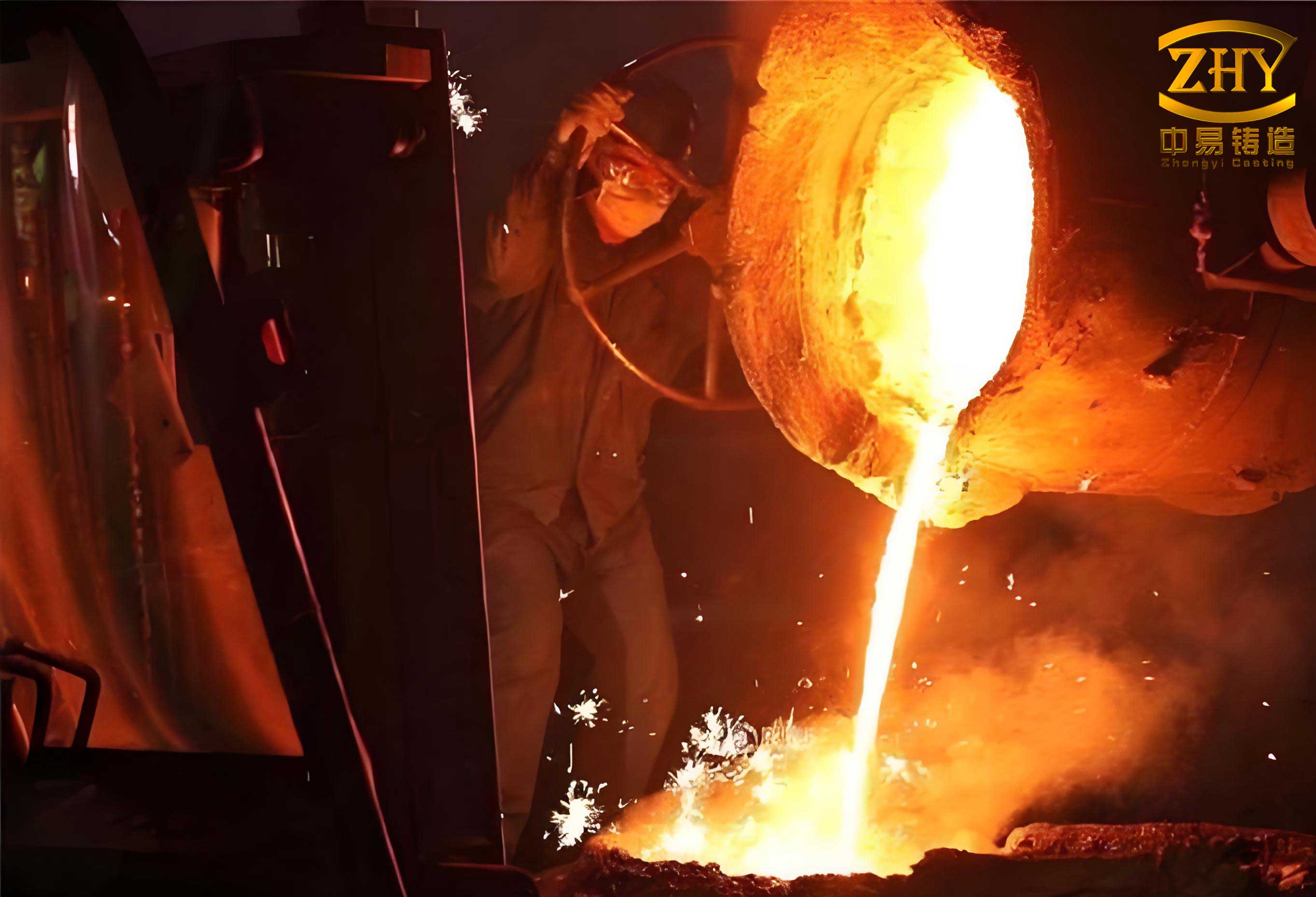
The alloy was prepared from high-purity Mg, Zn, and Al in a resistance furnace under a protective flux cover. After refining and a brief settling period, the melt was poured at 745°C into standard sand molds to produce both metallographic and tensile test specimens. This temperature was chosen to ensure adequate fluidity for the sand casting process while minimizing excessive oxidation. Chemical composition was verified using Inductively Coupled Plasma (ICP) analysis. Microstructural characterization involved optical microscopy, scanning electron microscopy (SEM) equipped with energy-dispersive X-ray spectroscopy (EDS), and X-ray diffraction (XRD). Thermal analysis was conducted using Differential Scanning Calorimetry (DSC) to identify phase transformation temperatures. Room-temperature tensile tests were performed, with reported values representing the average of three specimens. The heat treatment study involved solutionizing at various temperatures (323°C, 335°C, 343°C, and 350°C) for a prolonged duration of 17 hours, followed by quenching in hot water (70-80°C). A stepped heating regime was employed to prevent incipient melting.
The microstructure of the as-cast ZA53 alloy produced by sand casting is fundamentally biphasic. The DSC trace reveals two primary thermal events: an endothermic reaction starting around 356.8°C and the major melting endotherm of the matrix beginning near 503°C. This indicates a solidus temperature of approximately 356.8°C for the secondary phase. Combined XRD and EDS analyses conclusively identify the constituents. The matrix is the δ-Mg phase, a solid solution of Zn and Al in magnesium. The second phase, which forms a semi-continuous network along the grain boundaries of the δ-Mg matrix with some discrete particles within the grains, is the intermetallic τ phase. EDS quantification shows this phase has a composition close to Mg32(Al, Zn)49. The formation of this continuous network is characteristic of sand castings, where the relatively slow cooling rate allows for sufficient time for solute redistribution and phase growth along the solidifying grain boundaries.
| Phase | Mg (at.%) | Zn (at.%) | Al (at.%) |
|---|---|---|---|
| δ-Mg Matrix | 97.32 | 1.28 | 1.40 |
| τ Phase (Point a) | 33.56 | 42.64 | 23.80 |
| τ Phase (Point b) | 39.63 | 37.37 | 22.53 |
The mechanical properties of the as-cast ZA53 sand castings are summarized and compared with common benchmarks in Table 2. The alloy exhibits a tensile strength (σb) of 165 MPa, a yield strength (σ0.2) of 93 MPa, and an elongation (δ) of 5.8%. Its strength is comparable to the widely used AZ81A (ZM-5) alloy, but it demonstrates superior ductility. While its strength is lower than that of the high-strength ZK51A alloy, this initial performance is promising, considering the challenging continuous network of the brittle τ phase. This network typically acts as a preferred path for crack propagation, limiting ductility. However, the inherent solid solution strengthening from the Zn and Al in the matrix provides a reasonable baseline strength for sand castings.
| Alloy | Condition | σb (MPa) | σ0.2 (MPa) | δ (%) |
|---|---|---|---|---|
| ZA53 | As-Cast (F) | 165 | 93 | 5.8 |
| AZ81A (ZM-5) | As-Cast (F) | 160 | 95 | 3.0 |
| ZK51A (ZM-1) | As-Cast (F) | 230 | 120 | 11.0 |
Given the strong solid solution hardening potential of the Mg-Zn-Al system, a comprehensive solution heat treatment (T4) study was undertaken to dissolve the grain boundary τ phase. The DSC-determined solidus of 356.8°C dictated the temperature range. The extended hold time of 17 hours was selected to accommodate the relatively slow diffusion rates in magnesium alloys, especially for the dissolution of the Zn-rich τ phase. The microstructural evolution is dramatic. After treatment at 323°C, the finer and more isolated τ particles within the grains dissolve, but the continuous network at the boundaries remains largely intact. At 335°C, approximately 80% or more of the τ phase dissolves, significantly breaking up the continuous network. At 343°C, held for the same duration, the dissolution is complete, resulting in a single-phase solid solution microstructure. The optical micrographs of samples from sand castings after this treatment show featureless grains, a typical characteristic of water-quenched magnesium alloys where the grain boundaries are not readily etched. However, exceeding the safe window—as seen at 350°C—leads to localized melting at grain boundary junctions, resulting in an overburned structure with severely degraded properties.
| Solution Temperature (°C) | σb (MPa) | σ0.2 (MPa) | δ (%) | Microstructural State |
|---|---|---|---|---|
| 323 | 169 | 93 | 5.3 | Partial dissolution (network present) |
| 335 | 237 | 91 | 10.4 | ~80% dissolution |
| 343 | 245 | 90 | 12.1 | Full dissolution (single phase) |
| 350 | 66 | – | – | Overburned |
The mechanical property data in Table 3 reveals the profound impact of solution treatment. The treatment at 335°C results in a spectacular 44% increase in tensile strength and an 80% increase in elongation compared to the as-cast state. This corresponds to the critical dissolution of the continuous brittle network, which eliminates easy crack paths and enriches the matrix with solute atoms. Complete dissolution at 343°C pushes the properties slightly further to an optimal σb of 245 MPa and δ of 12.1%. It is noteworthy that the yield strength remains virtually unchanged, which is expected as solution treatment primarily affects obstacles to dislocation motion (precipitates/particles) rather than the intrinsic lattice friction stress, which is more governed by the base solid solution concentration. The near-constancy of yield strength confirms that the matrix composition is not significantly altered by the dissolution of the τ phase within this temperature range; the alloy is essentially at its saturation point for the given solution temperature. The performance of the optimized T4-treated ZA53 sand castings holds its own against other heat-treated commercial alloys, as shown in Table 4, offering a compelling combination of strength and ductility.
| Alloy | Condition | σb (MPa) | σ0.2 (MPa) | δ (%) |
|---|---|---|---|---|
| ZA53 | T4 (343°C/17h) | 245 | 90 | 12.1 |
| AZ81A (ZM-5) | T4 | 260 | 83 | 15.0 |
| ZK51A (ZM-1) | T1 (Aged) | 250 | 140 | 8.0 |
Fractography provides direct visual evidence of the microstructural changes induced by heat treatment. The fracture surface of the as-cast ZA53 sand castings is a mixed mode, featuring uneven cleavage facets and quasi-cleavage regions, indicative of brittle fracture initiated and propagated along the continuous τ phase network. In stark contrast, the fracture surface of the T4-treated specimen (343°C/17h) is dominated by a dimpled morphology, characteristic of microvoid coalescence and ductile fracture. This transition from a mixed/brittle to a fully ductile fracture mode perfectly correlates with the dissolution of the brittle grain boundary network and the concomitant improvement in measured ductility.
The optimization of solution treatment for sand-cast ZA53 can be framed using kinetic principles. The dissolution of the τ phase is a diffusion-controlled process. The rate of dissolution or the time `t` required to achieve a certain level of dissolution (e.g., to reduce the phase fraction below a critical value `f_c`) can be conceptually related to temperature by an Arrhenius-type relationship, acknowledging the complexity of a networked phase:
$$ t \propto \exp\left(\frac{Q}{RT}\right) $$
where `Q` is an effective activation energy for the dissolution process (amalgamating diffusion and interface reaction), `R` is the gas constant, and `T` is the absolute temperature. For a fixed time `t` (17 hours in this case), there exists a critical temperature `T_crit` required to achieve sufficient diffusion to dissolve the phase. My experiments delineate this window: `T_crit` for substantial property improvement is ~335°C, and `T_crit` for complete dissolution is ~343°C. The narrow range between 343°C and the overburning temperature at 350°C highlights the sensitivity of this alloy system. The driving force for dissolution, the deviation from equilibrium solubility, increases with temperature. The solubility `C_s` of Zn and Al in the δ-Mg matrix as a function of temperature `T` can be approximated from the phase diagram, leading to a driving force ∆C:
$$ \Delta C(T) = C_s(T) – C_0 $$
where `C_0` is the nominal alloy composition. As `T` approaches the solidus, `C_s(T)` increases significantly, providing a large chemical potential gradient to drive the dissolution of the τ phase. The process likely follows a diffusion-controlled growth (or shrinkage, in this case) law for the thickness `x` of the dissolving layer:
$$ x^2 \propto D(T) \cdot t $$
where `D(T)` is the effective interdiffusion coefficient for the rate-limiting species (likely Zn) in the matrix, which itself is temperature-dependent: `D(T) = D_0 \exp(-Q_d / RT)`. The prolonged 17-hour treatment was necessary because `D(T)` at these relatively low homologous temperatures for magnesium is small, especially for sand castings which start with a coarse, networked secondary phase.
The remarkable property enhancement stems from multiple, synergistic mechanisms. Primarily, the elimination of the continuous brittle τ network removes the primary sites for crack initiation and provides an unobstructed path for slip transfer across grain boundaries. Secondly, the dissolution enriches the δ-Mg matrix with Zn and Al atoms, enhancing solid solution strengthening. The increase in tensile strength with solution treatment is directly attributable to these two factors. The dramatic leap in ductility is almost exclusively due to the removal of the brittle network. The fact that the yield strength remains constant suggests that the solid solution strengthening contribution from the solutes already in the matrix in the as-cast state is the dominant factor for yield, and the additional solute from the dissolved τ phase does not significantly alter the lattice friction stress, or its effect is offset by other changes like grain growth.
This investigation underscores the significant potential of the Mg-Zn-Al system for producing strong and ductile sand castings. The ZA53 composition, when subjected to a tailored solution heat treatment, undergoes a microstructural metamorphosis—from a brittle, networked biphasic structure to a tough, single-phase solid solution. This transformation unlocks a compelling combination of tensile strength (245 MPa) and elongation (12.1%), positioning it favorably among existing commercial magnesium sand castings. The process window is narrow, demanding precise temperature control to avoid overburning, but the performance gains justify the process complexity. The study confirms that intelligent alloy design in the Mg-Zn-Al system, followed by optimized thermal processing, can effectively overcome the limitations imposed by as-cast microstructure, offering a viable alternative to more problematic high-strength alloy systems for critical sand-cast components.