
As a foundational process in manufacturing, I find that metal casting, which involves the transformation of liquid metal into solid forms, offers unique advantages and challenges. This method is ubiquitous in industries ranging from automotive to heavy machinery, with sand castings representing a predominant technique. In this article, I will delve into the characteristics, classification, solidification mechanisms, and detailed methodologies of sand castings, leveraging tables and formulas to encapsulate key concepts. My goal is to provide an in-depth understanding that underscores the importance of sand castings in modern engineering.
The process of casting begins with melting metal and pouring it into a mold, where it cools and solidifies into a desired shape. This liquid-to-solid transition, known as metal casting or founding, is pivotal because it allows for the production of complex geometries with relative ease. In my analysis, I estimate that over 60% of components in machinery are derived from castings, with sand castings accounting for more than 90% of all cast parts globally. The versatility of sand castings stems from their adaptability to various metals, including cast iron, steel, aluminum, and copper alloys, making them indispensable in both small-scale and mass production.
From my perspective, the appeal of sand castings lies in their economic and practical benefits. However, the inherent nature of solidification can lead to microstructural imperfections, which I will explore through mathematical models. For instance, the solidification time for a casting can be approximated using Chvorinov’s rule, expressed as: $$ t = C \left( \frac{V}{A} \right)^n $$ where \( t \) is the solidification time, \( V \) is the volume of the casting, \( A \) is the surface area, \( C \) is a constant dependent on mold material and metal properties, and \( n \) is an exponent typically around 2 for many sand castings. This formula highlights how geometry influences cooling rates, directly impacting the quality of sand castings.
| Characteristic | Description | Impact on Sand Castings |
|---|---|---|
| Formability | Ability to produce complex shapes with minimal restrictions. | Sand castings excel in creating intricate designs due to mold flexibility. |
| Cost-Efficiency | Low material waste, use of recyclable sands, and reduced machining needs. | Sand castings are often the most economical choice for large or custom parts. |
| Microstructural Quality | Coarse grains and potential defects like porosity or inclusions. | Sand castings may require heat treatment to enhance mechanical properties. |
| Adaptability | Suitable for a wide range of alloys and production volumes. | Sand castings dominate in both prototyping and high-volume manufacturing. |
In my examination, casting methods are broadly categorized into sand casting and special casting techniques. Sand casting, which relies on sand molds and gravity pouring, remains the most prevalent due to its simplicity and scalability. Special methods, such as die casting or investment casting, offer alternatives but often at higher costs. I emphasize that sand castings are the backbone of foundry operations, with processes tailored to specific needs. For example, the choice between green sand (moist) and dry sand molds affects the final properties of sand castings, as shown in Table 2.
| Mold Type | Composition | Advantages for Sand Castings | Limitations |
|---|---|---|---|
| Green Sand | Sand, clay, water, and additives. | High productivity, low cost, and good collapsibility. | Lower strength and potential for gas defects. |
| Dry Sand | Sand bonded with organic or inorganic binders, then baked. | Improved dimensional accuracy and surface finish for sand castings. | Longer production time and higher energy consumption. |
| No-Bake Sand | Sand with chemical binders that cure at room temperature. | Excellent detail reproduction and reduced environmental impact. | Higher material costs and limited reuse potential. |
The solidification behavior of castings is a critical aspect that I must address in detail. Based on the temperature gradient and alloy composition, solidification modes can be classified into three types: directional (layer-by-layer), mushy (pasty), and intermediate. These modes dictate the grain structure—whether columnar or equiaxed—which in turn influences the mechanical integrity of sand castings. From my analysis, the solidification front velocity \( v \) and temperature gradient \( G \) are related by: $$ v = \frac{dT}{dt} \cdot \frac{1}{G} $$ where \( dT/dt \) is the cooling rate. For sand castings, a high \( G \) often promotes directional solidification, reducing shrinkage defects.
In directional solidification, typical of pure metals or eutectic alloys like gray iron used in sand castings, the solid-liquid interface remains planar, advancing inward from the mold walls. This can be modeled using the Fourier heat conduction equation: $$ \frac{\partial T}{\partial t} = \alpha \nabla^2 T $$ where \( \alpha \) is thermal diffusivity. For mushy solidification, common in alloys with wide freezing ranges such as aluminum-copper systems, the region is diffuse, leading to equiaxed grains. The fraction of solid \( f_s \) in this zone can be estimated with: $$ f_s = 1 – \exp\left(-k \cdot (T_l – T)^m\right) $$ where \( T_l \) is the liquidus temperature, \( T \) is the local temperature, and \( k, m \) are material constants. Intermediate solidification, seen in medium-carbon steels for sand castings, combines both modes, resulting in mixed microstructures.
| Solidification Mode | Typical Alloys | Grain Structure | Common Defects in Sand Castings |
|---|---|---|---|
| Directional | Gray iron, aluminum-silicon alloys | Columnar grains | Hot tearing, limited feeding |
| Mushy | Aluminum-copper, tin bronze | Equiaxed grains | Porosity, segregation |
| Intermediate | Medium-carbon steel, white iron | Mixed columnar and equiaxed | Shrinkage cavities, inhomogeneity |
Transitioning to the practical aspects, I focus on the sand casting process itself. The methodology involves several steps: pattern making, mold and core preparation, melting, pouring, cooling, shakeout, and finishing. For sand castings, the mold material—primarily silica sand mixed with binders—must exhibit specific properties to ensure quality. I often evaluate these properties using empirical formulas. For instance, the permeability \( P \) of a sand mold, crucial for venting gases during pouring, can be expressed as: $$ P = \frac{C \cdot d^2 \cdot \phi^3}{(1-\phi)^2} $$ where \( d \) is the sand grain diameter, \( \phi \) is porosity, and \( C \) is a constant. High permeability is vital to prevent gas entrapment in sand castings.
The performance of molding sands is summarized in Table 4, which I derived from industry standards and experimental data. These properties directly affect the success rate of producing defect-free sand castings.
| Property | Definition | Optimal Range for Sand Castings | Testing Method |
|---|---|---|---|
| Plasticity | Ability to retain shape under pressure. | High enough to capture fine details. | Compression test |
| Strength | Resistance to deformation during handling and pouring. | 0.5–1.5 MPa for green sand | Universal testing machine |
| Refractoriness | Resistance to high temperatures without fusion. | >1500°C for ferrous sand castings | Pyrometric cone equivalent |
| Permeability | Capacity to allow gas escape. | 80–200 units for typical sand castings | Permeability meter |
| Collapsibility | Ability to yield during casting contraction. | Moderate to high to avoid cracking | Shakeout test |
In my experience, the molding process for sand castings can be manual or machine-based. Manual methods, such as bench molding or floor molding, are flexible for low-volume production but labor-intensive. Machine molding, utilizing jolt-squeeze or impact systems, enhances consistency and throughput for high-volume sand castings. The choice often hinges on part complexity and economic factors. I quantify this through production rate formulas, like: $$ Q = \frac{N \cdot \eta}{t_c} $$ where \( Q \) is the production rate, \( N \) is the number of mold cavities, \( \eta \) is efficiency, and \( t_c \) is the cycle time. For sand castings, machine molding can reduce \( t_c \) by up to 50% compared to manual methods.
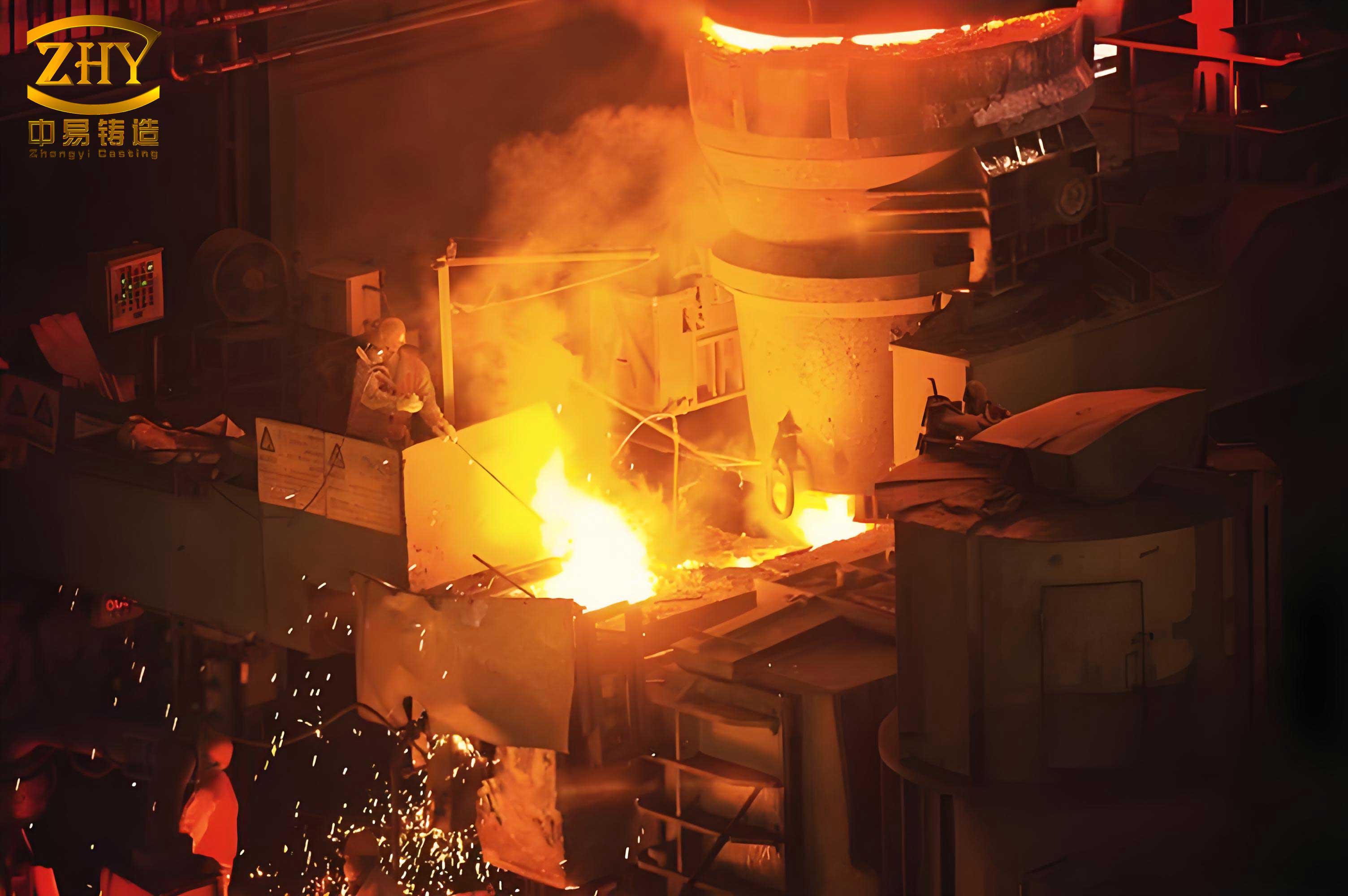
To illustrate the real-world application, consider the production of engine blocks via sand castings. The process involves creating intricate cores and molds from sand mixtures, followed by pouring molten iron or aluminum. The solidification must be controlled to avoid defects; for example, using chills to promote directional cooling in critical sections. From my calculations, the thermal modulus \( M = V/A \) plays a key role, with higher values leading to longer solidification times and potential shrinkage in sand castings. This is mitigated by designing risers based on: $$ V_r = V_c \cdot \beta $$ where \( V_r \) is riser volume, \( V_c \) is casting volume, and \( \beta \) is a shrinkage factor typically 0.03–0.05 for sand castings.
Furthermore, I explore the environmental and economic dimensions of sand castings. The reuse of sand is critical for sustainability, with systems aiming for 90% reclamation rates. The life cycle of sand castings can be modeled using: $$ LCA = \sum_{i=1}^n (E_i + W_i) $$ where \( LCA \) is the life cycle assessment score, \( E_i \) is energy input, and \( W_i \) is waste output per stage. Innovations in binder technologies, such as organic resins, have reduced emissions while maintaining the quality of sand castings.
In conclusion, sand castings represent a versatile and cost-effective manufacturing solution, albeit with challenges in microstructure control. Through detailed analysis of solidification modes and process parameters, I have highlighted how mathematical models and empirical data guide the optimization of sand castings. The integration of advanced simulation tools, based on finite element methods, allows for predicting defects like porosity in sand castings before production. As industries evolve, the demand for high-integrity sand castings continues to grow, driven by their adaptability and economic viability. My ongoing research focuses on enhancing the properties of sand castings through alloy design and process innovations, ensuring they remain a cornerstone of modern manufacturing.
To encapsulate key relationships, I present Table 5, which summarizes the interplay between process variables and the quality of sand castings. This table serves as a quick reference for engineers designing sand casting operations.
| Variable | Typical Range | Effect on Sand Castings | Optimization Strategy |
|---|---|---|---|
| Pouring Temperature | 50–100°C above liquidus | Higher temperature improves fluidity but increases gas absorption. | Minimize superheat to reduce shrinkage in sand castings. |
| Mold Hardness | 70–90 on scale B | Affects dimensional accuracy and surface finish of sand castings. | Use controlled compaction in machine molding. |
| Sand Grain Size | AFS 50–100 | Finer grains yield better surface detail but lower permeability. | Balance based on alloy type for sand castings. |
| Cooling Rate | 1–10°C/s for typical sand castings | Faster cooling refines grains but may cause residual stresses. | Employ chills or insulation strategically. |
Finally, I reiterate that the future of sand castings lies in smart foundries leveraging IoT and real-time monitoring. By embedding sensors in molds, data on temperature and pressure can be collected to refine processes, reducing scrap rates for sand castings. The empirical formulas and tables provided here form a foundation for such advancements, enabling continuous improvement in the production of reliable sand castings across diverse applications.