
As an engineer specializing in fluid machinery and casting processes, I have dedicated significant effort to developing innovative methods for producing complex components through sand castings. The multi-blade enclosed impeller, commonly used in low-noise centrifugal fans, presents a unique challenge due to its intricate geometry with numerous thin, curved blades and a hollow front shroud. Traditional manufacturing approaches, such as riveting separate parts, often lead to issues like fatigue failure and reduced reliability. In this article, I will detail a novel sand casting process that enables the integral production of these impellers, leveraging the versatility and precision of sand castings to overcome longstanding technical hurdles. This method not only enhances structural integrity but also improves aerodynamic performance, making it a game-changer in fan manufacturing.
The core innovation lies in an “open-blade core, closed integral casting” strategy, which involves creating separate sand molds for the impeller’s internal core and external轮廓. By meticulously designing and fabricating these molds, we achieve a monolithic impeller casting without the need for complex assembly. Throughout this discussion, I will emphasize the critical role of sand castings in achieving high-dimensional accuracy and repeatability, while also exploring the underlying principles through formulas and tables. The process has been validated in production, yielding impellers with superior quality and efficiency, and it is broadly applicable to various multi-blade designs.
To understand the process, let’s first examine the impeller’s structure. It typically features 9 to 12 forward-curved blades with an arc profile, where the curvature radius R is 17.6 mm, the radial length L is 116 mm, and the meridional exit height H is 31.5 mm. Each blade has a thickness δ of 2 mm, and they are evenly distributed around a central hub. The front shroud is a hollow ring with a thickness of 3 mm and an inlet diameter D of 210 mm. The entire impeller is cast from ZL104 aluminum alloy, integrating a steel sleeve at the hub for shaft connection. This geometry imposes strict requirements on mold accuracy, as even minor deviations can affect airflow and noise levels. Sand castings are ideal here due to their ability to replicate fine details, but the enclosed nature with narrow flow channels makes pattern removal notoriously difficult.
The primary technical challenge was developing a mold system that allows for the extraction of the blade patterns without damaging the sand cores. Initial attempts using a combined blade-and-backplate steel mold resulted in core damage during demolding, with success rates around 50%. After analysis, we identified that the resin sand cores lacked sufficient strength, and the long, thin blades were prone to distortion. Our solution involved reinforcing the core with three layers of骨架 and introducing a “blade demolding fixed base plate.” This steel plate, with a clearance of ≤0.1 mm relative to the blade mold, provided stability during pattern withdrawal. The改进 design increased demolding success to over 96%, demonstrating how tailored tooling can enhance sand castings outcomes.
The overall casting process employs a two-part mold assembly with组芯 techniques. The upper and lower molds are made from green sand, while the internal core uses resin-bonded sand. Key steps include:
- Internal Core Mold Fabrication: A blade-and-backplate组合 steel mold is positioned with an adjustable hub plate to accommodate both left- and right-hand impeller rotations, enabling dual usage from a single pattern. The fixed base plate is inserted, and the assembly is placed within an outer core mold. Resin sand is compacted around three layers of reinforcement骨架 to form the core. After curing, the blade mold is carefully withdrawn, leaving a precise internal core pattern.
- External Mold Creation: The impeller’s external轮廓 is shaped using a separate steel pattern pressed into green sand molds for both the upper and lower boxes.
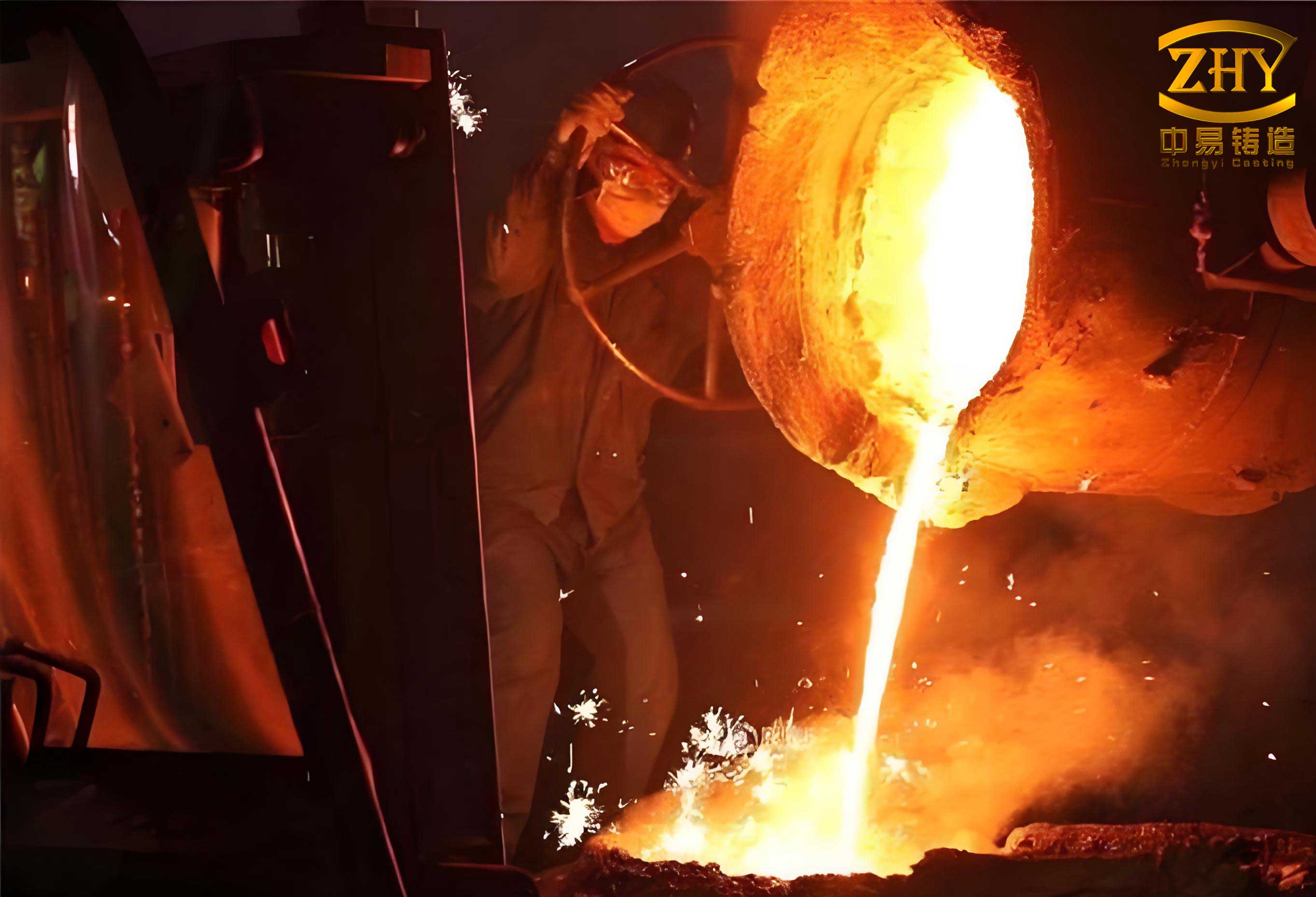
- Mold Assembly and Pouring: The internal core is placed inside the external mold cavity, forming the complete sand casting mold. Molten ZL104 aluminum alloy is poured at 760–800°C, with a gating system designed to ensure proper filling and solidification.
To quantify the process parameters, consider the following table summarizing key aspects of sand castings for this impeller:
| Parameter | Value or Description | Role in Sand Castings |
|---|---|---|
| Blade Thickness (δ) | 2 mm | Requires high precision in sand cores to avoid breakage. |
| Number of Blades | 9–12 | Increases complexity, demanding accurate core alignment. |
| Casting Material | ZL104 Aluminum Alloy | Offers good fluidity and strength for sand castings. |
| Core Sand Type | Resin-bonded (KJN-III) | Provides self-hardening properties for intricate shapes. |
| Mold Sand Type | Green Sand (Clay-based) | Ensures dimensional stability and ease of use in sand castings. |
| Pouring Temperature | 760–800°C | Optimizes metal flow and reduces defects in sand castings. |
| Solidification Time | Approx. 12 hours | Critical for achieving sound microstructure in sand castings. |
The gating system is designed based on fluid dynamics principles. The initial fast pour ensures complete filling of the thin blades, preventing cold shuts, while a slower follow-up aids in feeding shrinkage. The浇口 height of 0.6 m provides adequate metallostatic pressure, which is crucial for dense sand castings. Additionally, the steel sleeve is preheated to 800°C and placed in the mold with定位 features to ensure proper bonding with the aluminum, a common practice in sand castings to integrate dissimilar materials.
From a theoretical perspective, sand castings involve complex heat transfer and solidification phenomena. The solidification time for a casting can be estimated using Chvorinov’s rule:
$$ t = C \left( \frac{V}{A} \right)^2 $$
where \( t \) is the solidification time, \( V \) is the volume of the casting, \( A \) is the surface area, and \( C \) is a constant dependent on mold material and metal properties. For our impeller, the thin blades have a high \( A/V \) ratio, leading to rapid cooling, while the thicker hub solidifies slower. This necessitates careful design to avoid porosity. In sand castings, the mold’s thermal properties play a key role; green sand has lower thermal conductivity than resin sand, influencing the cooling gradient.
Another important aspect is the fluid flow during pouring. The Reynolds number \( Re \) indicates flow regime:
$$ Re = \frac{\rho v D_h}{\mu} $$
where \( \rho \) is density, \( v \) is velocity, \( D_h \) is hydraulic diameter, and \( \mu \) is viscosity. For aluminum in sand castings, \( Re \) typically exceeds 2000, implying turbulent flow, which can enhance filling but also trap gases. To mitigate this, we use tapered runners and filters in the gating system. The continuity equation ensures mass conservation:
$$ \frac{\partial \rho}{\partial t} + \nabla \cdot (\rho \mathbf{v}) = 0 $$
In practice, for incompressible flow during sand castings, this simplifies to \( A_1 v_1 = A_2 v_2 \), guiding the design of sprue and gate dimensions.
Post-casting, the impeller undergoes finishing processes. After shakeout and cleaning, the casting is inspected for defects like inclusions or shrinkage. Non-destructive testing methods, such as X-ray or dye penetrant, are employed to ensure integrity. Machining involves turning the outer diameter and faces, followed by polishing the blade passages to a surface roughness of 6.3 µm. The steel sleeve’s bore is honed to precise tolerances. These steps highlight how sand castings provide a near-net-shape product, reducing material waste and machining time.
Quality control is integral to successful sand castings. We monitor parameters like sand moisture (5.0–6.5% for green sand), compactness (wet strength of 3.0–5.0 × 10⁴ Pa), and permeability (>30 for green sand). Statistical process control charts track dimensions and defect rates over production runs. For instance, blade profile误差 is kept ≤0.1 mm, and出口安装角误差 within ±0.5°, ensuring consistent aerodynamic performance. The table below summarizes key quality metrics for sand castings of these impellers:
| Quality Metric | Target Value | Measurement Method |
|---|---|---|
| Dimensional Accuracy | ±0.2 mm on critical features | Coordinate Measuring Machine (CMM) |
| Surface Roughness | 6.3 µm (after polishing) | Profilometer |
| Porosity Level | < 2% by volume | Microscopic analysis of cross-sections |
| Mechanical Strength | Ultimate tensile strength ≥ 200 MPa | Tensile testing per ASTM standards |
| Production Yield | 78% (initial batch) | Ratio of acceptable castings to total poured |
The production yield of 78% reflects the learning curve associated with this novel sand castings process. Common defects in early trials included core shift and mistruns, which were addressed by optimizing the core reinforcement and gating design. Compared to traditional riveted impellers, the integral sand castings version shows a 15–20% reduction in noise levels and improved vibration resistance, as validated in environmental tests simulating shock and tilt. This underscores the advantage of monolithic structures produced through sand castings, where the absence of joints eliminates stress concentration points.
From a materials standpoint, ZL104 aluminum alloy is chosen for its excellent castability and mechanical properties. Its composition typically includes Si (8.0–10.5%), Mg (0.17–0.3%), and minor elements, providing good fluidity for filling thin sections in sand castings. The solidification sequence influences microstructure; we control cooling rates to promote fine-grained structures, enhancing toughness. The relationship between cooling rate \( \dot{T} \) and secondary dendrite arm spacing \( \lambda_2 \) is given by:
$$ \lambda_2 = k \dot{T}^{-n} $$
where \( k \) and \( n \) are constants. For sand castings, \( \dot{T} \) is relatively low, but by using chills in the mold, we can locally increase it to refine the microstructure in critical areas like blade roots.
Economic considerations also favor sand castings for such components. The tooling costs are moderate, and the process allows for high-volume production with minimal material loss. The ability to use a single pattern for both impeller rotations reduces模具 costs by approximately 30%. Moreover, sand castings are environmentally friendly, as the sand can be recycled and reused after reclamation. The energy consumption per impeller is lower than for machining from solid billets, aligning with sustainable manufacturing trends.
In conclusion, this innovative sand casting process represents a significant advancement in the manufacture of multi-blade enclosed impellers. By solving the demolding challenge through clever模具 design and leveraging the flexibility of sand castings, we achieve integral impellers with high precision, strength, and performance. The process is scalable and adaptable to various alloys and blade configurations, making it a versatile solution for the fan industry. Future work may explore automation of core assembly or the use of 3D-printed sand molds for further customization. As sand castings continue to evolve, they remain a cornerstone of metalworking, enabling the production of complex geometries that are both reliable and cost-effective.
Reflecting on the journey, the success of this project hinged on a deep understanding of sand castings fundamentals—from mold material science to fluid dynamics. It demonstrates how traditional techniques can be revitalized with modern engineering insights. I encourage fellow engineers to experiment with similar approaches, as sand castings offer untapped potential for innovation in component design. The key is to embrace the constraints and turn them into opportunities, much like we did with the blade cores. As we move forward, sand castings will undoubtedly play a pivotal role in advancing lightweight, efficient machinery across sectors.