
In my extensive research on wear-resistant materials, I have focused on improving the longevity of critical components in industrial machinery, particularly blades used in shot blasting machines. These blades are subjected to severe abrasive and impact wear during operation, as they interact with high-velocity metallic shot to clean or surface-treat workpieces. The material of choice for such applications is often high-chromium white cast iron, known for its excellent wear resistance due to the presence of hard chromium carbides. However, the inherent brittleness of white cast iron, stemming from the continuous network of carbides, limits its toughness and service life. Through my investigations, I have explored the use of composite modification treatments to refine the microstructure and enhance the mechanical properties of high-chromium white cast iron, thereby extending blade lifespan significantly.
The white cast iron family, characterized by its high carbon content and the formation of cementite or alloy carbides, offers superior abrasion resistance but often at the expense of ductility. In high-chromium white cast iron, the chromium content promotes the formation of (Cr,Fe)7C3 carbides instead of the softer (Fe,Cr)3C carbides found in low-chromium variants. These (Cr,Fe)7C3 carbides are harder, with a hardness of approximately 1500-1800 HV, and they tend to be more discontinuous, which marginally improves toughness. Nonetheless, in their as-cast state, these carbides often exhibit a coarse, elongated morphology that acts as stress concentrators and reduces impact resistance. My goal was to manipulate this microstructure through a composite modification process involving Ca-Si-Mg-Bi additions, aiming to transform carbide morphology, refine grain structure, and ultimately boost the performance of white cast iron blades.
To understand the basis of my approach, it is essential to delve into the metallurgy of white cast iron. The balance between carbide volume fraction, morphology, and matrix composition dictates the overall properties. In high-chromium white cast iron, the carbide volume fraction (Vc) can be estimated using empirical relationships based on composition. For instance, a simplified formula relates the carbon and chromium contents to the carbide type and amount. The eutectic reaction in these alloys typically involves the formation of austenite and (Cr,Fe)7C3 carbides. The matrix, which can be austenitic, martensitic, or pearlitic depending on heat treatment, provides the necessary toughness. However, when carbides are coarse and interconnected, they embrittle the white cast iron. My modification strategy targets this issue by promoting carbide spheroidization and dispersion.
The composite modifier I employed consists of calcium, silicon, magnesium, and bismuth. Each element plays a specific role: calcium and magnesium are known for their desulfurizing and grain-refining effects, while silicon influences the eutectic composition and matrix hardenability. Bismuth is added to modify solidification behavior and carbide nucleation. The interaction of these elements during solidification alters the kinetics of carbide growth, leading to morphological changes. The process involves adding the modifier to the molten white cast iron just before pouring, a method known as the “pour-in” technique. This in-situ treatment is cost-effective and integrates seamlessly into industrial foundry practices.
In designing the base composition of the high-chromium white cast iron, I considered several factors to optimize both wear resistance and toughness. Carbon content controls carbide volume; higher carbon increases carbides but reduces toughness. Chromium ensures the formation of hard (Cr,Fe)7C3 carbides and provides corrosion resistance. Molybdenum and copper are added to enhance hardenability, promoting martensite formation upon air cooling after heat treatment, while manganese stabilizes austenite and improves strength. Silicon, though typically limited due to its adverse effects on hardenability, is influenced by the modifier addition. The target composition I used is summarized in Table 1.
| Element | Target Range (wt%) | Role in White Cast Iron |
|---|---|---|
| C | 2.8-3.6 | Controls carbide volume and hardness |
| Cr | 14-18 | Forms (Cr,Fe)7C3 carbides, enhances wear resistance |
| Mo | 0.5-1.0 | Improves hardenability, refines matrix |
| Mn | 0.5-1.0 | Stabilizes austenite, increases strength |
| Si | 0.3-0.8 | Influences eutectic reaction, but reduces hardenability if excessive |
| Cu | 0.8-1.2 | Enhances hardenability, promotes martensite formation |
Melting was conducted in a medium-frequency induction furnace with an acidic lining to minimize contamination. The composite modifier, with varying addition rates from 0% to 1.5% by weight, was introduced into the ladle using the冲入法 (chong ru fa) or pour-in method. The molten white cast iron was then cast into sand molds to produce blade specimens and test samples. After casting, a heat treatment process was applied: heating to 980°C, holding for 2 hours, air cooling to room temperature, followed by tempering at 250°C for 2 hours. This regimen aims to produce a martensitic matrix with secondary hardening effects, maximizing both hardness and toughness in the white cast iron.
The effects of composite modification on chemical composition were notable. As shown in Table 2, the addition of Ca-Si-Mg-Bi led to a reduction in sulfur content and an increase in silicon content. Desulfurization is beneficial as it reduces inclusions that can act as crack initiation sites. The rise in silicon, however, must be controlled to avoid compromising hardenability. The data indicate that at modifier additions above 0.8%, desulfurization becomes significant, while silicon levels increase proportionally. This interplay is critical for tailoring the white cast iron properties.
| Modifier Addition (wt%) | S Content (wt%) | Si Content (wt%) | Observations |
|---|---|---|---|
| 0.0 | 0.03 | 0.45 | Baseline white cast iron |
| 0.4 | 0.02 | 0.58 | Moderate desulfurization, Si increase |
| 0.8 | 0.01 | 0.72 | Significant desulfurization, higher Si |
| 1.2 | 0.008 | 0.85 | Further improvements, but Si may be excessive |
| 1.5 | 0.007 | 0.92 | Limited additional benefit |
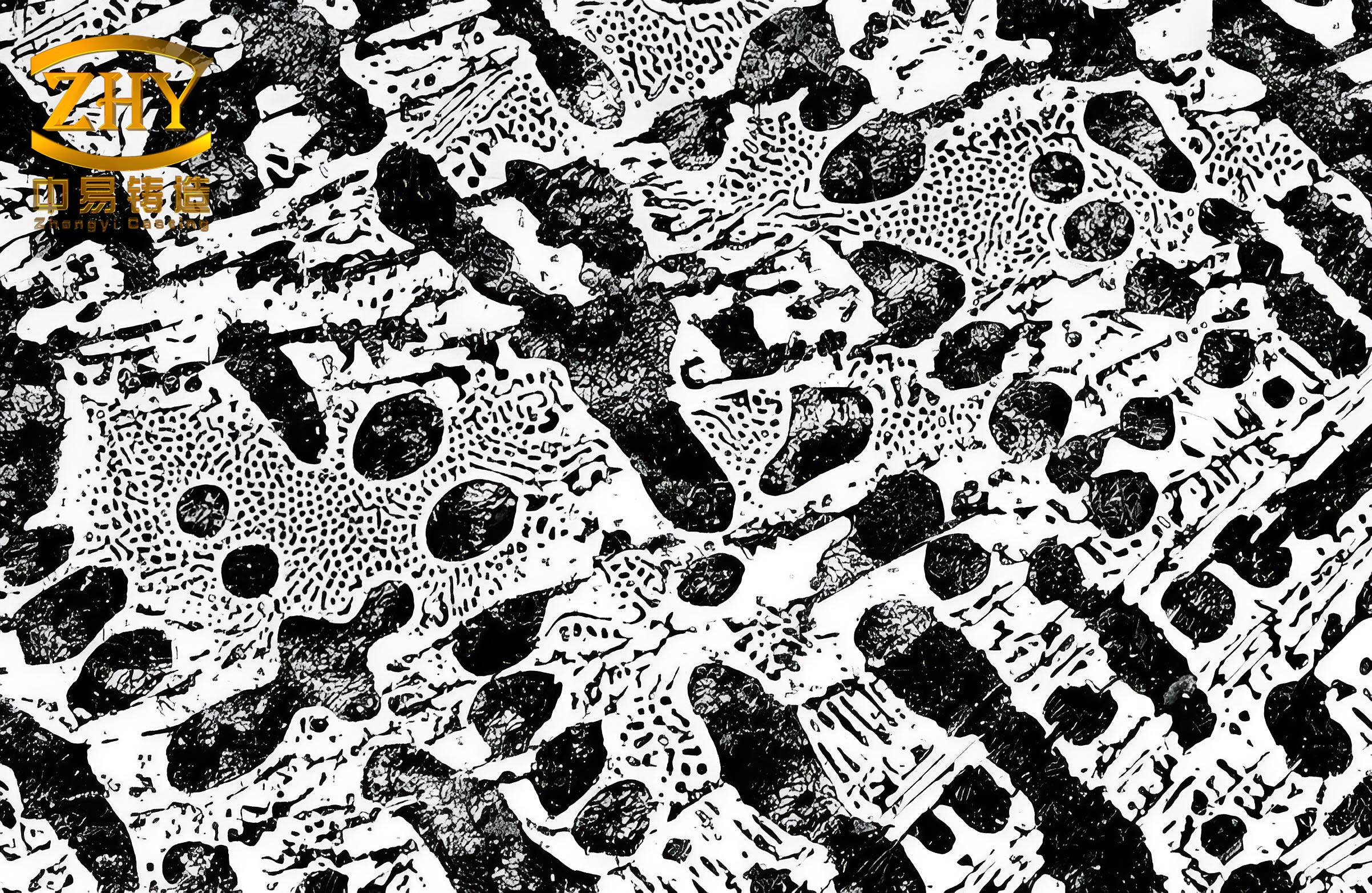
Microstructural analysis revealed profound changes. In unmodified white cast iron, the microstructure consisted of coarse austenite dendrites with large inter-dendritic spacing and elongated (Cr,Fe)7C3 carbides that formed a semi-continuous network. After composite modification, the dendrites refined, and the carbides transformed in morphology. With increasing modifier content, the progression was as follows: elongated carbides → short rod-like carbides → chrysanthemum-like clusters → fine worm-like and globular carbides. At an addition of 0.8%, the carbides became uniformly distributed, fine, and predominantly worm-like or spherical, which minimizes stress concentration and improves toughness. This transformation can be attributed to the effects of the modifier on nucleation and growth during solidification. The bismuth and magnesium likely act as inoculants, while calcium and silicon alter the interfacial energy between carbides and the melt.
To quantify microstructural refinement, I used image analysis to measure carbide aspect ratio and volume fraction. The aspect ratio (AR) is defined as the ratio of length to width for carbide particles. For unmodified white cast iron, AR averaged around 5-7, indicating elongated shapes. After modification with 0.8% addition, AR decreased to 1.5-2.5, signifying more equiaxed carbides. The carbide volume fraction (Vc) can be estimated using the formula derived from the lever rule in the Fe-Cr-C system. For a white cast iron with composition C0 and Cr0, the volume fraction of (Cr,Fe)7C3 is approximated by:
$$ V_c \approx \frac{C_0 – C_{\alpha}}{C_{carb} – C_{\alpha}} $$
where \( C_{\alpha} \) is the carbon solubility in austenite (around 0.1 wt% at the eutectic temperature) and \( C_{carb} \) is the carbon content in the carbide (approximately 9 wt% for (Cr,Fe)7C3). With increased silicon from modification, the eutectic point shifts, slightly raising \( V_c \), as observed in my experiments. However, the key benefit lies in morphology change rather than volume increase.
Mechanical properties were evaluated through impact toughness and hardness tests. Impact toughness was measured using unnotched Charpy specimens of size 10 mm × 10 mm × 55 mm, while hardness was tested on the Rockwell C scale. The results, summarized in Table 3, show that composite modification significantly enhances impact toughness up to an optimal addition level, beyond which it declines due to excessive carbide volume and inclusions. Hardness generally increases with modifier content, attributed to matrix strengthening and higher carbide content. The relationship between toughness and carbide morphology can be modeled using fracture mechanics concepts. The impact energy (IE) is influenced by the mean free path (λ) between carbides, which is reduced by refinement and spheroidization. An empirical relation is:
$$ IE \propto \frac{1}{\sqrt{\lambda}} $$
where λ decreases with finer, more dispersed carbides. Thus, modification improves IE by reducing λ. For white cast iron, this translates to better resistance to crack propagation.
| Modifier Addition (wt%) | Impact Toughness (J/cm²) | Hardness (HRC) | Microstructural Feature |
|---|---|---|---|
| 0.0 | 4.5 | 58 | Coarse elongated carbides |
| 0.4 | 6.2 | 60 | Refined dendrites, short carbides |
| 0.8 | 8.1 | 62 | Worm-like/globular carbides, uniform distribution |
| 1.2 | 7.0 | 63 | Increased carbide volume, some clustering |
| 1.5 | 6.5 | 64 | Similar to 1.2%, with higher Si effects |
The performance of blades made from this modified white cast iron was tested in industrial shot blasting machines, specifically in Q034 and Q3520 models. Blades were subjected to continuous operation with iron shot abrasive media. Service life was defined as the operating hours until wear reduced efficiency or caused failure. The results, shown in Table 4, demonstrate a dramatic improvement. At 0.8% modifier addition, blade life increased to 380 hours for the Q034 model and 320 hours for the Q3520 model, which are 2.5 and 2.0 times longer, respectively, than unmodified white cast iron blades. No premature fracture occurred, indicating sufficient toughness. This enhancement directly correlates with the microstructural refinements: the fine, spherical carbides resist spalling and cracking under impact, while the hardened matrix provides wear resistance. The synergy between carbide morphology and matrix properties is crucial for the durability of white cast iron components.
| Blade Material | Modifier Addition (wt%) | Machine Model | Service Life (hours) | Failure Mode |
|---|---|---|---|---|
| Unmodified white cast iron | 0.0 | Q034 | 152 | Abrasive wear, minor cracking |
| Modified white cast iron | 0.8 | Q034 | 380 | Uniform wear, no fracture |
| Unmodified white cast iron | 0.0 | Q3520 | 160 | Abrasive wear, edge deterioration |
| Modified white cast iron | 0.8 | Q3520 | 320 | Gradual wear, maintained integrity |
To further elucidate the mechanisms, I considered the thermodynamics of carbide formation. The addition of Ca-Si-Mg-Bi alters the activity of carbon and chromium in the melt, affecting the driving force for carbide precipitation. The Gibbs free energy change for (Cr,Fe)7C3 formation can be expressed as:
$$ \Delta G = \Delta G^0 + RT \ln \left( \frac{a_{Cr}^7 a_C^3}{a_{carb}} \right) $$
where \( \Delta G^0 \) is the standard free energy, \( a_{Cr} \) and \( a_C \) are activities of chromium and carbon, and \( a_{carb} \) is the activity of the carbide. The modifier elements may lower \( a_C \) or \( a_{Cr} \) at the solid-liquid interface, promoting finer nucleation. Additionally, silicon increases the eutectic temperature, modifying solidification kinetics. The presence of bismuth, with its low melting point, could create transient liquid phases that facilitate carbide spheroidization. These complex interactions underscore the effectiveness of composite modification in white cast iron.
In practice, the optimization of modifier addition is critical. Based on my findings, an addition of 0.8 wt% provides the best balance: sufficient desulfurization, controlled silicon increase, and optimal carbide morphology. Beyond this, diminishing returns set in due to silicon’s adverse effects on hardenability and increased carbide volume that may embrittle the white cast iron. The heat treatment cycle also plays a vital role; the air cooling after austenitizing allows martensite formation in the matrix, complemented by tempering to relieve stresses. The combined effect yields a white cast iron with high hardness (62-64 HRC) and improved toughness (8.1 J/cm² impact energy), making it ideal for abrasive environments.
The economic implications are significant. By extending blade life 2-2.5 times, the modified white cast iron reduces downtime, maintenance costs, and material consumption in shot blasting operations. Moreover, the modification process is simple and integrable into existing foundry workflows, requiring no specialized equipment. This makes it a viable solution for industries relying on wear-resistant white cast iron parts, such as mining, cement production, and steel manufacturing.
Looking ahead, there are opportunities to refine this approach further. For instance, varying the ratios of Ca, Si, Mg, and Bi could tailor properties for specific applications. Incorporating computational modeling to predict microstructure evolution based on composition and cooling rates would enhance precision. Additionally, exploring other alloying elements like vanadium or niobium could synergize with modification to form even harder carbides. The fundamental goal remains to push the boundaries of white cast iron performance, bridging the gap between wear resistance and toughness.
In conclusion, my research demonstrates that composite modification with Ca-Si-Mg-Bi effectively transforms the microstructure of high-chromium white cast iron, leading to superior mechanical properties and extended service life for shot blasting blades. The key achievements include sulfur reduction, silicon increase, dendrite refinement, and carbide spheroidization. These changes collectively enhance impact toughness and wear resistance, as validated by industrial trials. This work underscores the potential of targeted modification strategies to unlock new performance levels in white cast iron, a material central to many abrasive applications. As I continue to explore this field, I aim to develop even more advanced white cast iron variants, leveraging metallurgical principles to meet evolving industrial demands.