
My investigation focuses on the direct as-cast attainment of a troostite matrix in high-chromium white cast iron, a material renowned for its exceptional wear resistance. The primary challenge has been to bypass energy-intensive heat treatments like quenching and tempering, which are typically required to transform the metastable austenite present in as-cast structures into harder, more wear-resistant phases. This study systematically explores the interplay between chemical composition—specifically the carbon-to-chromium ratio (C/Cr)—solidification cooling rate, and micro-alloying to promote the direct transformation of undercooled austenite into troostite upon casting. The goal is to establish processing windows for producing white cast iron components with a favorable combination of hardness, toughness, and inherent wear resistance directly from the mold.
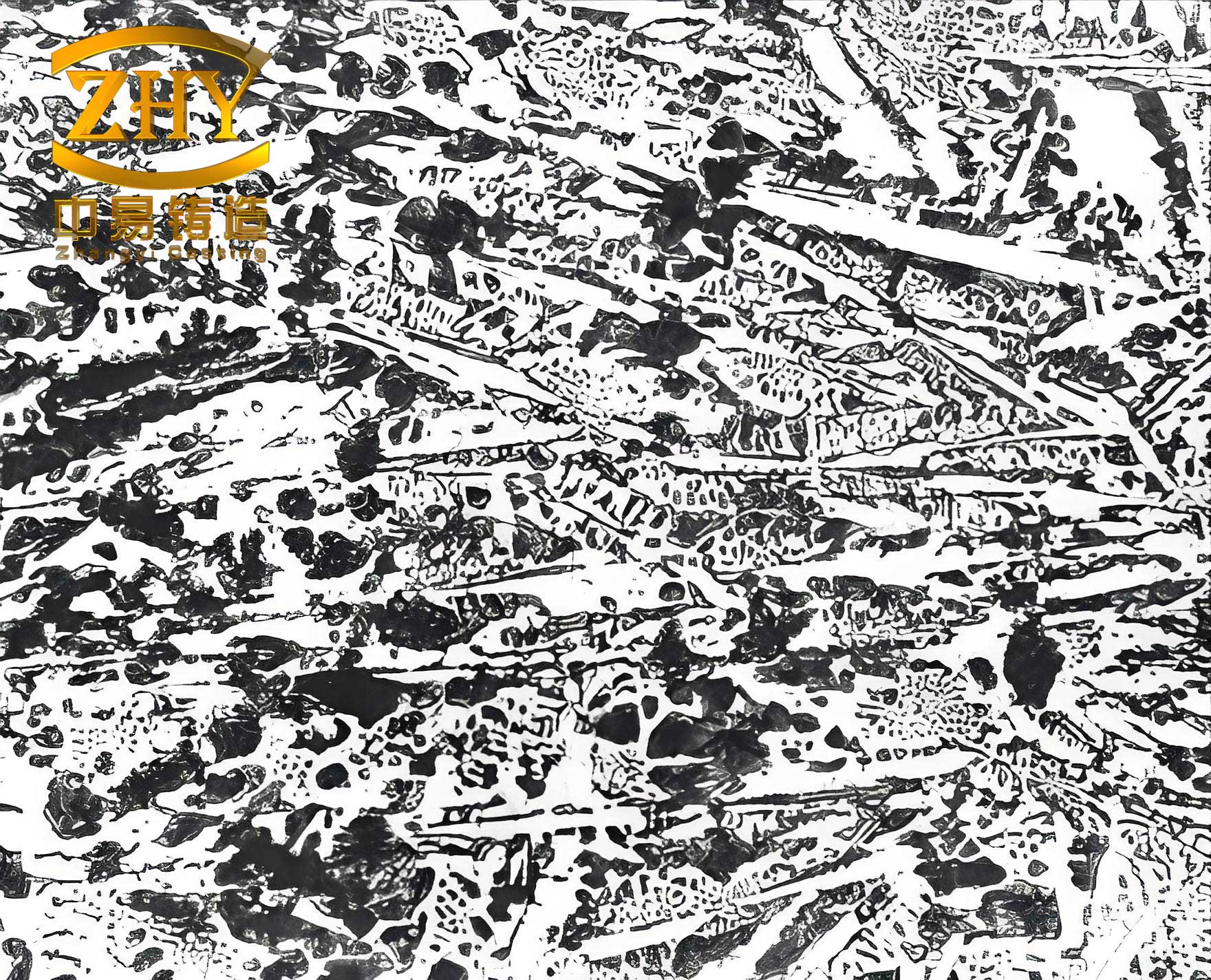
The experimental work was conducted under controlled laboratory conditions. The base materials included pig iron, scrap steel, ferrochromium, ferromanganese, ferrosilicon, electrolytic copper, and rare earth silicide. Melting was carried out in a medium-frequency induction furnace, with the melt superheated to approximately 1550°C and a pouring temperature maintained between 1380°C and 1420°C. Two distinct casting methods were employed to create different cooling regimes: green sand molds and metallic (chill) molds. Specimens for microstructural analysis and mechanical testing were cast accordingly. The chemical composition was strategically designed, with chromium content fixed to ensure the formation of the desired M7C3-type eutectic carbides, while the carbon content was varied to alter the C/Cr ratio, which is a critical parameter controlling the stability of the austenite phase. The foundational process is illustrated below:
1. The Critical Role of Carbon-to-Chromium Ratio and Cooling Rate
The initial phase of the study fixed the chromium content and varied the carbon within a medium range. For specimens cast in green sand molds—which represent a relatively slow cooling rate—the as-cast microstructure showed a clear dependence on the C/Cr ratio. At higher C/Cr ratios (lower carbon for a fixed Cr), the matrix remained predominantly austenitic. As the C/Cr ratio decreased (carbon content increased), an increasing volume fraction of the austenite transformed into troostite during cooling. When the C/Cr ratio was reduced to a threshold value of approximately 7.0 or below, the entire matrix in the sand-cast condition transformed to troostite, accompanied by an increasing network of eutectic and, at very high carbon levels, primary carbides.
The cooling rate proved to be an equally decisive factor. When identical melts were cast into metallic chill molds, the significantly faster cooling suppressed the austenite-to-troostite transformation. Even at C/Cr ratios where sand casting yielded full troostite, metallic mold casting often resulted in a fully retained austenite matrix or one with only minimal transformation at grain boundaries. This demonstrates that the critical cooling velocity for this transformation is exceeded by typical metallic mold practices for most compositions. Only when the C/Cr ratio was very low (≤ 5.0) did the metallic mold’s cooling rate fall below this critical value, allowing for a complete troostitic transformation even under rapid cooling conditions. The results are summarized in Table 1 below.
| Sample Set | C/Cr Ratio | Green Sand Mold (Slow Cool) | Metallic Mold (Fast Cool) | Predominant Matrix Phase |
|---|---|---|---|---|
| A | > 9.0 | Austenite + Carbides | Fully Austenite | Austenite |
| B | 7.0 – 9.0 | Troostite + Retained Austenite | Mostly Austenite | Mixed |
| C | 5.0 – 7.0 | Fully Troostite | Austenite / Partial Transformation | Troostite (Sand only) |
| D | ≤ 5.0 | Fully Troostite | Fully Troostite | Troostite |
This behavior can be interpreted through the lens of continuous cooling transformation (CCT) diagrams. The decrease in the C/Cr ratio effectively shifts the CCT curve for the austenite decomposition to shorter times (leftward), making the transformation kinetically more favorable even at faster cooling rates. The relationship can be conceptually modeled by considering the driving force for transformation, $\Delta G$, which increases with undercooling and is influenced by composition:
$$ \Delta G_{γ→α+ carbides} \propto f(T, X_C, X_{Cr}) $$
where a lower C/Cr ratio (higher $X_C$ at fixed $X_{Cr}$) enhances the driving force, promoting diffusion-controlled transformation to troostite (a fine aggregate of ferrite and carbides) over diffusionless martensitic transformation or austenite retention.
2. Isothermal Heat Treatment as a Processing Route
For compositions with a higher C/Cr ratio where direct metallic mold casting fails to produce troostite, an isothermal heat treatment process was investigated. This involved casting into a metallic mold, opening the mold at a specific temperature (e.g., 900-950°C), and immediately transferring the hot casting into a pre-heated furnace held at an intermediate temperature (e.g., 450°C) for a prolonged hold (e.g., 2 hours), followed by furnace cooling.
This process is highly effective. The isothermal hold within the “bay” of the Time-Temperature-Transformation (TTT) diagram allows for the precipitation of secondary carbides from the supersaturated austenite. This precipitation depletes the austenite matrix of carbon and chromium, significantly increasing its martensite start (Ms) temperature and stabilizing the ferritic phase. Consequently, upon subsequent cooling, the enriched and stabilized matrix readily transforms into troostite rather than retaining as austenite. The kinetics of isothermal transformation can be described by the Avrami equation:
$$ Y = 1 – \exp(-k t^n) $$
where $Y$ is the transformed fraction, $t$ is time, and $k$ and $n$ are constants dependent on temperature and composition. The isothermal treatment provides the necessary time $t$ at a temperature where $k$ is sufficiently large to complete the transformation to troostite in white cast iron. While successful, this method adds an extra production step, increasing cost and complexity.
3. Micro-Alloying with Aluminum for As-Cast Troostite
Seeking a more commercially viable single-step process for metallic mold casting, the effect of micro-alloying with aluminum was explored. Aluminum is known to have a powerful effect on the Fe-C phase diagram, dramatically shrinking the austenite phase field. The hypothesis was that even trace additions could destabilize austenite in white cast iron, promoting its transformation during continuous cooling.
The results were conclusive. For a medium-carbon white cast iron with a C/Cr ratio that would normally retain austenite in a metallic mold, the addition of a small, controlled amount of aluminum (on the order of a few tenths of a percent) induced a complete transformation to a troostitic matrix in the as-cast state, regardless of using a sand or metallic mold. This finding is pivotal, as it enables the production of sound, dense castings via chill casting (e.g., for grinding media) while achieving the desired microstructure directly. The mechanism is twofold: 1) Aluminum reduces the thermodynamic stability of austenite, and 2) it accelerates the kinetics of transformation, shifting the CCT curve leftward. The effect can be summarized as a modification to the driving force equation:
$$ \Delta G_{γ→α+ carbides} \propto f(T, X_C, X_{Cr}, X_{Al}) $$
where $X_{Al}$ > 0 significantly increases $\Delta G$.
Table 2 summarizes the transformative effect of aluminum addition on a specific medium-carbon white cast iron composition under different casting conditions.
| Condition | Al Addition | Green Sand Mold | Metallic Mold | Matrix Outcome |
|---|---|---|---|---|
| Without Al | 0% | Partial Troostite | Fully Austenite | Unsatisfactory for fast cooling |
| With Al | ~0.3% | Fully Troostite | Fully Troostite | Consistently Troostite |
4. Mechanical Properties and Wear Performance
The ultimate validation of this troostitic white cast iron lies in its mechanical and tribological properties. A fully troostitic matrix provides a superior combination of hardness and toughness compared to a brittle martensitic matrix or a soft austenitic one. The fine, dispersed carbides within the troostite offer strong resistance to abrasive wear while the ferritic base provides needed ductility to withstand impact.
Abrasive wear tests were conducted to compare the performance of the as-cast troostitic white cast iron against a traditionally heat-treated (quenched) martensitic white cast iron of similar bulk hardness and carbide volume. Using a controlled abrasion test against a standardized abrasive medium, the cumulative weight loss over a fixed period was measured. The results, detailed in Table 3, indicate that the wear resistance of the troostitic structure is comparable to, and in some cases marginally different from, that of the martensitic structure. This demonstrates that the troostite matrix, with its favorable balance of hardness and micro-ductility, effectively supports the hard M7C3 carbides, leading to excellent in-service performance without the risks of quench cracking associated with martensite formation.
| Material Condition | Matrix Phase | Macro Hardness (HRC) | Relative Abrasive Wear Loss | Key Advantage |
|---|---|---|---|---|
| As-Cast (Low C/Cr + Al) | Troostite | 50-55 | 1.00 (Baseline) | No heat treatment, good toughness |
| Quenched & Tempered | Martensite | 58-62 | 0.95 – 1.05 | Higher peak hardness |
| As-Cast (High C/Cr) | Austenite | 40-48 | > 1.20 | High toughness, work-hardens |
The wear resistance $\Omega$ of such a composite material can be conceptually related to the properties of its constituents:
$$ \Omega \propto H_m^{a} \cdot (1 – V_c)^{b} + H_c^{c} \cdot V_c^{d} \cdot S $$
where $H_m$ and $H_c$ are the microhardness of the matrix and carbides, $V_c$ is the carbide volume fraction, $S$ is a “support factor” related to matrix/carbide bonding and matrix specific volume, and $a, b, c, d$ are exponents. The troostitic matrix offers a higher $H_m$ and $S$ than austenite, and a better $S$ than potentially cracked martensite, optimizing the overall $\Omega$ for many applications.
5. Conclusions and Processing Guidelines
This comprehensive study establishes clear pathways for obtaining a troostite matrix in high-chromium white cast iron directly in the as-cast state, eliminating the need for post-casting hardening treatments. The findings can be condensed into the following actionable guidelines for designing and processing troostitic white cast iron:
- Compositional Control via C/Cr Ratio: For sand-cast components, targeting a C/Cr ratio of ≤ 7.0 can yield a fully troostitic matrix. For metallic mold casting without alloying, a very low C/Cr ratio (≤ 5.0) is required to overcome the rapid cooling rate, though this may lead to excessive carbide content and reduced toughness.
- Isothermal Process Route: For components cast in metallic molds with higher C/Cr ratios, an isothermal treatment involving holding the casting at an intermediate temperature (e.g., 450°C) immediately after mold opening can reliably produce a troostite matrix by allowing for secondary carbide precipitation and austenite conditioning.
- Micro-Alloying for Process Flexibility: The addition of small, controlled amounts of aluminum (e.g., ~0.2-0.4%) is a highly effective method for destabilizing austenite. This enables the production of medium-carbon white cast iron (C/Cr ~ 7-9) with a fully troostitic matrix in both sand and metallic molds, combining the dimensional accuracy and density of chill casting with the desired microstructure and properties.
- Performance Validation: The resulting as-cast troostitic white cast iron exhibits a favorable balance of hardness and toughness, with abrasive wear resistance comparable to that of heat-treated martensitic grades, making it a cost-effective and reliable material choice for demanding wear applications.
In summary, through precise control of the C/Cr ratio, cooling rate management, and strategic micro-alloying, the direct as-cast production of high-performance troostitic white cast iron is not only feasible but also represents a significant optimization in the manufacturing of wear-resistant components.