
The development of high-performance wear-resistant materials is a constant pursuit in industrial applications. Among these, white cast iron stands out due to its high hardness imparted by a microstructure rich in hard carbides embedded in a metallic matrix. However, the typical coarse, continuous network of carbides often acts as stress concentrators and crack propagation paths, leading to inherent brittleness that limits its application under impact or complex stress conditions. This brittleness is the primary challenge in white cast iron technology.
Alloying is a common strategy to modify carbide morphology. Vanadium, for instance, is a potent carbide former. Its carbides (typically VC) are extremely hard (HV ~2800) and tend to precipitate in a more discrete, less networked form compared to cementite, which is beneficial for toughness. However, high-vanadium white cast iron (containing 6-12% V) becomes expensive. This investigation explores an alternative route: using a cost-effective RE-Si (Rare Earth-Silicon) compound modifier to refine the microstructure and enhance the mechanical properties of a lower-vanadium white cast iron (1.8-2.1% V), subsequently optimized through various heat treatment cycles. The goal is to achieve a superior combination of toughness, strength, and wear resistance in this modified white cast iron.
1. Experimental Methodology and Material Processing
1.1 Melting, Modification, and Casting
The white cast iron was melted in a 50 kg medium-frequency induction furnace using foundry pig iron, steel scrap, and ferrovanadium as raw materials. Carbon content was adjusted using crushed graphite electrodes. The melt was superheated to 1450°C and deoxidized with aluminum prior to treatment.
The key step was the modification treatment. A RE-Si compound inoculant was introduced into the ladle using the bell-insertion method. The inoculant consisted of a mixture of a rare-earth alloy (RE) and 75% ferrosilicon (SiFe). The addition levels were varied to study the effect of residual rare-earth content. The chemical compositions of the resulting white cast iron heats are detailed in Table 1.
| Heat Designation | C | Si | V | RE (residual) | Inoculant Addition (%) | |
|---|---|---|---|---|---|---|
| RE Alloy | 75Si-Fe | |||||
| R0 (Unmodified) | 2.31 | 0.30 | 1.82 | 0 | – | – |
| SR1 | 2.31 | 0.75 | 1.93 | 0.069 | 0.10 | 1.0 |
| SR2 | 2.24 | 0.83 | 2.03 | 0.234 | 0.25 | 1.0 |
| SR3 | 2.28 | 0.76 | 2.04 | 0.321 | 0.40 | 1.0 |
| SR4 | 2.24 | 0.82 | 2.10 | 0.645 | 0.70 | 1.0 |
The modified liquid white cast iron was then poured into oil-sand molds to produce test specimens for bending strength (170 x 8 x 14 mm), impact toughness (55 x 10 x 10 mm, unnotched), and wear resistance (60 x 6 x 25 mm).
1.2 Heat Treatment Procedures
To further enhance the properties of the modified white cast iron, five distinct heat treatment schedules were applied. Four were normalizing treatments at different austenitizing temperatures, and one was an austempering process. The detailed parameters are summarized in Table 2.
| Process Code | Austenitizing | Quenching / Cooling | |||
|---|---|---|---|---|---|
| Temperature (°C) | Time (min) | Medium | Temperature (°C) | Time (min) | |
| a | 920 | 60 | Air | Room Temp. | – |
| b | 960 | 60 | Air | Room Temp. | – |
| c | 1000 | 60 | Air | Room Temp. | – |
| d | 1040 | 60 | Air | Room Temp. | – |
| e (Austempering) | 760/60 → 1000* | – | Salt Bath | 290 ±10 | 60 |
* Austenitizing involved holding at 760°C for 60 min, then heating to 1000°C with no hold before quenching.
1.3 Mechanical and Tribological Testing
The performance of the white cast iron was evaluated through a comprehensive set of tests:
Hardness (HRC): Measured on a Rockwell hardness tester (HR-150A).
Impact Toughness (αk): Determined using a JB6 pendulum impact tester on unnotched specimens; results in J/cm².
Transverse Rupture Strength (σbb): Measured via three-point bending on an Amsler 25-ton universal testing machine; results in MPa.
Wear Resistance (ε): Evaluated using a Brinell-type abrasive wear tester. The wear coefficient ε is defined as the weight loss of a standard 45# medium-carbon steel specimen divided by the weight loss of the tested white cast iron specimen. A higher ε indicates superior wear resistance.
2. The Mechanism and Effects of RE-Si Modification
2.1 Microstructural Transformation in As-Cast White Cast Iron
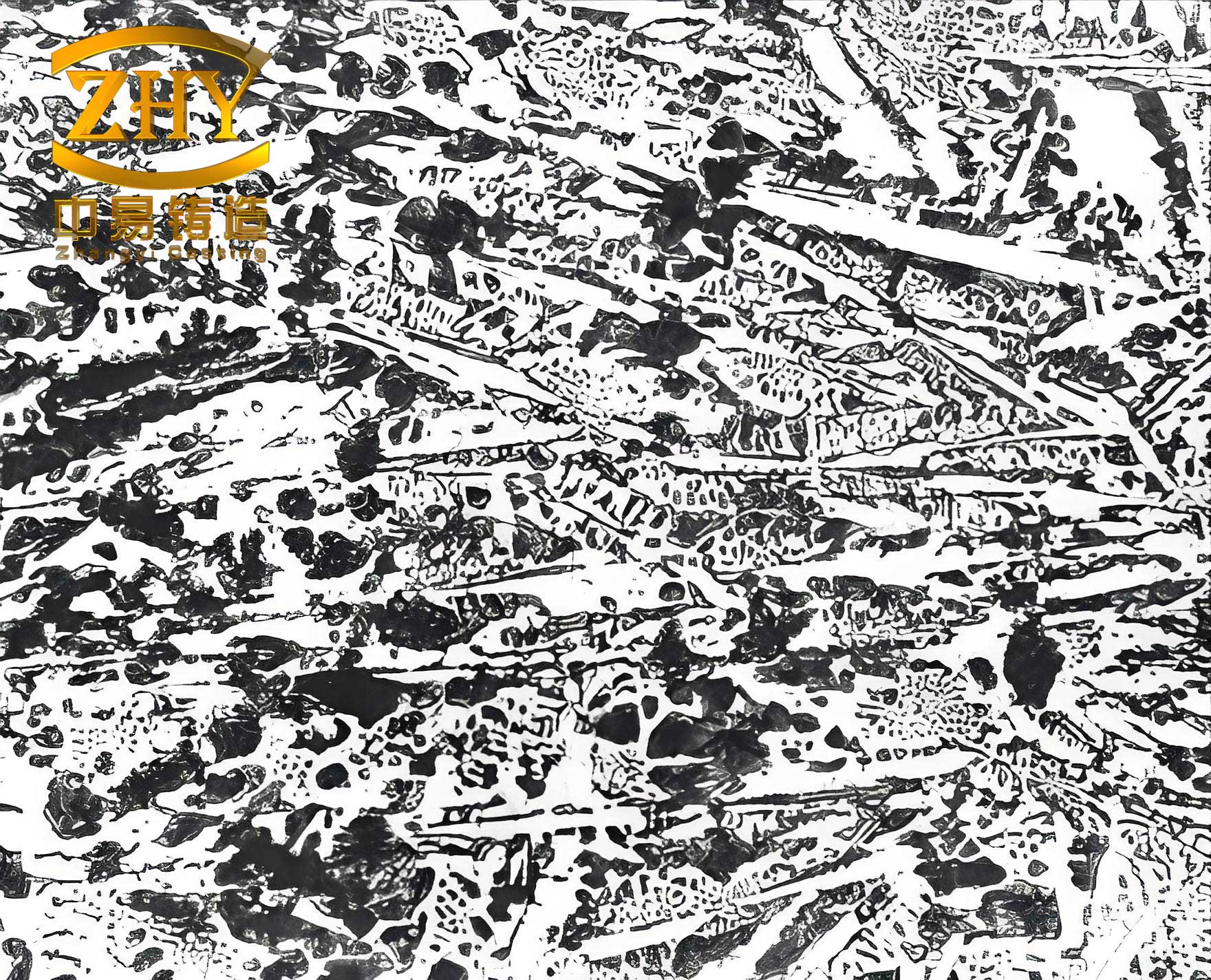
The fundamental action of the RE-Si modifier is to alter the solidification morphology of the carbides. In the unmodified white cast iron (R0), the microstructure exhibits a classic problem: a continuous, coarse network of carbides, often appearing as interconnected plates or needles. This structure severely partitions the metallic matrix, creating easy paths for crack propagation.
With the addition of the RE-Si compound, a remarkable transformation occurs. Even at low residual RE levels (~0.07%), the carbide network begins to break down, showing a tendency towards a more granular or clustered (“flocculent”) form. As the residual RE content increases to an optimal range (~0.2-0.3%), the refinement becomes pronounced. The carbides are significantly refined and adopt isolated, granular, or short-chain-like morphologies, uniformly dispersed within the matrix. The primary mechanisms for this transformation are:
- Surface Activity and Growth Inhibition: Rare earth elements are strong surface-active agents in molten iron. They segregate to the growing interface of nascent carbides during solidification, adsorbing onto preferential growth planes. This adsorption poisons the growth sites, inhibiting the directional, rapid growth that leads to interconnected networks. The growth is constrained, forcing the carbide to assume a more compact, isolated shape. This effect can be conceptually related to a modification of interfacial energy, influencing the morphology according to Gibbs-Wulff theorem. The modified growth kinetics can be expressed as a reduction in the anisotropy of growth velocity $v_{[hkl]}$ for different crystal directions of the carbide:
$$
\frac{v_{[hkl],\text{modified}}}{v_{[hkl],\text{unmodified}}} = f(\Gamma_{RE}, C_{RE}^{interface})
$$
where $\Gamma_{RE}$ is the surface excess concentration of RE at the interface and $C_{RE}^{interface}$ is its interfacial concentration, both acting to reduce the growth rate disparity.
- Heterogeneous Nucleation and Grain Refinement: Rare earths have a high affinity for oxygen and sulfur. They react to form stable, high-melting-point compounds such as RE-oxysulfides (e.g., RE2O2S). These compounds, suspended in the melt, act as potent heterogeneous nucleation sites for the eutectic carbides. The increased number of nucleation events leads to a much finer grain size and a higher population density of smaller carbides. The classic grain refinement relationship can be applied here, where the final grain/carbide size $d$ is inversely proportional to the number of effective nuclei $N$:
$$
d \propto \frac{1}{\sqrt[3]{N}}
$$
The RE inclusions significantly increase $N$, thereby reducing $d$.
- Purification of Grain Boundaries: By removing sulfur and oxygen from the melt to form harmless inclusions, the RE treatment cleanses the grain boundaries. Impurities like iron sulfide (FeS), which form low-melting-point films along boundaries and severely embrittle the material, are eliminated. This results in stronger, cleaner boundaries that are more resistant to intergranular fracture.
2.2 Influence on As-Cast Mechanical Properties
The microstructural refinement directly translates to improved mechanical properties in the as-cast white cast iron. The relationship between residual RE content and key properties follows a clear trend, as quantified in the data below and visualized in subsequent plots.
Impact Toughness (αk): The unmodified white cast iron exhibited very low toughness (3.72 J/cm²). Modification caused a dramatic increase, with toughness peaking at a residual RE content of approximately 0.3%. The improvement can be over 100% compared to the base material. The enhancement stems from: (i) the replacement of the continuous brittle carbide network with isolated particles, which blunts crack tips and increases the crack propagation energy; (ii) finer grains and carbides leading to more tortuous crack paths (higher fracture surface area); and (iii) purified, stronger grain boundaries.
Transverse Rupture Strength (σbb): The bending strength shows a similar trend, increasing with RE content up to the optimum level. The refined and uniformly dispersed carbides act as effective barriers to dislocation motion, strengthening the matrix through dispersion strengthening (Orowan mechanism). The strength increase $\Delta \sigma$ due to finely spaced particles of radius $r$ and volume fraction $f$ can be estimated as:
$$
\Delta \sigma_{orowan} \approx \frac{Gb}{2\pi\sqrt{1-\nu}} \cdot \frac{1}{\lambda} \ln\left(\frac{2r}{b}\right)
$$
where $G$ is the shear modulus, $b$ is the Burgers vector, $\nu$ is Poisson’s ratio, and $\lambda$ is the inter-particle spacing, which is reduced by refinement ($\lambda \propto r/\sqrt{f}$). A finer, more uniform distribution decreases $\lambda$, thereby increasing strength.
Hardness (HRC): The hardness of the as-cast white cast iron also increases with modification, though the change is less dramatic than for toughness. The increased hardness results from the combined effects of solid solution strengthening from silicon and residual RE, as well as the increased constraint offered by the finely dispersed hard phases.
Over-modification: Beyond the optimal RE content (~0.3-0.4% residual), all properties tend to decline slightly. This is attributed to the formation of excessive, coarse RE-containing inclusions (e.g., RE2O2S, RE2O3, REC2) which themselves can act as stress raisers and initiate fracture, counteracting the benefits of carbide refinement.
| Property | Unmodified White Cast Iron (R0) | Optimally Modified White Cast Iron (~0.3% REres) | Percentage Improvement |
|---|---|---|---|
| Impact Toughness, αk (J/cm²) | 3.72 | ~7.86 | ~111% |
| Transverse Rupture Strength, σbb (MPa) | ~850 (estimated) | ~970 | ~14% |
| Hardness, HRC | ~47 | ~49 | ~4% |
3. The Synergistic Role of Heat Treatment
While modification drastically improves the as-cast state, heat treatment is the crucial second step to unlock the full potential of this white cast iron. It primarily alters the matrix microstructure, which is critical for supporting the hard carbides and determining overall toughness and wear behavior.
3.1 Normalizing: Optimization of Matrix and Carbide Distribution
Normalizing involves austenitizing the white cast iron at a high temperature (920-1040°C in this study), holding to achieve a homogeneous austenite structure saturated with carbon and alloying elements, followed by air cooling. This process induces several beneficial changes:
- Matrix Homogenization and Stress Relief: The high-temperature soak promotes diffusion, homogenizing the chemical composition of the austenitic matrix and relieving internal casting stresses.
- Carbide Spheroidization and Coarsening (Ostwald Ripening): During prolonged holding at the austenitizing temperature, the sharp edges of carbides dissolve slightly, and the overall carbide morphology becomes more rounded or spheroidized. Small carbides may dissolve while larger ones grow, slightly increasing the average particle size but improving their shape factor. This further reduces stress concentration. The process is governed by the Ostwald ripening equation, where the average particle radius $\bar{r}$ increases with time $t$:
$$
\bar{r}^3 – \bar{r}_0^3 = K t
$$
where $\bar{r}_0$ is the initial average radius and $K$ is a rate constant dependent on temperature and diffusivity.
- Transformation upon Cooling: Upon air cooling, the austenite transforms into a mixture of fine pearlite and other transformation products (depending on composition and cooling rate), resulting in a matrix with good strength and some ductility.
The effect of normalizing temperature is critical. At 1000°C, the optimal combination of dissolution, homogenization, and spheroidization is achieved for this specific white cast iron composition. This leads to the best mechanical properties. Lower temperatures (920°C) provide insufficient diffusion and matrix conditioning. Higher temperatures (1040°C) may cause excessive austenite grain growth and potentially destabilize some carbides, leading to property deterioration.
The fracture surface analysis provides compelling evidence. The unmodified white cast iron shows a classic brittle cleavage fracture with large “river patterns.” The modified as-cast structure shows refined cleavage facets. However, the normalized (1000°C) modified white cast iron exhibits a quasi-cleavage fracture mode with distinct tear ridges and micro-voids (dimples) around carbides, indicating a significant increase in fracture energy absorption and a transition towards more ductile fracture mechanisms.
3.2 Austempering: Achieving a High-Strength Tough Matrix
Austempering (Process ‘e’) is an isothermal heat treatment designed to produce bainite, specifically lower bainite in steels and cast irons. The process involves quenching to a temperature above the martensite start (Ms) point (290°C here) and holding to allow the bainitic transformation to complete.
The resulting lower bainitic matrix is characterized by very fine acicular ferrite laths with a high density of dislocations and fine carbides precipitated within them. This structure offers an outstanding compromise: very high strength and hardness combined with significantly better toughness and ductility compared to martensite at similar hardness levels. For wear-resistant white cast iron, this is a game-changer. The tough, hard bainitic matrix can firmly support the hard primary carbides, preventing them from being easily plucked out during abrasive wear.
3.3 Comprehensive Performance Data After Heat Treatment
The combined effect of optimal RE-Si modification (0.234% REres) and various heat treatments is summarized in Table 4. The superiority of the 1000°C normalizing treatment for achieving peak toughness and strength is clear. Austempering produces the highest hardness and, as will be shown, exceptional wear resistance.
| Heat Treatment | Impact Toughness, αk (J/cm²) | Transverse Rupture Strength, σbb (MPa) | Hardness, HRC | Wear Coefficient, ε |
|---|---|---|---|---|
| As-Cast | 7.86 | 970.2 | 49.0 | ~1.10 |
| 920°C Normalized | 13.45 | 1187.5 | 48.5 | ~1.15 |
| 960°C Normalized | 15.67 | 1255.8 | 48.0 | ~1.25 |
| 1000°C Normalized | 18.78 | 1322.0 | 47.5 | ~1.43 |
| 1040°C Normalized | 16.34 | 1278.3 | 46.5 | ~1.35 |
| Austempered (290°C) | 14.92 | 1200.5 | 52.0 | >1.70 |
4. Analysis of Wear Resistance Behavior
The wear performance of white cast iron is a complex function of both carbide characteristics (volume fraction, size, morphology, hardness) and matrix properties (hardness, toughness, work-hardening capacity). The results show a nuanced interplay:
- Effect of Modification (As-Cast): RE-Si modification improves the wear resistance of the as-cast white cast iron. This is because the refined, isolated carbides are more difficult for abrasive particles to fracture and remove compared to a brittle, interconnected network which can be easily fragmented and spalled off in large chunks.
- Effect of Normalizing: Contrary to expectations, normalizing often leads to a decrease in wear resistance compared to the as-cast modified condition, despite improvements in toughness. The explanation lies in the matrix change. During high-temperature austenitizing, alloying elements (like silicon, vanadium) that were in solid solution in the as-cast matrix precipitate out as fine, secondary carbides. While this precipitation hardening occurs, it often results in a net decrease in the microhardness of the metallic matrix itself because the solid solution strengthening effect is lost. The Archard wear equation, while simplified, gives insight:
$$
V = K \frac{N \cdot L}{H}
$$
where $V$ is wear volume, $K$ is a wear coefficient, $N$ is load, $L$ is sliding distance, and $H$ is hardness. The wear resistance is inversely proportional to hardness. If the matrix hardness $H_{matrix}$ decreases significantly, even though the primary carbides are well-dispersed, they become vulnerable. Under abrasive action, the softer matrix is more easily cut or gouged, and the fine primary carbides, now lacking strong support, can be either undercut and removed or carried away with the deformed matrix material. Therefore, the overall wear resistance of the normalized white cast iron, while better than unmodified, is not as high as the as-cast or austempered versions.
- Superiority of Austempering for Wear: The austempered white cast iron exhibits the highest wear resistance by a significant margin. This is attributed to its unique matrix: a very hard and tough lower bainite. The bainitic matrix has a high hardness ($H_{matrix}^{bainite} > H_{matrix}^{normalized}$), providing excellent support for the primary carbides. Furthermore, its high toughness and work-hardening ability allow it to deform plastically without extensive micro-cracking, effectively “holding onto” the carbides. The abrasive particles find it extremely difficult to either cut the hard bainite or dislodge the firmly embedded carbides. The combination of hard, discrete primary carbides (from modification) and a hard, tough bainitic matrix (from austempering) creates a nearly ideal microstructure for severe abrasive wear conditions.
The wear coefficient ε shows a direct correlation with the product of matrix hardness and impact toughness, suggesting an optimal property window. A simplified merit index $M_w$ for wear resistance in such materials could be proposed as:
$$
M_w \propto (H_{matrix} \cdot \alpha_k)^{1/2} \cdot f(V_c, \lambda_c)
$$
where $f(V_c, \lambda_c)$ is a function of carbide volume fraction $V_c$ and inter-carbide spacing $\lambda_c$, optimized by modification. Austempering maximizes $H_{matrix} \cdot \alpha_k$.
5. Conclusions and Industrial Implications
This comprehensive study demonstrates a highly effective two-stage process for engineering high-performance low-vanadium white cast iron.
- RE-Si Compound Modification is a powerful and necessary first step. It fundamentally alters the solidification microstructure of the white cast iron, transforming coarse, continuous carbide networks into a refined, uniform dispersion of isolated granular or short-chain carbides. The optimal addition for this composition was found to be 1.0% 75Si-Fe plus 0.25% RE alloy, yielding a residual RE content of approximately 0.234%. The mechanisms are multifaceted, involving growth inhibition via surface-active RE elements, enhanced heterogeneous nucleation, and grain boundary purification.
- Subsequent Heat Treatment is not optional but essential for achieving the best overall engineering properties. It works synergistically with the modified microstructure.
- For Maximum Toughness and Strength: Normalizing at 1000°C after optimal modification produces the best combination of impact toughness (18.78 J/cm²) and transverse rupture strength (1322 MPa), with a good hardness of 47.5 HRC. This treatment homogenizes the matrix, further spheroidizes carbides, and produces a fine, strong matrix transformation product.
- For Maximum Wear Resistance: Austempering at 290°C after modification yields the highest hardness (52 HRC) and superior wear resistance (ε > 1.70). This is due to the formation of a very hard and tough lower bainitic matrix that provides exceptional support to the refined primary carbides.
- The Property Matrix can thus be tailored. The choice between a normalized or austempered state depends on the specific service conditions of the white cast iron component. For applications requiring high shock resistance and good wear resistance (e.g., crusher liners, hammer heads), the normalized grade is excellent. For applications dominated by severe, high-stress abrasion with less extreme impact (e.g., slurry pump wear parts, grinding rolls), the austempered grade is unparalleled.
This approach provides a cost-effective and technically robust pathway to produce premium-grade white cast iron with a balanced and superior set of properties, leveraging the synergistic effects of micro-alloying, intelligent inoculation, and precise thermal processing.