
As a researcher deeply involved in the development of advanced wear-resistant materials, I have long been fascinated by the unique properties of white cast iron. White cast iron, characterized by its hard eutectic phases, has been a cornerstone in applications requiring resistance to abrasive wear. The evolution of white cast iron from ordinary grades to nickel-hard and high-chromium variants has consistently aimed at enhancing wear performance, yet challenges like low toughness and impact resistance persist. In recent years, the exploration of white cast iron with eutectic borides as the primary wear-resistant phase has emerged as a promising avenue. This innovative approach, initially proposed by researchers in Australia and further developed in institutions like Inner Mongolia University of Science and Technology and Tsinghua University, leverages the superior hardness and potential toughness improvements offered by borides. However, a critical aspect that directly influences the engineering applicability of such materials is their hardenability—the ability to form martensite upon cooling. In this article, I delve into the hardenability of Fe-Cr-B white cast iron, a material where boron is added in extremely high amounts to form eutectic borides, and discuss how this affects its microstructure, properties, and practical utility.
Hardenability is a fundamental property in ferrous alloys, dictating the depth to which martensite can form during quenching. For white cast iron, which often contains over 20% of hard phases like carbides or borides, poor thermal conductivity can lead to high thermal stresses and cracking during rapid cooling. Thus, excellent hardenability is desirable to allow for slower cooling rates, such as air quenching, minimizing the risk of defects. In conventional steels, boron is known to significantly enhance hardenability at trace levels (typically below 6×10⁻³%), but its effect at higher concentrations, especially in high-carbon contexts, is less understood. In Fe-Cr-B white cast iron, boron is added at levels around 1.66 wt%, far exceeding the typical range for boron steels. This raises a pivotal question: does boron, when predominantly tied up in borides, still impart beneficial effects on the hardenability of the matrix? Through a combination of experimental techniques and computational analysis, I have investigated this issue, focusing on the microstructure, hardness profiles, end-quench tests, and continuous cooling transformation (CCT) curves. My findings reveal that Fe-Cr-B white cast iron exhibits exceptional hardenability, enabling martensite formation even under slow cooling conditions, and that the minute amount of boron dissolved in the matrix plays a positive role in this regard.
The importance of hardenability in white cast iron cannot be overstated. In industrial applications, components made from white cast iron often undergo heat treatment to optimize their mechanical properties. If the material has low hardenability, rapid quenching is required, which can induce cracks due to thermal stresses exacerbated by the low thermal conductivity of white cast iron. Conversely, high hardenability allows for milder cooling methods, reducing manufacturing risks and costs. For Fe-Cr-B white cast iron, the presence of eutectic borides, which are even harder than carbides, offers potential advantages in wear resistance. However, the matrix composition and its ability to transform to martensite are crucial for balancing hardness with toughness. My research aims to elucidate how the alloying elements, particularly boron, influence this balance. By studying Fe-Cr-B white cast iron, I hope to contribute to the development of a new class of white cast iron materials that combine superior wear resistance with improved manufacturability.
Materials and Experimental Methods
To investigate the hardenability of Fe-Cr-B white cast iron, I prepared the material using a 100 kg medium-frequency induction furnace with a basic lining. The melting process was conducted at a tapping temperature of 1550–1600°C, followed by pouring at a controlled temperature of (1430 ± 10)°C into standard keel block molds fabricated via investment casting. This method ensured a consistent cooling rate representative of typical casting conditions. The chemical composition of the Fe-Cr-B white cast iron was meticulously analyzed: carbon and other elements (except boron) were determined using a SPECTRO LAB M10 direct-reading spectrometer, while boron content was measured via chemical analysis. The composition is summarized in Table 1, highlighting the low carbon and high boron characteristics essential for forming eutectic borides while maintaining a matrix conducive to martensitic transformation.
| Element | C | B | Cr | Si | Mn | Ni | V | Fe |
|---|---|---|---|---|---|---|---|---|
| Content | 0.27 | 1.66 | 17.23 | 1.07 | 1.32 | 2.67 | 1.23 | Bal. |
Microstructural characterization was performed using a ZEISS Sigma 300 field-emission scanning electron microscope (SEM), equipped with energy-dispersive X-ray spectroscopy (EDS) for elemental mapping. Phase identification was carried out via X-ray diffraction (XRD) using a Shimadzu 7000X diffractometer. To assess hardenability, I conducted end-quench tests according to the GB/T 225-2006 standard, with austenitization at 950°C. The hardness along the length of the quenched specimen was measured to construct hardenability curves. Additionally, continuous cooling transformation (CCT) diagrams were developed using a dilatometer. Samples were heated to the austenitizing temperature and cooled at various rates (0.05, 0.1, 0.2, 0.5, 2, 5, 10, 20, 50, 100, 150, and 200°C/s). The resulting dilatometric curves, combined with metallographic examination and microhardness measurements, were used to determine phase transformation temperatures and regions, ultimately plotting the CCT diagram.
To complement experimental data, I employed molecular dynamics simulations via Thermo-Calc software with the TCFE3 database to estimate the equilibrium solubility of boron in the matrix at different temperatures. This computational approach provided insights into the distribution of boron between the borides and the matrix, which is difficult to quantify experimentally due to the low concentrations involved.
Results and Analysis
As-Cast Microstructure and Hardness
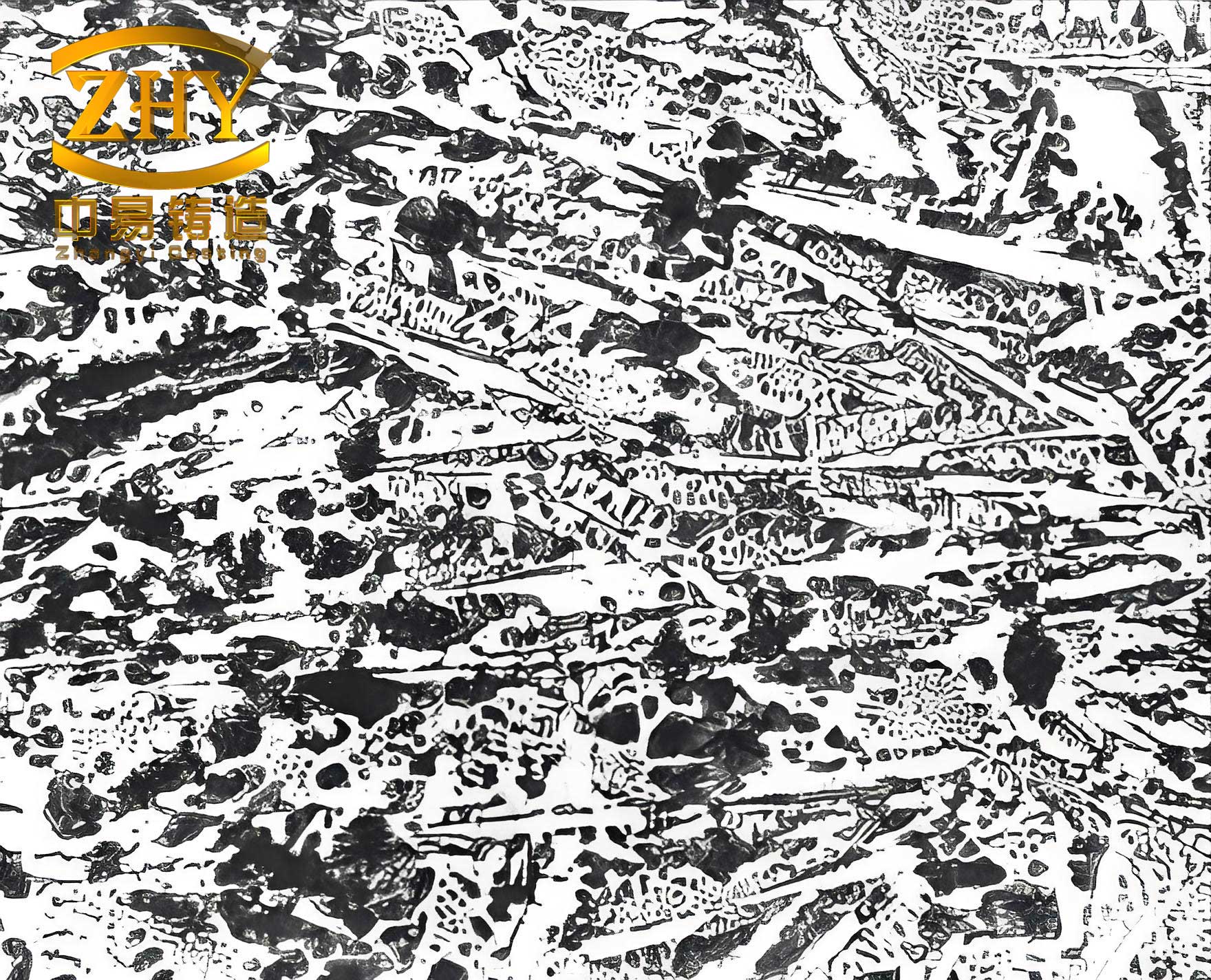
The as-cast microstructure of Fe-Cr-B white cast iron, as observed under SEM, consists of blocky eutectic borides embedded in a metallic matrix. The borides exhibit a morphology similar to the eutectic carbides in traditional high-chromium white cast iron, with an average area fraction of approximately 22.4% as measured using image analysis software. XRD patterns confirm the presence of boride phases, predominantly Fe2B-type compounds, alongside the ferritic or martensitic matrix. Notably, the matrix displays a distinct lath-like structure characteristic of martensite, as shown in the micrographs. EDS analysis of the matrix reveals peaks for elements such as C, Cr, Si, Mn, Ni, and V, indicating their solid solution in the matrix. However, the boron peak is barely detectable, suggesting that most boron is partitioned into the borides, with only trace amounts remaining in the matrix.
Hardness measurements of the as-cast material further support the microstructural observations. The macrohardness reaches 54.1 HRC, while microhardness tests show a matrix hardness of 378.3 HV and a boride hardness of 2164.0 HV. The relatively high matrix hardness, coupled with the martensitic morphology, indicates that the matrix transformed to martensite even under the relatively slow cooling conditions of investment casting. This initial finding hints at the exceptional hardenability of this white cast iron, as martensite formation typically requires faster cooling in many ferrous alloys. The data are summarized in Table 2.
| Property | Macrohardness (HRC) | Matrix Microhardness (HV) | Boride Microhardness (HV) |
|---|---|---|---|
| Value | 54.1 | 378.3 | 2164.0 |
The formation of martensite in the as-cast state is a key indicator of high hardenability. In white cast iron, the presence of hard phases can impede heat dissipation, but here, the alloy composition appears to stabilize austenite sufficiently to allow martensitic transformation upon cooling. This behavior is crucial for practical applications, as it suggests that Fe-Cr-B white cast iron might be used in as-cast conditions or with minimal heat treatment, reducing processing complexity.
End-Quench Hardenability Test
The end-quench test provides a standardized measure of hardenability by evaluating hardness variations along a quenched bar. For Fe-Cr-B white cast iron, two identical samples were austenitized at 950°C and subjected to water quenching at one end. The hardness profiles, plotted as a function of distance from the quenched end, are shown in Figure 1 (note: figures are referenced descriptively as per guidelines). Remarkably, the hardness remains consistently high across all distances, with no significant drop even at positions far from the quench end. Typically, materials with lower hardenability show a steep decline in hardness with distance due to decreased cooling rates. The flat hardness curve observed here underscores the superior hardenability of this white cast iron. This result aligns with the as-cast observations, explaining why martensite forms even under slow cooling: the material’s inherent ability to retain austenite and transform to martensite over a wide range of cooling rates.
To quantify this, the ideal critical diameter (DI), a common hardenability parameter, can be estimated. For a material with such a flat hardness curve, DI would be large, indicating deep hardening. The relationship between hardness and cooling rate can be expressed semi-empirically as:
$$ H = H_0 + k \log(\dot{T}) $$
where \( H \) is hardness, \( H_0 \) is a base hardness, \( k \) is a constant, and \( \dot{T} \) is the cooling rate. In this white cast iron, the minimal variation in hardness suggests that \( k \) is small, implying low sensitivity to cooling rate—a hallmark of high hardenability.
Continuous Cooling Transformation (CCT) Diagram
The CCT diagram, constructed from dilatometry data, offers a comprehensive view of phase transformations during cooling. For Fe-Cr-B white cast iron, the CCT diagram reveals a striking absence of pearlitic or bainitic transformation regions. Only martensitic transformation is observed, with start (Ms) and finish (Mf) temperatures marked. The diagram also includes the Ac1 and Ac3 temperatures, denoting the austenite transformation range. As shown in the diagram, martensite forms across all cooling rates tested, from as low as 0.05°C/s to as high as 200°C/s. This further confirms the exceptional hardenability, as even at cooling rates equivalent to furnace cooling (e.g., 0.05°C/s, akin to cooling in thick sections), the matrix avoids diffusion-controlled transformations and directly converts to martensite.
Microhardness of the matrix at different cooling rates was measured to correlate with the CCT data. The results, listed in Table 3, demonstrate an increase in hardness with cooling rate, consistent with the refinement of martensite and possible changes in residual austenite content. At 0.05°C/s, the matrix hardness is 403.4 HV, rising to 635.0 HV at 100°C/s. This trend aligns with typical martensitic hardening behavior, where faster cooling yields higher hardness due to finer structure and greater supersaturation.
| Cooling Rate (°C/s) | 0.05 | 0.1 | 0.2 | 0.5 | 2 | 5 | 10 | 20 | 50 | 100 |
|---|---|---|---|---|---|---|---|---|---|---|
| Microhardness (HV) | 403.4 | 432.8 | 463.9 | 537.6 | 593.8 | 603.8 | 615.9 | 626.4 | 635.0 | 635.0 |
Metallographic examination of samples cooled at 0.05°C/s and 100°C/s confirms the presence of lath martensite in both cases, albeit with finer laths at higher rates. The absence of other phases like ferrite or pearlite underscores the stability of austenite in this white cast iron, allowing martensitic transformation across a broad cooling spectrum. This behavior is highly advantageous for industrial processing, as it implies that components can be air-cooled after austenitization to achieve a fully martensitic matrix, mitigating distortion and cracking risks associated with rapid quenching.
Computational Analysis of Boron Distribution
Given the pivotal role of boron in hardenability, I used Thermo-Calc simulations to estimate its solubility in the matrix. The calculations, performed at temperatures of 900°C, 1000°C, and 1100°C, yield equilibrium boron contents in the matrix on the order of 1×10⁻⁵%, 6×10⁻⁵%, and 3×10⁻⁴%, respectively. These values, summarized in Table 4, indicate that boron dissolution in the matrix is extremely limited, consistent with EDS observations. At such low concentrations, boron is known to enhance hardenability in steels by segregating to austenite grain boundaries and inhibiting ferrite nucleation. In Fe-Cr-B white cast iron, this mechanism likely applies, explaining the high hardenability despite the bulk boron content being far above typical levels.
| Temperature (°C) | 900 | 1000 | 1100 |
|---|---|---|---|
| Boron Content (%) | 1×10⁻⁵ | 6×10⁻⁵ | 3×10⁻⁴ |
The effect of boron on hardenability can be modeled using an equation that accounts for its grain boundary segregation. The hardenability factor \( f_B \) due to boron can be expressed as:
$$ f_B = 1 + \alpha \cdot [B]_{eff} $$
where \( [B]_{eff} \) is the effective boron concentration at grain boundaries, and \( \alpha \) is a constant. For trace boron levels, \( f_B \) increases, boosting hardenability. In this white cast iron, the matrix boron content, though low, falls within this beneficial range. Conversely, excess boron in the matrix can form borides that act as nucleation sites for ferrite, reducing hardenability—but here, most boron is tied up in eutectic borides, preventing such detrimental effects.
Discussion
The exceptional hardenability of Fe-Cr-B white cast iron stems from a synergistic combination of alloying elements and microstructural features. The low carbon content (0.27 wt%) is crucial, as high carbon can stabilize austenite but also promote carbide formation that might impair toughness. In this white cast iron, carbon primarily influences the matrix, allowing for a lean alloy design that favors martensite formation. The addition of chromium (17.23 wt%) serves multiple purposes: it enhances hardenability by increasing austenite stability, contributes to corrosion resistance, and participates in boride formation, refining the eutectic structure. Silicon (1.07 wt%) and manganese (1.32 wt%) further boost hardenability by solid solution strengthening and delaying pearlitic transformation. Nickel (2.67 wt%) is particularly effective in stabilizing austenite and improving toughness, while vanadium (1.23 wt%) aids in grain refinement and secondary hardening.
Boron, at 1.66 wt%, is predominantly consumed in forming hard eutectic borides, which impart excellent wear resistance. However, the trace amount dissolved in the matrix plays a disproportionate role in hardenability. As calculations show, matrix boron is on the order of 10-4%, aligning with the optimal range for hardenability enhancement in low-carbon steels. Boron’s tendency to segregate to austenite grain boundaries during cooling can be described by the McLean equation for equilibrium segregation:
$$ \Gamma_B = \Gamma_{max} \frac{K [B]}{1 + K [B]} $$
where \( \Gamma_B \) is the grain boundary concentration of boron, \( \Gamma_{max} \) is the maximum coverage, \( K \) is the segregation coefficient, and \( [B] \) is the bulk concentration. Even at low \( [B] \), significant segregation occurs, impeding ferrite nucleation and extending the time-temperature window for martensite formation. This effect is amplified in white cast iron due to the alloy-rich matrix, resulting in the observed flat hardenability curve and martensitic transformation across cooling rates.
The practical implications are significant. For manufacturers, Fe-Cr-B white cast iron offers the possibility of air quenching after austenitization, simplifying heat treatment processes and reducing energy consumption. The material’s low thermal conductivity, a common challenge in white cast iron, becomes less of an issue when hardenability is high, as slower cooling can be employed without compromising martensite formation. This could expand the application scope of white cast iron to larger or more complex components where rapid quenching is impractical.
Compared to traditional white cast iron grades, such as high-chromium white cast iron, the Fe-Cr-B variant shows promise in balancing wear resistance and toughness. The borides, harder than carbides, provide superior abrasion resistance, while the martensitic matrix, achievable even in thick sections, offers better impact resistance. Future work could explore optimizing boron and other alloying elements to further enhance properties or reduce costs. For instance, varying chromium and boron ratios might adjust boride morphology and matrix composition, fine-tuning hardenability and wear performance.
Conclusion
In summary, my investigation into Fe-Cr-B white cast iron reveals that this material possesses outstanding hardenability, enabling martensite formation in the as-cast state and across a wide range of cooling rates. End-quench tests show minimal hardness variation with distance, indicating deep hardening, while CCT diagrams confirm the absence of non-martensitic transformations at cooling rates as low as 0.05°C/s. The key to this behavior lies in the alloy design: low carbon and a balanced combination of chromium, silicon, manganese, nickel, and vanadium enhance austenite stability, while boron, though added in high amounts, mostly forms eutectic borides, leaving only trace quantities in the matrix. Computational analysis estimates matrix boron content at the 10-4% level, within the range known to improve hardenability through grain boundary segregation. Thus, Fe-Cr-B white cast iron represents a significant advancement in wear-resistant materials, combining the hardness of borides with the toughness of a martensitic matrix achievable through simple air cooling. This makes it a compelling candidate for demanding applications in mining, construction, and other industries where abrasion resistance and manufacturability are paramount. Further research could delve into the long-term performance of this white cast iron under service conditions, but the foundational hardenability characteristics established here provide a solid basis for its engineering adoption.
The study of white cast iron continues to evolve, with Fe-Cr-B alloys offering a fresh perspective on how boron can be leveraged beyond traditional roles. By understanding and harnessing these hardenability mechanisms, we can develop next-generation white cast iron materials that meet the ever-increasing demands of industrial applications.