
In the production of engine exhaust system components, the manufacturing of thin-walled, complex geometry parts presents significant technical challenges. A prominent case involves a critical exhaust connecting pipe, or manifold, cast in silicon-molybdenum spheroidal graphite cast iron (Si-Mo SGI). The initial production campaign was plagued by a high scrap rate, primarily due to shrinkage porosity and sand inclusion defects, reaching a combined level of approximately 38%. Furthermore, the process yield was unacceptably low. This article details the systematic investigation and resolution of these issues from a first-person engineering perspective, focusing on a holistic approach integrating metallurgical control, process redesign, and sand system optimization.
The casting in question, designated as QTRSi4Mo1, is a structurally intricate component with a predominant wall thickness of only 4.5 mm. Its geometry features both large circular and square flanges connected by thin-walled passages. The specified material composition is critical for achieving high-temperature oxidation resistance and mechanical strength, as outlined in Table 1.
| C | Si | Mn | P | S | Mo | Mg |
|---|---|---|---|---|---|---|
| 2.7 – 3.5 | 4.0 – 4.5 | ≤0.3 | ≤0.05 | ≤0.015 | 1.0 – 1.5 | 0.01 – 0.05 |
The initial foundry practice employed a horizontally-parted green sand molding process. The gating and feeding system was designed based on conventional principles for spheroidal graphite cast iron. A semi-gating system with a ratio of $$ \sum F_{sprue} : \sum F_{runner} : \sum F_{ingate} = 1.15 : 1.1 : 1 $$ was used. To address the solidification shrinkage inherent to ductile irons, substantial feeding risers were applied. The circular flanges were fed from both sides, and the larger square flanges were fed via shared risers between adjacent castings in the mold, with one riser serving as the ingate and the opposite as an overflow. The riser necks were placed on the flange faces and were only 8 mm thick. Initial molding sand properties seemed adequate, as shown in Table 2.
| Green Compressive Strength (MPa) | Permeability | Moisture (%) | Compactability (%) | Bentonite Addition (%) | Coal Dust Addition (%) |
|---|---|---|---|---|---|
| 0.165 | 129 | 4.02 | 36 | 0.68 | 0.41 |
Melting was conducted in a medium-frequency induction furnace, with treatment performed in a transfer ladle using a sandwich method with a Mg6RE2 alloy. Despite adhering to the specified chemistry (Table 3) and standard procedures, the initial batch yield was disastrous.
| C | Si | Mn | P | S | Mo | Mgres | CE* |
|---|---|---|---|---|---|---|---|
| 3.32 | 4.15 | 0.13 | 0.038 | 0.012 | 1.15 | 0.040 | 4.70 |
*Carbon Equivalent (CE) = %C + 0.33(%Si) ≈ 4.70
Non-destructive testing (NDT) revealed significant shrinkage porosity in the heavy sections of the square flanges, near the riser necks. Furthermore, severe sand inclusions were found on the internal surfaces adjacent to the square flange, directly opposite the ingate riser neck. The process yield was calculated to be a mere 33.2%, burdened by the weight of 18 large risers per mold. The need for a comprehensive technical analysis was evident.
Root Cause Analysis of Defects
A detailed failure analysis was conducted, examining both the metallurgical and process design factors.
1. Shrinkage Porosity in Square Flanges: The primary cause was identified as premature freezing of the riser neck. Although the riser itself had a large modulus (approximately 1.19 cm) to provide adequate feed metal, the connecting neck had a very low modulus due to its thin (8mm) cross-section. The solidification time for a section can be approximated by Chvorinov’s rule:
$$ t = K \cdot \left( \frac{V}{A} \right)^2 = K \cdot M^2 $$
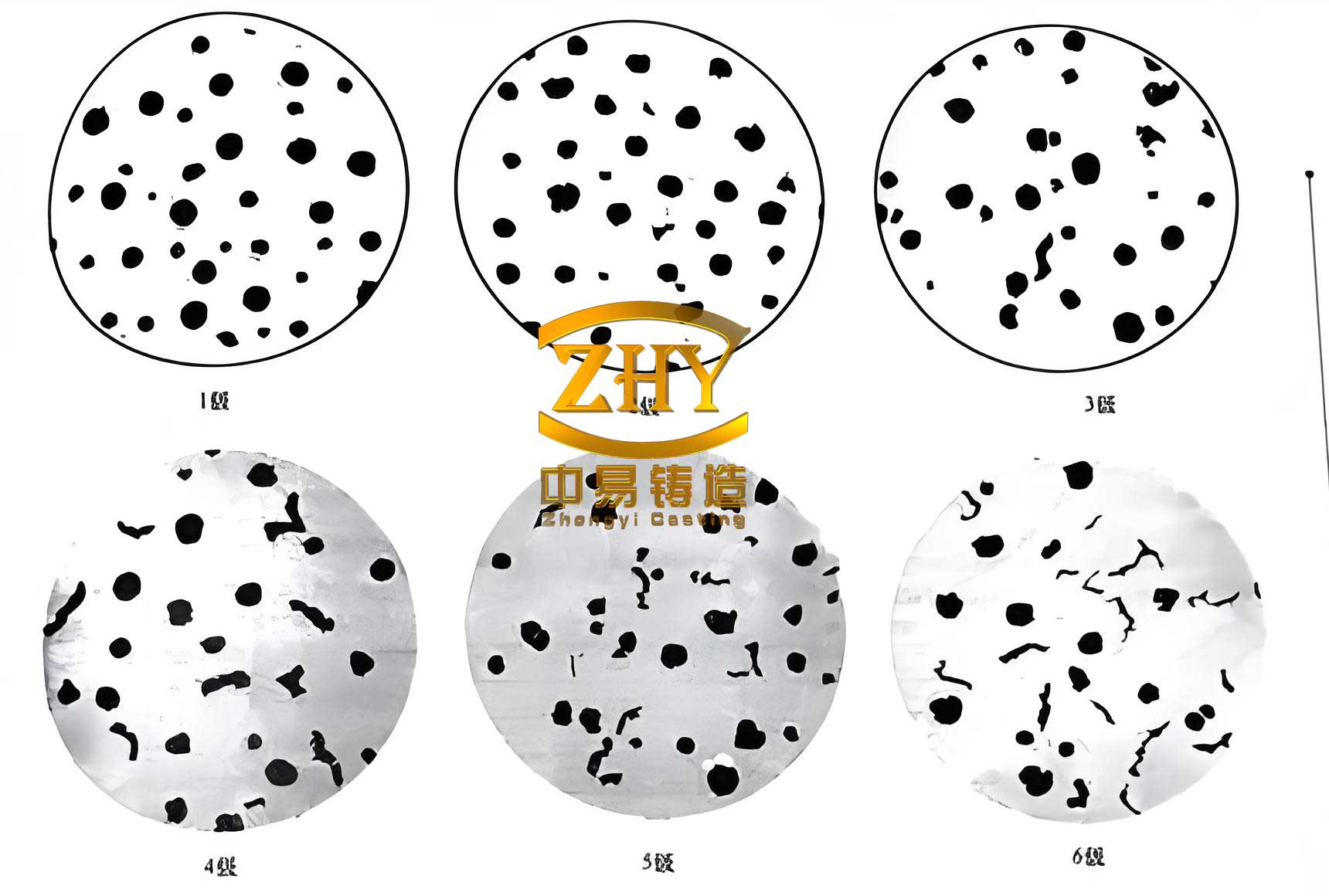
where \( t \) is solidification time, \( V \) is volume, \( A \) is surface area, \( M \) is the modulus (\(V/A\)), and \( K \) is a constant. The flange modulus was ~0.71 cm, while the neck modulus was significantly lower. This caused the feed path to freeze before the flange, isolating it from the liquid riser and leading to internal shrinkage. Additionally, the geometry trapped gases, creating combined shrink-gas porosity. The microstructure in these areas showed degenerated graphite and micro-shrinkage cavities, indicative of poor feeding.
2. Sand Inclusions in the Internal Cavity: This defect was a direct consequence of high metal velocity and erosion at the ingate. The thin riser neck acted as a restrictive choke. The velocity of the molten spheroidal graphite cast iron entering the mold cavity was excessively high, leading to impingement and erosion of the sand core forming the internal passage. The eroded sand was then entrapped in the solidifying metal, resulting in gross sand holes. The formula for metal velocity at the ingate is:
$$ v = \frac{Q}{A} $$
where \( v \) is velocity, \( Q \) is volumetric flow rate, and \( A \) is the total ingate cross-sectional area. With a fixed pouring time and a small \( A \), \( v \) becomes too high for the green sand strength to withstand.
3. Low Process Yield: This was a direct result of an overly conservative risering design. The use of large, multiple risers for every flange, while intended to ensure soundness, was economically inefficient. The total weight of risers was disproportionate to the casting weight.
Systematic Optimization Strategy
The solution required a multi-faceted approach, addressing material, process, and sand properties simultaneously.
1. Metallurgical Optimization and Melt Control:
The first step was to enhance the inherent “self-feeding” characteristics of the spheroidal graphite cast iron and ensure melt cleanliness.
- Charge Materials: The charge was standardized to clean, stamped steel scrap (avoiding baled scrap with impurities), high-purity pig iron, and a controlled amount of internal returns (<20%) to minimize defect inheritance.
- Chemical Composition: The carbon equivalent (CE) was targeted towards the upper specification limit to improve fluidity and graphitic expansion potential, which counteracts shrinkage. The residual magnesium level was critically controlled within a narrower, lower range (0.030-0.035%) to reduce shrinkage tendency while maintaining nodularity. A typical optimized composition is shown in Table 4.
- Pouring Practice: To minimize temperature drop and fade, the transfer ladle size was reduced from 1 ton to 0.5 tons. This drastically reduced the temperature difference between the first and last mold poured from a single ladle. Pouring time was strictly limited to under 6 minutes, with the last mold’s temperature maintained above 1410°C.
| C | Si | Mn | P | S | Mo | Mgres | CE |
|---|---|---|---|---|---|---|---|
| 3.35 – 3.40 | 4.20 – 4.25 | 0.13 – 0.15 | ≤0.038 | ≤0.013 | 1.15 – 1.18 | 0.030 – 0.034 | 4.72 – 4.75 |
2. Radical Process Redesign:
This was the most impactful change. The entire feeding philosophy was reconsidered.
- Riser Relocation for Square Flanges: The risers were moved from the face of the square flange to its side. This simple relocation allowed the riser neck thickness to be increased from 8 mm to 14 mm without affecting the casting’s final machined dimensions. The new neck modulus was significantly higher, ensuring it remained open to feed the flange hotspot longer. Furthermore, the number of feed points was increased, distributing the metal flow.
- Riser Size Reduction: With an improved feed path (thicker neck), the riser body size could be reduced. The modulus was recalculated. The new riser design had dimensions of Ø54 mm bottom x 148 mm height, compared to the original Ø61 mm x 193 mm.
- Optimization for Circular Flanges: Analysis showed the circular flange had a much smaller modulus (~0.4 cm). The original double-side risering was overkill. The new design employed a single, smaller top riser primarily for overflow and minor feeding, placed over the flange’s centerline where slight shrinkage might occur.
- Pattern Layout: The casting layout on the pattern plate was tightened, shortening flow lengths and improving yield. The total number of risers per mold was strategically managed.
The new gating/feeding system design principles can be summarized by the following modified relationships. The ingate area was increased to reduce velocity:
$$ \sum F_{ingate(new)} > \sum F_{ingate(old)} $$
$$ \therefore v_{new} = \frac{Q}{\sum F_{ingate(new)}} < v_{old} $$
The riser neck modulus was designed to be greater than the flange modulus to ensure directional solidification towards the riser:
$$ M_{neck} > M_{flange} $$
3. Enhanced Sand System Properties:
To combat sand erosion, the green sand’s resistance was improved. The bonding characteristics were enhanced by increasing bentonite and coal dust additions slightly and, crucially, by extending the mulling time to ensure optimal coating of sand grains. The results are shown in Table 5. The 15% increase in green compressive strength was vital for withstanding the hydraulic forces of the molten spheroidal graphite cast iron.
| Green Compressive Strength (MPa) | Permeability | Moisture (%) | Compactability (%) | Bentonite Addition (%) | Coal Dust Addition (%) | Mulling Time (s) |
|---|---|---|---|---|---|---|
| 0.190 | 127 | 4.06 | 35 | 0.70 | 0.43 | 110 |
Results and Validation
The combined optimizations were implemented and validated through successive production batches.
Defect Elimination: The results were dramatic. Sand inclusions on the internal surfaces were completely eliminated due to the lower metal velocity and stronger mold walls. Microstructural examination of the square flange areas previously prone to shrinkage now revealed sound, fully pearlitic matrix with well-dispersed, spherical graphite nodules and no signs of micro-porosity. NDT inspection confirmed the absence of shrinkage defects in the main body and flanges. Only minimal, acceptable levels of micro-porosity were occasionally detected in isolated hot spots like flange corners, well within the acceptance criteria of ASTM E446 Level II. The consolidated scrap rate for shrinkage and sand holes plummeted from 38% to below 2%.
Process Yield Improvement: The reduction in the number and size of risers directly translated to a higher yield. The total poured weight per mold decreased from 98.6 kg to 76.4 kg. The process yield was recalculated as follows:
$$ \text{Process Yield} = \frac{\text{Total Casting Weight}}{\text{Total Poured Weight}} \times 100\% $$
For the new process:
$$ \text{Process Yield}_{new} = \frac{(6 \, \text{pcs} \times 5.45 \, \text{kg})}{76.4 \, \text{kg}} \times 100\% \approx 42.8\% $$
This represented a significant increase of 9.6 percentage points from the initial 33.2%.
| Parameter | Initial Process | Optimized Process | Improvement |
|---|---|---|---|
| Shrinkage & Sand Hole Scrap Rate | ~38% | < 2% | > 36% reduction |
| Process Yield | 33.2% | 42.8% | +9.6 percentage points |
| Poured Weight per Mold | 98.6 kg | 76.4 kg | -22.2 kg (22.5% reduction) |
| Last Mold Pouring Temperature | >1400°C | >1410°C | More consistent thermal profile |
Conclusion and Foundry Principles
The successful resolution of the defects in this thin-walled Si-Mo spheroidal graphite cast iron exhaust manifold underscores several fundamental principles in foundry engineering:
1. Holistic System View: Isolated adjustments are often insufficient. A systemic approach covering metallurgy (chemistry, melting, pouring), process design (gating, risering), and tooling (sand properties) is essential for solving complex quality issues.
2. Intelligent Risering: For spheroidal graphite cast iron, the size and placement of risers must be precisely calculated based on modulus, not intuition. The feed path (riser neck) is as critical as the riser reservoir itself. Its modulus must be sufficient to remain open until the casting section has solidified. Relocating risers to non-machined areas can provide the design freedom needed to create effective feed paths.
3. The Critical Role of Carbon Equivalent and Residual Magnesium: Maximizing the carbon equivalent within specification improves fluidity and promotes graphitic expansion, reducing the feeding demand. Meticulous control of residual magnesium minimizes the shrinkage propensity inherent in ductile irons.
4. Thermal Management: Minimizing pouring temperature loss, especially for thin-section castings, is vital. Using smaller ladles and strict pouring time windows ensures consistent metal quality from the first to the last casting.
5. Sand Engineering: For green sand casting of intricate parts, the sand is not just a mold; it is a structural component. Optimizing its strength through precise additive control and mulling energy is a direct defense against erosion-related defects like sand inclusions.
This case study demonstrates that by applying these principles in a coordinated manner, it is possible to achieve near-elimination of major defects while simultaneously improving production efficiency and cost-effectiveness. The methodology provides a valuable framework for designing and optimizing casting processes for other complex, thin-walled components in spheroidal graphite cast iron and similar alloys.