
The production of high-integrity, large and medium-sized castings for critical applications demands precise control over the solidification process. For materials like spheroidal graphite cast iron, achieving soundness free from shrinkage defects presents unique challenges. While the graphitization expansion during solidification provides some degree of self-feeding, the characteristic mushy freezing mode and narrow feeding channels necessitate the use of effective risering systems. Riser covering agents play a pivotal role in this system, extending the liquid feeding time and improving feeding efficiency. This article details the development, performance evaluation through practical trials, and the introduction of a new metric for characterizing the efficacy of a novel, cost-effective, and environmentally conscious exothermic insulating covering agent designed specifically for risers of spheroidal graphite cast iron castings.
The fundamental requirement for a riser covering agent in spheroidal graphite cast iron foundry practice is to sustain the thermal state of the molten metal in the riser for a duration sufficient to compensate for the shrinkage occurring in the casting. Unlike steel, which exhibits a more directional columnar solidification, spheroidal graphite cast iron solidifies in a pasty manner. This, coupled with the potential for mold wall movement due to graphite expansion pressures, means that risers, even for medium and large castings, remain essential. While small spheroidal graphite cast iron castings may utilize blind risers, larger sections typically employ open risers topped with an exothermic insulating covering agent to maximize feeding efficiency.
Traditional covering agents often rely heavily on carbonaceous materials (like coal dust or coke) as fuels and fluorides (such as cryolite, Na3AlF6) as catalysts for the aluminothermic reaction and as fluxing agents. However, these components introduce significant drawbacks. High carbon content in the covering agent can lead to carbon pickup in the riser metal, complicating its recycling and remelting for subsequent heats by altering the final chemistry of castings. More critically, excessive fluoride residues have been documented to cause degeneracy of the graphite structure at the interface between the casting and the riser, leading to coarse or vermicular graphite formations and compromising the mechanical properties of the spheroidal graphite cast iron. The industry has thus been motivated to develop low-fluoride and low-carbon alternatives to address these quality, environmental, and operational concerns.
Driven by these needs, a new type of exothermic insulating covering agent was formulated. The design philosophy centered on achieving a balanced thermal performance—appropriate ignition temperature, rapid ignition, sustained heat release, and sufficient total calorific output—while minimizing undesirable elements. Key constituents include:
- Insulating Components: Cenospheres (a by-product from coal-fired power plants) and natural expanded perlite.
- Exothermic Components: Aluminum powder and low-cost industrial iron oxide (Fe2O3).
- Oxidizer: A nitrate-based mixture.
- Additives: Strictly controlled, minimal amounts of a fluoride mixture (acting as a reaction catalyst and flux) and carbonized rice hull (a processed agricultural by-product serving as a supplemental fuel and insulator).
The resulting composition for the spheroidal graphite cast iron grade features a fluoride content ≤1.0%, carbon content ≤5.5%, and a total exothermic value ≥170 J/g, positioning it as a low-fluoride, low-carbon solution.
A critical aspect of this work was the reevaluation of how riser feeding performance is quantified. The conventional Riser Feeding Efficiency (η) is defined as the ratio of the volume of metal fed into the casting (manifested as the sink volume at the riser top) to the total geometric volume of the riser:
$$ \eta = \frac{V_{feed}}{V_{riser}} \times 100\% $$
where \( V_{feed} \) is the sink volume and \( V_{riser} \) is the total riser volume. While this metric indicates the total volume of metal used for feeding, it fails to account for the shape of the shrinkage cavity. A riser with a deep, narrow sink may have the same \( V_{feed} \) as one with a shallow, wide sink, yet the latter leaves a larger “safety height” of sound metal above the casting, offering greater security against shrinkage penetration and allowing for potential riser size optimization.
To more accurately represent the practical feeding effectiveness, we propose the new metric of Relative Riser Feeding Efficiency (ηrelative). This is defined as the ratio of the sink volume \( V_{feed} \) to the geometric volume of the riser above the safety height \( V_{riser}^{upper} \). The safety height (H) is the distance from the riser top down to the highest point of the shrinkage cavity.
$$ \eta_{relative} = \frac{V_{feed}}{V_{riser}^{upper}} \times 100\% = \frac{V_{feed}}{V_{riser} – V_{riser}^{lower}} \times 100\% $$
Here, \( V_{riser}^{lower} \) is the volume of the sound metal section below the safety height. This metric \( \eta_{relative} \) simultaneously considers both the total fed volume and the profile of the shrinkage, providing a more comprehensive and practically relevant measure of a covering agent’s performance. The testing methodology involved applying equal masses of different covering agents to identical risers on the same casting, allowing for direct comparison of safety height, sink profile, and the calculated relative feeding efficiency post-solidification.
Performance Evaluation in Practical Foundry Trials
The novel covering agent for spheroidal graphite cast iron was evaluated against products from two renowned international and domestic suppliers through side-by-side trials on production castings.
Trial 1: Rail Casting (QT400-15)
The casting weighed approximately 980 kg. Two identical elliptical open risers (230 mm x 330 mm x 400 mm high) with insulating sleeves were used. One was treated with the new agent, the other with a domestic competitor’s product. Observations noted that the new agent ignited more rapidly, expanded well, and spread evenly, forming a loose, level cover that descended smoothly with the metal level.
| Parameter | Novel Covering Agent | Domestic Competitor Agent |
|---|---|---|
| Total Riser Height (mm) | 270 | 270 |
| Safety Height, H (mm) | 160 | 175 |
| Maximum Sink Depth (mm) | 110 | 95 |
| Sink Volume, \( V_{feed} \) (dm³) | 3.55 | 2.96 |
| Upper Riser Volume, \( V_{riser}^{upper} \) (dm³) | 7.10 | 6.13 |
| Traditional Efficiency, \( \eta \) (%) | 20.4 | 17.0 |
| Relative Efficiency, \( \eta_{relative} \) (%) | 50.0 | 48.3 |
The new agent demonstrated a higher traditional feeding efficiency. The new relative efficiency metric shows a closer but still superior performance for the new agent, aligning with the observed better spread and thermal control.
Trial 2: Pad Iron Casting (QT500-7)
This 730 kg casting featured multiple risers. A comparison between the new agent and an international supplier’s product was conducted. The riser with the international product exhibited an irregularly shaped sink with a subsurface shrinkage, complicating volume measurement. The riser with the new agent showed a larger, flatter-bottomed sink with a safety height of 55 mm versus 45 mm for the competitor (excluding subsurface shrinkage), indicating a clearly higher relative feeding efficiency for the new spheroidal graphite cast iron covering agent.
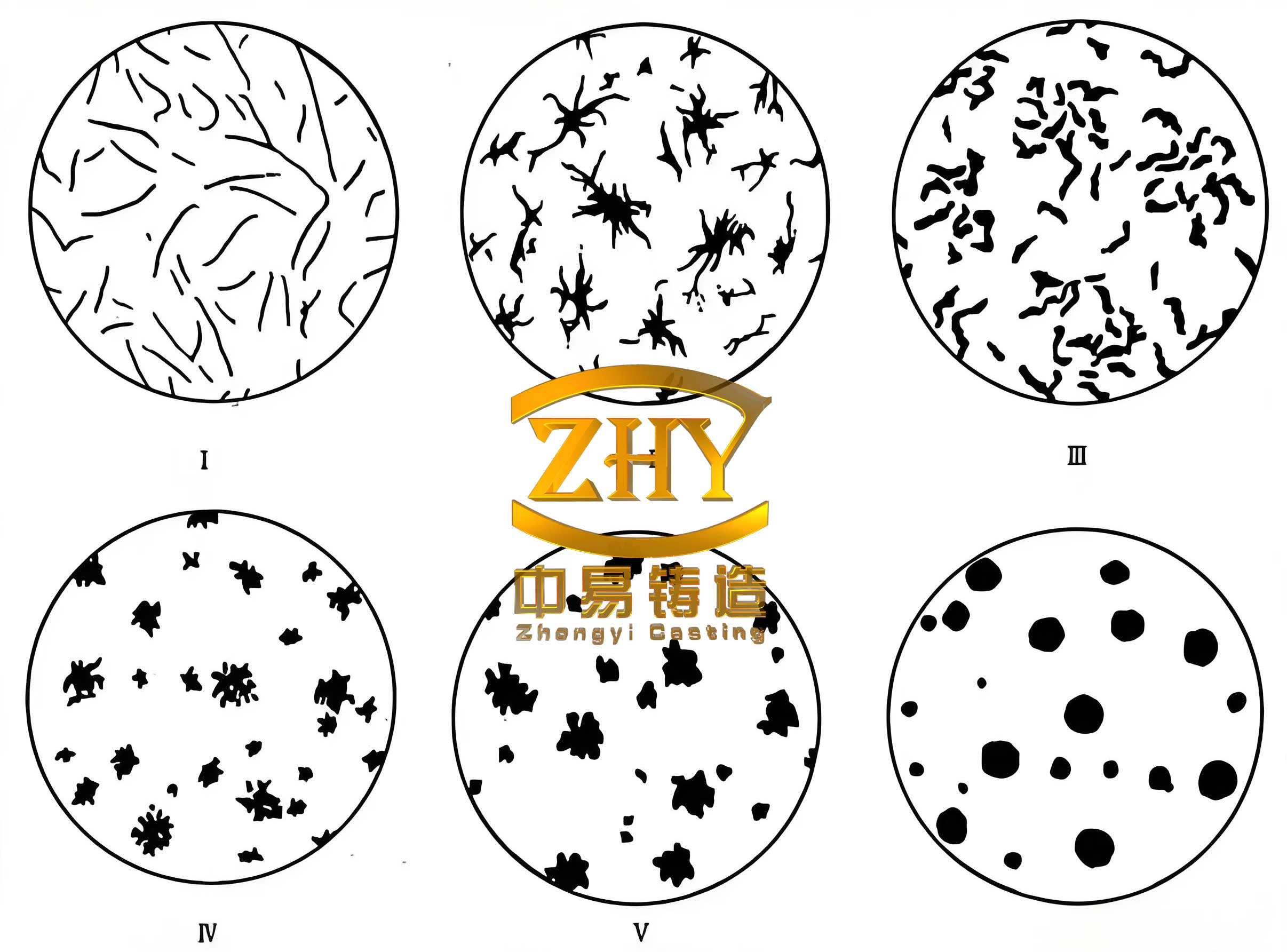
Metallographic examination of the riser neck areas was critical to assess the impact of the low fluoride content. For both covering agents, the graphite morphology was primarily nodular and spheroidal, with spheroidization grades of 80-90% (Grade 3) and graphite size of Grade 6. No coarse graphite or degeneration was found at the interface, confirming that the sub-1% fluoride level in the new agent is sufficiently low to preserve the integrity of the spheroidal graphite cast iron matrix.
Trial 3: Pump Cover Casting (QT600-3)
In this trial on a ~1 tonne casting, the new agent ignited and reached peak combustion about one minute earlier than the international competitor’s product, a significant advantage for the faster-cooling risers of spheroidal graphite cast iron. Post-combustion, the insulating layer from the new agent was thicker and more closed, with only a small central area glowing, whereas the competitor’s layer was thinner and revealed more glowing surface area, indicating inferior insulation.
The profile comparison was stark: the new agent produced a sink with a flat bottom and a safety height of 82 mm. The competitor’s product resulted in an irregular sink profile with a safety height of only 58 mm. This visual and measurable difference underscores the superior thermal management and higher relative feeding efficiency provided by the novel covering agent.
Thermal Analysis and Discussion
The performance superiority of the new covering agent stems from its meticulously balanced formulation. The use of both aluminothermic (Al-Fe2O3) and slower, carbon-based oxidation reactions ensures a heat release profile that is both intense and sustained. The increased Fe2O3 content aids both the exothermic reaction and the formation of a molten slag layer, improving insulation. The minimal fluoride content eliminates graphite degeneration risks in spheroidal graphite cast iron.
Differential Scanning Calorimetry (DSC) provides scientific validation. The DSC curve for the new agent shows three distinct, well-separated exothermic peaks over a broad temperature range from 245°C to 1100°C. In contrast, a competitor’s product showed less pronounced peaks concentrated in a narrower, higher temperature range.
| Exothermic Stage | Temperature Range (°C) | Peak Heat Flow (W/g) | Peak Temp. (°C) | Enthalpy (J/g) |
|---|---|---|---|---|
| Initial | 245 – 385 | 0.14 | 280 | 21.57 |
| Middle | 385 – 545 | 0.13 | 475 | 25.77 |
| Final | 545 – 1100 | 0.11 | 690 | 122.72 |
| Total Exothermic Enthalpy | 170.06 | |||
This distributed heat release profile is ideal for spheroidal graphite cast iron risers, providing early heat to delay solidification onset and sustained heat to maintain feeding capability into the later stages. The total exothermic enthalpy of over 170 J/g for the new agent was also measurably higher than that of the compared domestic product, directly correlating to its observed higher feeding efficiency.
The introduction and validation of the Relative Riser Feeding Efficiency (ηrelative) represent a significant methodological advancement. By incorporating the critical factor of safety height (H) into the efficiency calculation, it offers foundry engineers a more realistic and safety-conscious metric for comparing covering agents and optimizing riser designs for spheroidal graphite cast iron and other alloys. It shifts the focus from merely “how much metal was fed” to “how effectively and safely was the metal fed.”
Conclusion
The development and comprehensive testing of this novel exothermic insulating covering agent address several key challenges in the production of high-quality large and medium-sized spheroidal graphite cast iron castings. By utilizing industrial by-products and natural minerals in an optimized formulation, the agent achieves an excellent balance of rapid ignition, sustained and distributed heat release, and high total calorific output, leading to a relative feeding efficiency exceeding 50% in trials. Its strictly controlled low-fluoride and low-carbon composition prevents graphite degeneration in the critical riser contact zone and facilitates the recycling of riser metal, contributing to both quality assurance and sustainable foundry practice. The agent demonstrated superior performance compared to leading commercial alternatives in direct production trials. Furthermore, the proposed Relative Riser Feeding Efficiency metric provides a more accurate and practically useful tool for evaluating riser performance, considering both the volume and morphology of the shrinkage cavity. This work contributes to the advancement of feeding technology for spheroidal graphite cast iron, supporting the manufacture of more reliable and cost-effective cast components for demanding applications.