
In the production of complex, high-integrity castings for critical applications such as power systems in high-speed rail traction locomotives, the occurrence of shrinkage porosity presents a significant technical and economic challenge. My experience in addressing a persistent shrinkage defect in a special alloy gray iron diesel engine frame has underscored the necessity of a holistic approach, combining advanced simulation, disciplined process control, and a deep understanding of metallurgical principles. This article details the investigative journey and the methodologies employed to resolve this issue, with a focus on techniques broadly applicable to demanding castings, including those made from spheroidal graphite cast iron.
The subject casting, a structural frame, is characterized by its intricate geometry and severe variation in wall thickness, ranging from 15 mm to 120 mm. The material specification demanded a pearlitic gray iron with mechanical properties between GG30 and GG35, achieved through specific alloying additions exceeding those of conventional gray irons. The key requirements are summarized below:
| Element | Target Range (wt.%) |
|---|---|
| C | 3.05 – 3.30 |
| Si | 1.55 – 2.10 |
| Mn | 0.65 – 1.10 |
| P | ≤ 0.09 |
| S | 0.03 – 0.10 |
| Cr | ≤ 0.20 |
| Mo | 0.40 – 0.60 |
| Cu | 0.40 – 0.60 |
| Ni | ≤ 0.60 |
| CE | 3.60 – 3.90 |
The performance criteria were stringent: tensile strength exceeding 258 MPa on critical thick sections, hardness between 170-269 HBW, and a microstructure comprising predominantly Type A graphite (≥90%) with a fineness rating of 4 or finer, and carbides limited to less than 2%. The most critical quality requirement was the complete absence of defects on all machined surfaces and in key areas after processing. The combination of complex geometry, heavy sections, and specific alloy content created a pronounced susceptibility to shrinkage porosity, a problem distinct from but analogous to issues sometimes faced in heavy-section spheroidal graphite cast iron castings.
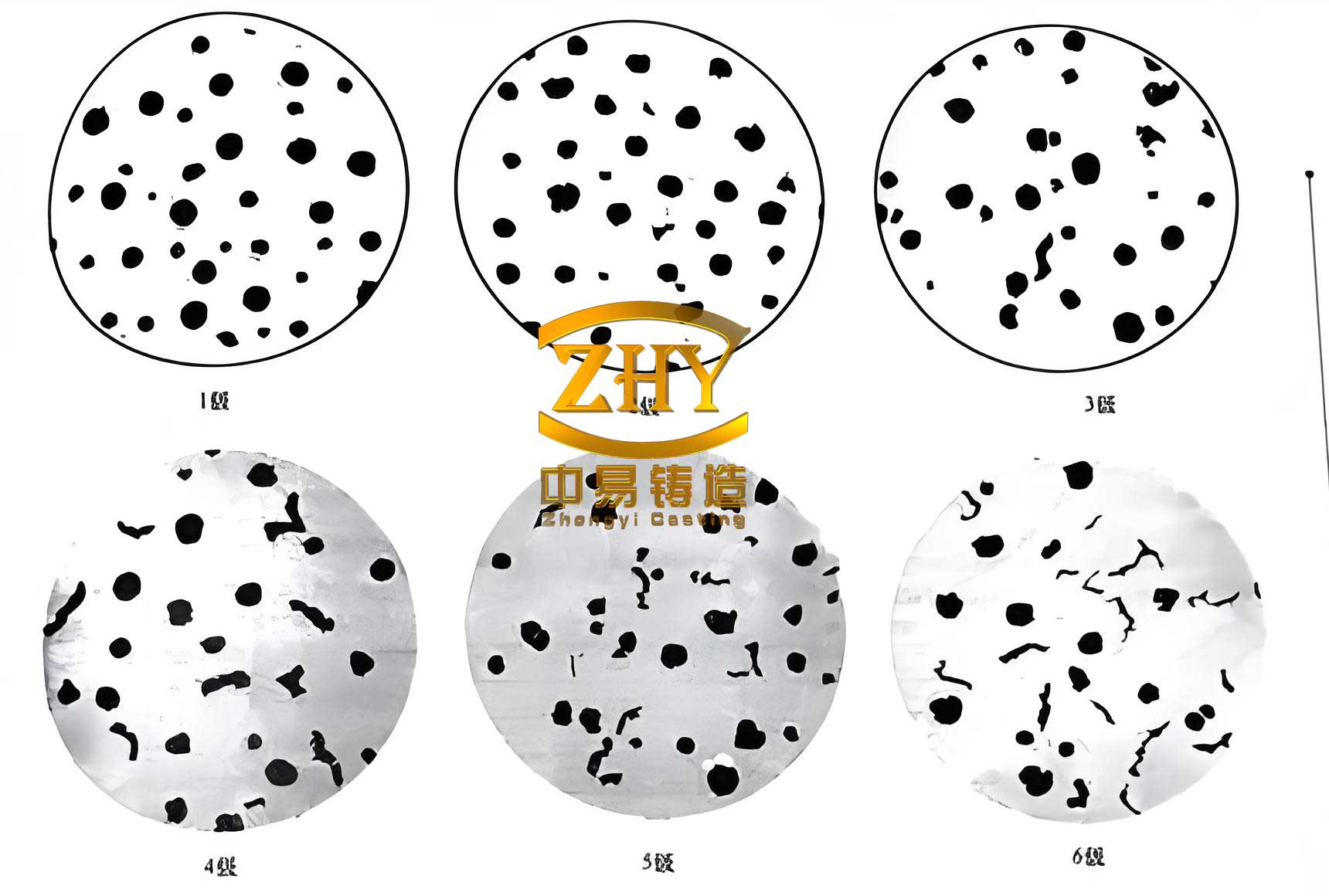
The defect manifested consistently in machined triple-bore features, specifically at certain angular positions (like 4 and 7 o’clock relative to the bore). Initial assessment through visual inspection of machined parts suggested an internal flaw. To conclusively identify the defect type, a controlled destructive analysis was performed on a casting stopped at the rough-machining stage. Penetrant testing (PT) revealed sub-surface indications, and subsequent macro-examination confirmed irregular, jagged cavities. Microstructural analysis at 100x magnification showed these cavities to be dendritic and tortuous, with ragged edges, confirming them as shrinkage porosity, not gas-related voids. This morphology results from the inability to feed liquid metal contraction during the final stages of solidification in an isolated thermal center.
The root cause analysis pointed to two interconnected domains: the casting’s thermal geometry and the stability of key process parameters. The original gating design positioned an ingate near the problematic bore, creating a significant hot spot. In a region already burdened by intersecting thick and thin sections, this exacerbated the temperature gradient, preventing directional solidification. The governing thermal dynamics can be conceptually described by the Chvorinov’s rule for solidification time, but the local thermal gradient is critical for feeding:
$$ t = B \left( \frac{V}{A} \right)^n $$
Where \( t \) is solidification time, \( V \) is volume, \( A \) is surface area, and \( B \) and \( n \) are constants. A high \( V/A \) ratio in the bore region, combined with proximity to a hot ingate, led to a prolonged \( t \), making it the last region to solidify. The feeding path was thus cut off early, leading to micro-shrinkage.
| Defect Feature | Observation | Interpretation |
|---|---|---|
| Location | Consistent in thick sections near bore | Indicates a persistent thermal hot spot. |
| Macro Morphology | Irregular, interconnected cavities | Characteristic of spongy shrinkage porosity. |
| Micro Morphology | Dendritic, jagged boundaries | Confirms solidification shrinkage, not gas. |
| Relation to Gating | Adjacent to original ingate location | Direct link to thermal input and poor gradient. |
The second contributing factor was process variability. While historical data for parameters like pouring temperature, Si, Cu, and Cr content were within specification limits, their statistical behavior over time showed unacceptable instability. This variability, even within specs, altered the solidification characteristics—affecting graphite expansion phases, cooling curve plateaus, and the feeding demand—from batch to batch, increasing the statistical probability of defect formation in the already critical area. This is a common challenge in alloyed irons, where small changes in composition can significantly impact the solidification range and shrinkage behavior, a principle equally important in the production of spheroidal graphite cast iron.
The corrective strategy was twofold, targeting both the thermal/geometric and the process/metallurgical causes.
1. Thermal Field Optimization via Simulation: A MAGMAsoft simulation was employed to visualize the solidification sequence. The original gating (Scheme A) clearly showed a large, isolated hot spot at the defect-prone bore. The simulation allowed for virtual redesign. The improved scheme (Scheme B) involved relocating the ingates to create a more favorable temperature gradient and implementing strategic chill placements in the thick sections around the bores. The chills acted as high-heat-capacity inserts, dramatically increasing the local cooling rate, effectively reducing the modulus \( (V/A) \) of the hot spot. The objective was to enforce a more progressive, directional solidification pattern toward a designed feed path (e.g., risers). The thermal effect of a chill can be approximated by considering the increased heat extraction rate, modifying the local solidification time equation. The goal was to minimize the temperature difference between the hot spot and the feeding source until the end of solidification, satisfying the condition for adequate feeding.
2. Implementation of Statistical Process Control (SPC): To combat process instability, Xbar-R (Mean-Range) control charts were implemented for the identified critical parameters: pouring temperature, Si, Cu, and Cr content. Unlike simple specification limits, control charts establish statistical control limits (Upper Control Limit, UCL, and Lower Control Limit, LCL) based on process capability.
$$ UCL_{\bar{X}} = \bar{\bar{X}} + A_2 \bar{R} $$
$$ LCL_{\bar{X}} = \bar{\bar{X}} – A_2 \bar{R} $$
$$ UCL_{R} = D_4 \bar{R} $$
$$ LCL_{R} = D_3 \bar{R} $$
where \( \bar{\bar{X}} \) is the grand mean, \( \bar{R} \) is the average range, and \( A_2, D_3, D_4 \) are constants based on subgroup size. This methodology revealed trends and shifts not apparent from mere specification checks. For instance, while Si content was always between 1.55% and 2.10%, the Xbar chart showed a distinct upward mean shift over one production period, increasing the shrinkage tendency. Corrective actions, such as adjusting charge make-up and inoculation practice, were taken to bring the process back to a stable, capable state centered on an optimal target value. This proactive monitoring is indispensable for consistent quality in complex castings, whether in alloyed gray iron or spheroidal graphite cast iron.
| Key Parameter | Original State (Unstable) | Post-SPC Implementation (Stable) | Impact on Shrinkage |
|---|---|---|---|
| Pouring Temp. (°C) | High variability, occasional spikes near upper spec. | Tight distribution around optimal target (~1380°C). | Lower superheat reduces total liquid contraction and thermal gradient. |
| Si Content (wt.%) | Mean shift observed; higher average within spec. | Mean controlled to ~1.98%, reduced variation. | |
| Cu Content (wt.%) | Fluctuating within the 0.40-0.60% range. | Stable at ~0.535%, minimal subgroup range. | Stable Cu ensures consistent pearlite promotion without adverse effects on solidification mode. |
| Cr Content (wt.%) | Unstable, occasionally approaching the 0.20% max. | Tightly controlled to a lower mean ~0.117%. | Reduced Cr minimizes carbide stability risk, favoring graphite formation and better feeding. |
The combined effect of these measures was validated through the destructive PT testing of subsequently produced castings. The previously defective bore areas now showed no indications, confirming the elimination of the shrinkage porosity. This success was maintained in subsequent production batches, demonstrating the robustness of the solution.
This case study highlights several critical principles for preventing shrinkage defects in high-performance castings. First, a proactive use of solidification simulation in the design phase is non-negotiable for identifying and mitigating thermal risks related to geometry and gating. It is a powerful tool for visualizing hot spots that might not be intuitively obvious. Second, maintaining process stability is as important as meeting specification limits. SPC is not merely a quality record-keeping exercise but a live diagnostic tool that signals process drift before it manifests as scrap. Instability in factors like pouring temperature and key alloying elements (Si, Cu, Cr) directly modulates the solidification dynamics, affecting both the shrinkage volume and the ability of the casting system to compensate for it. Finally, the methodologies described—simulation-led thermal management and statistical process control—are universally applicable. They are fundamental to the reliable production of any complex, quality-sensitive casting, from the special alloy gray iron discussed here to high-strength ductile iron components like spheroidal graphite cast iron drive housings or crankshafts. Embedding these practices from the outset of a production program is the most effective strategy for minimizing quality control costs and preventing significant economic losses from batch-related defects.