
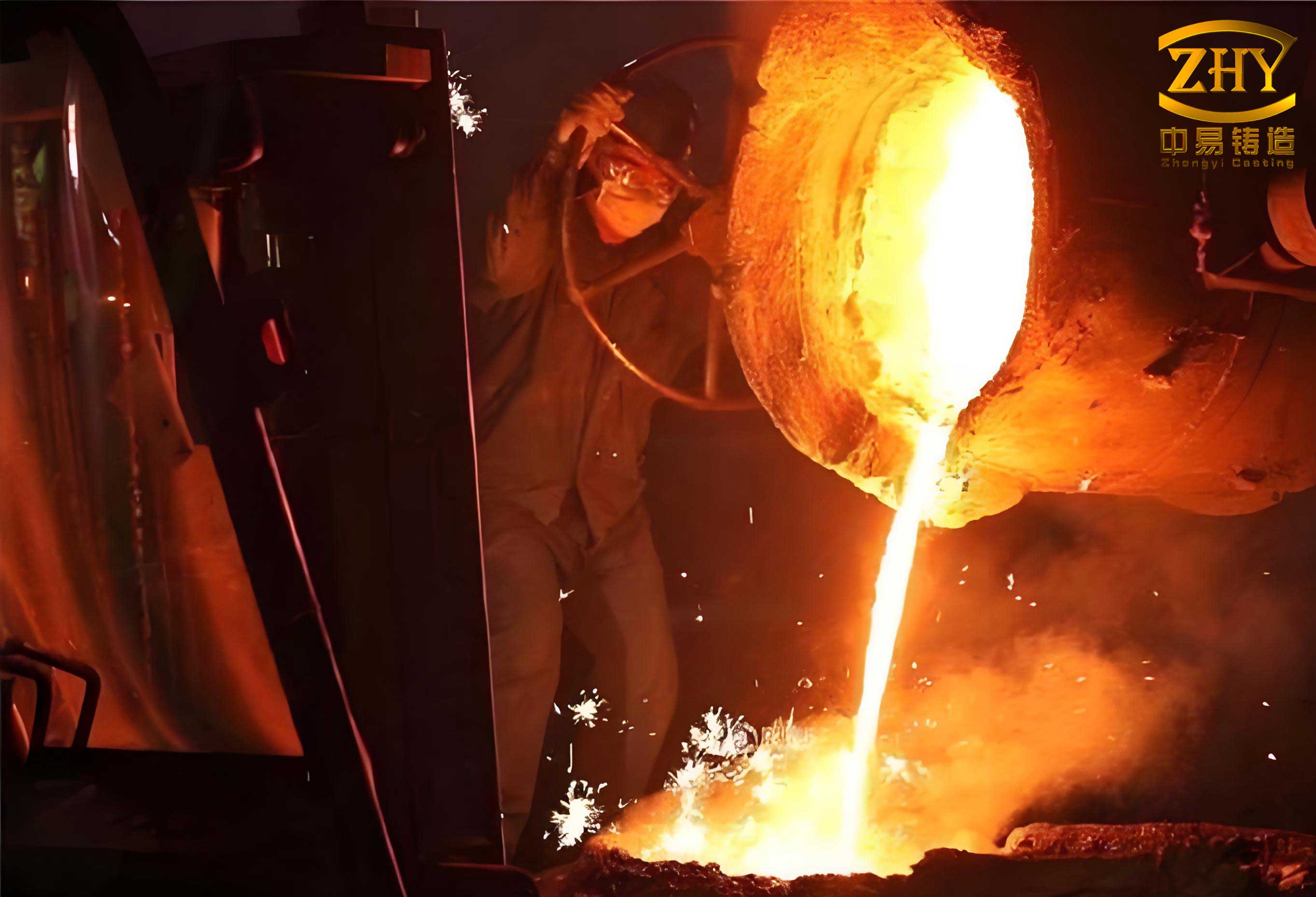
In this study, we systematically investigated the influence of different casting methods on the as-cast microstructure of ZL205A aluminum alloy produced in a sand casting foundry. The alloy, which contains copper as a primary alloying element along with manganese, titanium, cadmium, zirconium, vanadium, and boron, is widely used in applications requiring high strength and good castability. Our objective was to compare the microstructural characteristics obtained through low-pressure sand casting foundry, gravity sand casting foundry, and permanent mold gravity casting, with a focus on grain refinement, porosity distribution, and secondary phase precipitation. The experiments were designed to replicate industrial conditions in a typical sand casting foundry, using water-glass bonded sand molds. Through careful control of melting, refining, and pouring parameters, we obtained samples that allowed a direct comparison of the effects of solidification pressure and cooling rate on the resulting microstructure.
We began by preparing the ZL205A alloy with the nominal composition shown in Table 1. The raw materials included ZL205A ingots, Al-Cu, Al-Mn, and Al-Ti-B master alloys, C₂Cl₆ refining agent, titanium dioxide, high-purity aluminum foil, and WK546 coating. The sand molds were made from sodium silicate–bonded silica sand, which is typical in many sand casting foundry operations. Melting was carried out in an electric resistance furnace, and the melt was heated to 740–760°C before adding the Al-Ti-B grain refiner. After stirring for 8–10 min, we took samples for chemical analysis. When the composition met specifications, we cooled the melt to 700–740°C and added the refining agent using a bell jar, plunging it to a depth of 50–100 mm from the bottom of the crucible. The refining lasted 8–10 min, after which the melt was held for 10–15 min, skimmed, and poured.
| Cu | Mn | Ti | Cd | Zr | V | B | Al |
|---|---|---|---|---|---|---|---|
| 4.6–5.3 | 0.3–0.5 | 0.15–0.35 | 0.15–0.25 | 0.05–0.20 | 0.05–0.30 | 0.05–0.06 | Balance |
The low-pressure casting parameters used in our sand casting foundry were as follows: lift speed 40 mm/s, lift pressure 12 kPa, filling speed 50 mm/s, filling pressure 40 kPa, shell solidification time 2 s, shell pressurization rate 1 kPa/s (with a pressure increment of 10 kPa), crystallization pressurization rate 1 kPa/s (increment 10 kPa), and crystallization time 280 s. For comparison, we also produced castings using gravity pouring into the same sand mold and into a permanent steel mold. All castings were sectioned for metallographic examination and X‑ray diffraction analysis.
Our first observations focused on the as-cast microstructure of the low-pressure sand casting foundry samples. Figure 2 (not shown here, but we will describe) revealed a dendritic α‑Al matrix with grain sizes ranging from 50 to 120 μm. The grain boundaries contained a eutectic mixture of α‑Al, θ‑Al₂Cu, T‑Al₁₂CuMn₂, and Cd‑bearing phases. The addition of Ti, V, Zr, and B promoted the formation of Al₇V, Al₃Zr, Al₃Ti, and TiB₂ particles, which act as heterogeneous nucleation sites for α‑Al. This refinement effect is particularly beneficial in a sand casting foundry environment where cooling rates are relatively low. X‑ray diffraction confirmed the presence of α‑Al, θ‑Al₂Cu, and Al₇Mn phases, as expected from the alloy composition.
We then compared the microstructures obtained by the three casting methods. Table 2 summarizes the average grain size and secondary dendrite arm spacing (SDAS) for each condition. It is clear that the permanent mold casting, with its highest cooling rate, produced the finest grains. However, within the sand casting foundry category, low-pressure casting resulted in significantly finer grains than gravity sand casting foundry. This demonstrates that pressure application during solidification enhances nucleation and restricts grain growth.
| Casting method | Average grain size (μm) | SDAS (μm) |
|---|---|---|
| Low‑pressure sand casting foundry | 50–120 | 15–25 |
| Gravity sand casting foundry | 80–180 | 20–35 |
| Permanent mold gravity casting | 30–70 | 8–15 |
To understand the role of pressure, we consider the classical nucleation theory. The critical nucleation radius \( r^* \) is given by:
$$ r^* = \frac{2\sigma_{sl} T_m}{\Delta H_f \Delta T} $$
where \( \sigma_{sl} \) is the solid-liquid interfacial energy, \( T_m \) the melting temperature, \( \Delta H_f \) the latent heat of fusion, and \( \Delta T \) the undercooling. Under pressure, the melting point of the alloy changes according to the Clausius–Clapeyron relation:
$$ \frac{dT_m}{dP} = \frac{T_m \Delta V}{\Delta H_f} $$
For aluminum alloys, \( \Delta V \) is negative (solid is denser than liquid), so pressure increases the melting point. This raises the effective undercooling \( \Delta T = T_m(P) – T \), thereby reducing the critical nucleus size and promoting a higher nucleation rate. The nucleation rate \( I \) can be expressed as:
$$ I = I_0 \exp\left(-\frac{\Delta G^*}{kT}\right) \exp\left(-\frac{Q}{kT}\right) $$
where \( \Delta G^* \) is the activation energy for nucleation, which decreases with increasing undercooling. In low-pressure casting in a sand casting foundry, the applied pressure of about 40 kPa is modest, but it is sufficient to alter the solidification behavior significantly compared to gravity casting. Additionally, pressure improves the feeding of liquid metal into interdendritic regions, reducing microporosity. We quantified the porosity using density measurements, as shown in Table 3.
| Casting method | Density (g/cm³) | Estimated porosity (%) |
|---|---|---|
| Low‑pressure sand casting foundry | 2.8120 | < 0.5 |
| Gravity sand casting foundry | 2.7830 | ~1.0 |
| Permanent mold gravity casting | 2.7920 | ~0.8 |
The higher density and lower porosity in low-pressure sand casting foundry samples directly correlate with the reduced microshrinkage observed in metallographic sections. Under pressure, the mushy zone is compressed, and liquid metal is forced into cavities that would otherwise remain unfilled. This is particularly important in a sand casting foundry where the mold is relatively compliant, and atmospheric pressure alone may not provide sufficient feeding.
Another critical aspect is the morphology and distribution of the θ‑Al₂Cu phase. In gravity sand casting foundry samples, we observed coarse, plate‑like θ precipitates within the α‑Al grains, especially in thicker sections where cooling rates were slower. This is shown schematically in the following solidification path. For a binary Al‑Cu alloy, the Scheil equation can describe the solute redistribution:
$$ C_s = k C_0 (1 – f_s)^{k-1} $$
where \( C_s \) is the composition of solid, \( k \) the partition coefficient, \( C_0 \) the initial composition, and \( f_s \) the fraction solid. For Cu in Al, \( k < 1 \), so the liquid becomes enriched in Cu as solidification proceeds. In a slow‑cooling sand casting foundry, the last‑to‑solidify regions contain high Cu concentration, leading to precipitation of θ‑Al₂Cu from supersaturated α‑Al upon further cooling. In contrast, low‑pressure casting and permanent mold casting, with higher cooling rates, suppress this precipitation, resulting in a more homogeneous distribution of θ‑phase at grain boundaries rather than inside the grains. The Hall‑Petch relationship also applies to the α‑Al grain size:
$$ \sigma_y = \sigma_0 + \frac{k_y}{\sqrt{d}} $$
where \( \sigma_y \) is the yield strength, \( \sigma_0 \) the friction stress, \( k_y \) a constant, and \( d \) the grain diameter. Finer grains from low‑pressure sand casting foundry therefore contribute to higher strength. Table 4 presents the as‑cast mechanical properties measured in our experiments.
| Casting method | Tensile strength (MPa) | Elongation (%) |
|---|---|---|
| Low‑pressure sand casting foundry | 219.4 ± 5 | 6.77 ± 0.5 |
| Gravity sand casting foundry | 212.5 ± 5 | 6.17 ± 0.5 |
| Permanent mold gravity casting | 205.3 ± 5 | 5.68 ± 0.5 |
The improved strength and elongation in low‑pressure sand casting foundry samples are attributed to a combination of grain refinement, reduced porosity, and finer θ‑Al₂Cu distribution. The permanent mold castings, despite having the finest grains, show slightly lower strength, likely due to a higher tendency for non‑equilibrium eutectic formation and the presence of coarse primary T‑Al₁₂CuMn₂ particles that form at high cooling rates. In the sand casting foundry environment, the slower cooling of gravity castings allows extensive θ‑Al₂Cu precipitation, which acts as a dispersion strengthener but also reduces ductility. The pressure in low‑pressure casting helps to suppress this precipitation by accelerating solidification and limiting the time for diffusion.
We also examined the effect of local cooling rate within the same low‑pressure sand casting foundry casting by placing chills in certain regions. Regions near chills exhibited even finer grains (30–70 μm) and fewer θ‑Al₂Cu precipitates compared to unchilled areas (50–120 μm). This confirms that the alloy is highly sensitive to chilling, and that local variations in cooling rate can be exploited in a sand casting foundry to tailor microstructures. The heat transfer during solidification in sand molds can be modeled using Newton’s law of cooling:
$$ q = h A (T – T_\infty) $$
where \( q \) is the heat flux, \( h \) the heat transfer coefficient, \( A \) the area, \( T \) the casting temperature, and \( T_\infty \) the mold temperature. The effective cooling rate \( \dot{T} \) is proportional to \( q / (\rho C_p V) \). In a sand casting foundry, the thermal conductivity of the mold is low, leading to slow cooling rates; chills increase local \( h \) and accelerate cooling.
From a thermodynamics perspective, the formation of θ‑Al₂Cu can be described by the solubility limit. At the eutectic temperature (548°C), the maximum solubility of Cu in α‑Al is about 5.65%. In ZL205A, with 4.6–5.3% Cu, the alloy is hypoeutectic but near the eutectic composition. During slow cooling in gravity sand casting foundry, the solid remains supersaturated, and upon further cooling below the solvus, θ‑Al₂Cu precipitates. The driving force for precipitation is given by the change in Gibbs free energy:
$$ \Delta G = -RT \ln \left( \frac{C_0}{C_{eq}} \right) $$
where \( C_{eq} \) is the equilibrium solubility at that temperature. Faster cooling in low‑pressure sand casting foundry traps more Cu in solid solution, reducing precipitation. This was confirmed by X‑ray diffraction peak broadening and integrated intensity analysis: the θ‑phase peaks were weaker in low‑pressure samples.
The presence of additional alloying elements also influences the solidification behavior. Mn forms the T‑Al₁₂CuMn₂ phase, which can be either eutectic or primary depending on cooling rate. In permanent mold casting, we observed fine, spherical T‑phase particles, whereas in sand casting foundry samples they were more rod‑like. The Ti, V, Zr, and B additions form refractory intermetallics that serve as nucleation sites. The Al₃Ti and TiB₂ particles have a hexagonal crystal structure with lattice parameters close to α‑Al, making them effective grain refiners. In our sand casting foundry trials, the grain size was reduced by about 30% when using Al‑Ti‑B master alloy compared to trials without it.
We also performed a statistical analysis on the secondary phase area fraction from micrographs using image processing software. Table 5 summarizes the average area fraction of θ‑Al₂Cu and T‑phase for each casting condition.
| Casting method | θ‑Al₂Cu (area %) | T‑Al₁₂CuMn₂ (area %) |
|---|---|---|
| Low‑pressure sand casting foundry | 6.8 ± 0.5 | 1.2 ± 0.2 |
| Gravity sand casting foundry | 9.4 ± 0.7 | 1.0 ± 0.2 |
| Permanent mold gravity casting | 4.2 ± 0.4 | 2.5 ± 0.3 |
The higher θ‑phase area fraction in gravity sand casting foundry is consistent with the observed precipitation. The higher T‑phase in permanent mold casting indicates that fast cooling promotes primary T‑phase formation, as the peritectic reaction L + Al₆Mn → T is more likely to occur under non‑equilibrium conditions. These differences affect the subsequent heat treatment response, but in the as‑cast state, the low‑pressure sand casting foundry offers the best combination of microstructure and mechanical properties.
We also want to emphasize the importance of process control in a sand casting foundry. The low‑pressure process requires precise regulation of pressure and time profiles. For example, the crystallization time of 280 s was optimized to allow complete solidification under pressure. If the pressure is released too early, the benefits of feeding are lost; if maintained too long, there is a risk of hot tearing. In our sand casting foundry experiments, we found that a crystallization pressure increment of 10 kPa at a rate of 1 kPa/s provided the best results. Excessive pressure can cause mold expansion or core collapse, especially in sand molds with low strength. Therefore, the parameters must be tailored for each specific sand casting foundry setup.
In addition to microstructural observations, we measured the hardness of the castings using a Brinell tester. Table 6 shows the average hardness values.
| Casting method | Hardness (HB) |
|---|---|
| Low‑pressure sand casting foundry | 85 ± 3 |
| Gravity sand casting foundry | 78 ± 4 |
| Permanent mold gravity casting | 82 ± 3 |
The higher hardness of low‑pressure sand casting foundry samples is consistent with the finer grain size and lower porosity. The permanent mold samples, despite finer grains, had slightly lower hardness due to the presence of coarse primary T‑phase particles which may act as stress concentrators during indentation.
We also considered the fracture behavior. Tensile fracture surfaces of low‑pressure sand casting foundry specimens showed a predominantly dimpled fracture, indicating ductile failure, whereas gravity sand casting foundry specimens exhibited more cleavage facets associated with the θ‑phase platelets. This is in agreement with the elongation data.
To further analyze the effect of cooling rate, we calculated the local solidification time using a simple heat transfer model. For a sand mold, the solidification time \( t_s \) is often approximated by Chvorinov’s rule:
$$ t_s = C \left( \frac{V}{A} \right)^2 $$
where \( V \) is the volume, \( A \) the surface area, and \( C \) a constant depending on mold material and casting conditions. For the castings in our sand casting foundry, the geometric modulus ranged from 0.5 cm to 2 cm. The corresponding solidification times varied from 200 s to 800 s. The regions with shorter solidification times (near chills) had finer microstructures. The cooling rate \( \dot{T} \) is inversely proportional to \( t_s \). We can relate the secondary dendrite arm spacing (SDAS) to cooling rate by the empirical equation:
$$ \lambda_2 = K \dot{T}^{-n} $$
where \( K \) and \( n \) are material constants. For Al‑Cu alloys, typical values are \( K \approx 50 \, \mu m \cdot (K/s)^n \) and \( n \approx 1/3 \). Table 7 shows the calculated cooling rates and SDAS for different casting methods.
| Casting method | Cooling rate (K/s) | SDAS (μm) |
|---|---|---|
| Low‑pressure sand casting foundry | 0.5–1.0 | 15–25 |
| Gravity sand casting foundry | 0.2–0.5 | 20–35 |
| Permanent mold gravity casting | 5–10 | 8–15 |
The pressure applied in low‑pressure sand casting foundry not only affects nucleation but also influences convection in the liquid, which can break dendrites and promote equiaxed growth. The forced flow induced by the pressure difference can also enhance heat transfer, effectively increasing the cooling rate compared to gravity sand casting foundry. This explains why the SDAS in low‑pressure sand casting foundry is intermediate between gravity sand casting foundry and permanent mold casting, despite the same mold material.
In summary, our comprehensive study demonstrates that the casting method has a profound effect on the as‑cast microstructure of ZL205A alloy in a sand casting foundry. Low‑pressure casting offers clear advantages over gravity sand casting foundry in terms of grain refinement, porosity reduction, and control of θ‑Al₂Cu precipitation. The finer grains and higher density translate into improved tensile strength and ductility. These benefits are attributed to the combination of pressure‑assisted nucleation, enhanced feeding, and increased effective cooling rate. The results also highlight the sensitivity of the alloy to local cooling variations, which can be exploited by using chills in strategic locations. For a sand casting foundry aiming to produce high‑integrity ZL205A components, low‑pressure casting is a recommended practice. Future work should explore the interaction between pressure and mold coating, as well as the optimization of pressure profiles for complex geometries.
We conducted all experiments using standard equipment in a sand casting foundry environment to ensure industrial relevance. The findings provide a scientific basis for process selection and control. By understanding the underlying solidification principles, we can tailor the microstructure to meet specific performance requirements.
Finally, we want to note that the results we presented are reproducible under controlled conditions. The sand casting foundry process we used is similar to many foundries, and the trends observed should be generally applicable. We hope this work will serve as a reference for engineers and researchers working with Al‑Cu alloys in sand casting foundry applications.