
In modern industrial applications, as-cast high-performance thin-walled small and medium spheroidal graphite cast iron components are increasingly vital due to their superior mechanical properties, such as high strength, good ductility, and excellent machinability. These components are widely used in automotive, machinery, and other sectors where lightweight and durability are critical. However, producing these parts consistently with high quality poses significant challenges, particularly in controlling microstructure, minimizing defects like carbides and porosity, and ensuring dimensional accuracy. This article explores the key quality control strategies in manufacturing such spheroidal graphite cast iron components, focusing on iron mold sand-coated casting processes, wire feeding for spheroidization and inoculation, and in-stream inoculation techniques. The aim is to share insights and methodologies that enhance product reliability and production efficiency.
The foundation of producing high-quality spheroidal graphite cast iron lies in understanding the metallurgical principles behind its formation. Spheroidal graphite cast iron derives its properties from the spherical graphite nodules embedded in a metallic matrix, which can be ferritic, pearlitic, or a combination, depending on the composition and cooling conditions. For thin-walled sections, rapid cooling can lead to excessive pearlite, carbides, or even white iron formation, compromising performance. Thus, precise control over every production step is essential to achieve the desired as-cast microstructure without additional heat treatment.
Iron mold sand-coated casting is a process where a resin-coated sand layer is applied to an iron mold to form the casting shape. This method offers high rigidity, minimal deformation, fast cooling, and excellent dimensional accuracy, making it suitable for spheroidal graphite cast iron production. It leverages the graphitization expansion of spheroidal graphite cast iron for self-feeding, enabling riserless or minimal-riser casting. However, for thin-walled small and medium components, challenges arise due to the rapid cooling and poor venting of the mold, which can cause issues like high pearlite content, localized chill (white iron), and filling difficulties. Addressing these requires a holistic approach to quality control.
The quality control framework for as-cast high-performance thin-walled spheroidal graphite cast iron involves multiple interconnected elements: raw material selection and processing, melting, spheroidization and inoculation, heat treatment (if needed), post-processing, and rigorous inspection. Each element must be optimized to ensure consistent output. Below, I detail these aspects, incorporating tables and formulas to summarize key data and relationships.
Raw Material Selection and Processing
High-purity raw materials are crucial for minimizing impurity elements that can degrade the properties of spheroidal graphite cast iron. Typically, scrap steel, pig iron, and returns are used, but their quality must be strictly controlled. Impurities like sulfur, phosphorus, and trace anti-spheroidizing elements (e.g., lead, bismuth) should be kept low to avoid graphite distortion and carbide formation. A common practice is to use low-sulfur scrap and pre-treat materials through crushing, screening, and decontamination to ensure uniformity.
The chemical composition target for spheroidal graphite cast iron often includes carbon (C), silicon (Si), manganese (Mn), magnesium (Mg), and rare earth (RE) elements. For thin-walled components, carbon equivalent (CE) is critical to prevent chill. CE can be calculated using the formula:
$$ CE = C + \frac{1}{3}(Si + P) $$
Where C, Si, and P are weight percentages. For spheroidal graphite cast iron, a high CE (e.g., 4.0-4.5) is often preferred to enhance fluidity and reduce chilling tendency, but it must be balanced with strength requirements. Table 1 summarizes typical raw material specifications for producing as-cast high-performance spheroidal graphite cast iron.
| Material | Purity Requirement | Key Elements Control | Pre-processing Steps |
|---|---|---|---|
| Scrap Steel | Low S (<0.02%), P (<0.05%) | Carbon content adjusted | Crushing, magnetic separation |
| Pig Iron | High purity, low trace elements | Si: 1.5-2.5%, Mn: <0.5% | Sorting, removal of slag |
| Returns (Own Castings) | Clean, oxide-free | Monitor for contamination | Shaking out, sand removal |
| Alloys (FeSi, FeMn) | Standard grades | Si/Mn content as per need | Stored in dry conditions |
Processing involves blending materials to achieve the desired charge composition. For spheroidal graphite cast iron, charge calculation often uses mass balance equations to ensure correct element ratios. For instance, the total carbon input can be estimated as:
$$ C_{\text{total}} = \sum (m_i \cdot C_i) $$
where \( m_i \) is the mass of material i and \( C_i \) is its carbon percentage. This helps in maintaining consistency across melts.
Melting Process Control
Melting is typically conducted in medium-frequency induction furnaces, which offer precise temperature control and good homogeneity. For spheroidal graphite cast iron production, maintaining a stable superheat temperature (e.g., 1500-1550°C) is vital to ensure proper dissolution of alloys and avoid oxidation. Advanced equipment like front-end thermal analyzers, spectrometers, and automated temperature recording systems are employed to monitor key parameters.
The melting process should aim for a low oxidation loss and minimal slag formation. The temperature-time profile can influence nucleation sites for graphite. A common practice is to superheat the iron to above 1520°C and then cool to the pouring temperature (e.g., 1380-1440°C) to enhance inoculation effectiveness. The relationship between superheat and graphite nucleation density can be expressed empirically as:
$$ N = k \cdot e^{-E/(R T)} $$
where \( N \) is the graphite nodule count, \( k \) is a constant, \( E \) is activation energy, \( R \) is the gas constant, and \( T \) is temperature in Kelvin. This highlights the importance of thermal management in spheroidal graphite cast iron production.
Table 2 outlines key melting parameters for thin-walled spheroidal graphite cast iron components.
| Parameter | Target Range | Control Method |
|---|---|---|
| Superheat Temperature | 1500-1550°C | Thermocouple with data logger |
| Holding Time at Superheat | 5-10 minutes | Automated furnace control |
| Final Pouring Temperature | 1380-1440°C | Adjust based on casting thickness |
| Atmosphere | Minimized oxidation (cover fluxes) | Use of protective slag covers |
Spheroidization and Inoculation Treatment
Spheroidization and inoculation are critical steps that define the microstructure and mechanical properties of spheroidal graphite cast iron. Spheroidization involves adding magnesium (Mg) or magnesium-containing alloys to transform graphite from flake to spherical form. Inoculation adds silicon-based alloys to promote graphite nucleation, reduce chilling, and refine graphite nodules. For thin-walled sections, enhanced inoculation is necessary to counteract rapid cooling effects.
Wire feeding (wire injection) is a modern method for spheroidization and inoculation, where cored wires containing spheroidizing agents (e.g., Mg-FeSi alloys) and inoculants are injected into the molten iron. This offers precise control, reduced fume, and higher Mg recovery compared to traditional sandwich methods. The process parameters, such as wire feed speed, immersion depth, and wire composition, must be optimized for consistent results.
The spheroidization reaction can be modeled using kinetic equations. For instance, the rate of Mg dissolution in iron can be approximated as:
$$ \frac{d[Mg]}{dt} = -k_s A ([Mg] – [Mg]_{\text{eq}}) $$
where \( k_s \) is the mass transfer coefficient, \( A \) is the surface area, and \( [Mg]_{\text{eq}} \) is the equilibrium Mg concentration. In wire feeding, the wire dissolves in the melt, releasing Mg. The optimal feed speed (\( v \)) depends on factors like melt height (\( h \)), temperature (\( T \)), wire diameter (\( d \)), and Mg content. An empirical relationship can be:
$$ v = \frac{h}{\tau} $$
where \( \tau \) is the wire dissolution time, which decreases with higher \( T \) or thinner wire sheath. For spheroidal graphite cast iron, typical wire feed speeds range from 24 to 30 m/min, with Mg recovery rates of 40-60%.
In-stream inoculation is often used during pouring, where inoculant powder is added to the metal stream to provide late-stage nucleation. This is crucial for thin-walled spheroidal graphite cast iron to maintain inoculation effectiveness until solidification. The inoculant addition rate (\( R_i \)) can be calculated based on melt weight and desired silicon increase:
$$ R_i = \frac{W_m \cdot \Delta Si}{f_{Si}} $$
where \( W_m \) is melt weight, \( \Delta Si \) is the target Si increment, and \( f_{Si} \) is the Si content in the inoculant.
Table 3 summarizes typical spheroidization and inoculation parameters for producing as-cast high-performance spheroidal graphite cast iron.
| Parameter | Spheroidization (Wire Feeding) | Inoculation (Wire/In-Stream) |
|---|---|---|
| Agent Type | Mg-FeSi cored wire (Mg: 15-30%, RE: 1-3%) | FeSi-based cored wire or powder (Si: 65-75%) |
| Addition Rate | 20-25 m per ton of iron | 0.1-0.2% of melt weight for in-stream |
| Feed Speed | 24-30 m/min (adjust based on factors) | Continuous flow during pouring |
| Target Residuals | Mg: 0.03-0.05%, RE: 0.01-0.02% | Si increment: 0.1-0.3% |
| Key Influences | Melt height, temperature, wire sheath thickness | Pouring rate, stream turbulence |
Factors affecting wire feeding efficiency include melt height, temperature, wire core composition, and sheath quality. Higher melt height requires faster feed to ensure the wire reaches the bottom before sheath failure. Temperature affects the “process vaporization” of Mg, where premature Mg vaporization can damage the sheath, reducing Mg recovery. For spheroidal graphite cast iron, using wires with lower Mg content (e.g., 15-16%) can reduce vaporization pressure and improve uniformity.
The inoculation effect is quantified by graphite nodule count, which should be high for thin-walled spheroidal graphite cast iron to ensure strength and ductility. A typical nodule count target is 100-150 nodules/mm², achieved through effective inoculation. The relationship between inoculant addition and nodule count can be expressed as:
$$ N_c = \alpha \cdot C_{\text{inoc}} \cdot e^{-\beta t} $$
where \( N_c \) is nodule count, \( \alpha \) and \( \beta \) are constants, \( C_{\text{inoc}} \) is inoculant concentration, and \( t \) is time after inoculation. This underscores the need for timely pouring after treatment.
Heat Treatment and Post-Processing
For as-cast high-performance spheroidal graphite cast iron, heat treatment may not be required if the microstructure meets specifications directly from the mold. However, for components requiring specific matrix properties (e.g., high pearlite for wear resistance), controlled cooling or annealing can be applied. Common heat treatments include ferritizing annealing (to increase ductility) or normalizing (to enhance pearlite). The time-temperature-transformation (TTT) diagrams for spheroidal graphite cast iron guide these processes.
Post-processing involves cleaning, grinding, shot blasting, and machining to achieve final dimensions and surface quality. For thin-walled spheroidal graphite cast iron, careful handling is needed to avoid distortion. Shot blasting can introduce compressive stresses, improving fatigue resistance. Quality checks at this stage include dimensional verification and surface defect detection.
Quality Control and Inspection
A robust quality control system encompasses raw material inspection, in-process monitoring, and final product testing. For spheroidal graphite cast iron, key inspection methods include chemical analysis (spectrometry), mechanical testing (tensile, hardness), and microstructural evaluation (metallography). Non-destructive testing (NDT) like X-ray radiography or ultrasonic testing detects internal defects such as shrinkage or gas porosity.
Microstructural standards for spheroidal graphite cast iron are defined by norms like ISO 945 or ASTM A247. Key parameters include graphite nodularity (should be >80% for high-performance grades), nodule count, matrix structure (pearlite/ferrite ratio), and absence of carbides. For thin-walled components, carbide content should be below 1% to ensure machinability.
Table 4 outlines typical quality control tests for spheroidal graphite cast iron components.
| Test Type | Method | Acceptance Criteria for QT500-7 |
|---|---|---|
| Chemical Analysis | Optical emission spectrometry | C: 3.5-3.7%, Si: 2.8-3.0%, Mn: ≤0.5%, Mg: 0.03-0.05%, RE: 0.01-0.02% |
| Tensile Test | ASTM E8 standard | Tensile strength ≥500 MPa, Yield strength ≥320 MPa, Elongation ≥7% |
| Hardness Test | Brinell hardness (HB) | 170-230 HB |
| Metallography | Optical microscopy (etching) | Graphite spheroidality: 1-4 grade, Nodule size: 6-8 grade, Pearlite: 20-50%, Carbides+phosphides: <5% |
| NDT | X-ray or ultrasound | No major internal defects (per relevant standards) |
Statistical process control (SPC) tools, such as control charts for chemical composition or nodule count, help maintain consistency in spheroidal graphite cast iron production. For example, a p-chart can monitor the proportion of non-conforming castings based on microstructure defects.
Case Study: Application in Automotive Differential Housing
To illustrate the quality control practices, consider the production of an automotive differential housing made of as-cast spheroidal graphite cast iron grade QT500-7. This component is thin-walled (section thickness 4-6 mm), weighing approximately 4.5 kg, and requires high dimensional accuracy and mechanical properties. Initial production using iron mold sand-coated casting faced issues like high pearlite content (>70%), carbides, and poor graphitization, leading to hard spots and machining difficulties.
The microstructure of spheroidal graphite cast iron is central to its performance. As shown below, a typical micrograph reveals spherical graphite nodules in a matrix that can be adjusted through process control:
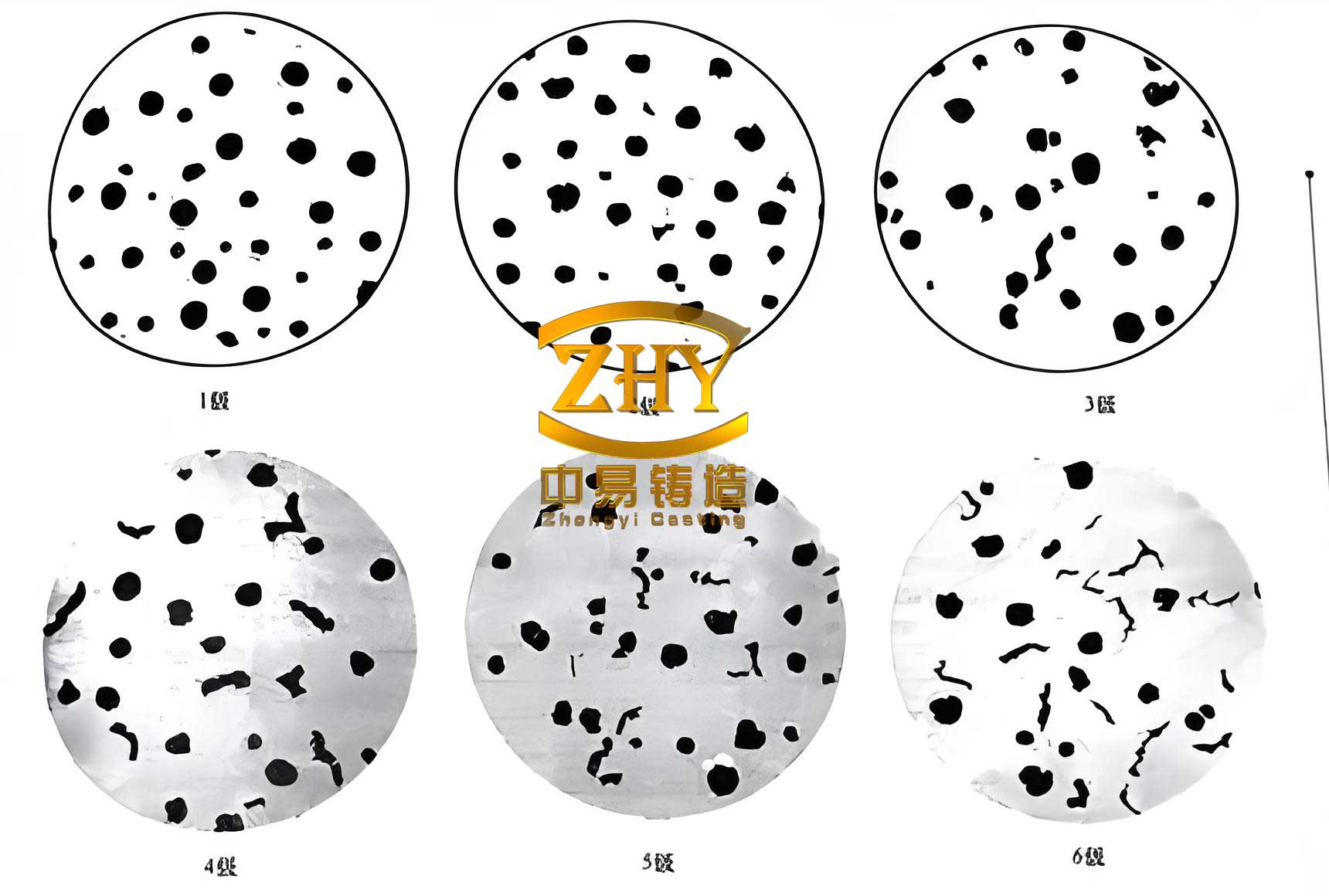
To address the challenges, several adjustments were made in the production of spheroidal graphite cast iron. First, the chemical composition was modified to increase silicon content for solid solution strengthening and reduce chilling tendency. The target composition range was narrowed as in Table 5.
| Element | Previous Range (%) | Improved Range (%) | Rationale |
|---|---|---|---|
| Carbon (C) | 3.6-3.8 | 3.5-3.7 | Balance fluidity and strength |
| Silicon (Si) | 2.4-2.8 | 2.8-3.0 | Enhance ferrite, reduce carbides |
| Manganese (Mn) | ≤0.3 | ≤0.5 | Avoid excessive pearlite stabilization |
| Magnesium (Mg) | 0.03-0.05 | 0.03-0.05 | Maintain spheroidization |
| Rare Earth (RE) | 0.01-0.03 | 0.01-0.02 | Control impurities, minimize porosity |
Second, the spheroidization and inoculation parameters were optimized. Wire feeding was used with a cored wire having lower Mg content (15-16% Mg) to reduce vaporization and improve Mg recovery. The feed speed was increased to 28-30 m/min to ensure bottom reaction. In-stream inoculation with an efficient inoculant (e.g., FeSi-based with Ba/Ca additives) was applied at 0.15% of melt weight. Table 6 details the revised parameters.
| Process | Material/Agent | Parameter | Value |
|---|---|---|---|
| Spheroidization | Mg-FeSi cored wire (15-16% Mg, 2% RE) | Addition rate | 23 m per ton of iron |
| Feed speed | 28-30 m/min | ||
| Inoculation (Wire) | FeSi cored wire (60% Si) | Addition rate | 18 m per ton |
| Feed speed | 24-26 m/min | ||
| Inoculation (In-Stream) | FeSi-Ba inoculant powder | Addition rate | 0.15% of melt weight |
These changes were implemented while keeping the melting temperature (1380-1440°C) and sand coating thickness (4-6 mm) constant. After producing six heats, the results showed significant improvement. All heats met the QT500-7 specifications, with pearlite content controlled to 25-45%, graphite spheroidality grade 2, nodule size grade 6, and minimal carbides (<1% or none). Hardness values ranged from 181 to 205 HB, within the target range. Table 7 summarizes the results from the trial heats for this spheroidal graphite cast iron component.
| Heat Number | Hardness (HB) | Pearlite Content (%) | Graphite Spheroidality Grade | Nodule Size Grade | Carbide Content (%) |
|---|---|---|---|---|---|
| 01-115 | 201 | 35 | 2 | 6 | <1% |
| 01-116 | 195 | 35 | 2 | 6 | None |
| 01-117 | 181 | 25 | 2 | 6 | None |
| 01-118 | 205 | 35 | 2 | 6 | None |
| 01-119 | 205 | 45 | 2 | 6 | <1% |
| 01-120 | 202 | 35 | 2 | 6 | None |
The improvement can be attributed to several factors in the spheroidal graphite cast iron process: adjusted carbon and silicon levels enhanced graphitization and reduced undercooling; lower Mg content in the wire minimized fading and improved uniformity; higher feed speed ensured effective Mg delivery; and efficient inoculation increased graphite nodule count, stabilizing the matrix. This case underscores how targeted adjustments in composition and treatment parameters can resolve quality issues in thin-walled spheroidal graphite cast iron production.
Discussion and Analysis
The production of as-cast high-performance thin-walled spheroidal graphite cast iron components requires a deep understanding of the interactions between process variables. Key learnings from this study include the importance of silicon in controlling matrix structure, the role of wire feeding parameters in Mg recovery, and the need for robust inoculation to counteract rapid cooling. For spheroidal graphite cast iron, the carbon equivalent plays a pivotal role; a higher CE generally promotes graphite formation but must be balanced against mechanical properties. Using the formula for CE, we can optimize composition for thin sections:
$$ CE = C + \frac{1}{3}Si $$
assuming low phosphorus. For QT500-7, a CE of 4.2-4.4 is often suitable to avoid chill while maintaining strength.
Wire feeding dynamics can be further analyzed through fluid dynamics models. The penetration depth of the wire into the melt affects reaction efficiency. A simplified model for wire immersion depth (\( D \)) is:
$$ D = v \cdot t_d $$
where \( v \) is feed speed and \( t_d \) is the time before sheath failure. This \( t_d \) depends on temperature and sheath thickness, emphasizing the need for calibrated equipment.
Inoculation effectiveness is measured by the increase in graphite nuclei. The nodule count (\( N \)) can be related to inoculant particle density (\( \rho_p \)) and potency factor (\( f_p \)):
$$ N = \rho_p \cdot f_p \cdot C_{\text{inoc}} $$
For thin-walled spheroidal graphite cast iron, high-potency inoculants with elements like barium or strontium are preferred to sustain nucleation under fast cooling.
Overall, quality control in spheroidal graphite cast iron production is a multivariate challenge. Statistical methods like design of experiments (DOE) can help identify optimal parameter sets. For instance, response surface methodology (RSM) can model the effects of Mg addition, inoculation rate, and pouring temperature on mechanical properties, enabling predictive control for spheroidal graphite cast iron components.
Conclusion
Producing as-cast high-performance thin-walled small and medium spheroidal graphite cast iron components demands a comprehensive quality control strategy that spans from raw material selection to final inspection. The iron mold sand-coated casting process, combined with wire feeding for spheroidization and in-stream inoculation, offers a viable route to achieve consistent microstructure and properties. Key factors include maintaining precise chemical composition (especially carbon and silicon), optimizing wire feed parameters based on melt conditions, using effective inoculants, and implementing rigorous testing protocols. The case study demonstrates how adjustments in these areas can resolve common issues like high pearlite or carbides, leading to components that meet stringent specifications without heat treatment.
Future advancements in spheroidal graphite cast iron production may involve real-time monitoring systems, AI-based process control, and improved alloy designs for enhanced performance. By continuing to refine these methodologies, manufacturers can further elevate the quality and reliability of thin-walled spheroidal graphite cast iron parts, supporting the evolving needs of high-tech industries. The journey toward perfecting spheroidal graphite cast iron is ongoing, but with diligent application of these principles, consistent excellence is attainable.