
The pursuit of enhanced mechanical properties in cast materials is a continuous driver for innovation in the foundry industry. Within the domain of spheroidal graphite cast iron, a significant challenge has historically been the inverse relationship between strength and ductility. Conventional grades often force a trade-off: high-strength pearlitic varieties exhibit limited elongation, while highly ductile ferritic grades possess lower strength. This paper details the first-person development and successful production application of two novel, high-performance pearlitic spheroidal graphite cast iron grades, QT800-5 and QT700-8, using the investment casting process. These materials achieve a superior combination of tensile strength and elongation in the as-cast condition, surpassing the specifications outlined in standards such as GB/T 1348-2019, thereby enabling opportunities for component lightweighting and increased reliability.
The development was motivated by specific market demands for components requiring high integrity and performance. Investment casting, with its unique thermal characteristics involving pouring into pre-heated ceramic shells, presents distinct challenges compared to sand casting. The slower cooling rate during the eutectic solidification phase promotes graphite growth, increasing the risk of graphite degeneration, flotation, and the formation of oversized nodules. Conversely, the faster cooling rate during the eutectoid transformation, due to the relatively thin shell wall, can be leveraged for microstructural refinement. The core development challenges were therefore threefold: 1) Achieving high strength concurrently with high ductility without relying on prohibitively expensive alloying elements like nickel; 2) Ensuring consistent and superior nodularity (Grade 1-3) given the constraints of small ladle treatment typical for investment casting; and 3) Developing an effective inoculation strategy in the absence of standard post-inoculation techniques like mold or stream inoculation.
Material Development Strategy and Chemical Composition Design
The foundational step involved establishing a chemical composition that would satisfy the mechanical property targets while being cost-effective and adaptable to the investment casting process. A critical parameter is the carbon equivalent (CE), which significantly influences graphite morphology and shrinkage tendency. For sand-cast spheroidal graphite cast iron, a slightly hypereutectic composition (CE ~4.3%-4.6%) is common. However, for investment casting, our extensive trials demonstrated that this leads to graphite flotation and “exploded” graphite due to the prolonged eutectic solidification time. We determined that a near-eutectic or slightly hypoeutectic composition for the base iron was necessary. Using thermal analysis for precise control, the target CE for the base iron before spheroidization was set at $$CE_{base} = C + \frac{Si}{4} \approx 4.20 \pm 0.05\%$$. After spheroidization and inoculation, the final CE typically ranges from 4.25% to 4.35%, effectively balancing graphite quality with minimized shrinkage defects.
To achieve the required matrix structure and strength, alloying elements were carefully selected. Copper was chosen as the primary pearlite promoter for its cost-effectiveness and moderate strengthening effect. For the higher-strength QT800-5 grade, molybdenum was added in small quantities (0.2%-0.3%) to refine the pearlite lamellae, thereby increasing the strength of the pearlitic matrix itself. Silicon content was tailored for each grade: lower for the pearlitic QT800-5 to avoid excessive ferrite, and higher for the mixed-matrix QT600-10 and QT700-8 to provide solid solution strengthening without compromising low-temperature toughness. Manganese, a potential embrittling element due to segregation, was kept at low to moderate levels. A pivotal decision was to shift from using pig iron as the primary charge material to using low-titanium scrap steel. This “synthetic iron” approach drastically and consistently reduced the levels of detrimental trace elements like P, S, and Ti, which are critical for achieving high elongation in high-strength spheroidal graphite cast iron.
| Grade | CEbase | Cbase | Sibase | Sifinal | Mn | P (max) | S (max) | Cu | Mo | Ti (max) |
|---|---|---|---|---|---|---|---|---|---|---|
| QT800-5 | 4.15-4.25 | 3.75-3.90 | 1.1-1.3 | 2.0-2.4 | 0.5-0.7 | 0.035 | 0.020 | 0.7-0.9 | 0.2-0.3 | 0.040 |
| QT700-8 | 4.15-4.25 | 3.65-3.85 | 1.3-1.5 | 2.2-2.6 | 0.3-0.5 | 0.035 | 0.020 | 0.5-0.7 | – | 0.040 |
| QT600-10 | 4.15-4.25 | 3.55-3.75 | 1.7-1.9 | 2.6-3.0 | 0.2-0.4 | 0.035 | 0.020 | 0.4-0.6 | – | 0.040 |
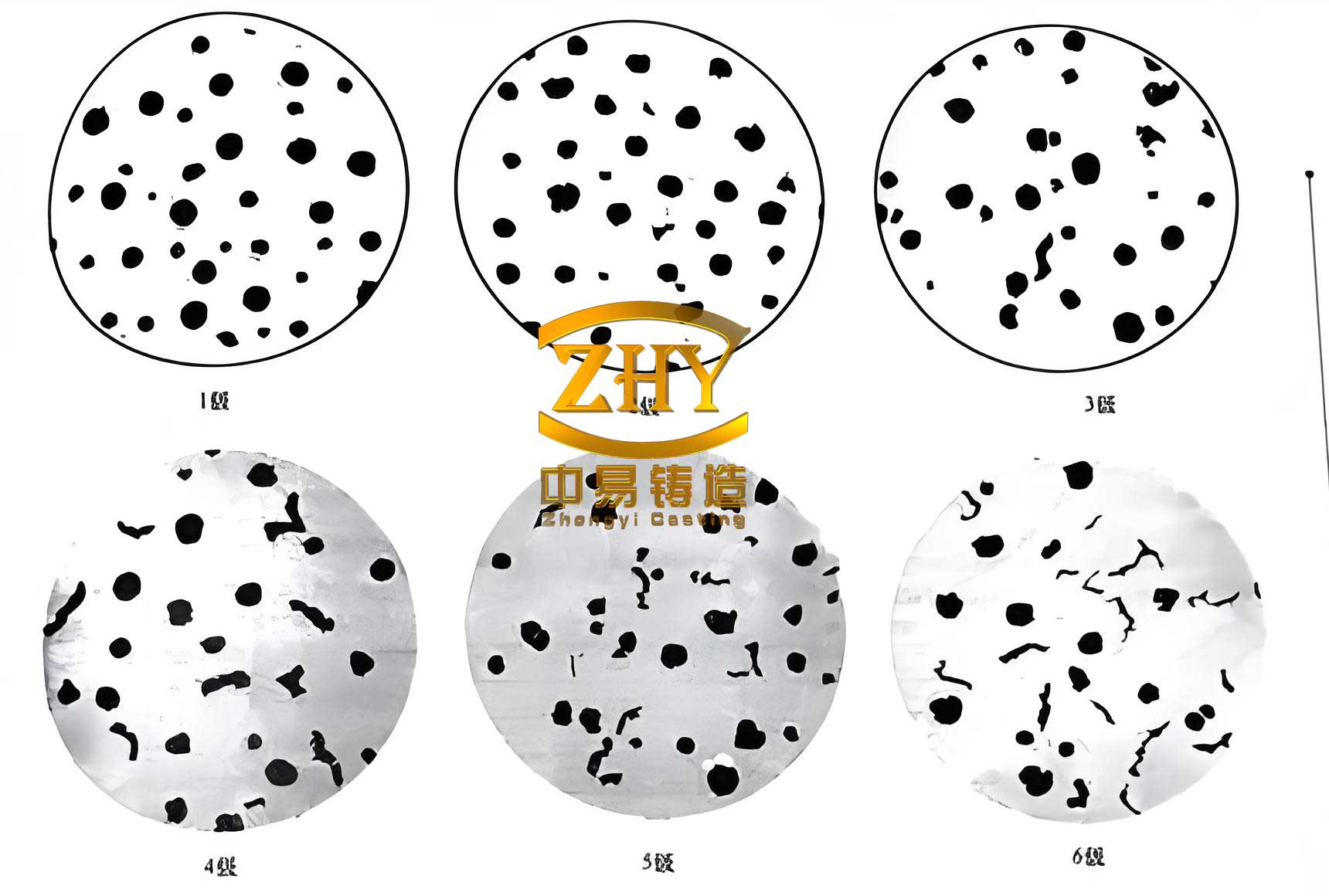
The successful production of high-performance spheroidal graphite cast iron hinges not just on composition but profoundly on the quality of the graphite nodules and the matrix structure they reside in. The spherical form of graphite is crucial for maximizing the material’s inherent ductility and strength.
Innovations in Spheroidization and Inoculation for Investment Casting
Traditional ladle-based spheroidization with a plunging bell proved unstable for the small batch sizes (250-500 kg) typical in investment casting, leading to high variability in residual magnesium and nodularity. To address this, a wire-feeding spheroidization process was adopted. However, standard cored wires led to excessively short reaction times and instability. A proprietary cored wire was developed specifically for investment casting spheroidal graphite cast iron. Its key characteristics were a lower magnesium content (8-12%) to moderate the violent reaction and the inclusion of Barium (9-11%) to impart a strong, long-lasting inoculation effect. This “low-Mg, high-Ba” wire, used in a specially designed tall ladle (height-to-diameter ratio of 2), provided a stable, controllable reaction and consistent residual magnesium levels between 0.04% and 0.06%, which is ideal for preventing graphite degeneration in the slow-cooling investment casting environment.
Inoculation posed another unique challenge. Common post-inoculation methods in sand casting, such as in-mold or stream inoculation, are not feasible in investment casting due to the pre-fired, hot shells and the manual, multi-cavity pouring practice. To combat inoculation fade and ensure a high nodule count, a robust three-stage inoculation practice was developed:
- Pre-inoculation: Adding 0.3-0.5% FeSi75 to the ladle before receiving the base iron.
- Co-inoculation: The Barium in the spheroidizing cored wire provides a potent inoculation effect during the treatment.
- Transfer Ladle Inoculation: Adding 0.4-0.6% fine-grain (1-4 mm) FeSi75 to the pouring ladle during the transfer of metal from the treatment ladle.
This multi-stage approach effectively maintains the necessary nucleation potential throughout the process, ensuring a fine, uniform distribution of graphite nodules in the final spheroidal graphite cast iron casting. Temperature control was also standardized, with a pouring temperature range of 1360-1400°C for the first shell to ensure good fluidity while minimizing fading.
Eutectoid Cooling Control for Grain Refinement
Achieving the targeted high strength and ductility required more than just good nodularity and alloying; it required matrix refinement. While sand castings often use expensive alloys or chilling for this, we exploited the inherent cooling characteristics of investment casting. The key was to control and enhance the cooling rate specifically during the eutectoid transformation to refine the pearlite and ferrite grains. An operational procedure was established: after pouring, the clusters (trees) of shells are spaced at least 60 mm apart on the cooling conveyor to promote radiative and convective cooling. After a natural cooling period of 15 minutes, which allows for eutectic solidification and initial cooling, forced air cooling (3-5 m/s wind speed) is initiated. This accelerates the cooling through the critical eutectoid temperature range (approximately 700-750°C), leading to a finer microstructure. The strengthening contribution from this grain refinement can be conceptually related to the Hall-Petch relationship, where the yield strength $$\sigma_y$$ is inversely proportional to the square root of the grain size $$d$$:
$$\sigma_y = \sigma_0 + \frac{k_y}{\sqrt{d}}$$
Here, a finer effective structural scale ($$d$$) resulting from controlled eutectoid cooling increases the yield and tensile strength without severely compromising ductility, a principle successfully applied to this spheroidal graphite cast iron.
Experimental Results and Mechanical Performance
The implemented process controls yielded consistent and excellent results. Metallographic examination of cast components confirmed that the microstructure met the stringent requirements. The spheroidal graphite cast iron exhibited nodularity grades of 2-3, with pearlite contents finely tuned to the grade specification and an absence of carbides.
| Grade / Condition | Yield Strength Rp0.2 (MPa), min | Tensile Strength Rm (MPa), min | Elongation A (%), min | Hardness (HBW) |
|---|---|---|---|---|
| Developed QT800-5 (As-Cast) | 480 | 800 | 5 | 245-335 |
| ISO 1083/JS/800-5 (Typical) | 480 | 800 | 5 | 270-320 |
| Developed QT700-8 (As-Cast) | 420 | 700 | 8 | 225-305 |
| ISO 1083/JS/700-8 (Typical)* | 420 | 700 | 8 | 225-305 |
| ISO 1083/JS/800-2 (As-Cast Reference) | 480 | 800 | 2 | 245-335 |
| ISO 1083/JS/400-18 (Ductility Reference) | 250 | 400 | 18 | 130-180 |
*Note: The QT700-8 grade demonstrates that the developed process achieves the strength-ductility combination of a standard grade but does so reliably in the as-cast state for investment castings, where such properties are more challenging to attain.
Tensile testing performed on separately cast keel blocks (Y-blocks) from production heats confirmed that the targets were consistently met and often exceeded. For QT800-5, typical results were tensile strength > 810 MPa with elongation between 5.2% and 6.1%. For QT700-8, tensile strength > 720 MPa was achieved with elongation between 8.3% and 9.1%. This performance envelope clearly demonstrates that the developed spheroidal graphite cast iron grades break the traditional strength-ductility trade-off, as visualized in the property chart where these grades occupy a superior position compared to conventional as-cast grades.
Conclusion
The successful development and production implementation of high-performance pearlitic spheroidal graphite cast iron grades QT800-5 and QT700-8 in investment casting have been detailed. This achievement was made possible through a holistic and tailored approach addressing the unique constraints of the process. Key outcomes include:
- The establishment of a specific near-eutectic carbon equivalent range (4.20% ± 0.05% for base iron) suitable for investment casting, preventing graphite floating and degeneration.
- The formulation of a cost-effective alloying system based on scrap steel charge, copper, and controlled use of molybdenum, minimizing reliance on expensive elements while tightly controlling detrimental impurities (P, S, Ti).
- The development and application of a proprietary low-magnesium, high-barium cored wire for stable wire-feeding spheroidization in small ladles, coupled with a robust three-stage inoculation strategy to overcome the limitations imposed by the absence of post-inoculation methods.
- The identification and implementation of a practical process control for eutectoid cooling (spaced cluster cooling followed by forced air convection), which provides essential grain refinement to synergistically enhance both strength and ductility in the final spheroidal graphite cast iron component.
This integrated methodology has proven reliable in mass production over several years, delivering spheroidal graphite cast iron investment castings with a mechanical property combination that significantly expands the design possibilities for lightweight, high-integrity components in demanding applications. The principles established contribute valuable knowledge to the broader field of producing advanced cast irons via precision casting techniques.