
The pursuit of superior wear resistance in grinding media has long been dominated by high-chromium cast alloys. The performance of these chromium-series cast grinding balls is fundamentally built upon increasing the content of chromium alloying elements, resulting in a surface hardness ranging from HRC 45 to 62. However, the contemporary surge in prices for various ferroalloys has rendered the production costs of these chromium-series balls prohibitively high. Forged steel balls, while offering high surface hardness (HRC 58-62), suffer from a significant hardness drop in their core (HRC 42-48), leading to inadequate wear resistance overall. Furthermore, their production is extremely vulnerable to the price fluctuations of raw steel billets. In this challenging economic and technical landscape, Carbidic Austempered Ductile Iron (CADI) emerges as a compelling alternative. As a member of the spheroidal graphite cast iron family, CADI achieves an exceptional balance of hardness (typically HRC 50-55 post-heat treatment) and toughness, endowing the grinding balls with a desirable “hard exterior, tough interior” characteristic. The inherent presence of numerous spherical graphite nodules—a non-metallic element—in the spheroidal graphite cast iron matrix gives these balls a density approximately 7% to 8% lower than that of low-chromium, high-chromium, or forged steel balls. While traditional balls have densities around 7.7-7.8 t/m³, CADI balls average about 7.3 t/m³. This reduction in weight directly translates to a decreased load in ball mills, consequently reducing the startup and operational power consumption by an estimated 5% to 8%, highlighting the significant economic benefits of CADI ball production and application. Recognizing this potential, our company embarked on a dedicated research and development project to master the production of high-quality CADI grinding balls, utilizing a 1-ton medium-frequency induction furnace for melting and continuously refining processes in molding, chemistry, nodularizing and inoculating, as well as the critical austempering and tempering heat treatments.
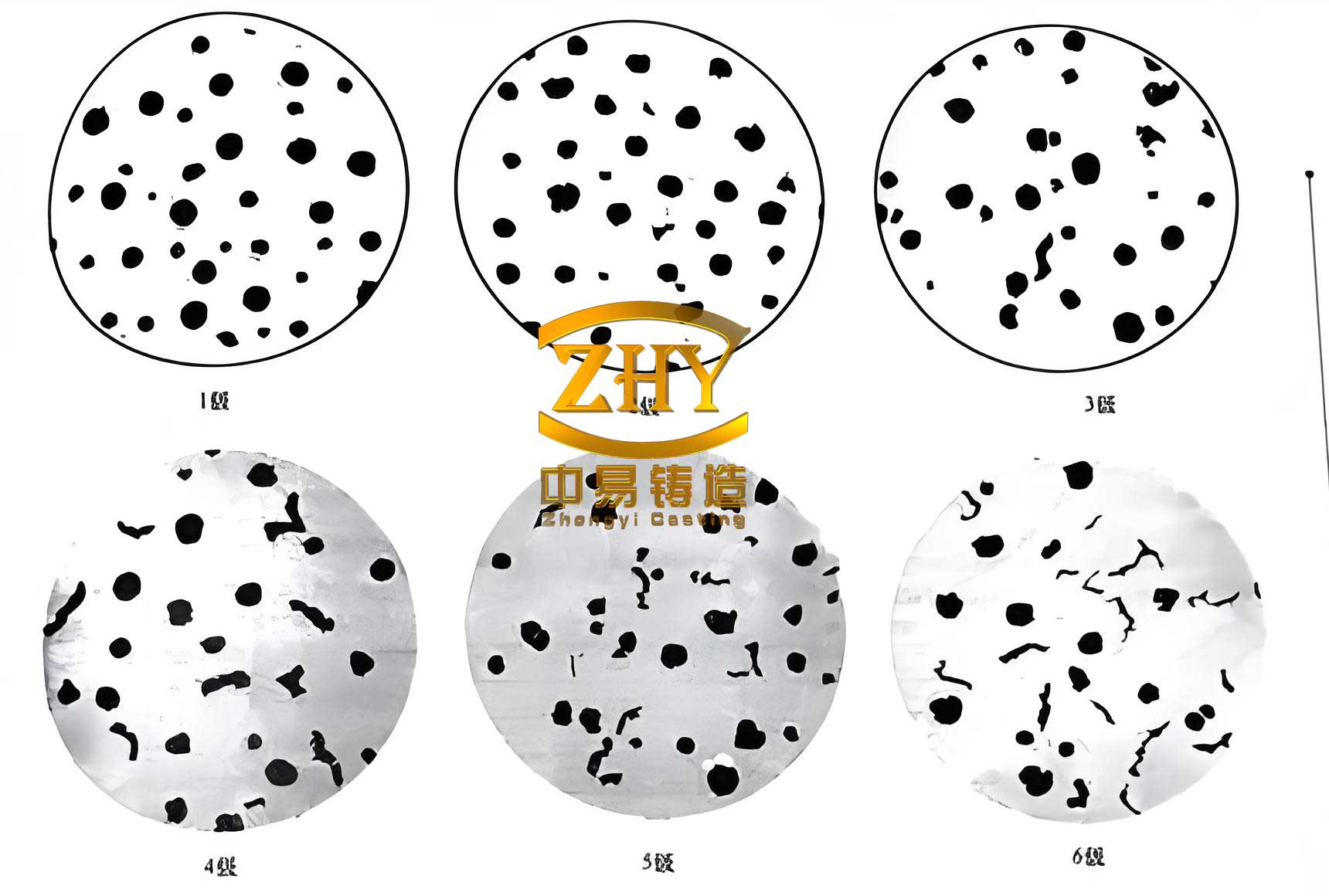
The microstructure of spheroidal graphite cast iron, as shown above, is pivotal. The spherical graphite nodules act as natural lubricants and crack arresters, while the matrix can be manipulated through heat treatment. In CADI, this matrix is transformed into a unique ausferritic structure (acicular ferrite with high-carbon stabilized austenite) along with controlled carbides, yielding the optimal combination of hardness and impact resistance for grinding applications.
Foundry Production Practice for CADI Grinding Balls
1. Selection of Molding Process
The production of spheroidal graphite cast iron grinding balls employs permanent metal molds. A single mold cavity is designed to produce four balls simultaneously. The gating system is formed using sodium silicate-coated sand placed in specific locations on the metal mold. This high-rigidity mold provides intense chilling, which promotes the formation of fine and uniformly distributed graphite nodules. Prior to pouring, the metal molds are preheated to a temperature between 250°C and 300°C. A unique practice involves inserting steel bars (4.5 mm × 4.5 mm × 10 mm) into the mold’s vent holes. This serves the dual purpose of facilitating gas escape while preventing molten iron from leaking through these vents.
2. Design of Chemical Composition
The performance of CADI grinding balls is primarily governed by graphite morphology and the metallic matrix. Carbon and Silicon are the primary elements influencing graphite formation. A higher carbon equivalent (CE) increases the amount of graphite, but can also lead to degraded graphite shape if inoculation is insufficient or trace harmful elements are present. Increasing C and Si content generally reduces pearlite and increases ferrite in the as-cast structure. Therefore, careful control is essential: Carbon content is maintained between 3.5% and 3.6%, and Silicon between 2.3% and 2.5%. Phosphorus and Sulfur are detrimental elements in spheroidal graphite cast iron. To effectively dephosphorize and desulfurize, scrap steel with low P and S content is selected, aiming for base iron with w(S) ≤ 0.06% and w(P) ≤ 0.06%—the lower, the better. Manganese is added post-deslagging as it enhances hardenability. However, being a strong positive segregation element, its content is controlled between 0.7% and 0.8% for standard sizes. For larger diameter CADI balls, alloying elements like Molybdenum (Mo), Copper (Cu), and Nickel (Ni) are introduced to further improve hardenability and ensure consistent microstructure throughout the cross-section. Chromium is a strong carbide-forming element. While increasing Cr content raises hardness by promoting harder (Fe,Cr)3C carbides, it can significantly reduce impact toughness. Thus, Chromium is carefully balanced between 1.1% and 1.2%. The target chemical composition for a φ110 mm grinding ball is summarized in the table below.
| Element | C | Si | Mn | P | S | Cr | Cu | Mo | Ni |
|---|---|---|---|---|---|---|---|---|---|
| Target (wt.%) | 3.6 | 2.4 | 0.8 | ≤0.01 | ≤0.01 | 1.2 | 0.5 | 0.3 | 0.3 |
The carbon equivalent (CE) is a crucial parameter for cast iron, calculated as: $$CE = \%C + \frac{\%Si + \%P}{3}$$ For our target composition (ignoring the minimal P), CE ≈ 3.6 + 2.4/3 = 4.4. This is a typical hypereutectic value suitable for promoting graphite formation in spheroidal graphite cast iron.
3. Nodularizing and Inoculation Treatment
This is the most critical step to achieve a high nodularity percentage, which is fundamental for superior mechanical properties in CADI. A nodularity level above 80% (corresponding to a graphite shape rating of 3 or better) and a graphite nodule size finer than 0.05 mm (size rating 6 or higher) are required. To achieve this, high-quality charge materials are used to minimize anti-nodularizing elements. The base iron is pre-deoxidized before tapping to control initial Si content and improve resistance to fading. For treatment, a 6-8% Rare Earth-Magnesium Ferrosilicon alloy is used as the nodularizer, and FeSi75 is used as the inoculant. The conventional sandwich method is employed: the nodularizer is placed at the bottom of the treatment ladle, covered by a layer of inoculant and then an iron plate. The amount of covering material is matched to the weight and temperature of the iron. The molten iron is tapped at approximately 1480°C, with the covering material amounting to about 0.3% of the iron weight. After treatment, pouring must be completed within 10 minutes to prevent nodularizer fade.
Austempering and Tempering Heat Treatment
The heat treatment cycle is what transforms the spheroidal graphite cast iron casting into a CADI product with its unique ausferritic matrix. The primary goal of austempering is to enrich the austenite with carbon. This high-carbon austenite then transforms, during the isothermal hold, into a mixture of acicular ferrite (ausferrite) and carbon-enriched stabilized austenite, without forming brittle martensite. This structure provides high strength, good hardness, and excellent wear resistance coupled with remarkable toughness.
The specific austempering process for our φ110 mm CADI balls is outlined below and illustrated in the corresponding工艺曲线. The process parameters are interdependent and can be modeled. The hardenability, crucial for achieving the desired microstructure in the core of the ball, is influenced by the alloy content. A simplified hardenability factor (DI) for ductile iron can be considered:
$$D_I \propto [Mn] + k_1[Mo] + k_2[Cu] + k_3[Ni] – k_4[Si]$$ where k1, k2, k3, k4 are proportionality constants specific to the system. Furthermore, the stability of the austenite and its carbon content (Cγ) after the isothermal transformation is critical for properties. An empirical relationship linking hardness (HV) to the volume fraction of carbides (Vcarb) and the carbon content in austenite could be expressed as:
$$HV \approx \alpha \cdot V_{carb} + \beta \cdot C_{\gamma} + \gamma$$ where α, β, and γ are material constants.
| Process Stage | Temperature | Time (min) | Atmosphere / Medium | Key Objective |
|---|---|---|---|---|
| Preheat | 490 °C | 220 | Air (Furnace) | Reduce thermal shock, slow heating. |
| Austentization – Stage 1 | 780 °C | 15 | Controlled (Carbon potential ~0.6%) | Gradual heating to target. |
| Austentization – Stage 2 (Soak) | 920 °C | 300 | Controlled (Carbon potential ~0.6%) | Dissolve carbides, homogenize austenite. Time depends on chemistry, nodularity, and section size. |
| Quench & Isothermal Hold | 250 °C | 150 | Salt Bath | Transform austenite to ausferrite + high-C austenite. |
| Cooling & Cleaning | To < 80 °C | – | Water / Air | Clean salts, prepare for tempering. |
| Tempering | 230 °C | 300 | Air (Furnace) | Relieve stresses, stabilize microstructure. |
Performance Evaluation of CADI Grinding Balls
1. Microstructural Analysis
Metallographic samples were prepared following standard procedures: sectioning, grinding, polishing, and etching with 5% Nital. Examination under an optical microscope at 100x magnification confirmed a nodularity grade of 2 and a graphite size rating of 6, with carbides uniformly distributed. At higher magnifications (200x, 500x), the spherical graphite nodules and the characteristic acicular structure of the ausferritic matrix (ferrite needles surrounded by stabilized austenite) are clearly visible. The high nodularity is the foundation that allows for this uniform matrix transformation during austempering.
2. Mechanical Property Testing
Randomly selected CADI balls were sampled to prepare standard test specimens (10 mm × 10 mm × 55 mm for impact, ensuring they were free from casting defects like shrinkage porosity). Hardness was measured on the Rockwell C scale, and impact toughness was determined using a semi-automatic impact tester. The technical specification required a minimum hardness of HRC 50 and a minimum impact toughness of 8 J/cm².
| Test Property | Individual Measurements | Average Value | Specification Requirement |
|---|---|---|---|
| Hardness (HRC) | 51.0, 51.8, 52.8, 54.2, 55.5, 51.5, 52.0, 53.0 | 52.7 | ≥ 50 |
| Impact Toughness (J/cm²) | 12.0, 12.2, 13.0 | 12.4 | ≥ 8 |
3. Analysis of Results
The test results convincingly demonstrate that the production practice was successful. The average hardness of HRC 52.7 and the impact toughness of 12.4 J/cm² significantly exceed the minimum requirements. This confirms that the CADI balls possess the desired high-toughness, wear-resistant profile suitable for demanding grinding applications. The microstructural analysis correlates directly with these properties: the high nodularity achieved during casting ensured a favorable starting structure, which upon precise austempering transformed into a uniform and high-performance ausferritic matrix with well-dispersed carbides. The relationship between nodularity (N), austempering parameters (Ta, ta), and final impact toughness (ak) can be conceptually summarized as: $$a_k \approx f(N, T_a, t_a)$$ where a higher N (nodularity) and optimal Ta, ta (austempering temperature and time) maximize toughness.
Conclusion and Discussion
The performance of any spheroidal graphite cast iron product, including CADI grinding balls, is decisively determined by its matrix microstructure. For CADI, the foundational step is securing a high-quality as-cast structure with superior nodularity (Grade 1-3) and fine graphite (Size ≥6). This is non-negotiable, as it directly facilitates the subsequent formation of a uniform and high-performance ausferritic matrix during heat treatment.
Austempering is the transformative process that unlocks the unique properties of CADI. The kinetics of the isothermal transformation dictate the final proportions and characteristics of acicular ferrite and carbon-stabilized austenite. The austempering工艺曲线 must be meticulously tailored, considering the complex interplay of the ball’s chemical composition (e.g., a 0.5% reduction in Cr may necessitate a ~5°C increase in isothermal temperature), section size, and the specific hardenability requirements. The empirical formula for adjusting the isothermal temperature (Tiso) based on a change in Chromium content (ΔCr) could be approximated as: $$\Delta T_{iso} \approx \eta \cdot \Delta Cr$$ where η is a negative constant (since lower Cr may require higher Tiso to achieve sufficient transformation drive).
The successful production of high-quality, reliable CADI grinding balls hinges on a holistic and rigorous approach to process management. Paramount importance must be placed on the metallurgy and practice of nodularizing and inoculation to guarantee high and consistent nodularity. This must be supported by systematic, detailed, and optimized process design across all stages—from charge make-up and melting to molding, pouring, and the critical heat treatment cycle. Only through such comprehensive and strict control can the desired mechanical properties (hardness ≥ HRC 50, impact toughness ≥ 12 J/cm²) be achieved with the stability and consistency required for industrial application. This integrated practice not only ensures the delivery of a superior product but also substantively enhances the core competitiveness of an enterprise in the competitive field of wear-resistant materials.