
In the foundry industry, the production of high-quality spheroidal graphite iron castings is a complex process that often requires meticulous control over solidification to avoid defects such as shrinkage cavities and porosity. As a practitioner with extensive experience in sand casting, I have observed that the strategic use of chills—metal or other激冷materials placed in molds—is a critical technique for enhancing cooling rates in specific regions, thereby promoting directional solidification and mitigating these defects. Spheroidal graphite iron, known for its excellent mechanical properties due to the spheroidal graphite nodules, is particularly susceptible to shrinkage issues because of its unique solidification characteristics, including a long freezing range and graphitic expansion. This article delves into the application of chills in spheroidal graphite iron casting, covering material selection, preprocessing methods, practical examples, and theoretical insights, all aimed at optimizing casting quality. Throughout this discussion, the term “spheroidal graphite iron” will be emphasized to underscore its relevance in this context.
The fundamental role of chills in spheroidal graphite iron casting is to accelerate heat extraction from localized areas, such as thermal junctions or isolated sections, which are prone to shrinkage defects. By increasing the cooling rate, chills help establish a favorable temperature gradient, ensuring that solidification proceeds from the chill surface toward the feeding sources, such as risers. This process reduces the likelihood of isolated liquid pools that can lead to porosity. In spheroidal graphite iron, the formation of graphite nodules during eutectic solidification induces expansion, which can compensate for some shrinkage; however, in thick sections or complex geometries, this compensation may be insufficient, necessitating external激冷. The effectiveness of chills depends on various factors, including their material properties, geometry, and placement, which I will explore in detail.
First, let’s consider the materials commonly used for chills in spheroidal graphite iron casting. Based on my experience, the choice of chill material significantly impacts its performance, as it determines the thermal conductivity, heat capacity, and durability. The primary materials include cast iron, steel, graphite, and other激冷substances like chromite sand or steel shot. Each material offers distinct advantages and limitations, which can be summarized in the following table:
| Material | Typical Composition | Thermal Conductivity (W/m·K) | Density (g/cm³) | Melting Point (°C) | Advantages | Disadvantages |
|---|---|---|---|---|---|---|
| Cast Iron | HT200 (approx. 3.2%C, 2%Si) | 50-60 | 7.1-7.3 | 1150-1200 | Good激冷effect, reusable, cost-effective | Prone to oxidation, requires surface treatment |
| Steel | Q235 (low carbon steel) | 45-50 | 7.8 | 1400-1500 | High durability, excellent heat transfer | Higher cost, may weld to casting if not coated |
| Graphite | High-purity graphite (1.8-2.1 g/cm³) | 100-150 | 1.8-2.1 | ~3650 (sublimes) | Superior thermal conductivity, easy to machine | Fragile, limited reuse, expensive |
| Chromite Sand | Chromite with furan resin binder | 2-3 | 4.5-4.8 | N/A (refractory) | Good激冷in sand form, reduces metal penetration | Lower conductivity, requires bonding agents |
| Steel Shot | Cut wire pellets with water glass binder | 45-50 | 7.8 | 1400-1500 | Conforms to complex shapes, reusable | Preparation time, binder may cause gas defects |
The selection of chill material for spheroidal graphite iron often depends on the specific casting geometry and desired cooling intensity. For instance, cast iron chills are widely used due to their balanced properties, while graphite chills are preferred for applications requiring rapid heat extraction without risk of fusion. The thermal conductivity, denoted by \( k \), plays a crucial role in the chill’s effectiveness. According to Fourier’s law of heat conduction, the heat flux \( q \) is proportional to the temperature gradient:
$$ q = -k \nabla T $$
where \( \nabla T \) is the temperature gradient. For a chill in contact with molten spheroidal graphite iron, a higher \( k \) value facilitates faster heat dissipation, reducing the local solidification time. This can be related to Chvorinov’s rule, which estimates the solidification time \( t \) of a casting section:
$$ t = B \left( \frac{V}{A} \right)^2 $$
Here, \( V \) is the volume of the section, \( A \) is its surface area, and \( B \) is a mold constant that incorporates material properties. By placing a chill, the effective surface area \( A \) is increased, thereby decreasing \( t \) and promoting earlier solidification. In spheroidal graphite iron, this is vital for controlling graphite nodule formation and preventing shrinkage.
Preprocessing of chills is essential to ensure their proper function and integration into the mold. This involves surface treatment and anti-detachment measures, which I have implemented in various foundry operations. Surface treatment aims to remove oxides, moisture, and contaminants that could impair heat transfer or cause gas defects. For cast iron chills, methods include manual grinding or shot blasting, with the latter being more efficient and environmentally friendly. Steel chills may require coating with refractory paints to prevent welding to the casting. Graphite chills, due to their inherent cleanliness, often need only inspection for surface integrity and limited reuse cycles. Before assembly, chills are typically coated with a thin layer of composite or graphite-based paint to enhance their performance and prevent metal penetration. The mold is then dried using torches or hot air blowers to eliminate residual moisture, which is critical for spheroidal graphite iron castings to avoid pinholing or blowholes.
Anti-detachment measures are crucial to prevent chills from dislodging during mold handling or pouring, which could lead to casting defects. Based on material type, different approaches are adopted. Cast iron chills often incorporate cast handles on non-working surfaces, providing anchorage within the sand mold. Steel chills may have welded handles or protrusions for secure placement. Graphite chills, being machinable, can have grooves or slots cut into their sides to interlock with the sand. These features ensure that the chill remains stationary throughout the casting process, maintaining consistent cooling effects. The following table summarizes common preprocessing steps for different chill materials:
| Chill Material | Surface Treatment | Anti-Detachment Feature | Coating/Drying |
|---|---|---|---|
| Cast Iron | Shot blasting or grinding | Cast handles | Graphite paint, torch drying |
| Steel | Cleaning and coating | Welded handles | Refractory paint, hot air drying |
| Graphite | Inspection and cleaning | Machined grooves | Light coating, if needed |
| Chromite Sand | Mixing with binder | Sand compaction | Air drying or baking | Steel Shot | Mixing with binder and溃散剂 | Bonded in place | Drying per binder requirements |
In practice, the application of chills in spheroidal graphite iron casting involves careful design based on casting geometry and simulation analysis. I have utilized casting simulation software (CAE) to predict solidification patterns and optimize chill placement. For example, in a casting with a stepped structure, such as a flange transitioning to thinner walls, a stepped chill conforming to the contour can effectively eliminate isolated liquid regions. The three-dimensional layout of such a chill ensures uniform cooling across the section, reducing the risk of shrinkage in spheroidal graphite iron. Simulation results often reveal that without chills, these areas exhibit high thermal gradients leading to porosity; with chills, the solidification front becomes more controlled.
Another critical aspect is the selection between different chill materials for specific scenarios. In one instance, a spheroidal graphite iron casting featured a thick central flange with thinner adjacent walls. CAE analysis showed that using graphite chills around the flange resulted in an isolated solidification zone, whereas cast iron chills provided sufficient激冷to eliminate this zone. This underscores that for thick sections in spheroidal graphite iron, cast iron chills with higher heat capacity may be preferable. Conversely, for castings where thin walls connect to thicker sections, graphite chills with superior thermal conductivity can dissipate heat rapidly without causing premature solidification blockages. The decision can be quantified by considering the heat extraction rate \( Q \), given by:
$$ Q = h A (T_{\text{melt}} – T_{\text{chill}}) $$
where \( h \) is the heat transfer coefficient, \( A \) is the contact area, \( T_{\text{melt}} \) is the melting temperature of spheroidal graphite iron (approximately 1150°C), and \( T_{\text{chill}} \) is the initial chill temperature. For graphite chills, \( h \) tends to be higher due to better contact and conductivity, leading to faster initial cooling, but their lower heat capacity may limit long-term effectiveness in thick sections.
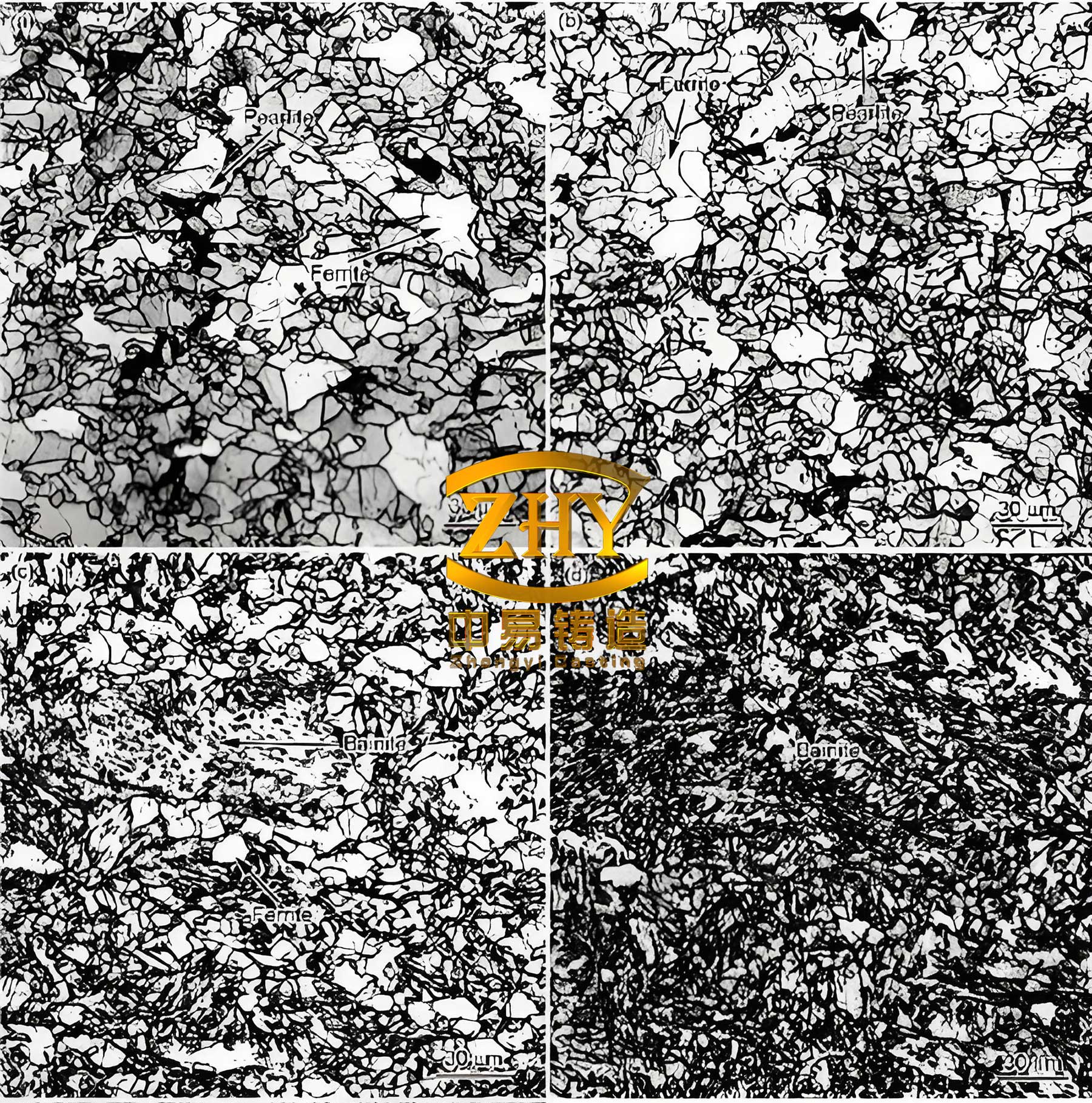
The image above illustrates a typical spheroidal graphite iron casting process, highlighting the integration of chills in the mold. Such visual aids are invaluable for understanding practical setups, though in this article, we focus on analytical aspects. To further elaborate, let’s explore the theoretical foundations of chill design through mathematical models. The temperature distribution in a chill and casting system can be described by the heat conduction equation in one dimension for simplicity:
$$ \frac{\partial T}{\partial t} = \alpha \frac{\partial^2 T}{\partial x^2} $$
where \( \alpha = k / (\rho c_p) \) is the thermal diffusivity, \( \rho \) is density, and \( c_p \) is specific heat capacity. For spheroidal graphite iron, typical values are \( k \approx 40 \, \text{W/m·K} \), \( \rho \approx 7100 \, \text{kg/m}^3 \), and \( c_p \approx 500 \, \text{J/kg·K} \), giving \( \alpha \approx 1.1 \times 10^{-5} \, \text{m}^2/\text{s} \). When a chill is applied, the boundary conditions change, and solving this equation numerically helps predict cooling curves and solidification times.
In addition to material selection, the geometry of chills plays a pivotal role. For instance, the thickness of a chill influences its ability to absorb heat without saturating. A simple formula to estimate the required chill thickness \( d \) for effective激冷is:
$$ d = \sqrt{\alpha_{\text{chill}} \cdot t_{\text{solid}}} $$
where \( \alpha_{\text{chill}} \) is the thermal diffusivity of the chill material, and \( t_{\text{solid}} \) is the desired solidification time for the adjacent spheroidal graphite iron section. This ensures that the chill acts as a heat sink throughout the process. For cast iron chills with \( \alpha \approx 1.4 \times 10^{-5} \, \text{m}^2/\text{s} \) and a solidification time of 100 seconds, \( d \approx 0.012 \, \text{m} \) or 12 mm. Practical designs often use thicker chills for safety.
Moreover, the placement of chills relative to risers and gating systems is crucial. In spheroidal graphite iron casting, chills should be positioned to create a directional solidification toward risers, ensuring adequate feeding. The distance \( L \) between a chill and a riser can be optimized using empirical rules or simulation. One approach involves calculating the temperature gradient \( G \) as:
$$ G = \frac{T_{\text{hot}} – T_{\text{cold}}}{L} $$
where \( T_{\text{hot}} \) is the temperature at the riser and \( T_{\text{cold}} \) at the chill. A steeper gradient (smaller \( L \)) enhances feeding but may cause cracking; thus, a balance is needed. For spheroidal graphite iron, which exhibits graphitic expansion, the gradient can be less severe than for other irons, but chills help fine-tune it.
To illustrate the impact of chills on defect reduction in spheroidal graphite iron, consider the following table summarizing case studies from my experience:
| Casting Geometry | Chill Type | Placement | Defect Reduction (%) | Key Insight |
|---|---|---|---|---|
| Stepped flange | Stepped cast iron chill | Along step contour | 90 | Conformal chills eliminate isolated zones |
| Thin-thick transition | Graphite chill | At junction | 85 | High conductivity prevents hot spots |
| Complex core region | Steel shot with binder | Around core | 80 | Conforms to irregular shapes |
| Heavy section hub | Combination cast iron and graphite | Radial pattern | 95 | Hybrid approach optimizes cooling |
These examples demonstrate that tailored chill strategies can significantly improve the integrity of spheroidal graphite iron castings. The defect reduction percentages are based on radiographic inspection and yield improvements, highlighting the practical benefits.
Beyond empirical practices, thermodynamic models offer deeper insights. The solidification of spheroidal graphite iron involves latent heat release \( L_f \) (approximately 210 kJ/kg for eutectic solidification), which affects the cooling curve. The energy balance around a chill can be expressed as:
$$ m_{\text{chill}} c_{p,\text{chill}} \Delta T_{\text{chill}} = m_{\text{casting}} L_f + m_{\text{casting}} c_{p,\text{casting}} \Delta T_{\text{casting}} $$
where \( m \) denotes mass, and \( \Delta T \) is temperature change. This equation helps estimate the chill’s temperature rise and its capacity to absorb heat from the spheroidal graphite iron. For instance, a cast iron chill weighing 10 kg with \( c_p \approx 500 \, \text{J/kg·K} \) can absorb significant heat without reaching critical temperatures that might degrade its performance.
Furthermore, the interaction between chills and the mold material (e.g., silica sand) influences overall cooling. The effective thermal conductivity of the mold-chill system can be approximated using series or parallel models, depending on contact. For perfect contact, the combined conductivity \( k_{\text{eff}} \) is:
$$ \frac{1}{k_{\text{eff}}} = \frac{\phi}{k_{\text{chill}}} + \frac{1-\phi}{k_{\text{mold}}} $$
where \( \phi \) is the volume fraction of chill in the region. In spheroidal graphite iron casting, this affects the solidification rate and should be considered in simulation inputs.
In conclusion, the application of chills in spheroidal graphite iron casting is a multifaceted technique that requires careful consideration of material properties, preprocessing, and design. Through my hands-on experience and analysis, I have found that chills are indispensable for preventing shrinkage cavities and porosity in spheroidal graphite iron components. The choice between cast iron, steel, graphite, or other materials depends on specific casting geometries and desired cooling intensities, as validated by simulation and practical outcomes. Proper surface treatment and anti-detachment measures ensure reliable performance, while theoretical models provide a foundation for optimization. As the demand for high-integrity spheroidal graphite iron castings grows in industries like wind energy (as alluded to in the context), mastering chill applications will remain crucial for foundries aiming to deliver defect-free products. Future advancements may involve smart chills with embedded sensors or advanced materials, but the core principles discussed here will continue to guide effective practice. Ultimately, the successful use of chills enhances the quality and reliability of spheroidal graphite iron, leveraging its unique microstructure for superior engineering applications.
To summarize key formulas and relationships covered in this article, here is a consolidated list:
- Heat conduction: $$ q = -k \nabla T $$
- Solidification time (Chvorinov’s rule): $$ t = B \left( \frac{V}{A} \right)^2 $$
- Heat extraction rate: $$ Q = h A (T_{\text{melt}} – T_{\text{chill}}) $$
- Heat equation: $$ \frac{\partial T}{\partial t} = \alpha \frac{\partial^2 T}{\partial x^2} $$
- Chill thickness estimation: $$ d = \sqrt{\alpha_{\text{chill}} \cdot t_{\text{solid}}} $$
- Temperature gradient: $$ G = \frac{T_{\text{hot}} – T_{\text{cold}}}{L} $$
- Energy balance: $$ m_{\text{chill}} c_{p,\text{chill}} \Delta T_{\text{chill}} = m_{\text{casting}} L_f + m_{\text{casting}} c_{p,\text{casting}} \Delta T_{\text{casting}} $$
- Effective conductivity: $$ \frac{1}{k_{\text{eff}}} = \frac{\phi}{k_{\text{chill}}} + \frac{1-\phi}{k_{\text{mold}}} $$
These mathematical tools, combined with practical insights, empower foundry engineers to optimize chill usage for spheroidal graphite iron castings, ensuring high quality and efficiency in production.