
In our company, we specialize in manufacturing spheroidal graphite iron castings using the iron mold sand-coating process. Our main products include crankshafts for automotive engine series, brake calipers for heavy-duty vehicles, air suspension components, air compressor crankshafts, and engine balance shafts for automobiles. In October 2015, during the production of 436 crankshaft products, a severe quality incident occurred: over two consecutive shifts, 1,664 crankshafts exhibited subsurface blowhole defects. These defects were not only irreparable through machining but also faintly visible on non-machined surfaces, leading to direct economic losses exceeding 120,000 yuan. This incident prompted an urgent investigation to identify the root cause and implement permanent solutions.
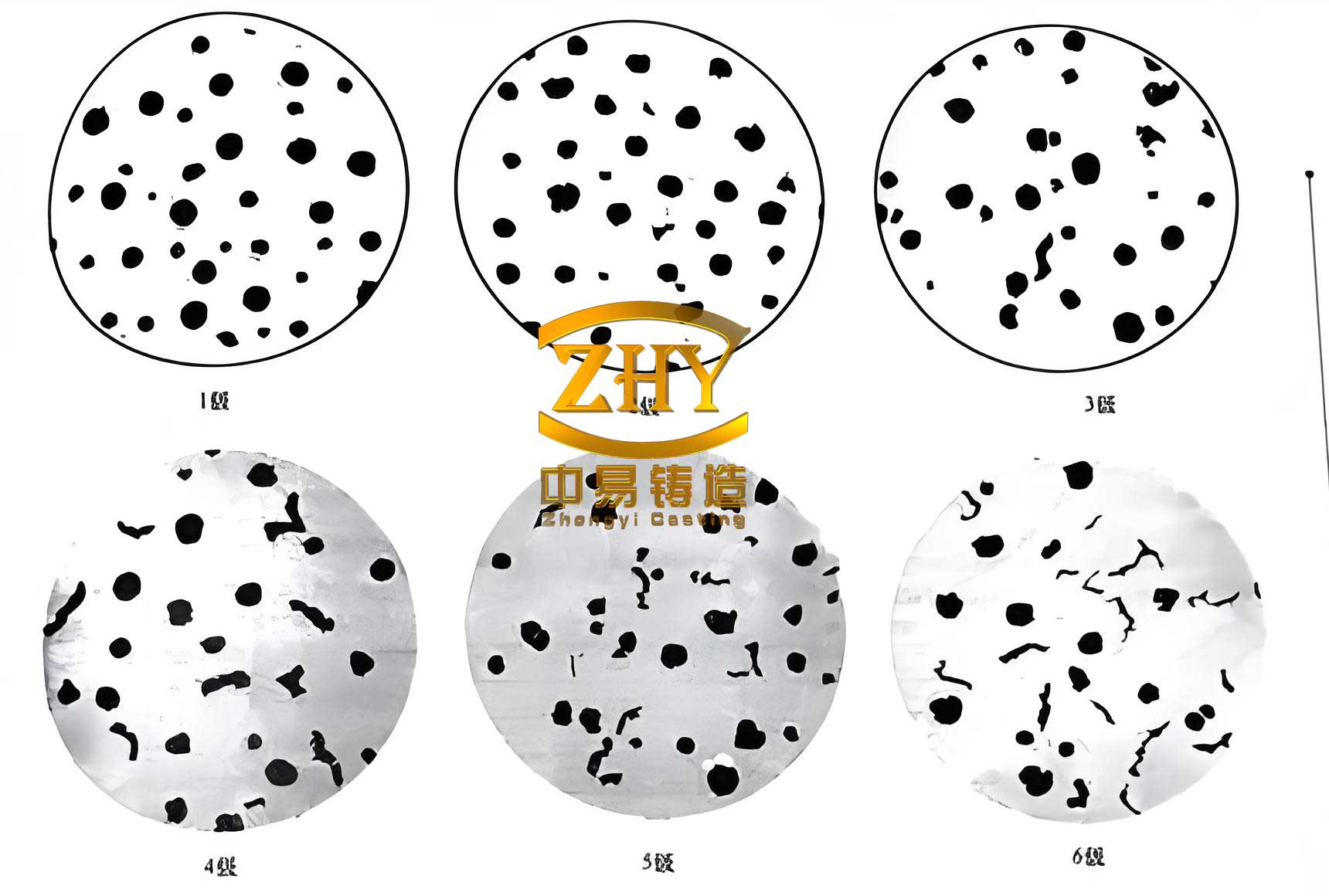
Subsurface blowholes in spheroidal graphite iron castings are typically small, rounded pores clustered beneath the casting surface, often caused by gas invasion during pouring. The formation mechanism involves gases from the mold or core penetrating the molten metal, where they become trapped as the metal solidifies. Factors influencing this include molten metal properties, mold conditions, and process parameters. For spheroidal graphite iron, which has unique metallurgical characteristics due to its graphite spheroidization, controlling these factors is critical to prevent defects.
Upon the occurrence of the defect, our company immediately halted production and convened a cross-functional team led by top management. The team was tasked with identifying the root cause within a week, regardless of cost, to ensure a fundamental resolution before resuming production. We initiated a detailed defect analysis, focusing on potential influencing factors based on the subsurface blowhole formation机理 and our specific production process for spheroidal graphite iron.
Defect Analysis and Potential Influencing Factors
The investigation centered on several key areas that could contribute to subsurface blowholes in spheroidal graphite iron castings. We considered variations in raw materials, molten iron temperature, sand mold gas evolution, iron mold venting, and other process changes. Each factor was evaluated for its impact on gas entrapment.
Raw Materials: Changes in raw materials can alter the molten iron’s characteristics, particularly surface tension. The surface tension of molten spheroidal graphite iron affects gas invasion susceptibility; higher surface tension resists gas penetration, while lower surface tension facilitates it. Elements like nitrogen (N) and oxygen (O) increase surface tension, whereas elements like fluorine (F) and silicon (Si) decrease it. We scrutinized any alterations in material batches or suppliers during the affected shifts.
Molten Iron Temperature: Higher pouring temperatures reduce the surface tension of molten spheroidal graphite iron, making it easier for gases to invade. Additionally, elevated temperatures increase gas generation within the mold, raising the likelihood of defect formation. The relationship can be approximated by the formula for surface tension dependence on temperature: $$\sigma = \sigma_0 – k(T – T_0)$$ where $\sigma$ is the surface tension, $T$ is the temperature, $\sigma_0$ is the reference surface tension at $T_0$, and $k$ is a material constant for spheroidal graphite iron.
Sand Mold Gas Evolution: The resin-coated sand used in our iron mold sand-coating process can generate gases during pouring. If the sand quality degrades or composition changes, gas evolution may increase, leading to higher gas pressure in the mold cavity and subsequent invasion into the molten spheroidal graphite iron.
Iron Mold Venting: Poor venting in the iron mold can trap gases, increasing internal pressure and forcing gases into the casting. Any modifications to the mold or pattern plates that impede venting could be a contributor.
Other Process Variables: Sudden batch defects often stem from an unplanned change in the production process. We reviewed all operational records and interviewed personnel to identify any deviations.
To systematically assess these factors, we compiled data from the affected and preceding shifts. The table below summarizes the key parameters investigated:
| Factor | Investigation Method | Result for Affected Shifts | Impact on Spheroidal Graphite Iron |
|---|---|---|---|
| Raw Materials | Batch records, supplier checks, spectral analysis | No changes in batches or suppliers; elemental composition within spec | No significant effect on surface tension or gas content |
| Molten Iron Temperature | Pyrometer calibration, pouring logs | Temperature recorded within process range (1540-1500°C) | Potential if temperature偏高, but records showed conformity |
| Sand Mold Gas Evolution | Resin sand配方 review, production logs | 配方 unchanged; no recorded deviations | Suspected due to catalyst overuse |
| Iron Mold Venting | Mold inspection, maintenance records | No modifications or blockages found | Not a direct cause |
| Process Changes | Operator interviews, shift logs | No reported abnormalities | Unlikely primary cause |
Production Process Investigation
Following the defect analysis, we conducted a thorough排查 of the production process. Each factor was examined in detail to isolate the cause.
Raw Materials排查: We verified that all raw materials for spheroidal graphite iron production—including pig iron, scrap, alloys, and inoculants—were from consistent batches. Carbon equivalent and major elements (C, Si, Mn, P, S) were within specified ranges, as confirmed by spectral analysis. Trace elements showed no notable variations, ruling out material-related issues.
Molten Iron Temperature Verification: Pouring temperatures were checked against工艺 requirements using calibrated pyrometers. Despite records indicating compliance, we suspected measurement errors. Cross-testing with multiple pyrometers yielded consistent readings. To further test the temperature hypothesis, we conducted experiments by gradually lowering the tapping temperature from 1540°C to 1500°C in 10°C increments. While lower temperatures induced slag inclusions due to reduced fluidity in spheroidal graphite iron, the subsurface blowholes persisted unchanged, indicating temperature was not the primary factor.
Resin Sand Quality Assessment: Our iron mold sand-coating process employs thermosetting resin sand, where hexamethylenetetramine (乌洛托品, (CH$_2$)$_6$N$_4$) serves as a curing catalyst. This compound can decompose at high temperatures to form ammonia (NH$_3$), which further dissociates into nitrogen and hydrogen gases: $$2NH_3 \rightarrow N_2 + 3H_2$$ These gases can invade the molten spheroidal graphite iron, creating small, rounded subsurface pores. We hypothesized that excessive hexamethylenetetramine in the resin sand might be the culprit.
Iron Mold Condition: Inspection of the iron molds and pattern plates revealed no alterations affecting venting. Regular maintenance had been performed, and no blockages were present.
Process Records Review: All production logs for molding, closing, and pouring showed no anomalies. Operator feedback indicated normal operations, and metallographic analysis of the castings confirmed acceptable graphite nodule count and size for spheroidal graphite iron.
Verification of Subsurface Blowhole Defects
Based on the排查, we narrowed the potential causes to two: molten iron temperature and resin sand issues. We designed verification experiments to test each.
Pouring Temperature Test: As mentioned, reducing the pouring temperature did not eliminate the defects in spheroidal graphite iron castings,反而 introducing slag issues. This ruled out temperature as the root cause.
Resin Sand Problem Verification: We focused on the resin sand, particularly hexamethylenetetramine content. Our company has a dedicated resin sand division responsible for reclaimed sand and coated sand production. We dispatched personnel to monitor the resin sand production process in real-time and produced a small batch strictly adhering to the standard工艺. This batch was used for trial production of spheroidal graphite iron crankshafts, resulting in zero subsurface blowholes. Repeating this with multiple small batches confirmed consistency. Subsequently, normal production resumed with the properly made resin sand, and no defects reoccurred.
This confirmed that the resin sand was the source of the problem. We isolated all existing resin sand inventory and investigated the production records for the affected batch.
Identification of Root Cause
Upon reviewing the resin sand division’s records, we found discrepancies in hexamethylenetetramine usage. The issuance records showed a 23% higher amount of hexamethylenetetramine than recorded in the production logs. This indicated that the operator had added excess catalyst违反 the工艺. To verify, we replicated the resin sand with the higher hexamethylenetetramine content (exceeding 15% of the resin weight) and used it for casting spheroidal graphite iron parts. Subsurface blowholes reappeared, confirming that excessive hexamethylenetetramine was the root cause.
The decomposition of hexamethylenetetramine at high temperatures generates substantial gases, which invade the molten spheroidal graphite iron during pouring. The reaction kinetics can be described by the Arrhenius equation for decomposition rate: $$k = A e^{-E_a/(RT)}$$ where $k$ is the rate constant, $A$ is the pre-exponential factor, $E_a$ is the activation energy, $R$ is the gas constant, and $T$ is the temperature. Overuse of the catalyst increases gas evolution beyond the mold’s venting capacity, leading to defect formation.
Corrective Measures Implemented
To prevent recurrence, we instituted several measures targeting resin sand control and process discipline for spheroidal graphite iron production.
Control of Hexamethylenetetramine Usage: The technical department revised the operating standard to cap hexamethylenetetramine at 15% of the resin weight. This limit was based on empirical tests to balance curing efficiency and gas evolution in spheroidal graphite iron casting.
Strict Adherence to工艺: We launched a company-wide campaign to enforce工艺 compliance, emphasizing the importance of following作业 standards. Penalties were established for violations, and training sessions were conducted to raise awareness.
Process Change Point Monitoring: We mandated thorough checks for any changes in raw materials, including verifying batch numbers against usage records and reconciling inventory issues with actual consumption. This ensures early detection of deviations in spheroidal graphite iron production.
The effectiveness of these measures is summarized in the table below:
| Measure | Implementation Detail | Impact on Spheroidal Graphite Iron Quality |
|---|---|---|
| Hexamethylenetetramine Limit | Max 15% of resin weight; regular audits | Reduced gas evolution, eliminated subsurface blowholes |
| 工艺 Enforcement | Training, penalties, supervision | Improved consistency in resin sand production |
| Change Point Tracking | Material batch verification, usage reconciliation | Early detection of anomalies, preventing batch defects |
Influence of Iron Mold Temperature
In January 2016, during another production run of 436 crankshafts made from spheroidal graphite iron, we encountered a recurrence of subsurface blowholes in 85 out of 832 castings (10.2%). Tracing the defective batches to specific pouring lots, we identified that the issue was linked to the third and fourth pours. Investigation revealed that the iron mold temperatures for these lots were significantly below the工艺 requirement of 200–280°C, ranging from 110°C to 170°C due to cold winter conditions affecting the production environment.
Low iron mold temperature can impair the curing of the resin sand, leaving uncured or “green” sand that generates excessive gases during pouring. The gas evolution rate $G$ can be modeled as a function of temperature: $$G = G_0 \cdot e^{-\frac{Q}{RT}}$$ where $G_0$ is a constant, $Q$ is the activation energy for gas generation, $R$ is the gas constant, and $T$ is the mold temperature. Lower temperatures reduce curing efficiency, increasing gas evolution and the risk of gas invasion into the molten spheroidal graphite iron.
We conducted an experiment: pre-heating the iron molds to the required temperature before use eliminated the defects, while using cold molds reproduced the subsurface blowholes. This confirmed that iron mold temperature is a critical factor for producing high-quality spheroidal graphite iron castings.
To mitigate this, we implemented pre-heating procedures for iron molds, ensuring they meet the temperature specification regardless of ambient conditions. This measure has proven effective in preventing subsurface blowholes in spheroidal graphite iron products, even in colder climates.
Conclusion and Lessons Learned
Through systematic investigation, we identified two key causes of subsurface blowholes in spheroidal graphite iron castings produced via the iron mold sand-coating process: excessive hexamethylenetetramine in resin sand and low iron mold temperatures. The root cause was operational misconduct in resin sand production, leading to overuse of the catalyst, while environmental factors exacerbated the issue through mold temperature variations.
Our corrective actions—capping hexamethylenetetramine usage, enforcing strict工艺 adherence, and implementing mold pre-heating—have successfully eliminated subsurface blowhole defects. Since then, no batch quality incidents have occurred, ensuring consistent production of defect-free spheroidal graphite iron components.
This experience underscores the importance of rigorous process control and continuous monitoring in foundry operations. For spheroidal graphite iron, which demands precise conditions for optimal properties, even minor deviations can lead to significant defects. By integrating these lessons into our quality management system, we have strengthened our capability to produce reliable spheroidal graphite iron castings for automotive applications.
Future work will focus on advanced monitoring techniques, such as real-time gas evolution sensors and automated temperature controls, to further enhance the robustness of the iron mold sand-coating process for spheroidal graphite iron. The principles learned here can also be applied to other casting alloys, contributing to overall foundry excellence.