
In my years of research and practical application in the manufacturing sector, I have witnessed firsthand the transformative impact of 3D printing, also known as additive manufacturing, on traditional industries. This technology, which builds objects layer by layer from digital models using materials like metal powders or plastics, has rapidly evolved to become a cornerstone of modern production. Its integration into fields such as aerospace, education, healthcare, and automotive has not only streamlined processes but also unlocked new possibilities for innovation. Particularly in the realm of casting parts, 3D printing is driving a paradigm shift, enabling faster development cycles, reduced costs, and enhanced design flexibility for complex components. This article delves into my experience applying 3D printing to the research and development of casting parts, with a focus on valve bodies, highlighting how this technology is reshaping the future of manufacturing.
The traditional casting process, especially for intricate casting parts, has long been fraught with challenges. As I have observed in numerous foundry settings, conventional sand casting with wooden patterns faces significant hurdles. For instance, creating molds for parts with complex曲面 structures often relies on skilled artisans manually carving wood, leading to difficulties in precision and consistency. Moreover, assembling multiple mold pieces introduces seams that can weaken the structure and affect the final quality of casting parts. The high costs associated with producing numerous patterns and core boxes for complex designs, coupled with labor-intensive operations like core assembly, result in prolonged lead times and inefficiencies. These limitations underscore the need for a more agile and precise approach to developing casting parts.
| Aspect | Traditional Casting with Wooden Patterns | 3D Printing-Based Casting |
|---|---|---|
| Design to Production Flow | Part Design → Pattern Design → Pattern Making → Pattern Inspection → Molding → Coring → Assembly → Pouring | Part Design → 3D Printing of Molds/Cores → Assembly → Pouring |
| Influence of Part Complexity | High complexity increases difficulty, cost, and time exponentially due to manual pattern making and assembly. | Complexity has minimal impact; each layer is a simple 2D contour, making it ideal for intricate casting parts. |
| Tooling Requirement | Requires physical patterns, core boxes, and fixtures, leading to high upfront costs and long lead times. | No tooling needed; direct digital fabrication reduces costs and accelerates iterations for casting parts. |
| Precision and Consistency | Dependent on artisan skill, prone to human error, and variability in final casting parts. | High precision driven by CAD models, ensuring consistent quality across all casting parts. |
| Environmental and Labor Impact | Labor-intensive, high material waste (e.g., wood), and potentially hazardous working conditions. | Automated processes reduce labor, minimize waste, and support greener production of casting parts. |
To quantify the advantages of 3D printing for casting parts, we can model the reduction in development time. Let \( T_{traditional} \) represent the total time for traditional casting and \( T_{3D} \) for 3D printing-based casting. Based on my projects, the time savings can be expressed as: $$ \Delta T = T_{traditional} – T_{3D} = \sum_{i=1}^{n} t_i^{traditional} – \sum_{j=1}^{m} t_j^{3D} $$ where \( n \) and \( m \) are the number of steps in each process, with \( n > m \) due to the elimination of pattern-making phases. For typical casting parts, I have found that \( \Delta T \) can be as high as 50%, significantly accelerating time-to-market. Furthermore, the cost efficiency can be modeled using a ratio: $$ C_{ratio} = \frac{C_{3D}}{C_{traditional}} $$ where \( C_{3D} \) and \( C_{traditional} \) are the total costs. In my valve body project, this ratio was approximately 0.25, indicating a 75% cost reduction for developing casting parts through 3D printing.
3D printing encompasses various technologies, each suited to different aspects of casting parts production. In my work, I have explored several key methods: Selective Laser Sintering (SLS) for printing wax patterns in investment casting, Stereolithography (SLA) for resin-based patterns, Fused Deposition Modeling (FDM) for plastic patterns to replace wood, Laminated Object Manufacturing (LOM) for paper-based patterns, and 3D Printing (3DP) or SLS for direct sand mold and core fabrication. Among these, direct sand printing via 3DP has proven exceptionally valuable for rapid prototyping of casting parts, as it bypasses pattern creation entirely, allowing for the direct production of molds and cores from digital designs. This capability is crucial for complex casting parts with internal cavities or thin walls, where traditional methods struggle.
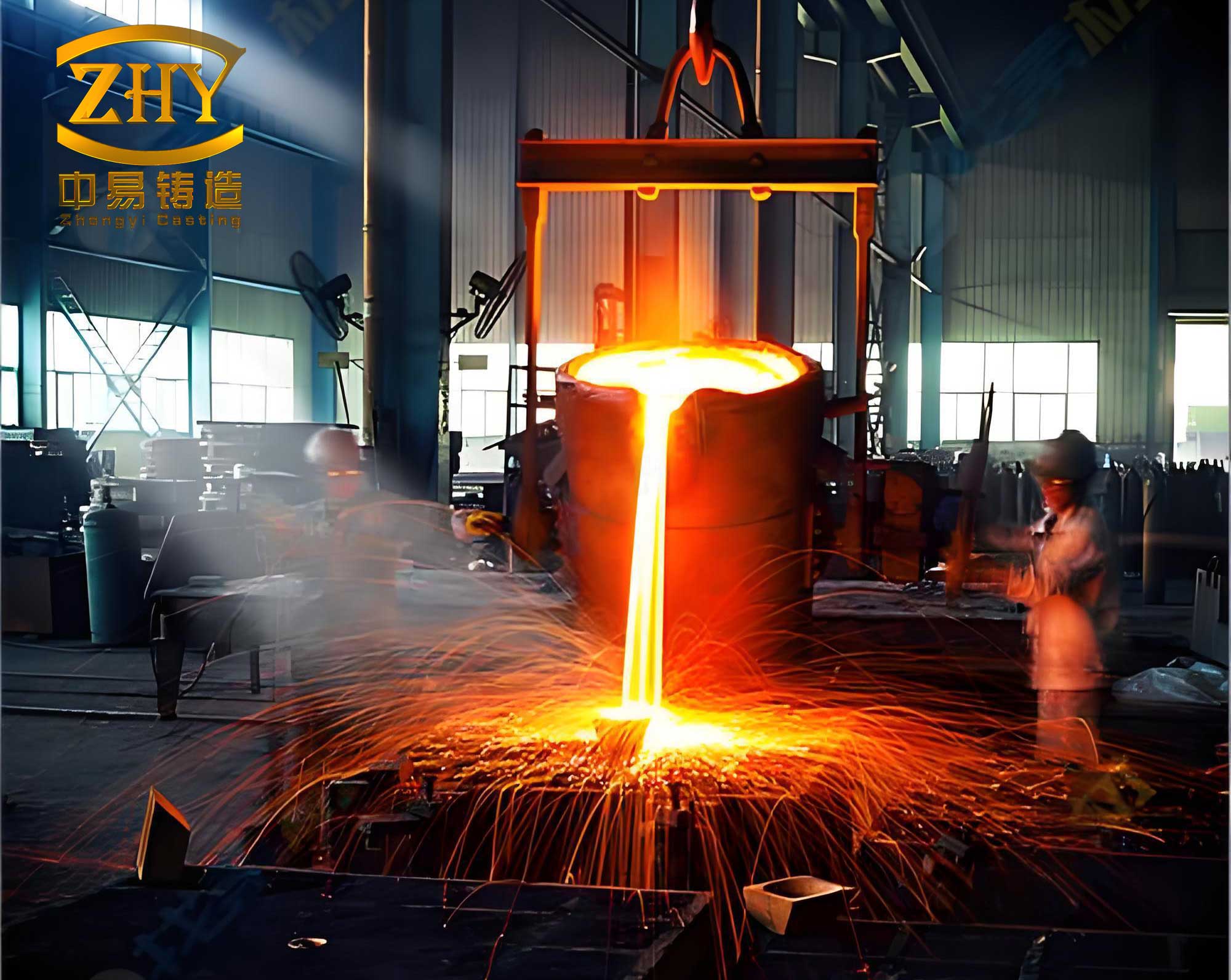
The image above illustrates the precision achievable in casting parts through advanced manufacturing techniques, akin to the outcomes possible with 3D printing. In my application, I focused on a valve body casting part made of aluminum alloy, with dimensions of 115 mm × 90 mm × 100 mm and variable wall thicknesses from 5 mm to 25 mm. This part required high integrity for pressure applications, necessitating leak-proof performance under 6.0 MPa hydraulic strength and 4.4 MPa pneumatic密封性 tests. Traditional approaches would involve multiple wooden patterns and core boxes, but I opted for 3DP sand printing to streamline the development of these casting parts.
For the valve body casting parts, I designed the sand molds and cores using CAD software, exporting them as STL files. The 3DP process involved using a quartz sand blend with an average fineness of 95–110 μm, mixed with a binder at 0.4% ratio. Key printing parameters were optimized to ensure quality: a layer thickness of 0.30 mm, print speed of 15 seconds per layer, and controlled curing to achieve a mold tensile strength of 2.55 MPa and low gas evolution of 10.8 mL/g. The printed sand molds and cores were then assembled, coated, and dried before pouring. The aluminum alloy (ZL102) was melted and poured at 695°C, with a浇注时间 of about 1 minute. After cooling and post-processing, the resulting casting parts were inspected for dimensional accuracy and performance.
| Parameter | Value | Impact on Casting Parts Quality |
|---|---|---|
| Sand Fineness (μm) | 95–110 | Influences surface finish and detail resolution of casting parts. |
| Layer Thickness (mm) | 0.30 | Thinner layers enhance precision but may increase print time for casting parts. |
| Print Speed (s/layer) | 15 | Balances efficiency with structural integrity of molds for casting parts. |
| Gas Evolution (mL/g) | 10.8 | Lower values reduce defects like porosity in final casting parts. |
| Tensile Strength (MPa) | 2.55 | Ensures mold stability during pouring for reliable casting parts. |
To assess the dimensional fidelity of the 3D-printed molds for casting parts, I employed 3D scanning and comparative analysis. The point cloud data from scans were processed to generate偏差 maps, showing deviations within ±0.3 mm across all sand components. This high accuracy is critical for producing casting parts that meet tight tolerances, especially for complex geometries like valve bodies. The relationship between printing parameters and dimensional error can be approximated by: $$ \epsilon = k \cdot \frac{h}{v} $$ where \( \epsilon \) is the error, \( h \) is layer thickness, \( v \) is print speed, and \( k \) is a material-dependent constant. By optimizing \( h \) and \( v \), I minimized \( \epsilon \) to ensure that the casting parts conformed to design specifications without the need for secondary adjustments.
The performance of the final casting parts was rigorously tested. The valve bodies underwent hydraulic pressure tests at 6.0 MPa for 3 minutes and pneumatic密封性 tests at 4.4 MPa for 3 minutes, with no leaks detected. This success demonstrates that 3D-printed molds can produce casting parts with mechanical properties equivalent to or better than those from traditional methods. The strength of casting parts can be modeled using the formula for hoop stress in pressure vessels: $$ \sigma = \frac{P \cdot r}{t} $$ where \( \sigma \) is the stress, \( P \) is the pressure, \( r \) is the radius, and \( t \) is the wall thickness. For the valve body casting parts, with \( P = 6.0 \) MPa, \( r \approx 50 \) mm, and \( t_{min} = 5 \) mm, the calculated stress is within safe limits for aluminum alloy, confirming the design adequacy achieved through 3D printing.
| Metric | Traditional Wooden Pattern Casting | 3D Printing Direct Sand Mold/Core | Improvement Factor |
|---|---|---|---|
| Development Cycle (days) | 6 | 3 | 2× faster |
| Total Cost (currency units) | 3200 | 800 | 4× cheaper |
| Number of Physical Tools | 5 (patterns, core boxes, etc.) | 0 | Complete elimination |
| Labor Intensity | High, manual skill-dependent | Low, automated process | Significant reduction |
| Quality Consistency | Variable, prone to human error | High, digitally controlled | Enhanced reliability for casting parts |
From this project, I concluded that 3D printing offers profound benefits for the research and development of casting parts. By eliminating the need for physical patterns, it simplifies workflows, reduces material waste, and cuts costs substantially. The agility to modify designs digitally and print new molds quickly allows for rapid iteration, which is invaluable for optimizing casting parts before mass production. Moreover, the precision of 3D printing ensures that even the most complex casting parts, such as those with internal channels or薄壁 structures, can be produced with high accuracy and repeatability. This technology also aligns with sustainable manufacturing goals by minimizing resource consumption and improving workplace conditions through automation.
Looking ahead, I believe that 3D printing will continue to evolve, with advancements in materials and multi-material printing further enhancing the capabilities for casting parts. Integration with artificial intelligence for process optimization and real-time monitoring could lead to even smarter foundries. For industries relying on high-performance casting parts, from automotive to energy, adopting 3D printing is not just an option but a strategic imperative to stay competitive. In my ongoing work, I am exploring hybrid approaches that combine 3D printing with traditional techniques to leverage the strengths of both, ensuring that casting parts meet ever-increasing demands for complexity, performance, and efficiency. The journey of innovating casting parts through 3D printing is just beginning, and I am excited to contribute to this transformative era in manufacturing.