
As an industry practitioner deeply involved in the foundry sector, I have witnessed a remarkable transformation in the production and application of large cast iron parts over recent decades. The drive towards industrialization and infrastructure development globally has placed immense emphasis on these foundational components, which are critical for heavy machinery, energy generation, and transportation. In this discourse, I aim to elaborate on the current state, challenges, and future directions for large cast iron parts, with a particular focus on the evolving demands for casting materials. The term “cast iron parts” will recur throughout, as these components are at the heart of modern manufacturing, and their advancement hinges on material innovation.
To begin, it is essential to define what constitutes large cast iron parts. In contemporary foundry practice, castings with a single weight exceeding 30 metric tons are generally classified as large. These massive components serve as the backbone for various industries, enabling the operation of equipment that powers our economy. The significance of large cast iron parts cannot be overstated; they are integral to sectors such as shipbuilding, power generation, mining, and construction, where durability, strength, and reliability are paramount. The development of these parts reflects broader technological progress, and as we move forward, the need for sophisticated casting materials becomes increasingly pressing.
| Industry Sector | Key Components | Common Cast Iron Materials | Weight Range (tons) |
|---|---|---|---|
| Shipbuilding | Crankshafts, cylinder liners, engine blocks | Ductile iron, gray iron | 30-150 |
| Power Generation (Thermal, Hydro, Nuclear, Wind) | Turbine housings, frames, hubs, bases | Ductile iron, high-strength gray iron | 30-200 |
| Machine Tool Manufacturing | Lathe beds,横梁 (beams), frames | Ductile iron, alloyed gray iron | 30-160 |
| Mining and Mineral Processing | Mill ends, grinding components, wear parts | Abrasion-resistant white iron, ductile iron | 30-120 |
| Petrochemical Industry | Reactor vessels, valves, piping segments | Ductile iron, corrosion-resistant alloys | |
| Urban Infrastructure | Large-diameter pipes and fittings | Ductile iron, gray iron | 20-100 |
The production landscape for large cast iron parts has evolved significantly, with numerous foundries in China and worldwide scaling up their capabilities. For instance, facilities specializing in heavy castings now routinely manufacture components weighing over 100 tons, such as machine tool beams and wind turbine hubs. These achievements underscore the advancements in molding techniques, melting processes, and quality control. However, the journey is not without hurdles; the sheer size of these cast iron parts introduces complexities in solidification, heat management, and defect prevention, which directly influence the choice and performance of casting materials.
Looking ahead, the development trajectory for large cast iron parts is closely tied to national and global industrial strategies. During recent planning periods, emphasis has been placed on achieving self-sufficiency in critical components, particularly for high-end applications like nuclear power and wind energy. The goal is to localize over 95% of production, reducing dependency on imports and fostering technological sovereignty. Concurrently, there is a strong push towards “green casting,” which entails minimizing environmental impact through energy-efficient processes, reduced emissions, and sustainable material usage. This paradigm shift necessitates a reevaluation of traditional casting materials and the adoption of novel solutions that align with circular economy principles—reduce, reuse, recycle, and remanufacture.
In the realm of casting materials, several technical issues arise specifically for large cast iron parts. The prolonged solidification times and high thermal masses inherent to these components can lead to defects such as shrinkage porosity, gas entrapment, and sand adhesion. To mitigate these, foundries employ specialized practices. For example, gating systems are often designed with multiple ingates in a bottom-pouring arrangement to ensure smooth filling and minimize turbulence. The use of insulating or exothermic risers is critical for effective feeding, and their placement must be optimized based on thermal analysis. Chills are strategically inserted to promote directional solidification, with their thickness typically ranging from 0.5 to 1.0 times the section thickness of the cast iron part. Moreover, core design must ensure adequate venting and strength to withstand metal pressure. These measures highlight the intricate interplay between process design and material properties.
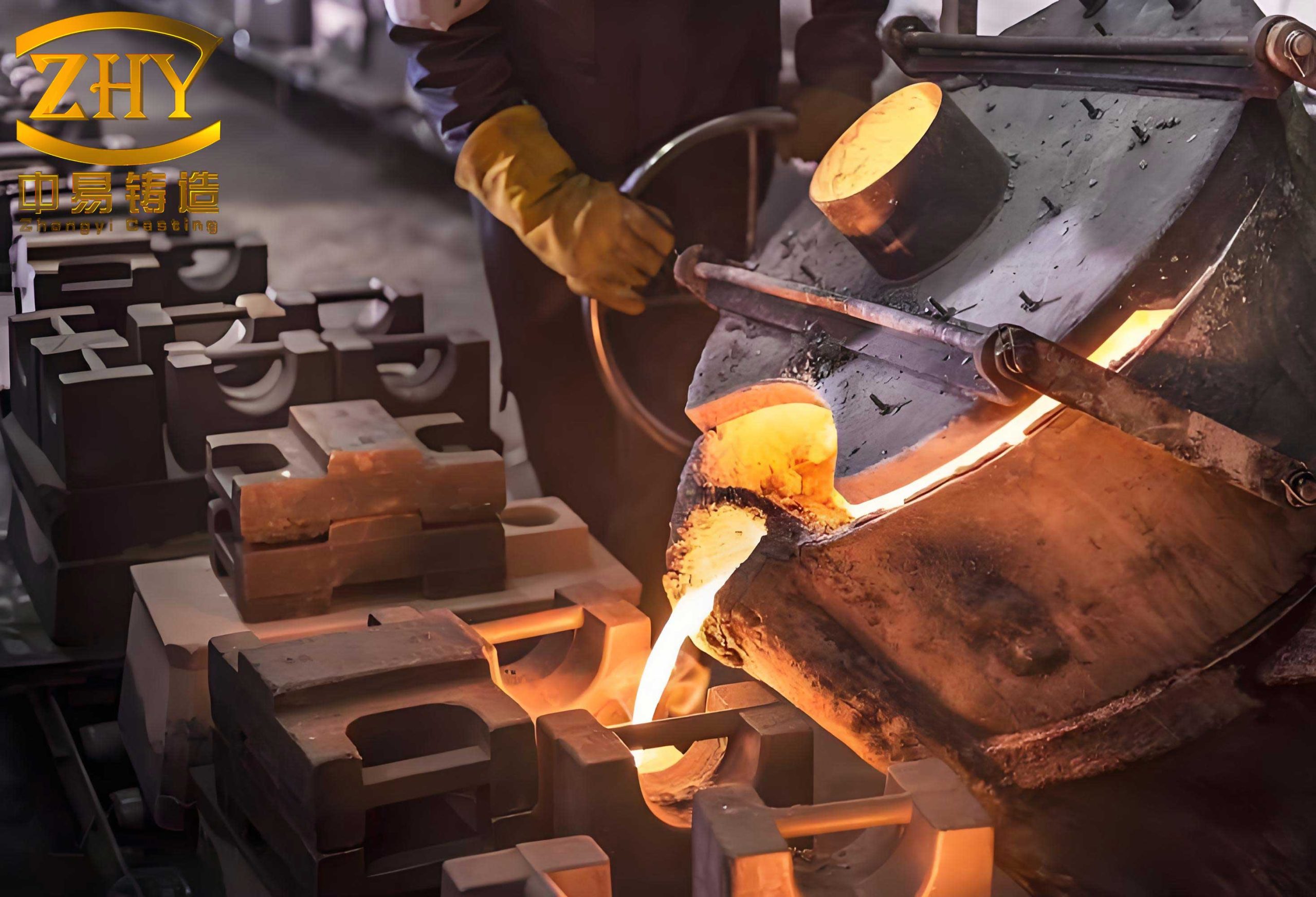
The selection and application of casting materials profoundly affect the quality, cost, and environmental footprint of large cast iron parts. Currently, furan resin-bonded sand is widely used for molding due to its excellent dimensional accuracy and ease of reclamation. However, concerns persist regarding the emission of volatile organic compounds (VOCs) during curing and pouring, which pose health risks and contribute to pollution. The nitrogen and sulfur contents in resins and hardeners can lead to gas-related defects, necessitating formulations with lower free formaldehyde and phenol. Coatings are another critical area; while zircon-based paints offer high refractoriness and prevent metal penetration, they may contain radioactive impurities and are costly. Traditional graphite coatings, though effective, generate dust during shakeout, impacting air quality. Thus, there is a clear demand for eco-friendly alternatives that maintain performance without compromising safety.
Regarding metallic inputs, the quality of pig iron is paramount for producing superior large cast iron parts. Domestic pig iron often contains elevated levels of trace elements like vanadium, titanium, arsenic, and lead, which can impair mechanical properties and promote carbide formation in thick sections. For applications requiring high toughness, such as wind turbine hubs, stringent control over manganese (below 0.3%) and other strong carbide formers is essential. This underscores the need for high-purity, low-residual pig iron to achieve consistent microstructure and performance in ductile iron castings. The equation below illustrates the influence of alloying elements on the tensile strength of cast iron, highlighting the importance of composition control:
$$ \sigma_t = \sigma_0 + k_1 \cdot \%C + k_2 \cdot \%Si + k_3 \cdot \%Mn + \sum (k_i \cdot \%X_i) $$
where $\sigma_t$ is the tensile strength, $\sigma_0$ is the base strength, $k_1, k_2, k_3$ are coefficients for carbon, silicon, and manganese, and $k_i$ represents the effect of other elements $X_i$ (e.g., Cr, Mo, Cu). Excessive residuals can alter these coefficients detrimentally, leading to reduced ductility and increased brittleness in large cast iron parts.
| Material Type | Key Advantages | Key Disadvantages | Typical Cost Impact (%) | Environmental Concerns |
|---|---|---|---|---|
| Furan Resin Sand | High precision, good collapsibility, reusable | VOC emissions, N/S content causes gas defects | 20-30 | Air pollution, health hazards |
| Zircon-based Coatings | Excellent refractoriness, minimal veining | High cost, potential radioactivity | 5-10 | Radioactive waste, mining impact |
| Graphite Coatings | Good thermal stability, easy application | Dust generation, adhesion issues | 3-7 | Particulate matter, respiratory risks |
| High-Purity Pig Iron | Low residuals, consistent properties | Limited domestic supply, higher price | 15-25 | Energy-intensive production |
| Insulating Riser Sleeves | Efficient feeding, reduces shrinkage | Disposal after use, cost additive | 5-7 | Non-biodegradable waste |
The cost structure of producing large cast iron parts is heavily influenced by material expenses, as outlined in Table 2. Foundries must balance performance with economics, especially when scaling up for massive castings. For instance, the use of advanced filters, inoculants, and nodularizing agents can add 5-10% to total costs, but they are indispensable for achieving sound microstructure and minimizing defects. To optimize this, research is directed towards developing cost-effective materials that do not sacrifice quality. For example, alternative binder systems based on phenolic or waterglass chemistry are being explored to reduce VOC emissions while maintaining strength. Similarly, the adoption of recycled sand and aggregates can lower raw material costs and environmental burden, aligning with green casting principles.
From a safety and environmental perspective, the production of large cast iron parts imposes significant demands on foundry operations. The prolonged exposure to fumes during pouring, which may contain carbon monoxide and organic volatiles, necessitates robust ventilation and personal protective equipment. Moreover, the disposal of spent sand and slag presents challenges for waste management. To address these, new material formulations aim to be low-emission and biodegradable. For instance, bio-based resins derived from renewable sources are gaining traction, offering reduced toxicity and easier reclamation. The integration of such materials into large-scale casting processes requires careful validation to ensure they meet the mechanical and thermal stresses encountered during the production of heavy cast iron parts.
In terms of resource efficiency, the concept of circularity is becoming central to material development for cast iron parts. This involves designing materials for easy separation and reuse, such as sand with enhanced durability for multiple cycles. Mathematical modeling aids in this endeavor; for example, the solidification behavior can be predicted using finite element analysis to minimize trial runs and material waste. One key formula used in feeding design is the modulus method for riser sizing:
$$ M_r = 1.2 \cdot M_c $$
where $M_r$ is the riser modulus and $M_c$ is the casting modulus, defined as volume divided by cooling surface area. Proper application of such principles ensures adequate compensation for shrinkage without overusing riser material, thereby conserving resources in the production of large cast iron parts.
The future demands on casting materials for large cast iron parts can be categorized into four pillars: quality enhancement, cost reduction, safety improvement, and environmental sustainability. For quality, materials must enable superior surface finish, dimensional stability, and internal soundness, even in thick sections. This calls for refined inoculants that promote uniform graphite nucleation in ductile iron, as described by the equation for nodule count:
$$ N = N_0 \cdot e^{-Q/RT} $$
where $N$ is the nodule count, $N_0$ is a pre-exponential factor, $Q$ is the activation energy for nucleation, $R$ is the gas constant, and $T$ is the temperature. Advances in alloy design and melt treatment can optimize these parameters, leading to better performance of cast iron parts under load.
Cost-wise, materials should be affordable and locally sourced to reduce logistics expenses. This may involve developing domestic alternatives to imported high-purity pig iron or creating composite materials that offer similar properties at lower cost. For safety, low-fume coatings and binders are essential to protect worker health and comply with stringent regulations. Environmentally, materials must support closed-loop systems, with high recyclability and minimal ecological footprint. For instance, water-based, non-toxic coatings that decompose harmlessly are under development to replace solvent-based options.
| Requirement Category | Specific Targets | Potential Material Solutions | Expected Impact on Cast Iron Parts |
|---|---|---|---|
| Quality Enhancement | Reduced shrinkage porosity, improved toughness | Nanostructured inoculants, advanced filters | Higher reliability in critical applications |
| Cost Reduction | Lower binder consumption, efficient riser designs | High-ductility resins, exothermic composites | Competitive pricing for global markets |
| Safety Improvement | Minimized fume emissions, non-hazardous handling | Bio-based binders, low-VOC coatings | Healthier workplace, regulatory compliance |
| Environmental Sustainability | Zero-waste sand reclamation, reduced CO₂ footprint | Recyclable aggregates, energy-efficient melting | Green certification, long-term viability |
To realize these goals, collaboration across the supply chain is vital. Material suppliers, foundries, and end-users must work together to test and deploy innovative solutions. Pilot projects focusing on large cast iron parts, such as those for wind energy or nuclear waste containers, can serve as benchmarks for performance. Additionally, digital tools like simulation software can optimize material usage by predicting flow patterns and thermal gradients, thereby reducing scrap rates. The integration of Industry 4.0 technologies, such as IoT sensors for real-time monitoring of sand properties or melt chemistry, will further enhance the consistency and quality of cast iron parts.
In conclusion, the evolution of large cast iron parts is inextricably linked to advancements in casting materials. As we strive to meet the demands of modern industry—be it for heavier, more complex components or for greener, more efficient processes—the role of materials becomes ever more critical. By embracing innovation in resin systems, coatings, metallic inputs, and auxiliary products, the foundry sector can overcome current limitations and unlock new possibilities. The journey towards producing flawless, cost-effective, and environmentally benign cast iron parts is challenging, but with sustained research and adoption of best practices, it is entirely achievable. The future of large cast iron parts shines bright, driven by material science that balances performance with planetary stewardship.