
In my many years of experience working in foundries, I have often observed that the production of cast iron parts is fraught with complexities. Numerous factors interplay during the casting process, making these components susceptible to a variety of defects. Among the most common and troublesome issues is porosity, specifically gas porosity. Other defects like shrinkage cavities, shrinkage porosity, deformation, cracks, sand inclusions, erosion, and sand burn-on also occur, but my focus here is to delve deeply into the origins and prevention of gas holes in gray cast iron parts. This phenomenon arises primarily due to gases becoming trapped within the molten metal during solidification. Understanding and controlling this is crucial for producing high-integrity cast iron parts.
When molten iron is poured into a mold, a significant amount of gas is generated. This includes air from the mold cavity, water vapor from the evaporation of moisture in the molding sand, gases volatilized from coal dust and coatings, and gases precipitated from the iron melt itself. If these gases enter the molten iron and fail to escape before solidification, they form pores within the casting. Typically, these gas pores appear spherical or pear-shaped with smooth walls, distinguishing them from the rough-walled shrinkage cavities. To systematically analyze porosity, I classify gas holes based on the source of the gas into three main categories: entrapped air porosity,侵入气孔 (which I will refer to as gas invasion porosity), and precipitated gas porosity. Each type has distinct mechanisms and requires specific countermeasures, which I will explore in detail, using tables and formulas to summarize key points.
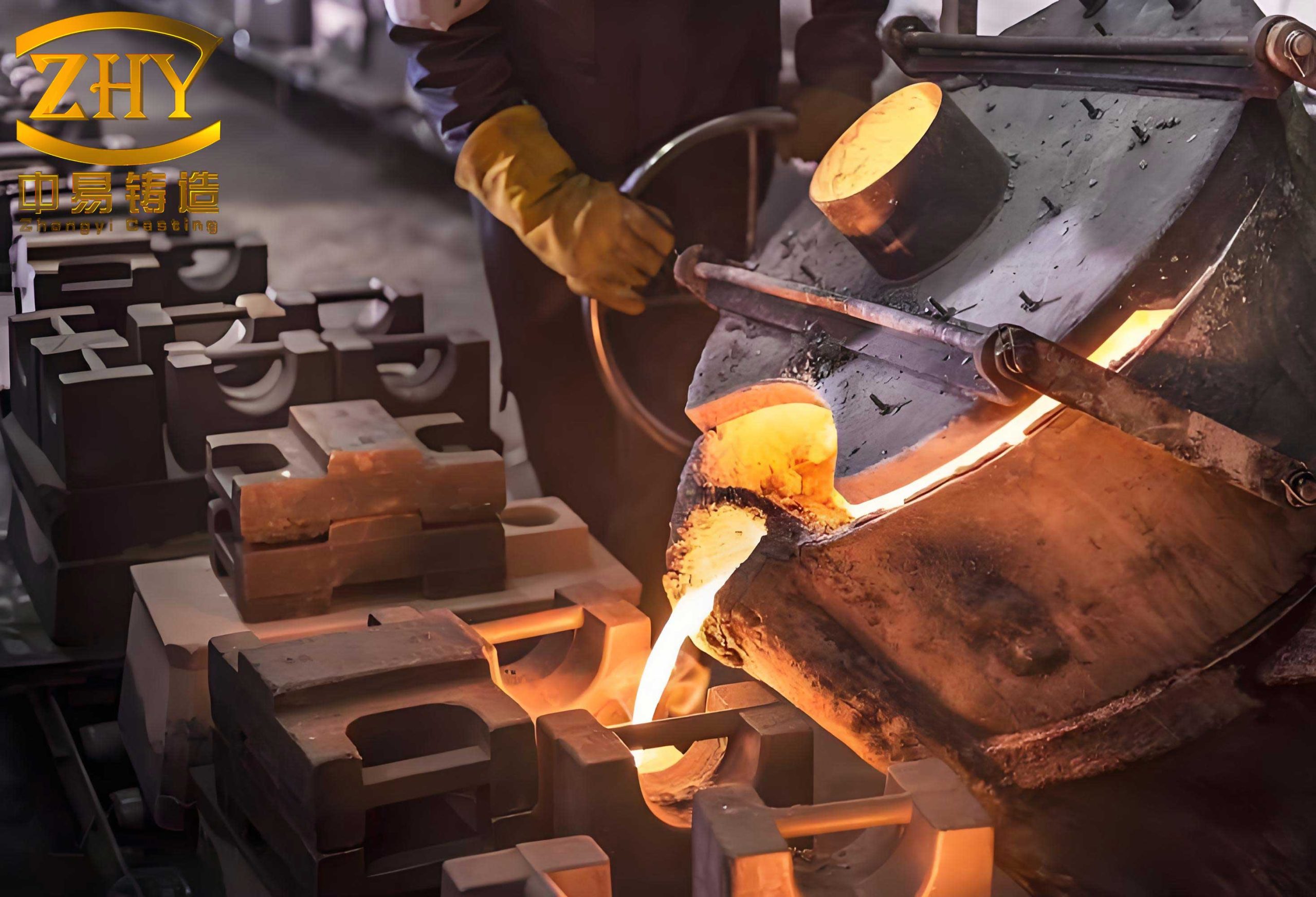
The quality of cast iron parts is paramount, and porosity directly compromises their mechanical properties and aesthetic appeal. Throughout this discussion, I will emphasize practical insights gained from the shop floor, aiming to provide a comprehensive guide for fellow practitioners. Let’s begin with the first type: entrapped air porosity.
Entrapped Air Porosity
Entrapped air porosity occurs when air bubbles are captured within the molten iron during mold filling. A common analogy is pouring tap water into a basin: when the water stream impacts the surface, it creates a depression that traps air, forming bubbles that rise and burst. Similarly, in casting, if the molten iron stream falls directly onto an existing metal pool in the mold, it can entrain air bubbles. If the surface of the iron does not freeze rapidly, these bubbles may float out. However, if solidification begins before bubbles escape, they become permanent defects in the cast iron parts. Besides direct pouring, high-velocity flow or turbulent filling—such as from a gate causing splashing—can also entrap air. The resulting pores are usually spherical and located in upper sections of the casting.
The risk of entrapped air porosity is influenced by several hydrodynamic factors. The冲击力 (impact force) of the liquid stream is proportional to the height of fall and the cross-sectional area of the stream. This can be expressed by a simplified relation:
$$ F \propto h \times A $$
where \( F \) is the impact force, \( h \) is the falling height, and \( A \) is the cross-sectional area. A greater force drives bubbles deeper, reducing their chance of escape. Therefore, for tall cast iron parts, top gating is generally unsuitable as it promotes both porosity and mold erosion. Instead, methods like middle gating, bottom gating, or step gating are preferred. If top pouring is necessary for feeding purposes, a shower gate (rain gate) system is advisable, as it disperses the stream into multiple thin flows, reducing impact:
$$ F_{\text{shower}} \approx \frac{F_{\text{single}}}{n} $$
where \( n \) is the number of streams, significantly lowering defect potential.
Another critical factor is the velocity of molten iron entering the mold cavity. The velocity \( v \) at the gate is related to the metallostatic pressure \( P \) there:
$$ v \propto \sqrt{P} $$
Higher pressure, such as from a fully filled sprue, leads to喷射 (jetting) and splashing. For bottom-gated cast iron parts, starting the pour slowly to keep the sprue unfilled initially reduces pressure and velocity. Once the mold cavity level rises above the gate, faster pouring becomes safe. Additionally, gate design should promote平稳 (smooth) flow; a tapered or reduced cross-section gate can minimize turbulence. Pouring temperature also plays a role: lower temperatures increase viscosity, slowing bubble ascent and hastening surface freezing. Thus, maintaining adequate fluidity is essential. The table below summarizes key measures to prevent entrapped air porosity in cast iron parts.
| Factor | Problem | Preventive Measure | Rationale |
|---|---|---|---|
| Pouring Height | High impact entrains air | Use bottom/middle gating or shower gates | Reduces impact force \( F \propto h \times A \) |
| Flow Velocity | Jetting causes turbulence | Control initial pour speed; design tapered gates | Lowers velocity \( v \propto \sqrt{P} \) |
| Pouring Temperature | Low viscosity traps bubbles | Ensure sufficiently high temperature | Enhances bubble buoyancy and fluidity |
| Mold Venting | Trapped air increases pressure | Add vents or risers at high points | Allows air escape, preventing back-pressure |
Apart from direct entrapment, inadequate mold venting can cause similar issues. As molten iron fills the cavity, displaced air must escape through sand pores or parting lines. If pouring is rapid and sand permeability is low, air pressure builds up, potentially forcing gas into the iron or even causing blowbacks. This often leads to mistruns in high sections of cast iron parts. To prevent this, vents or risers should be placed at the mold’s highest points. In metal mold casting, venting is even more critical for defect-free cast iron parts.
Gas Invasion Porosity
Gas invasion porosity results from gases generated by the mold or core materials invading the molten iron. When hot iron contacts the sand surface, the adjacent sand layer heats rapidly, causing moisture evaporation, clay dehydration, and volatilization of additives. This produces a gas layer at the interface with significant pressure \( P_g \). If this pressure exceeds the resistance to gas entry into the iron, gas invades, forming pores. These are often pear-shaped, with the small end pointing to the gas source (e.g., a core). They typically appear near mold or core surfaces in localized areas of cast iron parts.
The gas pressure \( P_g \) depends mainly on the gas evolution rate of the sand and its permeability. A higher evolution rate and lower permeability increase pressure, while the opposite reduces it. The resistance to invasion \( R \) varies during pouring: it starts low (due to low metallostatic head) and increases as the iron rises and the surface begins to solidify. Once a frozen skin forms, invasion stops. Thus, the critical period is from pouring until skin formation. The balance can be expressed as:
$$ P_g > R(t) \quad \text{leads to invasion} $$
where \( R(t) \) increases with time \( t \). Prevention focuses on minimizing \( P_g \). Key measures involve sand preparation and mold design.
First, for green sand molds, control moisture content strictly. Replace clay with bentonite as a binder to reduce gas evolution, and use uniform, fine sand with low ash content. Proper mulling and aging improve properties. The goal is to achieve adequate strength while minimizing gas evolution and maximizing permeability. For thick or large cast iron parts, green sand may be insufficient; dry sand or skin-dried molds are better, as baking reduces gas and increases permeability via micro-cracks. Second, poking vent holes in the mold enhances permeability dramatically, allowing gas to channel out. In pit molding, ensure under-ventilation to prevent dangerous gas buildup. Cores, surrounded by iron, are prone to gas generation; thus, core vents must be畅通 (unobstructed) and connected to the exterior. Igniting vented gases (which often contain CO) is beneficial, as the flame creates a draft, accelerating removal and lowering \( P_g \). Also, cold metals like chills or chaplets can adsorb moisture; pre-heating them prevents steam generation and subsequent porosity in cast iron parts. The table below outlines factors affecting gas invasion.
| Aspect | Influence on Gas Pressure \( P_g \) | Optimal Practice for Cast Iron Parts | Mathematical Relation (Simplified) |
|---|---|---|---|
| Sand Moisture | Higher moisture increases \( P_g \) | Minimize water content; use bentonite | \( P_g \propto W_{\text{water}} \) |
| Sand Permeability | Lower permeability raises \( P_g \) | Use uniform sand; add vents | \( P_g \propto \frac{1}{\kappa} \), where \( \kappa \) is permeability |
| Mold Condition | Green sand vs. dry sand | Use dry/skin-dried molds for heavy sections | \( P_g^{\text{dry}} \ll P_g^{\text{green}} \) |
| Core Venting | Poor venting traps gas | Ensure open vent channels | \( P_g \propto \frac{Q_{\text{gas}}}{A_{\text{vent}}} \), with \( Q_{\text{gas}} \) as gas flow |
| Metal Chills | Moisture adsorption causes local \( P_g \) | Pre-heat chills and chaplets | \( P_g \propto H_{\text{humidity}} \) |
From my实践 (practice), I recall an instance where improving core venting reduced rejection rates of complex cast iron parts by over 30%. The gas invasion process can be modeled as a transient diffusion problem, where the gas flux \( J \) into the iron is given by:
$$ J = -D \frac{\partial C}{\partial x} $$
but with the driving force being the pressure differential. For practical purposes, maintaining low \( P_g \) through sand control is the cornerstone.
Precipitated Gas Porosity
Precipitated gas porosity occurs when gases dissolved in the molten iron precipitate during solidification, often resulting in均匀 (uniform) pores throughout the casting cross-section. In gray cast iron, this is less common but can arise from two main scenarios: excessive oxidation of the melt or hydrogen absorption. Both are critical to address for quality cast iron parts.
First, if the iron is overly oxidized during melting, it contains high levels of iron oxide (FeO). During solidification, FeO reacts with carbon in the iron to produce carbon monoxide (CO) gas via the reaction:
$$ \text{FeO} + \text{C} \rightarrow \text{Fe} + \text{CO} \uparrow $$
This internally generated CO forms pores if trapped. Prevention involves careful melting practices: avoid heavily rusted charge materials (rust is Fe₂O₃), minimize use of burnt scrap (high in oxide), control blast volume in cupolas, maintain proper coke bed height, and prevent bridging or cold drops. Second, hydrogen absorption can cause precipitation. At high temperatures, iron can react with water vapor to form hydrogen, which dissolves:
$$ \text{Fe} + \text{H}_2\text{O} \rightarrow \text{FeO} + 2\text{H} \quad \text{and} \quad \text{H}_2 \rightleftharpoons 2\text{H} \text{ (dissolved)} $$
If hydrogen solubility is exceeded upon cooling, it precipitates as pores. To prevent this, ensure charge materials are dry, and furnace ladles are thoroughly dried. Also, avoid aluminum contamination in scrap, as even trace铝 (aluminum, e.g., 0.01%) accelerates hydrogen absorption, leading to severe porosity in cast iron parts.
Distinguishing between oxidation-based and hydrogen-based porosity can be done by a simple test: add a small amount of aluminum (e.g., 0.1%) to the melt. If pores diminish, oxidation is the cause (Al acts as a deoxidizer); if pores worsen, hydrogen is implicated. This highlights the nuanced nature of defect diagnosis in cast iron parts production. The following formula summarizes the gas precipitation threshold:
$$ C_{\text{gas}} > C_{\text{solubility}}(T) $$
where \( C_{\text{gas}} \) is the gas concentration in the melt, and \( C_{\text{solubility}} \) decreases with temperature \( T \) during solidification. Table 3 compares the two precipitation mechanisms.
| Type | Primary Cause | Chemical Reaction | Preventive Measures for Cast Iron Parts | Detection Method |
|---|---|---|---|---|
| Oxidation-Induced | Excessive FeO in melt | \( \text{FeO} + \text{C} \rightarrow \text{Fe} + \text{CO} \) | Use clean charge; control melting atmosphere | Add Al; if pores reduce, it’s oxidation |
| Hydrogen-Induced | H₂ absorption from moisture | \( \text{H}_2\text{O} + \text{Fe} \rightarrow \text{FeO} + 2\text{H} \) | Dry materials and equipment; avoid Al contamination | Add Al; if pores increase, it’s hydrogen |
In cupola melting for cast iron parts, I’ve seen that maintaining a consistent coke ratio and avoiding damp limestone can mitigate both issues. The solubility of hydrogen in iron follows Sievert’s law:
$$ C_{\text{H}} = K \sqrt{P_{\text{H}_2}} $$
where \( K \) is a temperature-dependent constant. Thus, reducing water vapor partial pressure in the environment is key.
Integrated Prevention Strategies and Quantitative Insights
To consistently produce sound cast iron parts, a holistic approach is necessary, combining insights from all porosity types. This involves optimizing gating design, sand properties, melting parameters, and pouring techniques. Let me synthesize this with some quantitative models and tables. First, consider the overall gas balance during casting. The total gas volume \( V_{\text{total}} \) in the system includes air, evolved gases, and dissolved gases. For defect-free cast iron parts, we aim to ensure that the escape rate \( \dot{V}_{\text{escape}} \) exceeds the trapping rate \( \dot{V}_{\text{trap}} \) until solidification time \( t_s \):
$$ \int_0^{t_s} \dot{V}_{\text{escape}} \, dt > \int_0^{t_s} \dot{V}_{\text{trap}} \, dt $$
This integral approach underscores the importance of time-dependent factors like solidification rate and gas evolution profiles.
For gating design, empirical rules exist. The Reynolds number \( Re \) for flow in gates should be kept below critical to avoid turbulence:
$$ Re = \frac{\rho v d}{\mu} $$
where \( \rho \) is density, \( v \) velocity, \( d \) hydraulic diameter, and \( \mu \) viscosity. For laminar flow in cast iron parts, \( Re < 2000 \) is desirable. Similarly, the pouring time \( t_p \) can be estimated using Bernoulli’s principle for bottom gating:
$$ t_p \approx \frac{A_{\text{mold}} h_{\text{mold}}}{A_{\text{gate}} \sqrt{2g h_{\text{sprue}}}} $$
where \( A \) are areas and \( h \) heights. Optimizing this minimizes air entrapment.
Sand properties are equally quantifiable. The gas evolution rate \( G \) (in cm³/g) can be measured via standard tests, and permeability \( \kappa \) (in units of darcy) affects pressure buildup. A simple relation for pressure rise \( \Delta P \) in a mold with low venting is:
$$ \Delta P = \frac{G \cdot \rho_{\text{sand}} \cdot V_{\text{mold}}}{\kappa \cdot A_{\text{vent}} \cdot t} $$
where \( \rho_{\text{sand}} \) is sand density, \( V_{\text{mold}} \) mold volume, \( A_{\text{vent}} \) vent area, and \( t \) time. This shows why increasing \( \kappa \) or \( A_{\text{vent}} \) is vital for cast iron parts.
Below is a comprehensive table summarizing defect causes and solutions across all porosity types, emphasizing the repetitive focus on cast iron parts.
| Porosity Type | Primary Mechanism | Key Parameters | Prevention Techniques | Impact on Cast Iron Parts |
|---|---|---|---|---|
| Entrapped Air | Air inclusion during filling | Pouring height \( h \), velocity \( v \), temperature \( T \) | Use bottom gating, shower gates, control pour speed, ensure high \( T \) | Reduces spherical pores in upper sections |
| Gas Invasion | Gas from mold/core invasion | Gas pressure \( P_g \), sand permeability \( \kappa \), evolution \( G \) | Control sand moisture, add vents, use dry molds, ignite gases | Minimizes pear-shaped pores near surfaces |
| Precipitated (Oxidation) | CO formation from FeO + C | FeO concentration, melting conditions | Use clean charge, control cupola blast, avoid oxidation | Prevents uniform CO pores throughout |
| Precipitated (Hydrogen) | H₂ precipitation from dissolution | H solubility, moisture content, Al presence | Dry materials, avoid Al contaminants, pre-heat ladles | Avoids fine hydrogen pores in matrix |
Furthermore, statistical process control can be applied. For instance, monitoring the density of cast iron parts before and after process changes can quantify porosity reduction. The density \( \rho_{\text{part}} \) relates to porosity fraction \( f \) by:
$$ \rho_{\text{part}} = \rho_{\text{iron}} (1 – f) $$
where \( \rho_{\text{iron}} \approx 7.2 \, \text{g/cm}^3 \). Aiming for \( f < 0.01 \) is typical for quality cast iron parts.
Advanced Considerations and Future Directions
In modern foundries, producing high-integrity cast iron parts involves advanced techniques like simulation software to model fluid flow and solidification. These tools solve Navier-Stokes equations coupled with heat transfer:
$$ \rho \left( \frac{\partial \mathbf{v}}{\partial t} + \mathbf{v} \cdot \nabla \mathbf{v} \right) = -\nabla p + \mu \nabla^2 \mathbf{v} + \mathbf{f} $$
and
$$ \frac{\partial T}{\partial t} + \mathbf{v} \cdot \nabla T = \alpha \nabla^2 T $$
where \( \mathbf{v} \) is velocity, \( p \) pressure, \( \mathbf{f} \) body forces, \( T \) temperature, and \( \alpha \) thermal diffusivity. Such simulations predict potential porosity sites, allowing proactive design adjustments for cast iron parts.
Another aspect is the role of inoculants and alloys. Adding elements like silicon or rare earths can modify solidification behavior, reducing gas solubility or promoting finer microstructure that traps less gas. For example, the effect of silicon on hydrogen solubility can be approximated by:
$$ \log C_{\text{H}} = A – \frac{B}{T} + \sum_i k_i [\% i] $$
where \( k_i \) are interaction coefficients. This highlights how composition control aids in making sound cast iron parts.
Environmental factors also matter. In humid climates, extra drying of sands and ladles is crucial. I’ve observed that maintaining a foundry ambient humidity below 60% significantly cuts hydrogen-related defects in cast iron parts. Moreover, recycling sand must be managed to prevent buildup of fines that reduce permeability.
To encapsulate, the journey to defect-free cast iron parts is multifaceted. It demands attention to every stage: from melting and material selection to mold preparation and pouring. By understanding the underlying physics and chemistry—summarized through formulas and tables—we can implement robust practices. Whether it’s adjusting a gate size, tweaking sand mix, or monitoring furnace atmosphere, each action contributes to minimizing porosity. The constant repetition of “cast iron parts” in this discussion underscores its centrality; after all, our goal is to produce durable, reliable cast iron parts for diverse applications. Through continuous learning and application of these principles, foundry workers can significantly enhance quality and efficiency, ensuring that cast iron parts meet the highest standards.