
In recent years, the development of engines has been driven by demands for higher efficiency and lower emissions. This trend necessitates continuous improvements in the performance of key components such as cylinder blocks and cylinder heads, which are typically manufactured as cast iron parts. Traditional materials like gray cast iron and aluminum alloys are increasingly inadequate for meeting the requirements of next-generation engines. Consequently, there is a growing need to develop and apply high-strength alloyed gray cast iron, compacted graphite iron, and ductile cast iron in these critical cast iron parts. Supporting this advancement requires reliable methods for assessing material properties, particularly graphite morphology, which significantly influences mechanical performance. Conventional metallographic analysis, while直观, is inefficient and destructive due to its reliance on sampling. Therefore, exploring rapid, convenient, and economical nondestructive testing techniques for graphite structure evaluation in cast iron parts holds substantial engineering significance. In this article, we delve into the principles and applications of ultrasonic testing based on sound velocity measurements, offering a practical solution for characterizing graphite morphology in various cast iron parts.
The core idea revolves around the fact that ultrasonic wave propagation speed varies with the material’s intrinsic properties. Specifically, the velocity of ultrasound in a medium depends primarily on the material’s Young’s modulus \(E\), density \(\rho\), and Poisson’s ratio \(\sigma\). For cast iron parts, the density and Poisson’s ratio exhibit relatively minor variations across different grades. For instance, gray cast iron typically has \(\rho\) ranging from 6.95 to 7.35 g/cm³ and \(\sigma\) from 0.23 to 0.27; compacted graphite iron has \(\rho\) from 7.25 to 7.35 g/cm³ and \(\sigma\) from 0.26 to 0.27; and ductile cast iron has \(\rho\) from 6.9 to 7.5 g/cm³ and \(\sigma\) from 0.25 to 0.29. Thus, the dominant factor affecting ultrasonic velocity in these cast iron parts is the elastic modulus \(E\), which in turn correlates strongly with graphite morphology, size, and distribution.
Graphite in cast iron parts exists in various forms: flake-like in gray iron, vermicular (compacted) in compacted graphite iron, and spheroidal in ductile iron. As the morphology transitions from flakes to vermicular and then to spheroids, the elastic modulus increases due to changes in graphite surface area and atomic bonding efficiency. This relationship can be expressed conceptually: the elastic modulus \(E\) decreases with higher graphite content for a given morphology, but for the same graphite content, ductile iron with spheroidal graphite exhibits a higher modulus than compacted graphite iron with vermicular graphite, which in turn is higher than gray iron with flake graphite. This implies that ultrasonic velocity, being proportional to \(\sqrt{E/\rho}\), will differ among these materials, providing a basis for nondestructive evaluation.
To quantify this, we consider the fundamental equations for ultrasonic wave propagation in solids. Ultrasound can propagate as shear waves (transverse waves) or longitudinal waves, depending on the particle displacement direction relative to wave propagation. In cast iron parts, which are solid media, both wave types can be utilized, but longitudinal waves are often preferred for thicker sections due to their higher velocity. The shear wave velocity \(C_L\) and longitudinal wave velocity \(C_S\) are given by:
$$C_L = \sqrt{\frac{E}{2\rho(1+\sigma)}}$$
$$C_S = \sqrt{\frac{E(1-\sigma)}{\rho(1+\sigma)(1-2\sigma)}}$$
From these, the ratio of longitudinal to shear wave velocity is:
$$\frac{C_S}{C_L} = \sqrt{\frac{2(1-\sigma)}{1-2\sigma}}$$
For typical cast iron parts with \(\sigma \ll 1\), \(C_S\) is approximately twice \(C_L\). Since \(E\) varies with graphite morphology, measuring \(C_S\) or \(C_L\) allows us to infer the graphite structure. In practice, ultrasonic testing devices, such as velocity-thickness gauges, operate by emitting a pulse and measuring the time interval between echoes from parallel surfaces. If the thickness \(d\) of the cast iron part is known, the sound velocity \(v\) can be calculated using:
$$t_n = \frac{2d}{v} \quad \text{or} \quad v = \frac{2d}{t_2 – t_1}$$
where \(t_n\) is the time difference between echoes, and \(t_1\) and \(t_2\) are specific echo reception times. This principle underpins the nondestructive assessment of graphite morphology in cast iron parts.
When implementing ultrasonic testing for cast iron parts, two primary methods are employed: transmission and pulse-echo (reflection). The transmission method involves two transducers placed on opposite parallel surfaces of the cast iron part—one emits ultrasound, and the other receives it. This method is highly stable and less sensitive to surface roughness, as it often uses immersion coupling (e.g., water or oil). However, it requires access to both sides and may not be suitable for complex-shaped cast iron parts with internal cavities. In contrast, the pulse-echo method uses a single transducer that both emits and receives waves. The ultrasound reflects off the back surface, and the time delay is measured. This method is more versatile for large or intricate cast iron parts, as it only requires access to one side, but it demands careful selection of testing locations to ensure parallel surfaces and sufficient thickness.
Selecting appropriate ultrasonic parameters is crucial for reliable detection in cast iron parts. Due to coarse grain structures and potential attenuation, low-frequency probes are generally preferred. For cast iron parts, frequencies between 0.5 MHz and 2.5 MHz are common, balancing penetration depth and sensitivity. The transducer size should match the accessible area on the cast iron part; larger sizes within constraints improve accuracy. We have conducted extensive tests to optimize these parameters, ensuring consistent results across various cast iron parts.
In practical applications, such as engine cylinder blocks and cylinder heads—key cast iron parts—the testing location must be a continuous structure with parallel faces and no hollow interiors. For cylinder heads, bolt boss areas are ideal, as they are贯通 and parallel. For cylinder blocks, main bearing cap regions (e.g., “瓦口” areas) with thicknesses between 20 mm and 80 mm are suitable. Based on thickness, we choose the method: transmission for thicknesses < 80 mm and pulse-echo for ≥ 80 mm. This adaptability ensures effective testing across diverse cast iron parts.
To validate the ultrasonic approach, we performed experiments on standardized samples of gray cast iron, compacted graphite iron, and ductile cast iron cast iron parts. The procedure involved: (1) selecting a flat, parallel-faced region on the cast iron part; (2) cleaning surfaces and applying couplant; (3) measuring thickness \(d\); (4) ensuring good transducer contact; (5) recording ultrasonic velocity \(v\); and (6) comparing with metallographic analysis for graphite morphology. Results from these cast iron parts are summarized in Table 1, demonstrating distinct velocity ranges for each material.
| Material Type | Typical Thickness (mm) | Ultrasonic Velocity Range (m/s) | Key Graphite Morphology |
|---|---|---|---|
| Gray Cast Iron | 50 | 4,787 – 4,929 | Flake Graphite |
| Compacted Graphite Iron | 50 | 5,245 – 5,403 | Vermicular Graphite |
| Ductile Cast Iron | 50 | 5,507 – 5,637 | Spheroidal Graphite |
Table 1: Ultrasonic velocity ranges for different cast iron parts, highlighting the correlation with graphite morphology. The data clearly show that gray cast iron parts exhibit the lowest velocities, ductile cast iron parts the highest, and compacted graphite iron parts intermediate values. This enables rapid material identification in unknown cast iron parts, such as competitive components.
Further, we investigated the relationship between ultrasonic velocity and vermicularity in compacted graphite iron cast iron parts. Vermicularity, defined as the percentage of vermicular graphite relative to total graphite, inversely correlates with elastic modulus and thus ultrasonic velocity. We tested samples with varying vermicularity and compared ultrasonic velocities with metallographic results. The findings, presented in Table 2, confirm that velocity decreases as vermicularity increases.
| Sample No. | Ultrasonic Velocity (m/s) | Vermicularity by Metallography (%) |
|---|---|---|
| 1 | 5,190 | 95 |
| 2 | 5,255 | 85 |
| 3 | 5,270 | 75 |
| 4 | 5,340 | 60 |
| 5 | 5,396 | 50 |
| 6 | 5,455 | 40 |
| 7 | 5,460 | 30 |
| 8 | 5,530 | 20 |
| 9 | 5,579 | 10 |
| 10 | 5,690 | 0 (Ductile Iron) |
Table 2: Correlation between ultrasonic velocity and vermicularity in compacted graphite iron cast iron parts. This relationship allows for nondestructive estimation of vermicularity, replacing destructive metallography in quality control for such cast iron parts.
For ductile cast iron parts, ultrasonic velocity serves as an indicator of nodularity (spheroidization rate). Higher nodularity corresponds to higher velocity due to improved elastic modulus. Industry standards often specify minimum velocity thresholds; for example, some companies require velocities above 5,550 m/s for critical ductile cast iron parts. Our tests on ductile iron samples showed velocities consistently above this threshold, confirming good球化率. This application is vital for ensuring the integrity of high-performance cast iron parts like engine components.
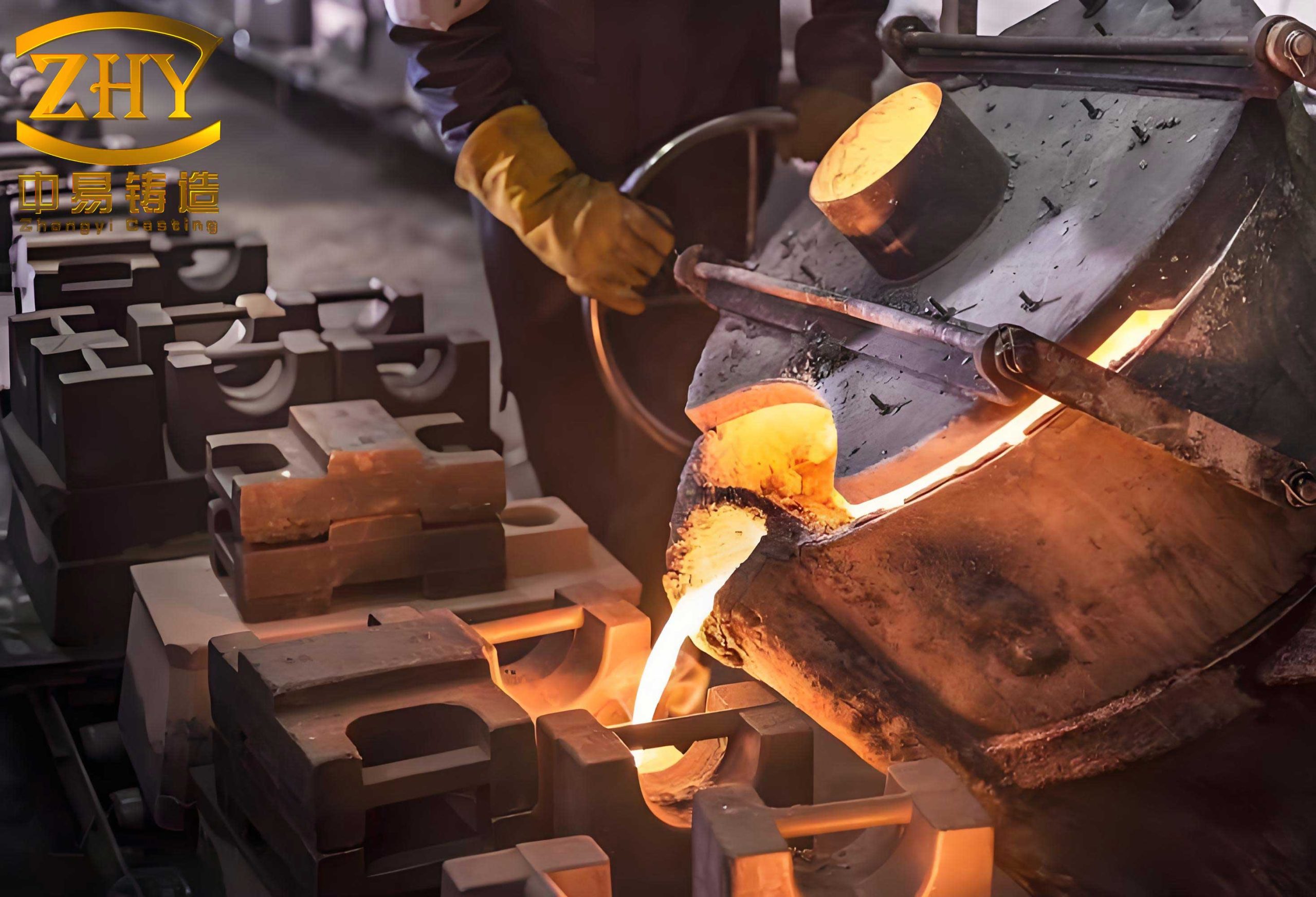
The image above illustrates typical cast iron casting parts, emphasizing the complexity and variety of shapes involved. Ultrasonic testing must adapt to such geometries, requiring careful method selection and parameter optimization for each cast iron part. In our experience, the ultrasonic velocity method not only distinguishes material types but also monitors production consistency. For instance, in mass production of engine cast iron parts, real-time velocity measurements can detect deviations in graphite morphology, enabling prompt adjustments in foundry processes like inoculation or alloying.
Beyond material classification, ultrasonic testing can assess internal defects in cast iron parts, such as porosity or inclusions. However, this requires different signal analysis, focusing on echo amplitude and pattern rather than velocity. For graphite morphology, velocity measurement is straightforward and highly repeatable. We have developed protocols for calibrating ultrasonic equipment using reference cast iron parts with known graphite structures. The calibration involves measuring velocity on standard samples and establishing a database for comparison. This approach minimizes errors due to instrument variability or surface conditions.
Mathematically, the relationship between ultrasonic velocity and graphite morphology can be modeled by considering the composite nature of cast iron. Cast iron is a two-phase material comprising a metallic matrix and graphite particles. The effective elastic modulus \(E_{\text{eff}}\) can be approximated using micromechanics models, such as the rule of mixtures or more advanced homogenization theories. For example, if we treat graphite as inclusions in a ferritic or pearlitic matrix, \(E_{\text{eff}}\) depends on the volume fraction \(V_g\) and shape factor \(S\) of graphite:
$$E_{\text{eff}} = E_m \cdot f(V_g, S)$$
where \(E_m\) is the matrix modulus, and \(f\) is a function that decreases with \(V_g\) and varies with \(S\) (e.g., lower for flakes, higher for spheres). Then, ultrasonic velocity \(v\) is:
$$v = \sqrt{\frac{E_{\text{eff}}(1-\sigma_{\text{eff}})}{\rho_{\text{eff}}(1+\sigma_{\text{eff}})(1-2\sigma_{\text{eff}})}}$$
for longitudinal waves. This model explains why velocity changes with graphite morphology in cast iron parts. Experimental data fit this trend, as shown in our tables.
In practice, when testing cast iron parts on the production line, we recommend the following steps: First, identify a suitable testing area—preferably a thick, solid section with parallel faces. Second, clean the surface to remove scale or debris. Third, apply a耦合剂 like glycerin or commercial gel to ensure acoustic coupling. Fourth, use a calibrated ultrasonic gauge with appropriate frequency (e.g., 1 MHz for thick cast iron parts). Fifth, take multiple readings to average out variations. Sixth, compare the velocity with established standards for the specific cast iron part. This process is quick, often taking less than a minute per cast iron part, making it feasible for 100% inspection in critical applications.
We have also explored the impact of microstructure variations on ultrasonic velocity in cast iron parts. Factors like matrix structure (ferrite vs. pearlite), carbide presence, and cooling rates can influence velocity. However, for a given matrix condition, graphite morphology remains the dominant factor. In our controlled studies, we normalized matrix effects by heat treatment, isolating graphite contributions. This reinforces the reliability of velocity measurements for graphite assessment in cast iron parts.
Looking ahead, advancements in ultrasonic technology, such as phased array or laser ultrasonics, could further enhance detection capabilities for cast iron parts. Phased array allows beam steering to inspect complex geometries, while laser methods enable non-contact measurements. However, conventional pulse-echo gauges remain cost-effective and adequate for most foundry needs. Integrating ultrasonic velocity data with process control systems can automate quality assurance for cast iron parts, reducing scrap and improving performance consistency.
In conclusion, ultrasonic sound velocity measurement offers a powerful nondestructive tool for evaluating graphite morphology in cast iron parts. Our research demonstrates that: (1) Different types of cast iron parts—gray, compacted graphite, and ductile—exhibit distinct ultrasonic velocity ranges, enabling material identification. (2) For compacted graphite iron cast iron parts, velocity inversely correlates with vermicularity, allowing rapid assessment without destruction. (3) For ductile cast iron parts, velocity indicates nodularity, supporting quality control. This method addresses the limitations of traditional metallography, providing efficient, economical, and practical solutions for the engine industry and beyond. As demands for high-performance cast iron parts grow, ultrasonic testing will play an increasingly vital role in ensuring material integrity and advancing manufacturing excellence.
We encourage widespread adoption of this technique in foundries producing cast iron parts. By implementing ultrasonic velocity checks, manufacturers can achieve real-time monitoring, reduce destructive testing costs, and enhance product reliability. Future work may focus on extending the method to other cast iron alloys or combining it with other nondestructive techniques for comprehensive characterization. Ultimately, the goal is to support the development of next-generation engines through improved quality assurance for critical cast iron parts.