
In my experience, the production of large cast iron parts, particularly those exceeding 30 tons in weight, represents a pinnacle of foundry engineering. These components are critical for heavy industries such as mining, power generation, and machine tools, where structural integrity and performance are paramount. The砂型铸造 (sand casting) method remains the dominant technique for such massive cast iron parts, owing to its flexibility and cost-effectiveness for low-volume, high-complexity items. This article delves into the practical aspects of producing large cast iron parts, drawing from historical context, essential production conditions, and detailed工艺案例分析. I will emphasize the unique challenges and solutions, incorporating tables and formulas to summarize key data, while repeatedly highlighting the importance of cast iron parts in modern manufacturing.
The evolution of large cast iron parts in China mirrors the nation’s industrial growth. Initially, in the early 1970s, cast iron parts like oxygen compressor housings weighing around 40 tons were considered monumental achievements. With改革开放, international collaborations accelerated, leading to the export of increasingly complex and heavier cast iron parts. Today, numerous foundries specialize in cast iron parts weighing over 30 tons, with some exceeding 100 tons, such as wind turbine hubs and diesel engine blocks. The demand for these large cast iron parts is driven by sectors like renewable energy and heavy machinery, necessitating rapid capacity expansion. Notably, the shift towards nodular cast iron for large cast iron parts—replacing steel in applications like turbine housings—has become a key trend, though it introduces technical hurdles related to strength and solidification in thick sections.
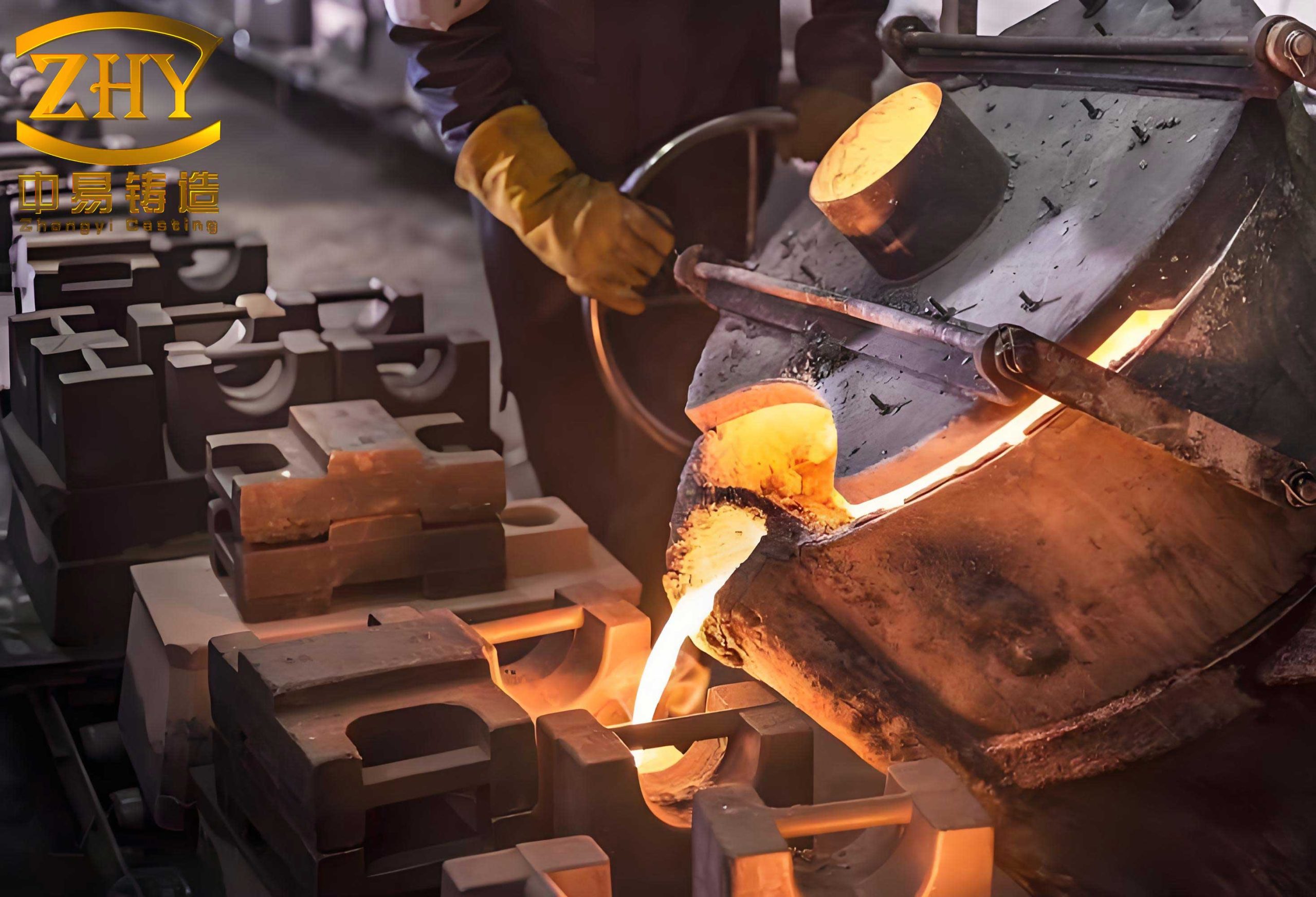
The production of large cast iron parts hinges on several indispensable conditions that I have consistently prioritized. First, iron melt supply must be robust; sufficient volume and temperature are crucial to fill molds completely and ensure sound solidification. For cast iron parts, the浇注 temperature and rate require precise control—too low, and defects like cold shuts occur; too high, and mold erosion becomes an issue. A common formula for浇注 time estimation in large cast iron parts is: $$t = \frac{V}{A \cdot v}$$ where \(t\) is the浇注 time (s), \(V\) is the volume of the cast iron part (m³), \(A\) is the total cross-sectional area of the浇口 (m²), and \(v\) is the flow velocity (m/s), typically around 0.5-1.0 m/s for cast iron. Second,起重 capacity must be carefully selected to handle not just the final cast iron part, but also molds, cores, and flasks. Over-sizing cranes increases costs unnecessarily; instead, process optimizations like split casting or core assembly can reduce lifting needs. Third, molding pits are essential for safety and efficiency in large cast iron parts production. They lower浇注 heights, contain spills, and provide thermal insulation for slow cooling, which minimizes residual stresses. The pit depth \(D\) can be approximated based on mold dimensions: $$D = H_m + C$$ where \(H_m\) is the mold height (m) and \(C\) is a clearance constant (e.g., 0.5 m). Fourth, a skilled team is vital, as large cast iron parts involve non-standard procedures and close coordination. Without expertise, defects become costly failures.
To illustrate these principles, I will discuss three typical large cast iron parts. Each案例 underscores how工艺 parameters are tailored to specific geometries and materials. For instance, a slag pot—a common large cast iron part—weighing 32 tons, requires dual浇注 systems to manage iron volume. Meanwhile, a pump body demands meticulous venting to prevent gas defects. Below, Table 1 summarizes key工艺 parameters for these cast iron parts, highlighting the diversity in approaches.
| Cast Iron Part | Weight (t) | Material | 浇注 Temperature (°C) | Cooling Time (h) | 铸造缩尺 (%) | Key工艺 Features |
|---|---|---|---|---|---|---|
| Slag Pot | 32 | Gray/Nodular Iron | 1280-1310 | 6-8 | 0.8 | Dual浇注; post-pouring冒口 topping |
| Pump Body | 12 | HT250 Gray Iron | 1320-1340 | 72 | 0.8 | Single浇注; enhanced core venting |
| Lathe Bed | 7.2 | HT250 Gray Iron | 1330-1360 | 90 | 0.8 | Core assembly; anti-deformation allowance |
Delving deeper, the slag pot exemplifies adaptation to起重 constraints. As a large cast iron part, its natural浇注 position—flange down—is often reversed to flange up to reduce吊装 weight, using a hanging core technique. The浇注 involves synchronized pours from multiple ladles, with冒口 re-feeding to compensate for shrinkage. The cooling regime includes loosening the cope after 1.5-2 hours to prevent hot tearing, a critical step for such massive cast iron parts. For the pump body, another critical large cast iron part, venting is paramount due to intricate cores; insufficient排气 leads to gas porosity. The浇注 temperature is kept high (1320-1340°C) to ensure fluidity, and冒口 are sized using modulus methods: $$M = \frac{V}{A_s}$$ where \(M\) is the modulus (m), \(V\) is the volume of the cast iron part section (m³), and \(A_s\) is the cooling surface area (m²).冒口 are designed with \(M_{冒口} > M_{casting}\) to promote directional solidification. The lathe bed, though lighter, presents challenges in dimensional stability. As a long, slender large cast iron part, it requires an anti-deformation allowance (often 2-3 mm over 7 m) to compensate for warping during cooling. The组芯 process involves assembling 22 cores in a pit, with工艺补正量 added to critical dimensions. Cooling time is extended to 90 hours to minimize残余应力, following the Chvorinov’s rule approximation: $$t_c = k \left( \frac{V}{A_s} \right)^2$$ where \(t_c\) is the cooling time (s), and \(k\) is a solidification constant specific to cast iron (e.g., \(k \approx 0.8-1.2 \, \text{s/mm}^2\) for gray iron).
The development of large cast iron parts is closely tied to material advancements. Nodular cast iron, in particular, offers superior strength-to-weight ratios, making it ideal for heavy-duty cast iron parts like turbine housings. However, producing large nodular cast iron parts introduces issues like graphite floating and segregation. To mitigate these, I emphasize controlled cooling and improved melt treatment. For example, the nodule count in thick sections can be enhanced by inoculants, with the fading effect modeled as: $$N = N_0 e^{-kt}$$ where \(N\) is the nodule count at time \(t\), \(N_0\) is the initial count, and \(k\) is a decay constant. Additionally, the use of chills and insulating sleeves helps manage solidification gradients in large cast iron parts. Table 2 compares common defects and solutions for large gray vs. nodular cast iron parts.
| Defect Type | Common in Large Gray Cast Iron Parts | Common in Large Nodular Cast Iron Parts | Mitigation Strategies |
|---|---|---|---|
| Shrinkage Porosity | Moderate, due to graphite expansion | High, due to lack of expansion | Adequate冒口 design; controlled浇注 temperature |
| Graphite Flotation | Rare | Severe in thick sections | Lower浇注 temperature; alloying (e.g., cerium) |
| Thermal Stress | High, leading to cracks | Moderate, due to ductility | Extended cooling in pits; stress-relief annealing |
| Dimensional Inaccuracy | Due to mold wall movement | Similar, with added solidification收缩 | Precise缩尺 allowance (0.8-1.0%); CAD simulation |
In terms of production infrastructure, the choice of melting equipment is pivotal for large cast iron parts. While traditional冲天炉 remain in use, medium-frequency induction furnaces are gaining popularity due to better temperature control—critical for consistent quality in cast iron parts. The power requirement for melting can be estimated as: $$P = \frac{m \cdot c \cdot \Delta T}{\eta \cdot t}$$ where \(P\) is the power (kW), \(m\) is the mass of iron (kg), \(c\) is the specific heat of cast iron (\(\approx 0.65 \, \text{kJ/kg·K}\)), \(\Delta T\) is the temperature rise (K), \(\eta\) is the thermal efficiency (e.g., 0.7), and \(t\) is the melting time (s). For a 30-ton cast iron part, with \(\Delta T = 1300\, \text{K}\) and \(t = 2\, \text{hours}\), \(P \approx 3800\, \text{kW}\), justifying large-scale installations. Furthermore, sand systems like furan resin-bonded sand are preferred for large cast iron parts due to high strength and low gas generation, though moisture control is essential to prevent pinholes. The sand-to-binder ratio, typically 95:5, impacts mold stability; deviations can lead to veining or erosion in cast iron parts.
Quality assurance for large cast iron parts necessitates全程 monitoring, from pattern making to finishing. Non-destructive testing (NDT) methods like ultrasonic testing are employed to detect internal flaws in thick-walled cast iron parts. Additionally, computational simulation using CAD/CAE tools is indispensable for optimizing工艺 before production. For instance, simulating浇注 flow helps identify turbulence zones that could cause slag entrapment in cast iron parts. The雷诺 number \(Re\) for flow in浇道 can indicate turbulence: $$Re = \frac{\rho v d}{\mu}$$ where \(\rho\) is the iron density (\(7100 \, \text{kg/m}^3\)), \(v\) is velocity (m/s), \(d\) is the浇道 diameter (m), and \(\mu\) is the dynamic viscosity (\(\approx 0.005 \, \text{Pa·s}\) for iron at 1300°C). Keeping \(Re < 2000\) ensures laminar flow, reducing defects in cast iron parts. Moreover, thermal simulation predicts shrinkage and hot spots, allowing for冒口 and chill placement adjustments. This proactive approach is cost-effective, as large cast iron parts are too expensive to scrap.
Looking ahead, the future of large cast iron parts lies in sustainability and innovation. Lightweighting through design optimization reduces material usage without compromising strength, benefiting both cost and environment. For example, topological optimization algorithms can generate ribbed structures for large cast iron parts, minimizing weight while maintaining stiffness. The stiffness \(S\) of a cast iron part can be approximated as: $$S = \frac{E \cdot I}{L^3}$$ where \(E\) is the modulus of elasticity (e.g., \(120 \, \text{GPa}\) for gray iron), \(I\) is the moment of inertia (m⁴), and \(L\) is the length (m). By increasing \(I\) through strategic ribbing, weight can be reduced. Additionally, recycling of sand and iron scrap is crucial for large-scale production of cast iron parts, with closed-loop systems gaining traction. The carbon footprint of producing large cast iron parts can be lowered using electric arc furnaces powered by renewables, aligning with global green initiatives.
In conclusion, the production of large cast iron parts is a complex yet rewarding endeavor that demands a holistic approach. From ensuring adequate iron melt supply and起重 capacity to leveraging advanced simulation tools, every aspect must be meticulously planned. The examples of slag pots, pump bodies, and lathe beds demonstrate how工艺 is tailored to specific challenges, whether it’s managing浇注 sequences or preventing deformation. As cast iron parts continue to grow in size and application—especially with the rise of nodular iron—foundries must invest in both equipment and expertise. By adhering to sound engineering principles and embracing innovation, we can meet the growing demand for these critical components, solidifying the role of large cast iron parts in industrial progress. Remember, successful production of large cast iron parts hinges not just on technology, but on the continuous refinement of实践 knowledge.