
In the production of cast iron parts, defects such as intrusive blowholes can significantly compromise structural integrity, mechanical properties, and overall quality. As a seasoned engineer specializing in casting processes, I have extensively studied the identification, causes, and prevention of these defects. This article delves into the intricate details of intrusive blowholes in cast iron parts, leveraging first-hand experience and technical insights. The focus is on providing a thorough understanding through systematic analysis, enhanced with tables and mathematical formulations to summarize key concepts. Throughout this discussion, the term “cast iron parts” will be frequently emphasized to underscore its relevance in industrial applications.
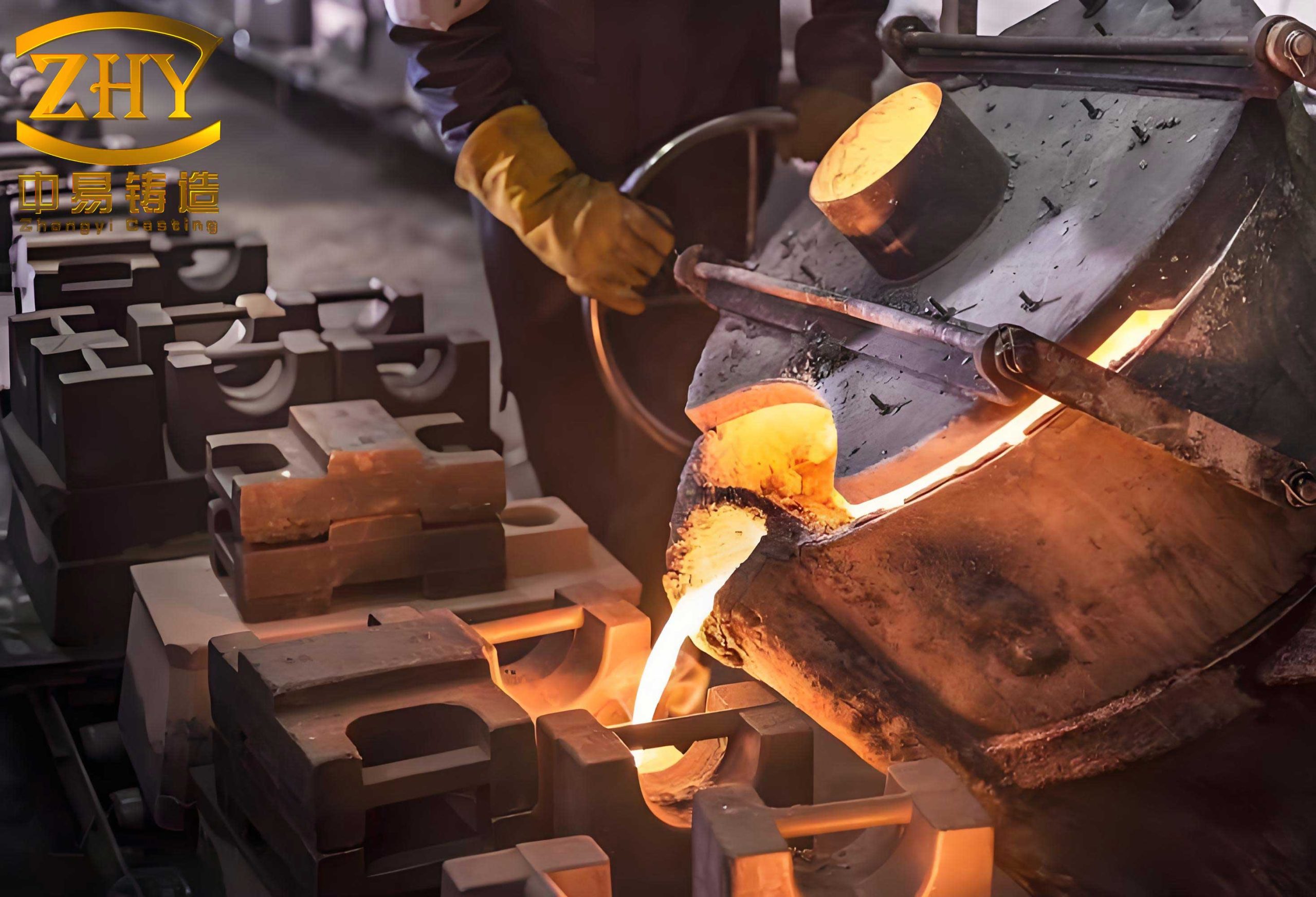
Intrusive blowholes are gas pores that form within cast iron parts due to the entrapment of gases from the mold or core during pouring and solidification. These defects are particularly prevalent in cast iron parts due to the high thermal conductivity and fluidity of iron alloys, which interact vigorously with molding materials. The ability to accurately identify and address these blowholes is crucial for minimizing scrap rates and enhancing the reliability of cast iron components in sectors like automotive, machinery, and infrastructure. This article will explore the distinctive features of intrusive blowholes, analyze their root causes with empirical evidence, and propose effective prevention methods, all tailored to the unique challenges of manufacturing cast iron parts.
The identification of intrusive blowholes in cast iron parts relies heavily on visual inspection of macroscopic characteristics, including location, shape, distribution, and internal surface morphology. These features serve as diagnostic tools for distinguishing intrusive blowholes from other porosity types, such as shrinkage or reaction pores. Below, I outline the key identification parameters, supported by a summary table for clarity.
Shape and Morphology: Intrusive blowholes in cast iron parts typically exhibit rounded forms, such as circles or ellipses. When the shape resembles a pear, the pointed end indicates the direction of gas invasion, providing clues about gas source orientation. In severe cases, excessive gas accumulation leads to honeycomb-like clusters, while turbulent pouring can cause incomplete filling and malformed cast iron parts. The internal wall of these blowholes is generally smooth, but its appearance varies with the dominant gas composition. For cast iron parts, if carbon monoxide (CO) is primary, the wall adopts a bluish tint; for hydrogen (H₂), it retains the metallic luster; and for water vapor (H₂O), it appears oxidized and darkened. This color differentiation aids in pinpointing gas origins during failure analysis of cast iron parts.
Size and Dimensions: These blowholes are relatively large, often exceeding several millimeters in diameter. In cast iron parts, their size can range from 2 mm to over 10 mm, depending on gas volume and pouring conditions. This substantial size makes them easily detectable through non-destructive testing or machining of cast iron parts.
Location and Distribution: Intrusive blowholes preferentially form at the upper surfaces of cast iron parts relative to the pouring position, adjacent to mold or core interfaces. Their distribution is usually localized, with individual or few blowholes clustered in specific regions. While they may aggregate into honeycomb patterns, diffuse dispersion is rare in cast iron parts, contrasting with microporosity from solidification shrinkage.
| Feature | Description for Cast Iron Parts | Typical Examples |
|---|---|---|
| Shape | Circular, elliptical; pear-shaped with tip pointing to gas source; honeycomb clusters in severe cases. | Round pores on upper surfaces; pear-shaped defects near cores. |
| Internal Wall | Smooth; color varies: blue for CO, metallic for H₂, dark for H₂O. | Bluish hue in CO-rich environments; shiny surfaces in H₂-dominated zones. |
| Size | Large, often >2 mm diameter, up to several centimeters. | 5 mm pores in machined sections of cast iron parts. |
| Location | Upper surfaces of cast iron parts, close to mold or core boundaries. | Top faces of horizontal castings; interior walls near sand cores. |
| Distribution | Localized, single or few pores; occasionally honeycomb; rarely diffuse. | Clustered blowholes in isolated regions of cast iron parts. |
The formation of intrusive blowholes in cast iron parts is governed by thermodynamic and fluid dynamic principles during pouring. When molten iron contacts the mold or core surface, rapid heating triggers gas generation from moisture vaporization, organic binder decomposition, and combustion. This gas accumulates at the metal-mold interface, creating pressure that, if sufficiently high, infiltrates the liquid metal. The critical condition for blowhole formation can be expressed mathematically as:
$$P_{\text{gas}} > P_{\text{liquid}} + P_{\text{resistance}} + P_{\text{cavity}}$$
Here, \(P_{\text{gas}}\) denotes the gas pressure at the interface, \(P_{\text{liquid}}\) is the metallostatic pressure from the molten iron, \(P_{\text{resistance}}\) represents viscous and surface tension resistances, and \(P_{\text{cavity}}\) accounts for atmospheric or cavity pressures in the mold. For cast iron parts, this inequality must be satisfied for gas intrusion to occur. Below, I dissect the primary causes into three categories, each elaborated with examples and summarized in a table.
Excessive Gas Generation from Molds or Cores: A common cause in cast iron parts is high gas evolution due to elevated moisture or organic content in molding materials. For instance, if sand cores are inadequately dried or contain excess binders, they release copious gases upon heating. In one case involving cast iron parts like push rods, blowholes pervaded the entire inner bore after machining, leading to batch rejection. Experiments confirmed that un-dried cores were the culprit, as they produced gas pressures exceeding the threshold in the equation above. This underscores the need for stringent drying protocols in producing cast iron parts.
Insufficient Venting Capacity of Molds or Cores: Even with moderate gas generation, poor排气 can elevate \(P_{\text{gas}}\). Factors include high clay content in sand reducing permeability, improperly designed vent channels, or blocked通气孔. In cast iron parts, such limitations trap gases, increasing the likelihood of intrusion. For example, a pump casing defect was traced to inadequate core venting; by adding venting cores and connecting them to mold vents, blowholes were eliminated in subsequent cast iron parts.
Inadequate Metallostatic Pressure: Low liquid metal pressure, often from shallow pouring heads, reduces \(P_{\text{liquid}}\), making it easier for gases to invade. In wet mold casting of cast iron parts like drainage pipes, blowholes appeared at the highest points when the distance between the top cavity and pouring cup was less than 65 mm. Increasing this height raised \(P_{\text{liquid}}\), suppressing blowholes. Additionally, low pouring temperatures can hinder gas escape from the molten iron, exacerbating porosity in cast iron parts.
| Cause Category | Specific Factors | Impact on Gas Pressure Equation | Example in Cast Iron Parts |
|---|---|---|---|
| High Gas Generation | Un-dried molds/cores, high moisture, excess organic binders. | Increases \(P_{\text{gas}}\) due to rapid gas release. | Push rod defects from wet cores. |
| Poor Venting | Low sand permeability, clogged vents, inadequate core design. | Elevates \(P_{\text{gas}}\) by trapping gases. | Pump casing blowholes from insufficient core vents. |
| Low Metallostatic Pressure | Shallow pouring heads, improper gating, low浇注温度. | Decreases \(P_{\text{liquid}}\), reducing resistance to gas entry. | Drain pipe defects due to insufficient head height. |
To mitigate intrusive blowholes in cast iron parts, a multifaceted approach is essential, targeting both gas pressure reduction and enhanced resistance to intrusion. The strategies can be derived from the gas pressure inequality: minimize \(P_{\text{gas}}\) and maximize \(P_{\text{liquid}} + P_{\text{resistance}} + P_{\text{cavity}}\). Below, I detail practical methods, supported by formulas and a comprehensive table.
Reducing Gas Pressure at the Interface: This involves lowering gas generation and improving排气. For cast iron parts, key measures include:
- Enhancing Sand Permeability: Use coarser base sands with low fines content to facilitate gas diffusion. The permeability \(k\) can be approximated by the Kozeny-Carman equation for granular materials: $$k = \frac{\phi^3}{C(1-\phi)^2 S^2}$$ where \(\phi\) is porosity, \(C\) a constant, and \(S\) specific surface area. Higher \(k\) reduces \(P_{\text{gas}}\) in cast iron parts.
- Optimizing Venting Systems: Incorporate vent holes in molds, ensure畅通的 core通气孔, and add auxiliary vents via strategic holes in cast iron parts. For instance, in complex cast iron parts, extra cores can be designed solely for排气.
- Minimizing Gas Sources: Control moisture content below 3-4% in green sand, and limit organic binders to 1-2% in core sands for cast iron parts. Pre-drying molds and cores to below 0.5% residual moisture is critical.
Increasing Resistance to Gas Intrusion: This focuses on boosting metallostatic pressure and promoting gas逸出 from the molten iron in cast iron parts.
- Raising Pouring Heads: Ensure the height from the cavity top to the pouring cup exceeds 100 mm for heavy cast iron parts, increasing \(P_{\text{liquid}}\) as per \(P_{\text{liquid}} = \rho g h\), where \(\rho\) is iron density, \(g\) gravity, and \(h\) height.
- Implementing Tilt Pouring: Pour at an angle (e.g., 10-15°) to accelerate metal rise over large planes, enhancing \(P_{\text{liquid}}\) locally and allowing gradual gas escape from molds in cast iron parts.
- Adjusting Pouring Parameters: Increase pouring temperature by 20-30°C above the liquidus to lower viscosity, aiding bubble flotation via Stokes’ law: $$v = \frac{2(\rho_{\text{metal}} – \rho_{\text{gas}}) g r^2}{9 \eta}$$ where \(v\) is ascent velocity, \(r\) bubble radius, and \(\eta\) viscosity. This helps gases escape before solidification in cast iron parts.
- Using Overflow Risers: Place risers at high points to trap gases and divert them from critical sections of cast iron parts.
| Method Category | Specific Actions | Mechanism | Application in Cast Iron Parts |
|---|---|---|---|
| Gas Pressure Reduction | Use high-permeability sands, add vent holes, reduce moisture and binders. | Lowers \(P_{\text{gas}}\) by enhancing排气 and minimizing gas generation. | Coarse silica sand in molds for engine blocks. |
| Venting Enhancement | Design open通气孔 in cores, connect vents to atmosphere, add auxiliary vents. | Decreases \(P_{\text{gas}}\) by providing escape paths for gases. | Vented cores in pump housings of cast iron parts. |
| Metallostatic Pressure Increase | Increase pouring head height, implement tilt pouring. | Raises \(P_{\text{liquid}}\), resisting gas entry. | High heads for thick-walled cast iron parts. |
| Gas Escape Promotion | Raise pouring temperature, use overflow risers, optimize gating. | Enhances bubble flotation and removal from molten iron. | 1350°C pouring for intricate cast iron parts. |
To operationalize these strategies for cast iron parts, consider an integrated quality control framework spanning raw material selection, mold preparation, and pouring operations. For example, in producing cylinder heads as cast iron parts, specify sand with AFS grain fineness number of 50-70 for optimal permeability, and monitor core drying via weight loss curves to ensure moisture below 0.3%. During pouring, maintain a head height of 120 mm and a temperature of 1370°C, with tilt angles of 10° for horizontal sections. These parameters can be fine-tuned using statistical process control, reducing blowhole incidence in cast iron parts to under 1%.
Furthermore, advanced simulation tools can model gas pressure dynamics in cast iron parts. The gas pressure buildup can be described by a diffusion-reaction equation: $$\frac{\partial P_{\text{gas}}}{\partial t} = D \nabla^2 P_{\text{gas}} + Q(t)$$ where \(D\) is gas diffusivity in sand, and \(Q(t)\) the gas generation rate from thermal decomposition. Solving this numerically helps predict blowhole risks in cast iron parts before production.
In conclusion, preventing intrusive blowholes in cast iron parts demands a holistic approach rooted in process optimization and rigorous quality assurance. By focusing on gas pressure management through enhanced permeability, venting, and controlled gas sources, coupled with maximizing metallostatic pressure and promoting gas逸出, manufacturers can significantly reduce defects. The key lies in tailoring these methods to the specific geometry and alloy of cast iron parts, as illustrated in the tables and formulas above. Continuous monitoring and adaptation are essential, as even minor deviations in moisture or pouring height can trigger blowholes in sensitive cast iron parts. Through diligent application of these principles, the integrity and performance of cast iron parts can be consistently upheld, driving efficiency in diverse industrial sectors.
Ultimately, the battle against intrusive blowholes in cast iron parts is won through knowledge and precision. By mastering identification features, understanding causal mechanisms, and implementing robust prevention strategies, engineers can transform casting challenges into opportunities for quality excellence. This comprehensive guide, enriched with empirical insights and technical depth, aims to empower practitioners in advancing the production of reliable cast iron parts for the future.