
The production of cast iron parts via metal mold (also known as permanent mold or gravity die) casting is a technology that has garnered significant attention and development in industrialized nations. As a practitioner in this field, I observe that the annual global output of metal mold cast iron likely exceeds one million tonnes, representing a notable share of total cast iron production. The resurgence of interest in this ancient yet revitalized technique stems from its inherent advantages: substantial savings in energy, resources, and labor, coupled with minimal environmental pollution due to the absence or drastic reduction of waste sand. The primary historical challenges hindering wider adoption—namely, limited mold life and the tendency for surface chill (white iron formation)—have been progressively mitigated through scientific and technological advancements over recent decades. This article synthesizes the principles underlying chill formation in metal mold casting and outlines effective, commonly employed strategies to prevent it, thereby facilitating the production of sound, high-quality cast iron parts.
The microstructure and resultant properties of any cast iron part are governed by a complex interplay of chemical composition and cooling conditions. The fundamental challenge in metal mold casting arises from the drastically different thermal properties of the mold material compared to traditional sand. The thermal conductivity of a cast iron metal mold is approximately 42-50 W/(m·K), whereas that of a sand mold is only about 0.5-0.8 W/(m·K). This difference of one to two orders of magnitude leads to cooling rates during solidification that are substantially higher in metal molds. Typical cooling rates for a cast iron part in a metal mold can range from 10-100 °C/s, while in sand molds, they are generally below 10 °C/s. This rapid extraction of heat significantly shortens the eutectic solidification time, favoring crystallization via the metastable system (ledeburite, i.e., cementite + austenite) over the stable system (graphite + austenite), consequently leading to the formation of undesirable chill or white iron structures at the casting surface and in thin sections. The central objective for foundry engineers is to harness the benefits of rapid cooling—such as refined microstructure and improved density—while simultaneously preventing the formation of chill. This goal is pursued through meticulous control of the iron’s chemical composition, effective inoculation (post-treatment), and precise management of the thermal exchange between the molten metal and the mold.
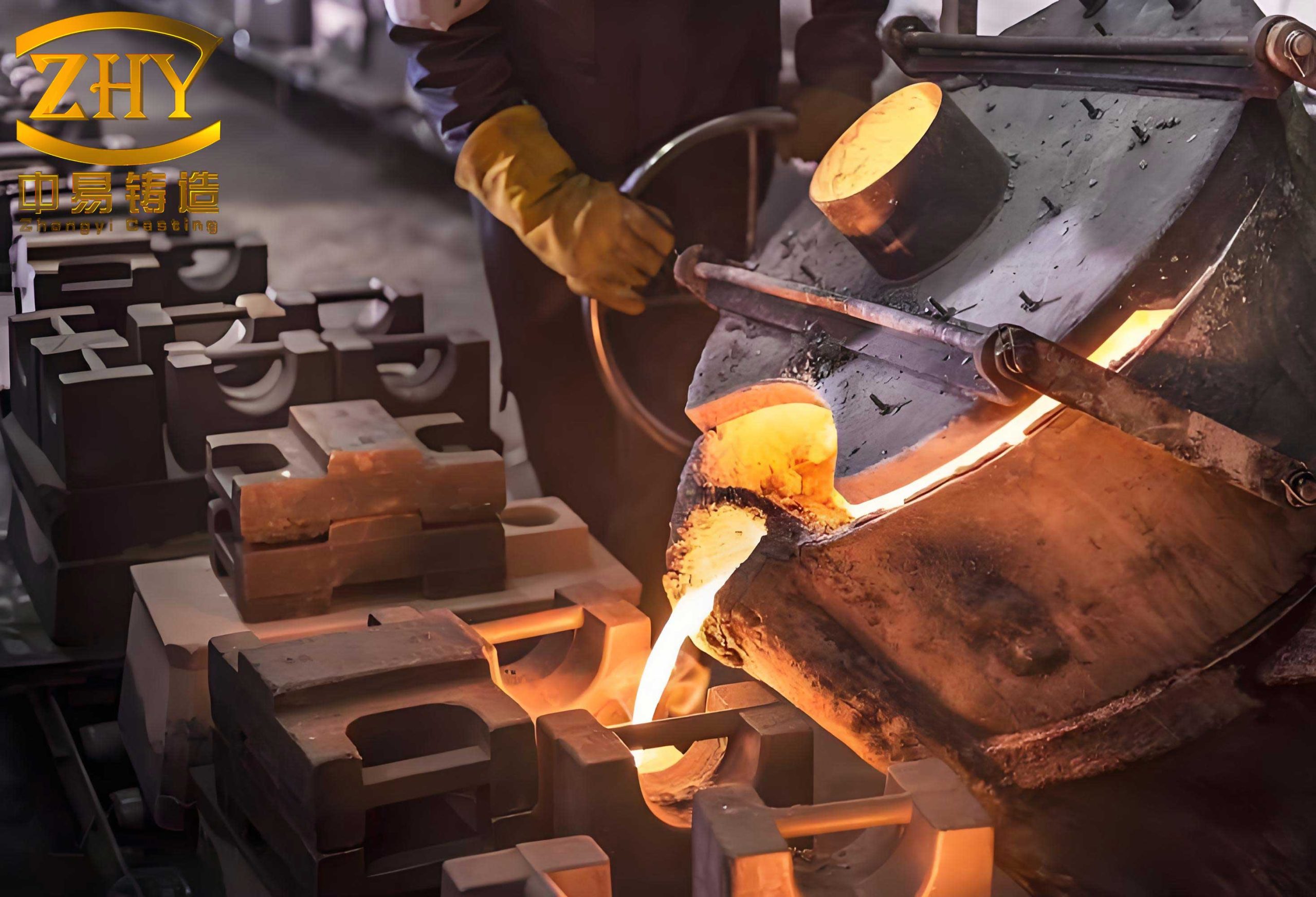
Fundamentals and Methods for Chill Prevention
1. Chemical Composition for Chill-Free Cast Iron Parts
The primary elemental composition of the iron is the first line of defense against chill in a metal mold cast iron part. The five main elements—Carbon (C), Silicon (Si), Manganese (Mn), Phosphorus (P), and Sulfur (S)—must be carefully balanced. Their individual and combined effects on chill depth are well-documented. Broadly, the composition should promote graphitization to counteract the chilling tendency imposed by the fast cooling metal mold.
Carbon and Silicon: Both C and Si are potent graphitizers. Increasing the carbon equivalent (CE) is the most direct approach to reduce chill. Empirically, each 0.1% increase in carbon can reduce chill depth by approximately 1-2 mm, while each 0.1% increase in silicon can reduce it by 1.5-2 mm. Silicon is particularly effective as it raises the eutectic temperature for graphite formation and decreases carbon solubility in the melt, thereby increasing its activity and strongly promoting graphite nucleation and growth. For metal mold casting, the composition range is chosen primarily to eliminate chill, but it is also constrained by the required mechanical properties. A higher carbon equivalent generally yields a softer, more machinable but lower-strength cast iron part. The carbon saturation degree (Sc) is often used to define this range:
$$ Sc = \frac{C}{4.26 – 0.31Si – 0.33P} $$
Typical compositions for chill-prone metal mold castings aim for an Sc value between 0.9 and 1.1. The table below summarizes typical chemical compositions and corresponding mechanical properties for metal mold cast iron parts as seen in various international standards and practices, emphasizing the adjustments made for section thickness.
| Grade / Standard | Typical Wall Thickness (mm) | Chemical Composition (%) | Tensile Strength (MPa), min | Hardness (HB) |
|---|---|---|---|---|
| Typical for thin sections | < 10 | C: 3.4-3.8, Si: 2.6-3.2, Mn: 0.4-0.8, P<0.15, S<0.12 | 250 – 300 | 180 – 220 |
| General purpose metal mold | 10 – 25 | C: 3.2-3.6, Si: 2.2-2.8, Mn: 0.6-1.0, P<0.10, S<0.10 | 300 – 350 | 200 – 240 |
| High-strength倾向 | > 25 | C: 3.0-3.4, Si: 1.8-2.4, Mn: 0.8-1.2, P<0.08, S<0.08 | > 350 | > 220 |
Manganese and Sulfur: Mn is a mild carbide stabilizer. An increase of 0.1% Mn can increase chill depth by about 0.5-1.0 mm. It also promotes pearlite formation and refines graphite morphology. S has a complex effect; while it can increase carbon activity, an excess strongly promotes chill and degrades fluidity. The harmful effects of S are often neutralized by Mn through the formation of MnS inclusions. A common rule is to maintain Mn ≈ 1.7 * S + 0.3% to ensure this balance and prevent either element from exerting a deleterious influence on the final cast iron part.
Phosphorus: P acts as a graphitizer similar to Si and improves fluidity. However, it also promotes coarse graphite formation and increases brittleness (cold shortness). For general metal mold gray iron parts, P is usually kept below 0.15%. For higher-duty castings where graphite refinement is critical, P should be limited to below 0.08%.
Trace Elements: Micro-alloying elements are powerful tools to modify microstructure. Titanium (Ti), often added as ferrotitanium, is highly effective in reducing section sensitivity and promoting the formation of undercooled (Type D) graphite. An optimal addition ranges from 0.05% to 0.15%. Chromium (Cr) is a strong carbide stabilizer and pearlite promoter; its content must be kept very low (typically <0.1%) to avoid excessive chill in a metal mold cast iron part. Tin (Sn) and Antimony (Sb) are used in small amounts (0.05-0.1%) to stabilize pearlite without significantly affecting graphite shape. Bismuth (Bi) and Tellurium (Te) are potent chillers even at very low levels (<0.01%) and are generally avoided unless specifically used to create a hard surface layer.
2. Inoculation Treatment
Inoculation is an indispensable secondary metallurgical treatment performed just before pouring to enhance graphite nucleation. For a metal mold cast iron part, the primary goal of inoculation is to prevent surface chill, but it also refines graphite, improves distribution, and can slightly enhance mechanical properties. The effectiveness of various inoculants varies with cooling rate and base iron composition.
Common inoculants include FeSi alloys containing small amounts of other elements like Ca, Al, Ba, Zr, and Sr. The graph below conceptually illustrates the relative effectiveness of different inoculant types on reducing chill depth. FeSi-based inoculants with Ca and Al are standard, but Ba- and Sr-bearing inoculants often show superior resistance to fading (loss of inoculating effect over time) and perform better under the rapid cooling conditions of a metal mold. A composite inoculant containing elements like Si, Ca, Ba, Al, and Zr, added in the range of 0.2-0.6% of the molten iron weight, has been reported to provide excellent chill resistance with slow fading. The inoculation temperature is typically kept below 1450°C, and the addition amount should be the minimum required to eliminate chill, as over-inoculation can lead to coarse graphite. To combat fading, late inoculation methods, such as placing inoculant inserts in the mold’s pouring basin or gating system (mold inoculation), are highly effective and widely practiced, especially for producing consistent cast iron parts.
| Inoculant Type (Base: FeSi) | Typical Composition Range | Key Benefits for Metal Mold Casting | Typical Addition Rate (%) |
|---|---|---|---|
| Standard (Ca, Al) | Si=70-75%, Ca=0.5-1.5%, Al=0.5-1.5% | Cost-effective, good general graphitization | 0.3 – 0.6 |
| Barium (Ba) | Si=65-75%, Ba=1-4%, Ca, Al | Excellent fade resistance, powerful against chill | 0.2 – 0.4 |
| Strontium (Sr) | Si=70-75%, Sr=0.6-1.2%, low Al | Minimizes undercooling, good for thin sections | 0.1 – 0.3 |
| Complex (Ti, Zr, etc.) | Si=60-70%, Ti, Zr, Ca, Al, etc. | Reduces section sensitivity, refines microstructure | 0.4 – 0.8 |
3. Influence and Control of Cooling Rate
Even with an optimal chemistry and inoculation, the cooling rate imposed by the metal mold must be suitably managed to obtain a chill-free cast iron part. The cooling rate is a function of the heat extraction dynamics, determined by the casting geometry, mold mass, pouring temperature, initial mold temperature, and the presence of any interfacial coatings.
A useful parameter for characterizing the casting’s geometry is the casting modulus, M, defined as the volume (V) divided by the cooling surface area (Acool):
$$ M = \frac{V}{A_{cool}} $$
Experimental data establishes a relationship between the casting modulus and the average cooling rate during solidification. For a given metal mold wall thickness, a smaller modulus (thinner casting) corresponds to a higher cooling rate. This relationship can be approximated by an inverse power law for a specific mold system.
Cooling rate critically determines graphite morphology. Very high cooling rates (>30 °C/s) promote the formation of finely dispersed, undercooled Type D graphite. Intermediate rates (roughly 10-30 °C/s) yield a mixture of Type A (flake) and Type D graphite. Rates similar to sand casting (<10 °C/s) result in coarse Type A or even Type C (kish) graphite. Paradoxically, while rapid cooling favors carbides, if the composition is sufficiently graphitizing, it can also lead to a ferritic matrix because the fast cooling suppresses the pearlite transformation. Therefore, achieving a fully pearlitic matrix in an as-cast metal mold cast iron part often requires alloying with pearlite stabilizers like Cu, Sn, or Sb.
By combining data on composition, inoculation, and cooling rate, quantitative microstructure diagrams can be constructed. These diagrams map regions of expected chill depth, graphite type, and matrix structure as functions of carbon equivalent and cooling rate. They serve as invaluable guides for process design to reliably produce a sound cast iron part. The cooling rate (v) can be related to the casting modulus (M) and the thermal properties of the mold/casting system through simplified heat transfer models. One conceptual form is:
$$ v \approx \frac{T_{pour} – T_{eutectic}}{ \rho_{iron} \cdot c_{p,iron} } \cdot \frac{k_{mold}}{M \cdot d_{eff}} $$
where $T_{pour}$ is pouring temperature, $T_{eutectic}$ is the eutectic temperature, $\rho_{iron}$ is density, $c_{p,iron}$ is specific heat, $k_{mold}$ is mold thermal conductivity, and $d_{eff}$ is an effective interface resistance distance. This illustrates the direct proportionality of cooling rate to mold conductivity and inverse proportionality to casting modulus.
4. Management of Metal Mold Thermal Exchange
Active control of the heat transfer between the solidifying cast iron part and the metal mold is a sophisticated and highly effective strategy for chill prevention. Several practical methods are employed:
A. Use of Refractory Coatings: Applying a layer of low-thermal-conductivity material (a wash or die coat) onto the mold cavity surface is standard practice. This coating serves a dual purpose: it protects the mold surface from thermal shock and soldering, and it regulates the initial heat extraction rate. Common coating materials include zircon, graphite, alumina, or mixtures of refractory powders with binders. The coating thickness ($\delta_{coat}$) directly influences the interfacial heat transfer coefficient (h):
$$ h \approx \frac{k_{coat}}{\delta_{coat}} $$
where $k_{coat}$ is the thermal conductivity of the coating. By varying thickness and composition, the effective cooling rate can be finely tuned for different areas of the cast iron part.
B. Mold Lining or Facing: A more robust method involves lining the mold cavity with a permanent or semi-permanent layer of sand (e.g., sodium silicate or resin-bonded sand) or even a low-melting-point alloy. A sand lining, typically 3-10 mm thick, dramatically slows cooling, effectively converting a metal mold process into something closer to a sand mold process for the casting skin, thus reliably preventing chill. Conversely, a lining made of a high-conductivity material like copper or aluminum (for iron or steel molds) can be used to accelerate cooling in specific regions. In a clever application, a low-melting-point alloy liner melts away after the iron solidifies, creating a gap that allows for natural air cooling and eliminates chilling pressure on the mold surface.
C. Creation of an Air Gap: This method utilizes the natural contraction of the cast iron part during solidification and cooling. By designing the mold with movable sections or cores that retract shortly after pouring, a deliberate air gap is created between the casting and the mold wall. This gap introduces a significant thermal resistance, drastically reducing the heat flux and allowing the latent heat of the casting to “self-anneal” any nascent chill layer. The timing of gap formation is critical and is often calculated using solidification simulation software.
D. Localized Mold Heating/Cooling: Preheating the entire mold or selectively heating critical, thin-section areas (e.g., with gas torches or electric heaters) before pouring reduces the thermal gradient and chilling tendency. Conversely, internal cooling channels with water or air can be used in thicker mold sections to extract heat more uniformly and prevent overall mold overheating, which is crucial for maintaining consistent cycle times and preventing chill variation in subsequent castings.
The thermal management can be summarized by considering the overall heat flux (q) from the casting to the mold, governed by a series of resistances:
$$ q = \frac{\Delta T}{R_{total}} = \frac{T_{casting} – T_{mold,bulk}}{R_{int,cast} + R_{coat} + R_{gap} + R_{mold}} $$
Where $R_{int,cast}$ is the resistance within the casting’s solidified shell, $R_{coat}$ is the coating resistance, $R_{gap}$ is the air gap resistance (if present), and $R_{mold}$ is the conduction resistance through the mold wall. Chill prevention strategies actively manipulate $R_{coat}$ and $R_{gap}$ to control ‘q’.
Conclusion and Future Directions
The successful production of a high-integrity, chill-free cast iron part via metal mold casting is an achievable goal that rests on a three-pillar approach: the selection of a graphitizing chemical composition, effective and timely inoculation, and precise control of the thermal exchange between the molten metal and the mold. The synergy of these elements allows the foundry to exploit the benefits of metal mold casting—superior dimensional accuracy, surface finish, and productivity—without the detrimental microstructural defects associated with chill.
Among the current technologies, the trend leans toward using higher silicon levels with moderate carbon (a “low carbon, high silicon” approach) to achieve adequate strength (often exceeding 300 MPa) while maintaining robust graphitization potential. Inoculation with fade-resistant alloys containing Ba, Sr, or complex elements is considered best practice for consistent results. The method of utilizing the casting’s own heat to self-anneal a potential chill layer through controlled air gap formation is particularly attractive from an energy-saving and simplicity perspective and warrants deeper research and broader implementation. For applications demanding the utmost reliability and where mold life is paramount, the use of bonded sand linings in metal molds remains one of the most robust and widely applicable solutions for chill prevention.
Looking forward, the development of chill prevention technology continues to evolve. The integration of real-time thermal monitoring and adaptive control systems in metal mold casting machines promises even greater consistency. Furthermore, research into novel, high-performance inoculants and more durable, tunable mold coating materials will further enhance the capability and economic viability of producing complex, high-quality cast iron parts via this efficient and environmentally friendly casting process. The ultimate aim remains the development of ever simpler, more economical, and more reliable methods to master the thermal dynamics of the process, ensuring the reliable production of superior castings.