
As a metallurgical engineer deeply involved in the field, I recently had the opportunity to participate in a significant academic gathering focused on steel and iron technologies. This event, which I will refer to as the annual metallurgy conference, brought together professionals from various institutions to share insights and innovations. The conference emphasized the importance of collaborative research and practical applications in the industry, particularly highlighting advancements in cast iron part production. In this article, I aim to elaborate on the key topics discussed, with a special focus on cast iron part development, incorporating technical details, tables, and formulas to provide a comprehensive overview. The cast iron part remains a cornerstone in many industrial applications, and its evolution continues to drive efficiency and performance improvements.
The conference kicked off with an overview of recent achievements in metallurgical science. One of the central themes was the integration of new materials and processes to enhance the properties of cast iron parts. For instance, discussions revolved around how alloying elements and heat treatment techniques can be optimized to improve durability and reduce costs. I was particularly intrigued by the presentations on non-traditional methods that eliminate the need for post-casting热处理, which aligns with the growing demand for sustainable manufacturing. The cast iron part, in this context, serves as a critical component in sectors like automotive, construction, and machinery, where strength and wear resistance are paramount.
During the sessions, several papers were presented on the subject of cast iron part fabrication. One notable area was the use of novel additives to modify the microstructure of cast iron, thereby enhancing its mechanical properties without extensive processing. For example, the addition of certain elements can lead to the formation of graphite nodules in ductile iron, which significantly improves toughness. This can be summarized using the following formula for the nucleation rate of graphite during solidification:
$$ N = A \cdot \exp\left(-\frac{\Delta G^*}{kT}\right) $$
where \( N \) is the nucleation rate, \( A \) is a pre-exponential factor, \( \Delta G^* \) is the activation energy for nucleation, \( k \) is the Boltzmann constant, and \( T \) is the temperature. This equation helps in understanding how controlled cooling and additives affect the cast iron part’s final structure. Moreover, the relationship between cooling rate and graphite morphology can be expressed as:
$$ \lambda = \frac{C}{R^n} $$
Here, \( \lambda \) represents the graphite spacing, \( C \) is a material constant, \( R \) is the cooling rate, and \( n \) is an exponent typically around 0.5. Such formulas are essential for designing casting processes that yield high-quality cast iron parts.
To illustrate the diversity in cast iron part types and their properties, I have compiled a table comparing different grades of cast iron based on composition and performance metrics. This table underscores how variations in carbon, silicon, and other elements impact the cast iron part’s characteristics.
| Cast Iron Type | Carbon Content (%) | Silicon Content (%) | Tensile Strength (MPa) | Hardness (HB) | Typical Applications for Cast Iron Part |
|---|---|---|---|---|---|
| Gray Iron | 2.5 – 4.0 | 1.0 – 3.0 | 150 – 400 | 150 – 300 | Engine blocks, pipes |
| Ductile Iron | 3.0 – 4.0 | 2.0 – 3.0 | 400 – 900 | 150 – 300 | Gears, crankshafts |
| White Iron | 1.8 – 3.6 | 0.5 – 2.0 | 200 – 500 | 400 – 600 | Wear-resistant liners |
| Malleable Iron | 2.0 – 2.9 | 0.9 – 1.9 | 300 – 700 | 110 – 250 | Fittings, hardware |
This table highlights how each cast iron part variant is tailored for specific uses, with ductile iron offering superior strength for demanding applications. The conference also touched upon emerging trends, such as the incorporation of trace elements like germanium, which was discussed in the context of material enhancements beyond traditional metallurgy. While initially noted for health applications, germanium’s role in improving the corrosion resistance of cast iron parts is being explored, potentially leading to longer-lasting components in harsh environments.
Another key topic was the development of cast iron parts that require minimal or no heat treatment. This approach reduces energy consumption and production time, making it economically and environmentally favorable. The process involves adding modifiers to the molten iron before casting, which alter the solidification behavior to achieve desired properties directly from the mold. For instance, the addition of boron-based compounds can refine the microstructure, as described by the following kinetic model for grain refinement:
$$ \frac{dD}{dt} = -k \cdot (D – D_0) $$
where \( D \) is the grain size, \( t \) is time, \( k \) is a rate constant, and \( D_0 \) is the equilibrium grain size. This simplification helps in predicting how modifiers affect the cast iron part’s grain structure during cooling. Additionally, the yield strength of a cast iron part can be estimated using the Hall-Petch relationship:
$$ \sigma_y = \sigma_0 + \frac{k_y}{\sqrt{d}} $$
In this equation, \( \sigma_y \) is the yield strength, \( \sigma_0 \) is the friction stress, \( k_y \) is a strengthening coefficient, and \( d \) is the average grain diameter. By controlling grain size through modifiers, manufacturers can produce cast iron parts with high strength without post-casting热处理, aligning with sustainable practices.
The conference also featured discussions on quality control and testing methods for cast iron parts. Non-destructive testing techniques, such as ultrasonic inspection and X-ray tomography, are crucial for ensuring the integrity of critical components. The probability of detecting flaws in a cast iron part can be modeled using statistical distributions. For example, the detection rate \( P_d \) as a function of flaw size \( a \) is often expressed as:
$$ P_d(a) = 1 – \exp\left(-\left(\frac{a}{a_0}\right)^m\right) $$
where \( a_0 \) and \( m \) are material-specific parameters. This formula aids in setting inspection standards for cast iron parts used in safety-critical applications. Furthermore, the fatigue life of a cast iron part under cyclic loading can be predicted using the Basquin equation:
$$ N_f = C \cdot (\Delta \sigma)^{-b} $$
Here, \( N_f \) is the number of cycles to failure, \( \Delta \sigma \) is the stress range, and \( C \) and \( b \) are constants derived from experimental data. Such models are vital for designing durable cast iron parts for automotive and aerospace industries.
In terms of practical applications, the cast iron part is ubiquitous in daily life, from water pipes to machine tools. During the conference, a case study was presented on optimizing the casting process for a complex cast iron part used in hydraulic systems. By simulating fluid flow and solidification using computational tools, engineers reduced defects like shrinkage porosity. The governing equation for heat transfer during casting is the Fourier heat conduction law:
$$ \frac{\partial T}{\partial t} = \alpha \nabla^2 T $$
where \( T \) is temperature, \( t \) is time, and \( \alpha \) is thermal diffusivity. Solving this numerically helps in designing molds that produce sound cast iron parts. Additionally, the mechanical behavior of a cast iron part under load can be analyzed using stress-strain relationships. For linear elastic regions, Hooke’s Law applies:
$$ \sigma = E \cdot \epsilon $$
with \( \sigma \) as stress, \( E \) as Young’s modulus, and \( \epsilon \) as strain. However, for cast iron parts exhibiting plasticity, more complex models like the Ramberg-Osgood equation are used:
$$ \epsilon = \frac{\sigma}{E} + \left(\frac{\sigma}{K}\right)^n $$
where \( K \) and \( n \) are material constants. These formulas enable precise engineering of cast iron parts for specific performance criteria.
The integration of advanced materials into cast iron part production was another highlight. For example, composite cast iron parts reinforced with ceramic particles offer enhanced wear resistance. The effective modulus of such a composite can be estimated using the rule of mixtures:
$$ E_c = V_f E_f + (1 – V_f) E_m $$
where \( E_c \) is the composite modulus, \( V_f \) is the volume fraction of reinforcement, \( E_f \) is the modulus of the reinforcement, and \( E_m \) is the modulus of the cast iron matrix. This approach allows for tailoring properties in cast iron parts for extreme conditions, such as high-temperature environments.
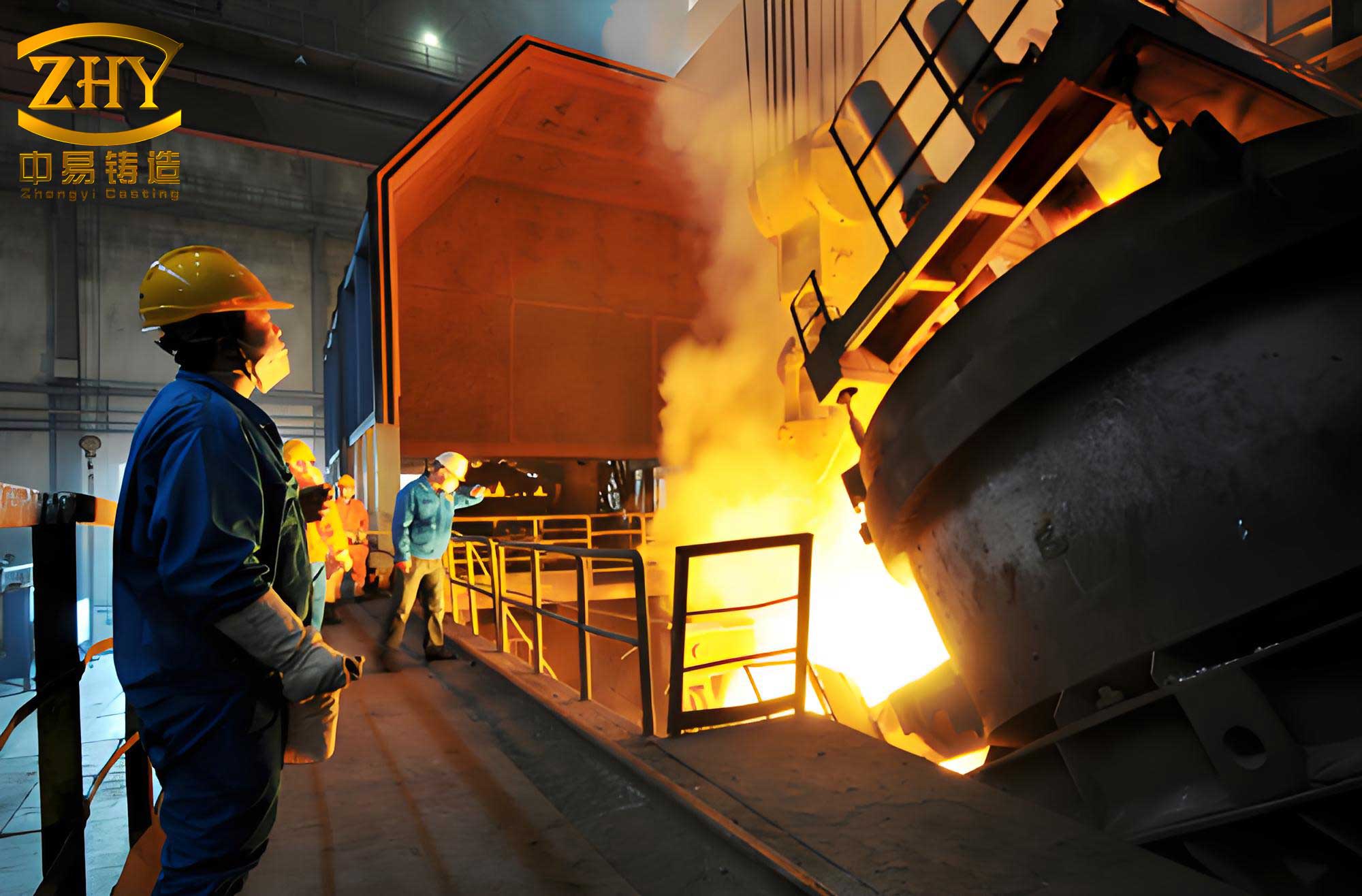
As seen in the image above, a cast iron part can exhibit intricate geometries and smooth surfaces, which are achievable through modern casting techniques. This visual representation underscores the importance of precision in manufacturing, where every cast iron part must meet stringent dimensional tolerances. The conference emphasized that ongoing research in mold design and material science is key to producing reliable cast iron parts consistently.
To further elaborate on the technical aspects, let’s consider the economics of cast iron part production. A table comparing cost factors for different casting methods can provide insights into process selection.
| Casting Method | Initial Tooling Cost | Production Rate (parts/hour) | Typical Cast Iron Part Size Range | Surface Finish Quality | Suitability for High-Volume Cast Iron Part |
|---|---|---|---|---|---|
| Sand Casting | Low | 10 – 50 | Small to large | Moderate | Yes |
| Investment Casting | High | 5 – 20 | Small to medium | Excellent | No |
| Die Casting | High | 100 – 500 | Small to medium | Good | Yes |
| Centrifugal Casting | Medium | 20 – 100 | Cylindrical shapes | Good | Yes |
This table illustrates that sand casting is often preferred for large cast iron parts due to its flexibility, while die casting excels for high-volume production of smaller cast iron parts. The choice of method directly impacts the cost and quality of the final cast iron part, making it a critical decision in manufacturing.
Moreover, the conference delved into environmental considerations for cast iron part production. Recycling scrap iron into new cast iron parts is a common practice that reduces waste and energy usage. The energy savings can be quantified using the formula for embodied energy:
$$ E_{total} = E_{virgin} – E_{recycled} \cdot R $$
where \( E_{total} \) is the net energy consumed, \( E_{virgin} \) is the energy for virgin material production, \( E_{recycled} \) is the energy for recycling, and \( R \) is the recycling rate. For a typical cast iron part, recycling can cut energy use by up to 50%, highlighting its sustainability benefits. Additionally, emissions from casting processes can be modeled using diffusion equations, such as:
$$ \frac{\partial C}{\partial t} = D \nabla^2 C + S $$
where \( C \) is pollutant concentration, \( D \) is diffusivity, and \( S \) is source term. Optimizing furnace operations minimizes the environmental footprint of producing cast iron parts.
In the realm of innovation, the conference showcased research on smart cast iron parts embedded with sensors for real-time monitoring. These cast iron parts can detect stress, temperature, and wear, enabling predictive maintenance. The data from such sensors can be analyzed using machine learning algorithms, where the prediction error \( \epsilon \) is minimized via gradient descent:
$$ \theta_{t+1} = \theta_t – \eta \nabla J(\theta_t) $$
Here, \( \theta \) represents model parameters, \( \eta \) is the learning rate, and \( J \) is the loss function. This integration of IoT with cast iron parts opens new avenues for industrial automation and safety.
Furthermore, the mechanical testing of cast iron parts involves standardized procedures to ensure reliability. For instance, the Charpy impact test measures toughness, with energy absorption given by:
$$ E = mg(h_1 – h_2) $$
where \( E \) is energy, \( m \) is mass, \( g \) is gravity, and \( h_1, h_2 \) are heights. This test is crucial for cast iron parts used in dynamic loads. Similarly, hardness testing for a cast iron part often uses Brinell or Rockwell scales, correlated to tensile strength via empirical formulas like:
$$ \sigma_{TS} = a \cdot HB + b $$
with \( a \) and \( b \) as constants. These correlations help in quality assurance for mass-produced cast iron parts.
The conference also addressed global trends in the cast iron part market. With increasing demand from emerging economies, production volumes are rising, necessitating advancements in automation and quality control. Statistical process control (SPC) charts are used to monitor cast iron part dimensions, where control limits are set as:
$$ UCL = \bar{X} + A_2 \bar{R} $$
$$ LCL = \bar{X} – A_2 \bar{R} $$
Here, \( \bar{X} \) is the sample mean, \( \bar{R} \) is the average range, and \( A_2 \) is a constant. This ensures consistency in cast iron part manufacturing across batches.
In conclusion, the conference reinforced the vital role of cast iron parts in modern industry. From traditional applications to cutting-edge innovations, the cast iron part continues to evolve through research and collaboration. The insights gained from this event, combined with ongoing technological advancements, promise a future where cast iron parts are more efficient, durable, and sustainable. As an engineer, I am excited to contribute to this field, leveraging formulas, tables, and empirical data to drive progress. The cast iron part, in all its forms, remains a testament to the ingenuity of metallurgical science, and I look forward to seeing its continued transformation in the years ahead.
To summarize key points, the cast iron part benefits from microstructure control, additive modifications, and optimized processes. The use of mathematical models and experimental data, as shown in this article, underpins the development of high-performance cast iron parts. Whether in automotive engines or industrial machinery, the cast iron part is indispensable, and its innovation will shape the future of manufacturing. I encourage fellow professionals to explore these avenues further, ensuring that every cast iron part meets the highest standards of quality and functionality.