
In my extensive experience with heavy-duty casting applications, the production of large-scale pump bodies from nodular cast iron presents unique challenges due to stringent quality requirements and complex geometries. Sand suction pumps, utilized in dredging, river channel excavation, and land reclamation projects, operate under harsh conditions, handling abrasive media with solid concentrations exceeding 40%. The pump body, a critical component, must exhibit exceptional integrity—free from shrinkage porosity, voids, or defects—to ensure reliable sealing and longevity. This article delves into the first-person exploration of casting a massive nodular cast iron pump body, weighing 46,600 kg with dimensions of 5,800 mm × 3,480 mm × 2,200 mm, and a material grade of QT500-7. The focus is on overcoming manufacturing hurdles through innovative process design, emphasizing the use of expanded polystyrene (EPS) mold casting, rigorous gating and feeding systems, and advanced metallurgical treatments for nodular cast iron.
The pump body’s irregular shape, with wall thicknesses ranging from 75 mm to 355 mm, necessitates a meticulous approach to avoid defects like shrinkage cavities and porosity, particularly in threaded hole regions for pump cover assembly. Traditional methods often fall short for such thick-section nodular cast iron castings, leading us to adopt EPS mold casting—also known as lost foam or evaporative pattern casting. This technique eliminates the need for draft angles and complex mold parting, but introduces challenges in mold assembly, surface finish, and sand compaction. Below, I detail the comprehensive process, integrating formulas and tables to encapsulate key parameters and decisions.
The EPS mold was crafted by segmenting the digital model into modular blocks for CNC machining and hot-wire cutting, ensuring precision upon assembly. A coating of graphite-based paint, applied in two layers of 0.2 mm each via brushing, enhanced surface smoothness and gas permeability. For the gating system, a bottom-gated two-tier step design was implemented to facilitate filling, slag trapping, and pressure balance. The metal head pressure was calculated using the formula:
$$H_p = H_{\text{mold}} + H_{\text{pour}} – \frac{C}{2}$$
where \(H_p\) is the metal head pressure (mm), \(H_{\text{mold}}\) is the mold height (mm), \(H_{\text{pour}}\) is the pouring cup height (mm), and \(C\) is the casting height (mm). The pouring time was determined based on the casting weight \(G_L\) (kg) and the choke area \(A_{\text{choke}}\) (mm²):
$$t = \sqrt{\frac{2 G_L}{\mu \cdot A_{\text{choke}} \cdot \sqrt{2g H_p}}}$$
with \(\mu = 0.4\) as the flow coefficient, \(\rho = 7.3 \text{ kg/mm}^3\) the density of nodular cast iron, and \(g = 9.8 \text{ m/s}^2\) gravitational acceleration. The gating ratios were set as \(A_{\text{choke}} : A_{\text{runner}} : A_{\text{ingate}} = 1 : 1.2 : 0.8\), with the sprue area \(A_{\text{sprue}} = A_{\text{choke}} / 0.8\). A summary of gating dimensions is provided in Table 1.
| Component | Cross-Sectional Area (mm²) | Dimensions (mm) | Function |
|---|---|---|---|
| Sprue | Calculated per \(A_{\text{sprue}}\) | Diameter: 120 | Initial flow control |
| Runner (Lower) | \(A_{\text{runner}} = 1.2 \times A_{\text{sprue}}\) | Rectangular: 100 × 60 | Distribution and slag arrest |
| Ingates (Upper Tier) | \(A_{\text{ingate}} = 0.8 \times A_{\text{sprue}}\) | Multiple slots: 40 × 30 each | Reduced turbulence |
Chill design was critical for this thick-section nodular cast iron casting to accelerate solidification and prevent graphite degradation. External chills of cast iron were applied in regions with modulus below 9 cm, such as the pump cover flange, while internal chills were used for sections exceeding 300 mm thickness, like the bearing housing. The solidification time \(t_s\) was targeted under 50 minutes to maintain a nodular graphite structure with >80% nodularity, estimated via Chvorinov’s rule:
$$t_s = k \left( \frac{V}{A} \right)^2$$
where \(V\) is volume, \(A\) surface area, and \(k\) the mold constant (approximately 1.2 min/cm² for resin sand). Risers included six Ø180 mm insulated sleeve risers on the bearing seats and two Ø140 mm conventional risers on the base feet, sized using the modulus method to compensate for shrinkage in nodular cast iron. Venting channels were strategically placed at high points and along ribs to exhaust gases during pouring.
Molding involved furan resin sand with 1.2% binder addition. A four-part mold assembly enabled stepwise core placement and inspection. Cores were reinforced with welded or cast chaplets, coated with zirconia-based paint (65–70 Bé) to resist metal penetration. Anti-swelling measures, such as steel plates and water glass sand barriers, countered metallostatic pressures. The process emphasized tight control over sand compaction to minimize loose grains and inclusion risks.
Metallurgical treatment for nodular cast iron is paramount. We employed a pre-conditioning step with 0.4% inoculant to enhance nucleation, followed by spheroidization using 1.05% DY-7F heavy rare-earth magnesium ferrosilicon alloy. Post-inoculation involved 0.4% CALBALLOY inoculant during tapping and 0.15% YFY-1A efficient inoculant via stream addition during pouring. The chemical composition was meticulously controlled, as outlined in Table 2, to achieve the desired microstructure and mechanical properties in nodular cast iron.
| Element | Pre-Treatment Range | Post-Treatment Range | Target for QT500-7 |
|---|---|---|---|
| Carbon (C) | 3.4–3.5 | 3.2–3.4 | 3.2–3.6 |
| Silicon (Si) | 1.5–1.6 | 2.3–2.5 | 2.2–2.6 |
| Manganese (Mn) | 0.35–0.45 | 0.35–0.45 | ≤0.5 |
| Phosphorus (P) | ≤0.04 | ≤0.04 | ≤0.05 |
| Sulfur (S) | ≤0.03 | ≤0.02 | ≤0.02 |
| Copper (Cu) | – | 0.65–0.75 | 0.6–0.8 |
| Residual Mg | – | 0.035–0.055 | 0.03–0.06 |
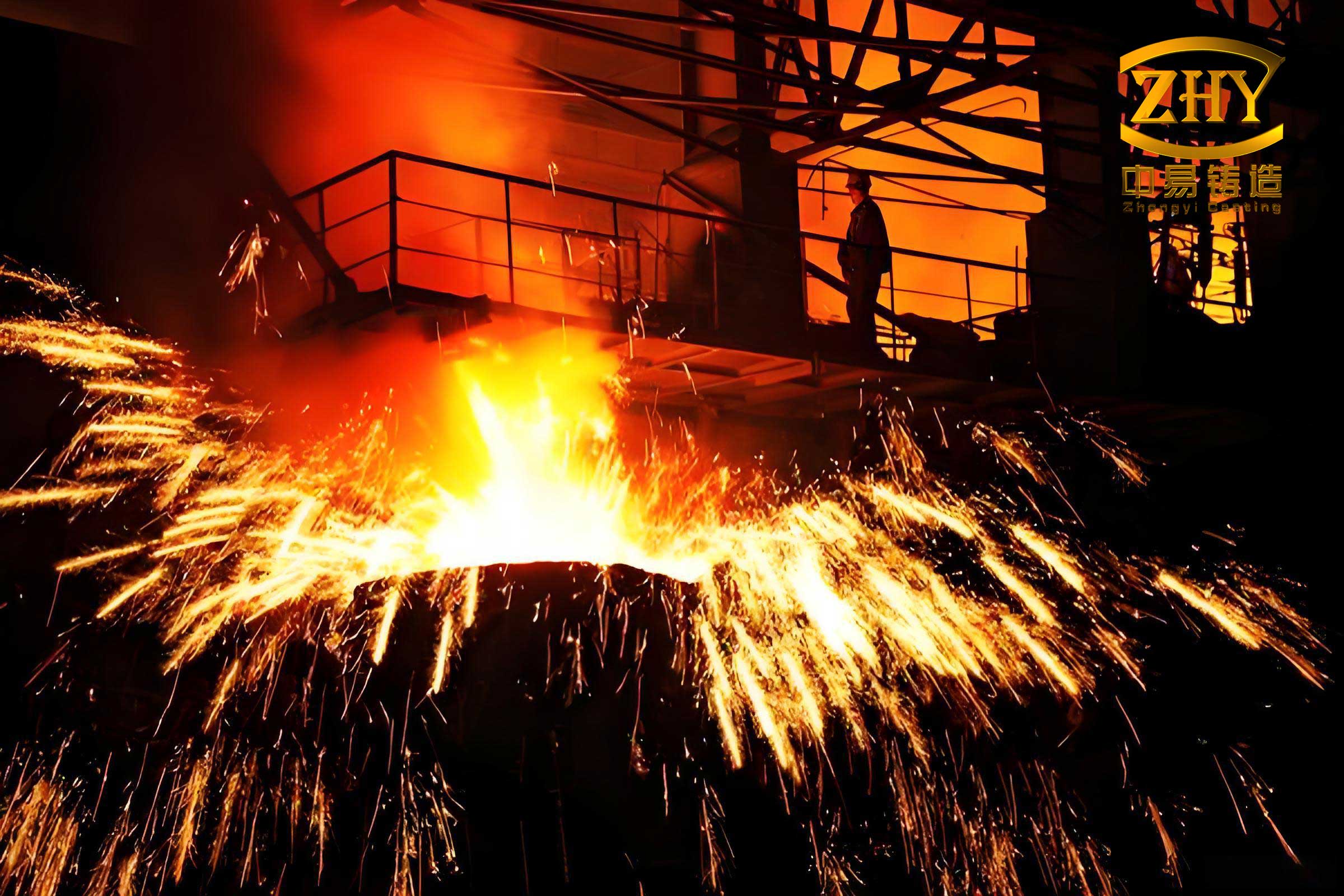
Melting and pouring were conducted in three ladles to manage the large volume. The pouring temperature was maintained at 1,330–1,350°C to ensure fluidity while minimizing gas absorption. A fast, continuous pour was executed under a 40-ton total weight of押铁 to prevent mold lifting. The cooling protocol leveraged the insulating properties of resin sand; the casting was left in-mold for 240 hours for stress relief and slow cooling, with shakeout at temperatures below 300°C after progressive loosening of mold restraints.
Quality validation was performed on attached test lugs. The mechanical properties and microstructural data, summarized in Table 3, confirm the success of the nodular cast iron process. All samples exceeded the QT500-7 specifications, with tensile strengths over 460 MPa, elongation above 7%, and nodularity levels surpassing 90%. The microstructure comprised fine pearlite (55–60%) and well-formed graphite nodules, indicative of effective chilling and inoculation.
| Sample | Tensile Strength (MPa) | Yield Strength (MPa) | Elongation (%) | Hardness (HB) | Nodularity (%) | Pearlite Content (%) |
|---|---|---|---|---|---|---|
| 1 | 460 | 325 | 11.0 | 175 | 92.06 | 54.91 |
| 2 | 490 | 330 | 7.0 | 177 | 92.00 | 60.71 |
| 3 | 485 | 330 | 7.5 | 179 | 90.54 | 57.89 |
The production of this nodular cast iron pump body underscored the importance of integrated design. Key lessons include the efficacy of EPS molds for complex geometries, the necessity of multi-tier gating for thick sections, and the role of chills in modulating solidification. The nodular cast iron exhibited superior performance due to controlled alloying and repeated inoculation. Future iterations could optimize riser sizes using simulation software to further reduce material use. This endeavor demonstrates that with meticulous planning, even the most demanding nodular cast iron castings can be achieved reliably, offering a benchmark for industrial pump manufacturing.
In reflection, the nodular cast iron process required balancing numerous variables: from mold making and sand control to metallurgy and thermal management. The use of nodular cast iron, with its inherent ductility and strength, was pivotal for the pump’s durability. By sharing these insights, I aim to contribute to the broader foundry community’s ability to tackle large-scale, high-integrity castings in nodular cast iron. The synergy of traditional craftsmanship and modern techniques, as detailed here, paves the way for advancing nodular cast iron applications in heavy machinery and beyond.