
In our foundry operations, we have encountered a persistent issue with surface color differences in nodular cast iron castings manufactured using furan resin sand. These color variations are not merely cosmetic; they indicate underlying metallurgical problems such as poor spheroidization of graphite at the casting surface, leading to degraded mechanical properties. This defect compromises product quality and fails to meet stringent customer specifications. Our investigation traced the root cause to sulfur contamination from the sand system, specifically from the sulfonic acid hardener used in the furan resin binder. Upon pouring, sulfur from the mold reacts with magnesium in the iron melt at high temperatures, depleting the residual magnesium necessary for graphite nodulization. This results in a surface layer with deteriorated graphite morphology—often exhibiting flake or vermicular graphite—which manifests as a discolored zone. This article details our comprehensive study, from problem analysis to solution implementation, employing advanced anti-sulfur coatings to mitigate this issue.
The production process initially involved manufacturing large injection molding machine plate castings, with a material grade of QT450-10 nodular cast iron. These castings weighed approximately 500 kg, with a machining allowance of 5–6 mm on critical surfaces. The requirement was for a spheroidization grade of 2, with unacceptable defect depth limited to ≤0.2 mm. The molding sand was a blend of 30/50 mesh scrubbed sand and reclaimed sand in a 1:9 ratio. Key parameters of the reclaimed sand included a loss on ignition (LOI) of 2.6%–3.2% and a sulfur content ranging from 0.12% to 0.20%. A standard 800-type coating was applied, with specifications summarized in Table 1. The mold design utilized a two-part cope and drag, one casting per mold, with four ingates. The binder system consisted of FD305 furan resin at 0.85%–0.90% addition and GH28 sulfonic acid hardener at 25%–35% addition relative to resin. Technical specifications for these materials are provided in Table 2 and Table 3. Melting was conducted in a cupola furnace, with nodularization using C-1 nodularizer (1.2%–1.4% addition) and inoculation using BS-1 inoculant (0.4%–0.7% addition). The pouring temperature was controlled between 1,310 °C and 1,330 °C. The base iron and final casting compositions are detailed in Table 4.
| Type | Color | Main Aggregates | Density (g/cm³) | Baumé Degree (°Bé) | Suspension Rate (2 h) | Application | Shelf Life |
|---|---|---|---|---|---|---|---|
| 800-Type | Red-brown | Graphite, Mullite | 1.60–2.00 | >90 | ≥90% | Nodular Cast Iron | 6 months |
| Type | Nitrogen Content (%) | Free Formaldehyde (%) | Viscosity at 20°C (mPa·s) | Density (g/cm³) | Free Furfuryl Alcohol (%) | pH Value | Shelf Life |
|---|---|---|---|---|---|---|---|
| FD305 | ≤3.0 | ≤0.3 | ≤65 | 1.12–1.20 | ≥75 | 7.5–8.5 | 6 months |
| Type | Viscosity at 20°C (mPa·s) | Density (g/cm³) | Total Acidity (%) | Free Sulfuric Acid (%) | Non-Crystallization Property | Shelf Life |
|---|---|---|---|---|---|---|
| GH28 | ≤25 | 1.1–1.3 | 27–29 | ≤12 | No crystallization at -15°C | 6 months |
| Component | C | Si | Mn | P | S | Mg | Cu |
|---|---|---|---|---|---|---|---|
| Base Iron | 3.82 | 1.47 | 0.12 | 0.034 | 0.053 | 0.0010 | 0.015 |
| Casting | 3.64 | 2.40 | 0.12 | 0.036 | 0.012 | 0.063 | 0.015 |
Metallographic analysis was performed on sections exhibiting color difference, typically at edges and inner cavity surfaces of the castings. The microstructure revealed a mixture of graphite forms: spherical, vermicular, and flake graphite in the affected surface layers. In contrast, the core regions showed well-nodularized graphite. This gradient in graphite morphology directly correlated with the observed discoloration. Mechanical properties from these surface-affected zones were substandard, as shown in Table 5. Tensile strength, yield strength, and elongation all fell below the specifications for QT450-10 nodular cast iron. The degradation was severe enough that spheroidization grading was impossible in some areas due to the prevalence of non-spherical graphite.
| Location | Tensile Strength (MPa) | Yield Strength (MPa) | Elongation (%) | Spheroidization Rate (%) | Graphite Size |
|---|---|---|---|---|---|
| Customer Requirement | ≥420 | ≥290 | ≥10 | ≥90 | 5–7 |
| Position ① (Edge) | 382 | 276 | 8.3 | Unrateable (mixed forms) | N/A |
| Position ② (Edge) | 379 | 271 | 7.9 | Unrateable (mixed forms) | N/A |
| Position ③ (Inner Cavity) | 386 | 279 | 9.2 | Unrateable (mixed forms) | N/A |
To diagnose the issue, we analyzed the entire sand system. The furan resin sand process inherently introduces sulfur because sulfonic acid hardeners are used for curing. The hardener’s acidity and free sulfuric acid content directly influence the sulfur level in the reclaimed sand. The reaction during pouring can be described by the following chemical equation:
$$ \text{S (from sand)} + \text{Mg (in iron melt)} \rightarrow \text{MgS} $$
This reaction scavenges magnesium from the surface layer of the molten nodular cast iron. Magnesium is a crucial nodularizing element; its depletion shifts graphite growth from spheroidal to flake or vermicular forms. The thermodynamic driving force is high at pouring temperatures, and the kinetic diffusion of sulfur from the mold into the metal is facilitated by the high temperature and the porous sand mold. The sulfur content in the reclaimed sand was measured at 0.12%–0.20%, which is significant for causing surface degradation in nodular cast iron. The LOI of 2.6%–3.2% indicated substantial organic residue, which can also contribute to gas defects and further complicate the casting quality. The acid demand value (ADV) of the base sand was 20–40 mL (for pH=7), indicating its potential reactivity.
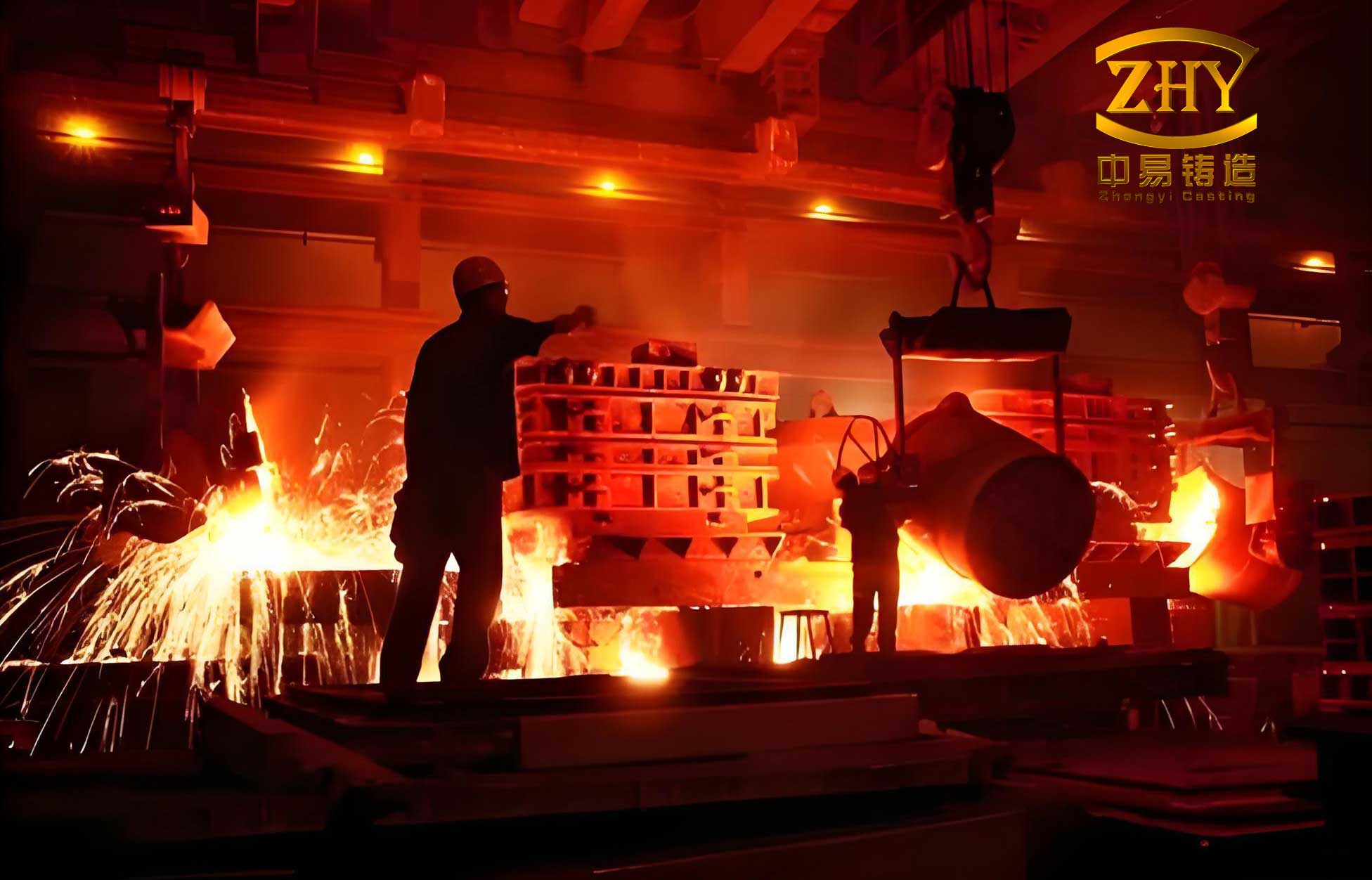
The image above illustrates a typical nodular cast iron casting, highlighting the importance of surface integrity. In our case, the surface defects were not immediately visible on the as-cast surface but became apparent after machining, revealing the subsurface layer affected by sulfur penetration. This underscores the need for effective barrier technologies in the mold system.
Our approach to solving this problem considered three fundamental strategies: reducing the sulfur source, interrupting the transmission path, and neutralizing the sulfur’s effect. Reducing the source involves measures like lowering the LOI of reclaimed sand, using low-sulfur hardeners, reducing hardener addition, minimizing the sand-to-metal ratio, and adding new sand. Interrupting the path includes using anti-sulfur coatings, increasing cooling rates, and lowering pouring temperatures. Neutralizing the effect could involve increasing residual magnesium content in the iron. After evaluation, we focused on interrupting the transmission path as the most practical and immediate solution, specifically by implementing a specialized anti-sulfur coating.
The optimized production protocol retained the original resin (FD305) and hardener (GH28) but replaced the standard 800-type coating with FQ30pro, an advanced anti-sulfur coating. The application procedure was meticulous: two brush coats were applied. The first coat had a Baume degree of 50–55 °Bé, applied evenly and allowed to bond with the sand mold. After a suitable drying period, the coating was ignited to remove solvents and strengthen the bond. Once the mold cooled to ambient temperature, a second coat with a Baume degree of 40–45 °Bé was applied. The total coating thickness was controlled between 0.3 mm and 0.5 mm. Specifications for FQ30pro coating are given in Table 6.
| Type | Color | Main Aggregates | Density (g/cm³) | Baumé Degree (°Bé) | Suspension Rate (2 h) | Application | Shelf Life |
|---|---|---|---|---|---|---|---|
| FQ30pro | Yellow | Graphite, Forsterite | 1.20–1.50 | 60–70 | ≥98% | Nodular Cast Iron | 6 months |
Post-implementation, castings were inspected and tested extensively. Visual examination showed no discernible color difference on machined surfaces. Metallographic samples from previously problematic locations now exhibited excellent graphite nodulization, with spheroidization rates exceeding 90% and graphite sizes predominantly in the 5–6 range. Mechanical properties recovered fully to meet and exceed specifications, as demonstrated in Table 7. The effectiveness of the FQ30pro coating in preventing sulfur penetration was unequivocally proven.
| Location | Tensile Strength (MPa) | Yield Strength (MPa) | Elongation (%) | Spheroidization Rate (%) | Graphite Size |
|---|---|---|---|---|---|
| Customer Requirement | ≥420 | ≥290 | ≥10 | ≥90 | 5–7 |
| Position ① (Edge) | 428 | 301 | 21.6 | 95 | 6 |
| Position ② (Edge) | 433 | 308 | 22.8 | 95 | 6 |
| Position ③ (Inner Cavity) | 426 | 297 | 19.5 | 90 | 5–6 |
The success of the FQ30pro coating hinges on its unique formulation. The primary aggregates are graphite and forsterite (magnesium olivine, Mg₂SiO₄). Graphite provides a refractory barrier and lubricity, while forsterite plays an active chemical role. Forsterite is a magnesium silicate that can absorb and neutralize sulfur compounds at high temperatures. The proposed mechanisms involve several reactions that occur within the coating layer during pouring:
First, sulfur from the sand mold, which may be present as elemental sulfur, sulfides, or sulfur oxides from decomposition, migrates toward the metal. Upon encountering the coating, it reacts with magnesium oxide (MgO) derived from forsterite or other components:
$$ \text{SO}_2 + \text{MgO} \rightarrow \text{MgSO}_3 $$
Additionally, sulfite ions or sulfide ions can react with magnesium ions:
$$ \text{SO}_3^{2-} + \text{Mg}^{2+} \rightarrow \text{MgSO}_3 $$
$$ \text{S}^{2-} + \text{Mg}^{2+} \rightarrow \text{MgS} $$
These reactions effectively trap sulfur in the coating as magnesium sulfite or magnesium sulfide, preventing its diffusion into the nodular cast iron melt. The coating thus acts as a sacrificial and reactive barrier. This is a significant advancement over conventional coatings, which primarily serve as refractory washes without specific chemical inhibitors for sulfur.
To delve deeper into the metallurgical principles, the graphitization behavior in nodular cast iron is governed by interfacial energies and the presence of surface-active elements. Sulfur is a potent surface-active element that adsorbs preferentially on the prismatic planes {10\(\bar{1}\)0} of graphite. This adsorption reduces the interfacial energy between the iron melt and these prismatic planes, promoting graphite growth along the \(\langle 10\bar{1}0 \rangle\) direction, leading to flake graphite formation. The nodularizing element magnesium counters this by reacting with sulfur to form stable compounds like MgS, thereby eliminating sulfur’s surface-active effect. Magnesium also alters the interfacial energy balance, favoring growth along the \(\langle 0001 \rangle\) direction (c-axis), which results in spherical graphite. The equilibrium can be expressed conceptually as:
$$ \Delta G_{\text{nodularization}} = \Delta G_{\text{Mg-S}} + \Delta G_{\text{interface}} $$
Where \(\Delta G_{\text{Mg-S}}\) is the free energy change for magnesium-sulfur compound formation, and \(\Delta G_{\text{interface}}\) is the change in interfacial energy due to magnesium. When sulfur infiltrates from the mold, it increases the effective sulfur concentration at the casting surface, shifting the equilibrium towards flake graphite unless sufficient residual magnesium is present. The relationship between critical residual magnesium content \([Mg]_{\text{crit}}\) and sulfur content \([S]\) can be approximated by:
$$ [Mg]_{\text{crit}} = k \cdot [S] + C $$
Here, \(k\) is a proportionality constant dependent on temperature and other melt conditions, and \(C\) is a base level required for nodulization. For high-quality nodular cast iron, maintaining \([Mg]_{\text{residual}} > [Mg]_{\text{crit}}\) is essential. The infiltration of sulfur from the mold elevates \([S]\) locally, thereby increasing \([Mg]_{\text{crit}}\) and potentially causing \([Mg]_{\text{residual}}\) to fall below the threshold, resulting in degraded spheroidization.
Our study also involved modeling the diffusion of sulfur from the sand mold into the casting. Fick’s second law can be applied to estimate the sulfur concentration profile in the casting surface layer:
$$ \frac{\partial C_S}{\partial t} = D_S \frac{\partial^2 C_S}{\partial x^2} $$
Where \(C_S\) is the sulfur concentration, \(t\) is time, \(D_S\) is the diffusion coefficient of sulfur in liquid iron, and \(x\) is the distance from the surface. Assuming a constant sulfur concentration \(C_0\) at the mold-metal interface and initial bulk concentration \(C_b\), the solution for semi-infinite medium gives:
$$ C_S(x,t) = C_b + (C_0 – C_b) \cdot \text{erfc}\left( \frac{x}{2\sqrt{D_S t}} \right) $$
The depth of the affected layer, where \(C_S\) exceeds a critical value \(C_{\text{crit}}\) that impairs nodulization, can be estimated. For typical pouring and solidification times in our 500 kg nodular cast iron castings, this depth correlated well with the observed metallurgically degraded zone of 0.2–0.5 mm before machining. The role of the FQ30pro coating is to drastically reduce \(C_0\), the interfacial sulfur concentration, by providing a chemical barrier. Effectively, the coating introduces an additional diffusion layer with a very low effective sulfur diffusivity and active sulfur capture.
Further optimization of the sand system remains crucial. While the coating solved the immediate problem, we also recommend ongoing measures to reduce sulfur at the source. This includes improving sand reclamation to lower LOI below 2.0%, exploring alternative hardeners with lower free sulfuric acid content, and optimizing the sand-to-metal ratio. The composition of the base iron for nodular cast iron is also critical; we maintain tight control over elements like titanium, lead, and antimony, which can also interfere with graphite spheroidization. The inoculation practice is another factor; we use late stream inoculation to ensure a high count of graphite nuclei, which helps counteract any minor surface degradation.
In conclusion, the color difference issue in nodular cast iron castings produced with furan resin sand is a direct consequence of sulfur-induced surface spheroidization degradation. Through systematic investigation, we identified the sulfur from the sulfonic acid hardener in the reclaimed sand as the primary contaminant. By implementing FQ30pro, an advanced anti-sulfur coating containing forsterite, we successfully created a chemical and physical barrier that intercepts and neutralizes sulfur before it can react with magnesium in the iron melt. This resulted in the elimination of surface color differences and the restoration of full mechanical properties in the castings. The solution is robust, practical, and integrable into existing production lines without major process alterations. This research underscores the importance of a holistic approach to sand system management in foundries producing high-integrity nodular cast iron components. Future work may involve developing even more efficient coating formulations and exploring integrated sand additives that permanently reduce sulfur mobility in furan resin sand systems.