
In my extensive experience in the field of metal casting, I have witnessed the transformative impact of advanced sand casting services on the production of large, thin-walled aluminum alloy components. These components, such as pressure vessels for high-voltage electrical equipment and heavy-duty engine parts, demand exceptional mechanical properties, airtightness, and dimensional accuracy. Traditional methods like welding or gravity casting often fall short due to issues like porosity, shrinkage, and inconsistent wall thickness. Through years of research and practical application, I have developed and refined a low-pressure sand casting technology that addresses these challenges. This approach combines optimized alloy chemistry, innovative melt purification, precise mold positioning, and specialized equipment design, all integral to modern sand casting services. In this article, I will detail these advancements, emphasizing how they enhance the quality and reliability of large aluminum castings, while repeatedly highlighting the critical role of sand casting services in industrial manufacturing. The goal is to provide a comprehensive guide that underscores the efficiency and versatility of this technology, making it accessible for widespread adoption.
The demand for large aluminum castings has surged with the rapid development of industries like power generation, transportation, and aerospace. Components such as SF6-insulated tanks for electrical switchgear, diesel engine blocks, and turbocharger housings require complex geometries, uniform thin walls (often 8–15 mm), and localized thick sections (up to 80 mm). These parts must exhibit high density, excellent conductivity, and leak-proof performance to ensure long-term reliability. Historically, fabrication involved welded steel or aluminum plates, but this led to maintenance issues like frequent oil changes. The shift to cast aluminum alloys, particularly Al-Si-Mg systems, offered a solution, but conventional casting methods struggled with defects like shrinkage porosity and gas entrapment. My work focuses on leveraging low-pressure sand casting to overcome these limitations. This technology involves filling a sand mold from below using controlled gas pressure, promoting directional solidification and reducing turbulence. As a cornerstone of sand casting services, it enables the production of intricate, high-integrity parts with minimal investment, making it ideal for both prototype and mass production.
Central to this technology is the optimization of aluminum alloy composition. For electrical applications, alloys like AlSi7Mg (similar to A356 or ZL101A) are preferred due to their balance of castability and properties. However, achieving optimal mechanical strength and electrical conductivity requires precise control of elements like silicon, magnesium, and impurities. In my research, I have established that silicon content significantly affects conductivity; as silicon increases, conductivity decreases due to its poor conductive nature. This relationship can be expressed as: $$ \sigma = \sigma_0 – k \cdot C_{Si} $$ where $\sigma$ is the electrical conductivity, $\sigma_0$ is the base conductivity of pure aluminum, $k$ is a constant, and $C_{Si}$ is the silicon concentration. To maintain good fluidity for thin-wall casting while maximizing conductivity, I narrow the silicon range to 6.8–7.2%, tighter than standard specifications. Magnesium, which forms Mg2Si precipitates for strengthening, must be limited to 0.3–0.5% to avoid degrading conductivity. The interplay between strength and conductivity is summarized in Table 1, which I derived from experimental data.
| Element | Optimal Range | Effect on Mechanical Properties | Effect on Conductivity |
|---|---|---|---|
| Silicon (Si) | 6.8–7.2% | Improves fluidity and castability | Decreases with higher content |
| Magnesium (Mg) | 0.3–0.5% | Enhances strength via Mg2Si | Moderate decrease |
| Iron (Fe) | < 0.2% | Reduces elongation and corrosion resistance | Negligible impact |
| Phosphorus (P) | < 10 ppm | Causes coarse silicon structure | Slight decrease |
| Calcium (Ca) | < 5 ppm | Increases gas absorption | Minor effect |
Additionally, I incorporate trace elements like rare earths (RE), zirconium (Zr), and boron (B) to refine microstructure and reduce hydrogen content. For instance, RE elements such as lanthanum and cerium modify eutectic silicon and form hydrides, lowering hydrogen activity. Zirconium and boron generate compounds like Al3Zr and AlB2, which act as grain refiners and hydrogen scavengers. A key innovation is the secondary titanium addition technique: after melting, I introduce a salt-based refiner containing Ti-B-Zr at 0.1% of the melt weight. This generates fresh Al3Ti, TiB2, and Al3Zr nuclei, dramatically enhancing grain refinement compared to pre-alloyed titanium. The effectiveness is quantified by the grain size reduction equation: $$ d = \frac{K}{\sqrt{f \cdot C_{Ti}}} $$ where $d$ is the average grain diameter, $K$ is a material constant, $f$ is the nucleation frequency, and $C_{Ti}$ is the titanium concentration. This approach ensures a fine, uniform microstructure, crucial for the performance of castings produced through sand casting services.
Melt purification is another critical aspect of my methodology. Aluminum melts are prone to hydrogen gas and oxide inclusions (Al2O3), which lead to porosity and weakened mechanical properties. In my sand casting services, I employ a multi-step purification process. First, I use a proprietary flux that combines refining, modification, and slag removal functions. Added at 720°C, it generates inert bubbles that capture hydrogen and oxides during flotation. The flux also contains cerium, which reacts with residual hydrogen to form stable CeH3, preventing gas pore formation during solidification. For centralized melting operations, I have developed a rotary degassing system with pulsed gas injection. This produces fine bubbles for efficient hydrogen removal, described by the efficiency equation: $$ \eta = 1 – e^{-k \cdot Q \cdot t} $$ where $\eta$ is the degassing efficiency, $k$ is a rate constant, $Q$ is the gas flow rate, and $t$ is the treatment time. This system reduces hydrogen levels to below 0.1 ml/100g Al, ensuring high melt quality. Table 2 outlines the purification steps and their outcomes.
| Step | Method | Temperature | Key Actions | Result |
|---|---|---|---|---|
| 1. Flux Addition | Proprietary flux | 720°C | Inert bubble generation, slag removal | Reduces H and Al2O3 |
| 2. Rotary Degassing | Pulsed argon injection | 730–750°C | Fine bubble dispersion | H content < 0.1 ml/100g |
| 3. Filtration | Ceramic foam filter | Before casting | Traces inclusion removal | Clean melt for casting |
Precise mold positioning is essential for achieving uniform wall thickness in large castings. In traditional sand casting services, core prints and mold seats often have gaps of 1.0–1.5 mm, leading to misalignment and thickness variations of 2–3 mm. My innovation involves using iron chills combined with metallic core prints. The chills, made from ductile iron, are machined with ventilation channels and undergo salt bath nitriding to form an anti-oxidation layer. This prevents rusting, which could otherwise introduce moisture and hydrogen into the melt. These chills are placed at thick sections like flanges to promote rapid cooling and prevent shrinkage. More importantly, they serve as accurate seats for metallic core prints. Instead of conventional sand cores with wooden or iron frames, I use machined ductile iron plates as core prints, attached to steel tube cores. This creates a metal-to-metal fit with a clearance of only 0.5 mm, akin to permanent mold precision. The improvement is illustrated by the wall thickness deviation formula: $$ \Delta t = \frac{D_m – D_c}{2} $$ where $\Delta t$ is the thickness deviation, $D_m$ is the mold cavity diameter, and $D_c$ is the core diameter. With my method, $\Delta t$ is reduced to less than 1 mm, ensuring dimensional consistency. This advancement is a hallmark of high-quality sand casting services, enabling the production of complex parts like 500 kV transformer housings with minimal post-processing.
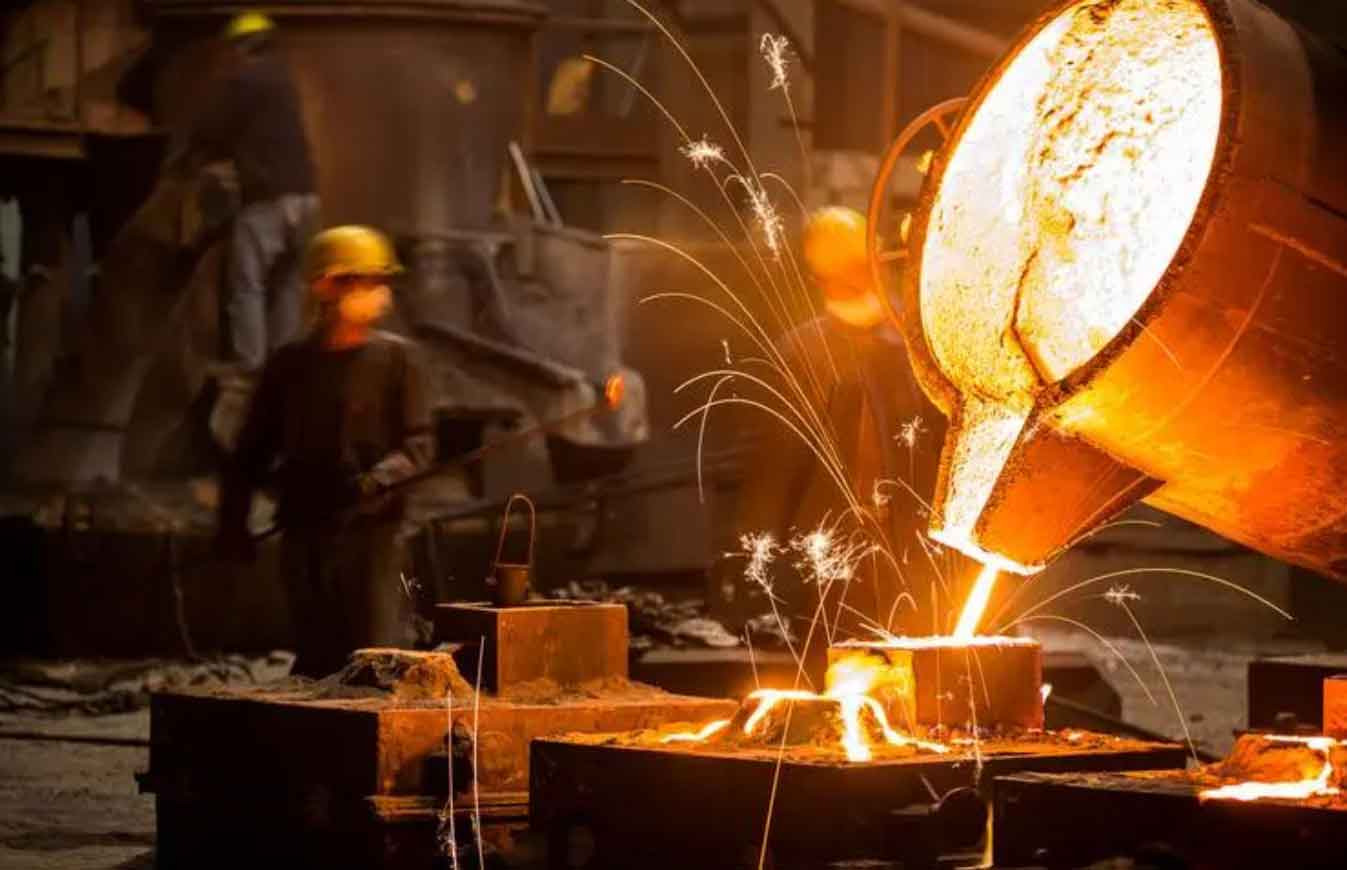
The low-pressure sand casting equipment I designed is tailored for large-scale applications. Commercial low-pressure casting machines often use furnace body sealing, but this limits mold size and weight. My patented crucible sealing technique shifts the load to ground supports, allowing for heavier molds (up to 13 tons) and larger castings (e.g., 620 kg switchgear tanks). The system features a resistance furnace with a chromium-silicon steel crucible, rated for 500–800 kg melt capacity. The crucible withstands pressures up to 0.13 MPa and lasts over 150 cycles due to optimized material and casting parameters. The pressure control system uses a throttle valve and pressure gauge to regulate filling speed, minimizing turbulence. The benefits are quantified by the Bernoulli-based filling equation: $$ v = \sqrt{\frac{2(P – \rho g h)}{\rho}} $$ where $v$ is the metal velocity, $P$ is the applied pressure, $\rho$ is the melt density, $g$ is gravity, and $h$ is the height. This ensures smooth, upward filling, reducing defects like cold shuts and gas entrapment. Moreover, the pressure during solidification enhances feeding, as described by the Darcy law for interdendritic flow: $$ Q = \frac{K A \Delta P}{\mu L} $$ where $Q$ is the feed flow rate, $K$ is the permeability, $A$ is the area, $\Delta P$ is the pressure drop, $\mu$ is the viscosity, and $L$ is the flow length. This results in dense, leak-free castings, a key advantage of my sand casting services. Table 3 compares my equipment with conventional systems.
| Feature | My Low-Pressure System | Conventional System |
|---|---|---|
| Sealing Method | Crucible sealing | Furnace body sealing |
| Mold Weight Capacity | Up to 13 tons | Limited to 5–8 tons |
| Crucible Material | Chromium-silicon steel | Cast iron |
| Crucible Life | 150+ cycles | 50–100 cycles |
| Pressure Control | Precise, no fluctuations | Potential fluctuations |
Computer-aided design and solidification simulation have revolutionized my approach to process optimization. For complex parts like high-voltage circuit breakers, I use 3D CAD modeling to visualize geometries and design gating systems. Then, input parameters such as alloy thermal properties, mold materials, and boundary conditions are fed into simulation software. The energy equation for solidification is: $$ \frac{\partial}{\partial t}(\rho H) = \nabla \cdot (k \nabla T) $$ where $\rho$ is density, $H$ is enthalpy, $k$ is thermal conductivity, and $T$ is temperature. This predicts shrinkage and porosity locations, allowing iterative adjustments before physical trials. For instance, simulations might indicate hot spots at flange junctions, prompting additional chills or risers. This reduces development time by over 50% and cuts costs significantly, enhancing the responsiveness of sand casting services to market demands. In one project for a large diesel engine block, simulation helped identify optimal chill placement, reducing scrap rate from 15% to under 3%.
High-finish, high-precision core making is vital for internal surfaces of castings, such as connector tubes with small access holes. Traditional methods involve sand cores with coated surfaces, but these often suffer from inaccuracies and brush marks. My patented “negative mold positive making” technique addresses this. First, I machine a metal core to exact dimensions and smooth finish. Then, a shrinkage-free silicone rubber is used to create a replica core box. Next, I use a modified sodium silicate sand with good collapsibility to produce cores in the rubber mold. This sand, another innovation in my sand casting services, contains additives that improve breakdown after casting. The core quality is expressed by the surface roughness equation: $$ R_a = C \cdot \frac{D_g}{P} $$ where $R_a$ is the average roughness, $C$ is a constant, $D_g$ is the grain size, and $P$ is the packing density. With this method, $R_a$ is reduced to below 6.3 µm, meeting strict internal finish requirements. After casting, the sand disintegrates easily under vibration, and residual coatings are removed with high-pressure water jets. This process has enabled the production of leak-proof SF6 valve bodies, with productivity five times higher than overseas methods and costs 70% lower, showcasing the efficiency of advanced sand casting services.
Over the past decade, this low-pressure sand casting technology has been implemented in multiple factories, producing over 200 types of large aluminum components, totaling more than 50,000 pieces. Applications span electrical insulators, engine blocks, medical imaging devices, and military vehicles. For example, 345 kV switchgear tanks measure Ø870 mm × 2350 mm and weigh 620 kg, yet exhibit wall thickness deviations under 1 mm and helium leak rates below 1×10^-9 mbar·L/s. These parts are exported globally, supplying major corporations like ABB and Siemens. The success stems from the integrated approach: alloy optimization ensures mechanical and electrical properties; melt purification minimizes defects; precise mold positioning guarantees accuracy; low-pressure equipment enables scale; and advanced cores achieve fine finishes. This holistic method underscores the value of comprehensive sand casting services in modern manufacturing.
In conclusion, my work demonstrates that low-pressure sand casting is a robust solution for large aluminum alloy castings. Key innovations include tailored Al-Si-Mg compositions with trace elements, effective melt purification, chilled metallic mold positioning, crucible-sealed low-pressure equipment, CAD simulation, and precision core making. These elements collectively enhance density, dimensional accuracy, and surface quality, meeting stringent industry standards. The technology is cost-effective, flexible across sand types (clay, resin, or sodium silicate), and scalable for high-volume production. As industries demand lighter, stronger, and more reliable components, sand casting services incorporating these advancements will play a pivotal role. Future directions may involve AI-driven process control and sustainable sand reclamation, further solidifying the position of sand casting services as a cornerstone of advanced manufacturing. Through continuous refinement and sharing of these practices, I aim to empower foundries worldwide to achieve excellence in aluminum casting.