
The landscape of industrial manufacturing is perpetually evolving, driven by the relentless pursuit of efficiency, precision, and agility. Within the venerable domain of foundry engineering, sand casting has long been a cornerstone for producing metal components, particularly for large, complex, or low-to-medium volume applications. Traditional sand casting, while robust, often grapples with protracted lead times, high costs for tooling, and quality inconsistencies, especially during the research, development, and prototyping phases of complex sand casting products. The advent and integration of advanced digital technologies—collectively termed here as 3D technologies—are precipitating a fundamental transformation. This article synthesizes a new, integrated mode for rapid sand casting, a paradigm built upon the seamless application of Computer-Aided Design (CAD), Engineering (CAE), and Manufacturing (CAM), alongside additive and subtractive digital fabrication and metrology. This mode aims to achieve a fully digital thread across the entire casting process, from initial concept to validated part, thereby enhancing the competitiveness and responsiveness in producing sand casting products.
Limitations of the Conventional Sand Casting Paradigm
The classical sand casting workflow is linear and heavily dependent on physical tooling. It typically encompasses several sequential stages: casting process and mold design, pattern and core box manufacturing, mold and core assembly, metal melting and pouring, post-casting processing (cleaning, heat treatment), and final inspection. The creation of high-quality patterns and core boxes is time-consuming and expensive. For intricate sand casting products, the design must incorporate draft angles, parting lines, and loose pieces, which constrains geometric freedom and adds complexity. Any design modification mandates corresponding, costly changes to the tooling, rendering the process inflexible and unsuitable for rapid iteration. Furthermore, the manual skills required for mold assembly and finishing introduce variability, potentially affecting the dimensional accuracy and internal soundness of the final sand casting products.
The Pillars of the New 3D-Enabled Rapid Sand Casting Mode
The proposed new mode disrupts this linear, tooling-dependent chain by establishing a digital continuum. Its foundational pillars are Digitalization & Visualization, Tool-less & Flexible Fabrication, Automation & Precision, and Information Integration & Rapidity.
1. Digitalization and Visualization of the Entire Process
In this new paradigm, every artifact is inherently digital and visual. The journey begins with a 3D CAD model of the desired component. Using this model, the foundry engineer performs digital casting design—adding machining allowances, designing the gating and feeding systems (risers, gates), and partitioning the mold. This digital prototype allows for intuitive analysis and instant communication between design and manufacturing teams, ensuring manufacturability feedback is incorporated early.
The digital model then feeds into CAE simulation software. Here, critical physical phenomena are visualized and analyzed before any metal is poured. Engineers can simulate filling to predict turbulence, mistuns, or air entrapment. Solidification and cooling simulations reveal potential shrinkage porosity or hot spots. Stress analysis can forecast distortion. This virtual trial-and-error process is summarized by key predictive metrics, often governed by equations like the Niyama criterion for predicting shrinkage porosity:
$$Niyama = G / \sqrt{\dot{T}}$$
where \(G\) is the temperature gradient and \(\dot{T}\) is the cooling rate. Areas where this value falls below a critical threshold indicate a high risk of microporosity in the final sand casting product.
Finally, digital metrology using 3D scanning captures the as-built geometry of molds, cores, and finished castings, creating a visual and quantifiable record for comparison against the digital master.
2. Tool-less and Flexible Fabrication of Molds and Cores
This is the most transformative aspect. The need for physical patterns and core boxes is eliminated. The digital mold design is directly used to fabricate the sand molds and cores via two primary routes:
- 3D Sand Printing (Binder Jetting): An additive manufacturing process where a recoater deposits a thin layer of sand, and a print head selectively deposits a binder agent, bonding the sand particles layer-by-layer to form the complex geometry.
- CNC Machining of Sand Blocks: A subtractive process where a solid block of cured resin-bonded sand is machined using CNC mills to sculpt the precise mold cavity.
This “pattern-less” capability offers unprecedented geometric freedom. Undercuts, internal channels, and conformal cooling passages that were impossible or prohibitively expensive with traditional tooling can now be produced directly. It enables true rapid prototyping and production of sand casting products, as design changes only require modifying the digital file, not re-manufacturing costly tooling.
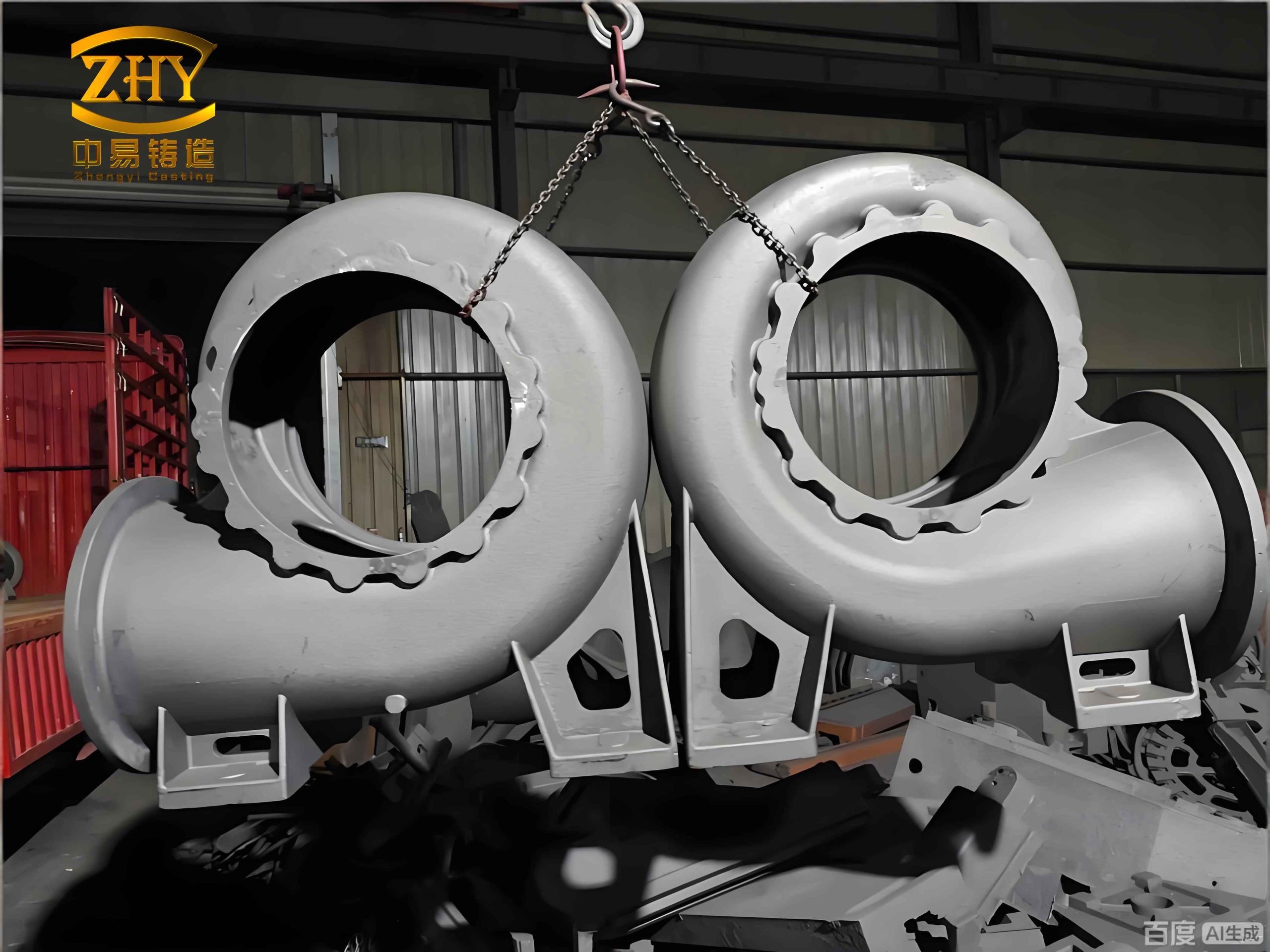
3. Automation and Enhanced Precision
Automation shifts quality assurance from skilled labor to machine control. In CNC machining, the path and precision of the cutting tool are dictated by the CAM software, ensuring dimensional fidelity of the mold. In 3D printing, the layer thickness and binder deposition are precisely controlled. This reduces human error in mold assembly. Furthermore, the integration of 3D scanning for in-process inspection of cores and molds allows for a closed-loop control system. Deviations can be detected early, and the digital process can be adjusted accordingly, pushing towards “right-first-time” manufacturing of precision sand casting products.
4. Information Integration and Cycle Time Compression
The mode thrives on the continuous flow and leverage of two key data streams: Product and Process Data (3D models, simulations, scan data) and Production Management Data (scheduling, machine status, quality records). An integrated digital platform connects design, simulation, production planning, and quality control. This integration compresses the timeline dramatically by enabling concurrent activities (e.g., simulation while the mold is being printed), eliminating tooling lead time, and reducing trial runs through accurate simulation. The feedback from scanned as-cast dimensions also allows for rapid process optimization for subsequent iterations.
| Aspect | Traditional Sand Casting | 3D-Enabled Rapid Sand Casting |
|---|---|---|
| Pattern/Mold Fabrication | Manual pattern making (wood/metal); Long lead time. | Direct digital fabrication (3D Print/CNC); Short lead time. |
| Geometric Complexity | Limited by draft, parting line, core boxes. | Extremely high; Near-total geometric freedom. |
| Design Change Impact | Very high cost and time; New tooling required. | Low cost and time; Modify digital file only. |
| Primary Skill Dependency | Skilled pattern makers and molders. | CAD/CAE/CAM engineers and machine operators. |
| Prototyping Speed | Slow | Very Fast |
| Economic Batch Size | Medium to High Volume | Ideal for Single Pieces and Low Volumes |
Core Technical Considerations within the New Mode
Successfully implementing this new paradigm requires rethinking established foundry practices and mastering new technical considerations specific to digital mold fabrication.
1. Integrated Design and Precision Assembly of Mold Blocks
The distinction between “mold” and “core” blurs in the digital realm. The focus shifts to a holistic design of all sand blocks that will constitute the mold cavity. This requires meticulous planning for the assembly of these blocks. Key design features must be incorporated digitally:
- Precision Locating Features: Dowel pins and matching holes must be designed into the adjoining faces of sand blocks to ensure perfect alignment during assembly.
- Handling and Lifting Features: Lugs or threaded inserts for lifting must be integrated to facilitate safe handling of often heavy and fragile sand blocks.
- Venting Channels: Escape paths for gases generated during pouring must be consciously designed into the sand blocks, as they cannot be added manually as easily as in traditional molding.
The goal is to design a mold kit that assembles with the precision of a machined component, ensuring the dimensional integrity of the resulting sand casting products.
2. Precise Integration of Post-Placement Items (Chills, Filters)
Digital molds must accommodate traditional foundry aids like chills and filters. Their placement needs to be designed into the mold cavity from the outset. For chills, the challenge is twofold: ensuring proper metallurgical effect and managing dimensional distortion. The intense local cooling from a chill can cause differential shrinkage, warping the casting. This must be pre-compensated in the digital model. A simplified model for pre-distortion might consider the thermal contraction:
$$\Delta L = \alpha \cdot L_0 \cdot \Delta T$$
where \(\Delta L\) is the change in length, \(\alpha\) is the coefficient of thermal expansion for the alloy, \(L_0\) is a critical dimension, and \(\Delta T\) is the temperature drop from solidus to room temperature. In areas adjacent to chills, an effective \(\Delta T\) must be estimated to adjust the mold dimensions accordingly.
Filters require precisely sized and shaped seats in the gating system to be held securely without causing flow restriction or sand inclusion.
3. Data-Driven Feedback and Process Re-optimization
The digital thread enables a powerful feedback loop. Dimensional data from 3D scanning at various stages—mold, as-cast, after heat treatment—is compared against the original CAD model and the simulation predictions. This data fusion allows for the quantitative analysis of the entire casting deformation chain.
| Stage | Data Captured (3D Scan) | Analysis Purpose |
|---|---|---|
| Fabricated Sand Mold | Actual mold cavity geometry. | Verify fabrication accuracy; Identify machining/printing errors. |
| As-Cast Component | Geometry after casting, before heat treatment. | Measure total casting shrinkage/distortion. |
| Heat-Treated Component | Final geometry before machining. | Quantify stress-relief or quenching distortion. |
By correlating this measured data with simulation results (e.g., predicted distortion vectors), a compensation factor can be derived. The original CAD model for the mold can then be intelligently pre-distorted in the opposite direction of the observed error, a process often governed by an iterative algorithm to minimize the final deviation \(D_f\):
$$D_f = |G_{target} – (G_{initial} + \sum_{i=1}^{n} C_i \cdot S_i) |$$
where \(G_{target}\) is the target geometry, \(G_{initial}\) is the initial mold design, \(C_i\) are compensation coefficients for different phenomena (solid shrinkage, thermal stress), and \(S_i\) are the simulated or historical distortion shapes. The objective is to iteratively adjust \(C_i\) to drive \(D_f\) to zero, ensuring highly accurate sand casting products.
Material, Process Selection, and Hybrid Approaches
The choice between 3D sand printing and CNC machining of sand blocks depends on several factors related to the desired sand casting products.
| Criteria | 3D Sand Printing (Binder Jetting) | CNC Machining of Sand Blocks |
|---|---|---|
| Best for Geometric Complexity | Excellent. Ideal for organic shapes, undercuts, integrated cores. | Good, but limited by tool access. Deep pockets or internal features are challenging. |
| Surface Finish | Layered texture (stair-stepping); May require coating. | Superior, machine-tool finish. |
| Production Speed for Single Mold | Speed is layer-dependent; Faster for very complex molds. | Speed is volume-dependent; Faster for simpler, larger molds. |
| Material Properties | Binder chemistry critical; Strength and gas evolution vary. | Uses standard, certified foundry sand mixes; Predictable properties. |
| Waste Material | Minimal (only printed material used). | Significant (material is cut away). |
| Economic Driver | Complexity, integration, no tooling. | Surface finish, material certainty, available CNC capacity. |
A pragmatic approach often involves a hybrid strategy. For a large casting, the main mold drag and cope might be produced using traditional methods or CNC-machined sand for cost-effectiveness and surface finish, while an incredibly complex core cluster is 3D printed. This combines the benefits of both digital and conventional techniques to optimize the overall cost and lead time for specific sand casting products.
Future Outlook and Concluding Synthesis
The 3D-enabled rapid sand casting mode represents a significant leap forward for the foundry industry, particularly for high-value, low-volume, and complex components. Its success hinges not on the complete abandonment of traditional knowledge but on the synergistic fusion of digital precision with foundational metallurgical and foundry principles.
The future trajectory of this mode points towards several key areas:
- Advanced Materials for Digital Molds: Development of sand-binder systems with enhanced strength, better surface finish, and controlled permeability and breakdown.
- AI-Powered Process Optimization: Using machine learning algorithms to analyze the vast datasets from simulations and scans to auto-optimize gating design and predict defects with higher accuracy.
- Fully Automated Mold Assembly and Pouring Cells: Integrating robotic systems to handle, assemble, coat, and pour digital molds, creating lights-out production cells for sand casting products.
- Integrated Digital Twins: Creating a live, evolving digital replica of the physical casting process that updates with real-time sensor data (temperature, pressure) for ultimate process control.
In conclusion, the new paradigm of rapid sand casting, built upon a foundation of integrated 3D technologies, effectively addresses the critical challenges of speed, cost, and flexibility in modern manufacturing. By enabling a fully digital flow—from virtual design and simulation through tool-less fabrication to data-rich inspection—it drastically shortens development cycles for prototypes and small batches while improving the dimensional accuracy and internal quality of sand casting products. This mode is not a mere incremental improvement but a fundamental re-engineering of the casting workflow, positioning sand casting as a agile, precise, and digitally-native manufacturing process ready to meet the demands of Industry 4.0. The ongoing convergence of digital and physical realms in the foundry promises to unlock new frontiers in the design and production of metal components, ensuring that sand casting remains a vital and innovative technology for decades to come.