
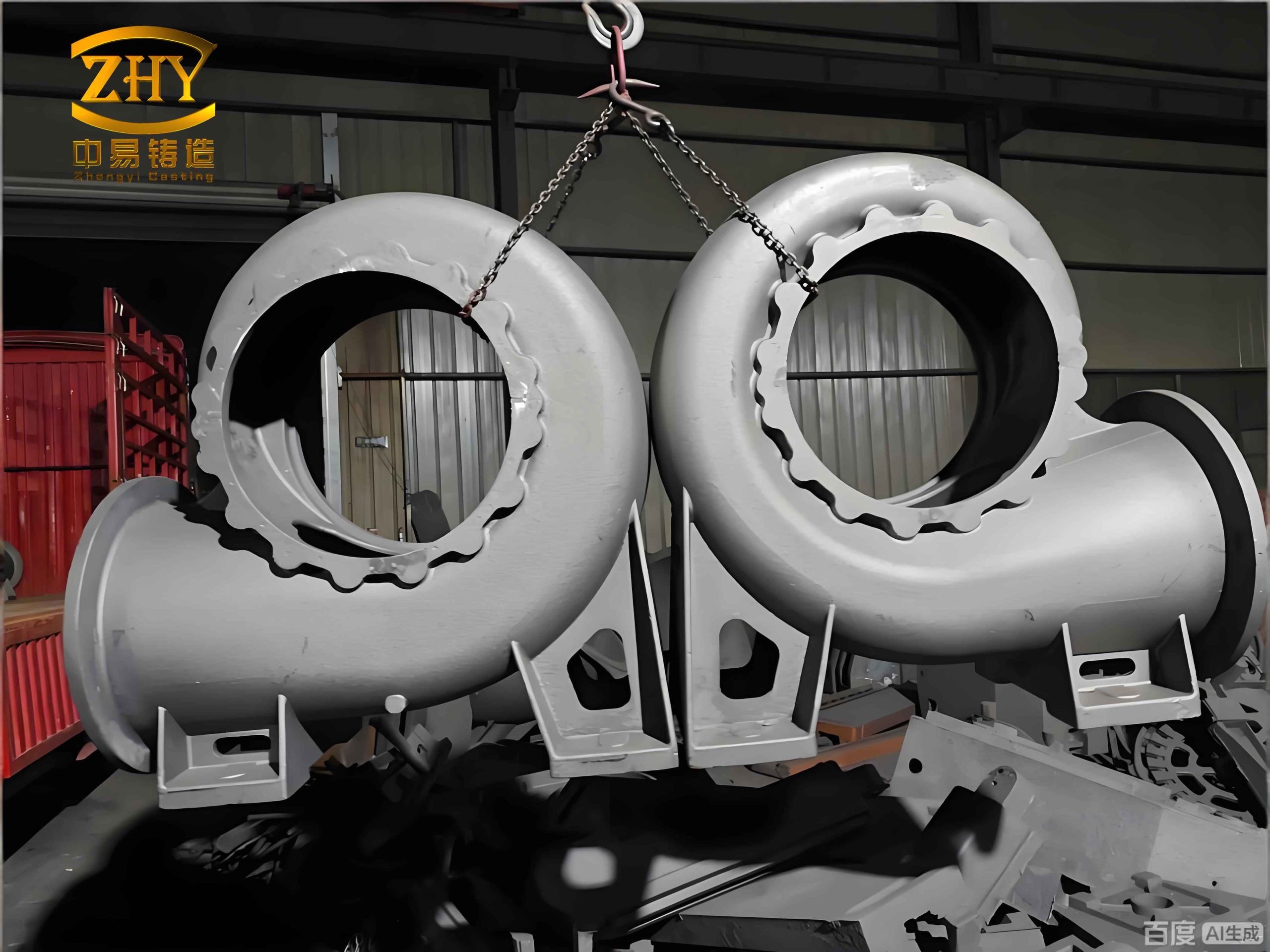
As a researcher deeply immersed in the field of additive manufacturing, I have witnessed firsthand the transformative power of 3D printing technologies, particularly in the realm of sand casting products. The shift from traditional subtractive methods to additive processes represents not just a technological leap but a paradigm change in how we conceive, design, and manufacture complex components. In this article, I will explore the intricate details of 3D printing applications for sand casting products, delving into technical principles, advantages, industry dynamics, and future trends, all while emphasizing the centrality of sand casting products in this evolution. To illustrate the practical outcomes, consider the following image of advanced sand casting products fabricated through 3D printing techniques, which showcases the precision and complexity achievable.
The core of this revolution lies in 3D printing, or additive manufacturing, which builds objects layer by layer from digital models. Specifically for sand casting products, the 3DP (Three-Dimensional Printing) technology has emerged as a game-changer. This method involves depositing a binder onto a powder bed, typically sand, to create intricate molds and cores directly from CAD data. The process eliminates the need for physical patterns or molds, enabling rapid prototyping and production of sand casting products with unprecedented design freedom. From my experience, the efficiency gains are staggering; for instance, production cycles for sand casting products can be reduced by up to 50%, while dimensional accuracy improves significantly, often within 0.3 mm tolerances. This precision is crucial for high-performance sand casting products used in aerospace, automotive, and heavy machinery sectors, where every micron counts.
To understand the technical underpinnings, let’s delve into the mathematics of 3DP for sand casting products. The layer-by-layer fabrication can be modeled using additive principles. For a given sand casting product with a volume \( V \) and surface area \( S \), the total printing time \( T \) can be approximated by the formula:
$$ T = \frac{V}{A \cdot v} + \frac{S}{r} $$
where \( A \) is the cross-sectional area per layer, \( v \) is the printing speed (in layers per unit time), and \( r \) is the resolution factor accounting for binder jetting rates. This equation highlights how optimizing parameters can accelerate the production of sand casting products. Moreover, the mechanical properties of the final sand casting products depend on binder penetration depth \( d \), which can be expressed as:
$$ d = \sqrt{\frac{2 \gamma \cos \theta}{\rho g}} $$
where \( \gamma \) is the surface tension of the binder, \( \theta \) is the contact angle with sand particles, \( \rho \) is density, and \( g \) is gravitational acceleration. Such formulas guide the development of superior sand casting products with enhanced strength and minimal defects.
The advantages of 3D printing for sand casting products are multifaceted, fundamentally altering traditional foundry practices. In my analysis, the most significant benefits include the elimination of mold-making, reduced labor intensity, and environmental improvements. For example, traditional sand casting products often require extensive manual labor in pattern creation and core assembly, whereas 3D printing automates these steps. To quantify this, consider the following table comparing key metrics between conventional methods and 3D printing for sand casting products:
| Metric | Traditional Sand Casting | 3D Printed Sand Casting Products |
|---|---|---|
| Production Time | Weeks to months | Days to hours |
| Dimensional Accuracy | ±1.0 mm | ±0.3 mm |
| Material Waste | High (up to 30%) | Low (less than 5%) |
| Labor Intensity | High, requiring skilled workers | Low, automated processes |
| Design Complexity | Limited by mold constraints | Unlimited, enabling intricate geometries |
| Cost for Small Batches | High due to tooling | Low, no tooling needed |
This table underscores why 3D printing is becoming indispensable for custom and low-volume sand casting products. Additionally, the environmental impact is reduced through near-zero waste and elimination of harmful emissions, aligning with global sustainability goals for sand casting products.
Moving to the industry ecosystem, the 3D printing landscape for sand casting products encompasses a robust supply chain. From my observations, the upstream segment includes raw materials like silica sand, furan resins, and phenolic binders, which are critical for producing high-quality sand casting products. The midstream involves equipment manufacturers developing advanced 3D printers tailored for sand casting products, while downstream applications span aerospace, automotive, medical, and consumer goods. To illustrate the interdependencies, here’s a table outlining the key players and roles in the 3D printing industry for sand casting products:
| Industry Segment | Key Components | Impact on Sand Casting Products |
|---|---|---|
| Upstream (Materials & Software) | Sand powders, binders, CAD software | Determines material properties and design flexibility for sand casting products |
| Midstream (Equipment) | 3D printers, print heads, control systems | Enables precision and speed in fabricating sand casting products |
| Downstream (Applications) | Foundries, OEMs, service bureaus | Drives demand and innovation for sand casting products in various sectors |
This chain highlights how advancements in one area, such as developing cheaper binders, can lower costs and expand the market for sand casting products. Notably, the localization of supply chains is reducing reliance on imports, fostering growth in regions like Asia for sand casting products.
Efficiency remains a central focus in advancing 3D printing for sand casting products. Based on my research, several factors contribute to print speed and cost-effectiveness. The overall efficiency \( E \) of a 3D printer for sand casting products can be modeled as:
$$ E = \frac{N \cdot L}{T_c + T_p} $$
where \( N \) is the number of layers, \( L \) is layer thickness, \( T_c \) is cycle time for powder deposition, and \( T_p \) is printing time per layer. Innovations such as multi-jet print heads and optimized motion systems are pushing \( E \) higher, making sand casting products more affordable. For instance, dual-box printers can achieve parallel processing, cutting downtime by up to 40% for sand casting products. The economic viability is further captured by the cost per part \( C \) for sand casting products:
$$ C = \frac{M + E \cdot t}{P} $$
with \( M \) as material cost, \( E \) as energy consumption rate, \( t \) as time, and \( P \) as production volume. This formula shows that as \( t \) decreases through faster printing, \( C \) drops, enabling mass customization of sand casting products.
Looking ahead, the trends in 3D printing for sand casting products are poised to accelerate adoption. From my perspective, key developments include the diversification of printer architectures, with machines offering varying build sizes and speeds to cater to different scales of sand casting products. Moreover, the localization of critical components like servo drives and inkjet heads is reducing costs and lead times for sand casting products. Another trend is the integration of AI and IoT for predictive maintenance and quality control in producing sand casting products, ensuring consistency. The push for standards and certifications will also bolster trust in 3D-printed sand casting products for critical applications. To summarize potential growth areas, consider this table on future directions for sand casting products:
| Trend | Description | Expected Impact on Sand Casting Products |
|---|---|---|
| Multi-Material Printing | Using hybrid sands and binders for graded properties | Enhanced performance and lightweighting of sand casting products |
| Cloud-Based Platforms | Remote monitoring and design sharing | Faster collaboration and iteration for sand casting products |
| Green Manufacturing | Recyclable sands and bio-based binders | Reduced environmental footprint of sand casting products |
| Automated Post-Processing | Robotic cleaning and finishing systems | Lower labor costs and higher throughput for sand casting products |
These innovations will further embed 3D printing into the mainstream of sand casting products, driving the industry toward digital, smart factories. In my view, the convergence of these trends will make sand casting products more accessible, sustainable, and versatile than ever before.
In conclusion, the journey of 3D printing in the realm of sand casting products is one of relentless innovation and disruption. From enabling complex geometries to slashing production times, this technology has redefined what’s possible for sand casting products across industries. As we continue to refine materials, hardware, and processes, the future of sand casting products looks increasingly digital and efficient. The ongoing research and development efforts, coupled with growing industry acceptance, suggest that 3D-printed sand casting products will soon become the norm rather than the exception, paving the way for a new era in manufacturing where customization and sustainability go hand in hand for sand casting products.