
In the field of industrial manufacturing, sand casting remains a widely used method for producing complex metal components due to its versatility, cost-effectiveness, and adaptability to various alloys. Among sand casting products, steel castings are critical in applications such as mining machinery, transportation, and heavy equipment, where high strength and durability are required. However, defects like porosity, inclusions, insufficient pouring, shrinkage cavities, and shrinkage porosity often arise during the sand casting process, leading to reduced qualification rates and increased production costs. To address these challenges, I focus on optimizing the sand casting process for a steel shell component through numerical simulation, aiming to minimize defects and enhance the quality of sand casting products.
This study involves designing and evaluating multiple casting process schemes for a steel shell made of ZG270-500 alloy. By employing computer simulation software, I analyze the effects of pouring temperature and pouring velocity on the filling and solidification processes, as well as on the volume of shrinkage defects. Orthogonal experiments are conducted to determine optimal process parameters, and production validation is performed to verify the improvements. The goal is to provide a reference for designing sand casting processes for similar shell-type steel castings, ultimately shortening trial cycles, reducing costs, and improving economic benefits for sand casting products.
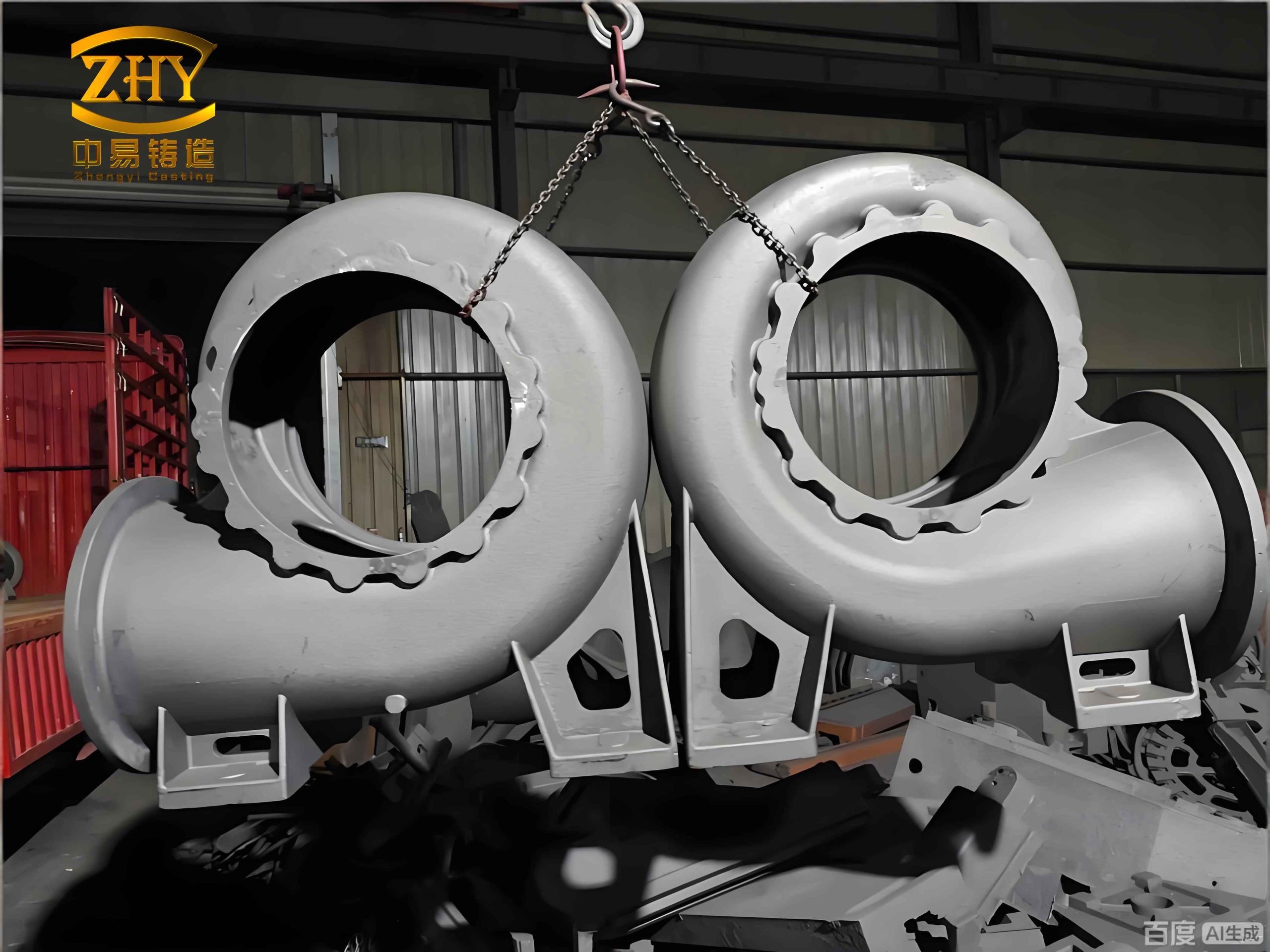
The steel shell casting under investigation has a hollow structure with high internal surface quality requirements and localized thick sections. Its mass is approximately 392.93 kg, with dimensions of 812 mm × 525 mm × 356 mm and an average wall thickness of 8 mm. Such geometries are common in sand casting products, where proper gating and riser design is essential to ensure sound castings. The chemical composition of the ZG270-500 alloy is detailed in Table 1, which ensures adequate plasticity, toughness, strength, and hardness for demanding applications.
| Element | Content (wt.%) |
|---|---|
| C | 0.4–0.5 |
| Mn | 0.7–0.8 |
| P | ≤0.04 |
| S | ≤0.05 |
| Fe | Balance |
Based on the parting surface selection principles, I initially designed two casting process schemes. Scheme 1 places the ingates at the base of the casting, while Scheme 2 positions them at the cylindrical portion of the shell. Both schemes aim for simplicity in molding and operation. Since the casting is made of steel, an open gating system is adopted to promote smooth filling, minimize turbulence, and reduce metal oxidation—a common consideration for high-quality sand casting products. The gating system design involves calculating key parameters such as pouring time and metal rise velocity using fundamental formulas.
The pouring time \( t \) is determined by the mass of molten metal in the mold \( G_L \), the number of ladles \( N \), the number of pouring holes per ladle \( n \), and the average pouring rate \( q \). The formula is:
$$ t = \frac{G_L}{N n q} $$
For this casting, \( G_L = 450 \, \text{kg} \), \( N = 1 \), \( n = 1 \), and \( q = 27 \, \text{kg/s} \), yielding:
$$ t = \frac{450}{1 \times 1 \times 27} \approx 16.7 \, \text{s} $$
To verify the suitability of the pouring time, the rise velocity \( v \) of molten metal in the mold is calculated based on the casting height \( C \) and pouring time \( t \):
$$ v = \frac{C}{t} $$
Here, \( C = 356 \, \text{mm} \), so:
$$ v = \frac{356}{16.7} \approx 21.3 \, \text{mm/s} $$
This rise velocity is within an acceptable range for steel castings, ensuring proper filling without excessive turbulence. The gating system cross-sectional area ratios follow a standard proportional relationship for sand casting products:
$$ \sum A_{\text{阻}} : \sum A_{\text{直}} : \sum A_{\text{横}} : \sum A_{\text{内}} = 1 : (1.8-2.0) : (1.8-2.0) : (2.0-2.5) $$
Given a ladle hole diameter of 40 mm, the calculated areas are: \( \sum A_{\text{阻}} = 1256 \, \text{mm}^2 \), \( \sum A_{\text{内}} = 2763 \, \text{mm}^2 \), and \( \sum A_{\text{直}} = 2386 \, \text{mm}^2 \) with a sprue diameter of 55 mm. These design parameters form the basis for numerical simulation to predict and mitigate defects in sand casting products.
I use ProCAST software for numerical simulation of the casting process. In the pre-processing stage, the casting geometry is imported, and meshing is performed with a grid step size of 30 mm. The mesh consists of 12,722 surface elements and 45,906 volume elements, checked for quality to avoid cracks, overlaps, or other issues. The material properties are defined: the casting is set as Medium-Carbon AISI 1040 (equivalent to ZG270-500), the mold and cores are made of silica sand, and the initial mold temperature is 25°C. The heat transfer coefficient between metal and sand mold is set to 1000 W/(m²·K), with cooling conditions specified as COINCIDENT. Boundary conditions, gravity acceleration, and other parameters are configured to replicate real-world sand casting environments.
Simulations are conducted for Schemes 1 and 2 with a pouring temperature of 1560°C and a pouring velocity of 1.6 m/s. The filling process results indicate that both schemes exhibit insufficient pouring defects at the top of the cylindrical portion of the shell, as shown in the temperature and porosity distributions. To address this, I modify the designs by adding open risers: Scheme 1 includes two risers, and Scheme 2 incorporates two risers as well. However, porosity analysis reveals significant shrinkage defects, with Scheme 1 having a porosity volume of 28.23 cm³ and Scheme 2 having 50.58 cm³. Such defect levels are unacceptable for functional sand casting products, necessitating further optimization.
Based on these findings, I develop Scheme 3, which adjusts the ingate positions and incorporates four open risers. Two risers have a diameter of 110 mm and height of 350 mm, while the other two are stepped with a lower diameter of 200 mm (height 32.5 mm) and an upper diameter of 135 mm (height 330 mm). This design aims to improve feeding and reduce shrinkage in critical areas. The filling process simulation for Scheme 3 shows that molten metal enters the mold cavity from the ingates, filling upward from the base, which facilitates gas expulsion and minimizes air entrapment—a key advantage for defect-free sand casting products. The temperature distribution during filling indicates that the base regions cool faster, while the cylindrical sections remain hotter, promoting directional solidification.
The solidification process for Scheme 3 is simulated to assess defect formation. Results demonstrate that the casting solidifies progressively from thin sections to thick sections, with risers providing adequate feeding to compensate for shrinkage. The total solidification time is longer than the filling time, but the optimized riser placement ensures minimal porosity. To quantify the effects of process parameters, I conduct orthogonal experiments focusing on pouring temperature and pouring velocity, as these factors critically influence the quality of sand casting products. The factor levels are designed as shown in Table 2.
| Level | Pouring Temperature (°C) | Pouring Velocity (m/s) |
|---|---|---|
| 1 | 1530 | 1.3 |
| 2 | 1560 | 1.6 |
| 3 | 1590 | 1.9 |
Nine simulation runs are performed according to the orthogonal array, with porosity volume as the response variable. The results are analyzed using range analysis to determine the influence of each factor. The porosity volumes for each combination are listed in Table 3, along with calculated K values (sum of results for each level) and ranges R.
| Group No. | Pouring Temperature (°C) | Pouring Velocity (m/s) | Porosity Volume (cm³) |
|---|---|---|---|
| 1 | 1530 | 1.3 | 2.368 |
| 2 | 1530 | 1.6 | 2.201 |
| 3 | 1530 | 1.9 | 2.503 |
| 4 | 1560 | 1.3 | 1.553 |
| 5 | 1560 | 1.6 | 1.416 |
| 6 | 1560 | 1.9 | 1.818 |
| 7 | 1590 | 1.3 | 1.984 |
| 8 | 1590 | 1.6 | 2.066 |
| 9 | 1590 | 1.9 | 2.206 |
The K values for pouring temperature are: \( K_1 = 7.072 \), \( K_2 = 4.782 \), \( K_3 = 6.256 \), giving a range \( R = 2.290 \). For pouring velocity: \( K_1 = 5.905 \), \( K_2 = 5.683 \), \( K_3 = 6.527 \), with \( R = 0.844 \). The larger range for pouring temperature indicates it has a more significant effect on porosity volume compared to pouring velocity. The optimal combination is identified as pouring temperature of 1560°C and pouring velocity of 1.6 m/s, which yields the smallest porosity volume of 1.416 cm³. This optimization directly enhances the integrity of sand casting products by reducing defects.
I validate the optimized parameters through production trials. The results show that Scheme 3 with the optimal settings eliminates insufficient pouring defects and significantly reduces shrinkage porosity. The qualification rate of the steel shell castings increases from 81% to 96%, and the process yield reaches 66%. Microstructural and mechanical property evaluations confirm that the castings meet required specifications, demonstrating the effectiveness of numerical simulation in improving sand casting products. The optimized process not only shortens development cycles but also lowers costs, contributing to sustainable manufacturing practices.
The success of this optimization highlights the importance of integrating simulation tools into the design phase for sand casting products. By virtually testing different gating and riser configurations, I can predict defect formation and adjust parameters before physical trials, saving time and resources. Additionally, the use of orthogonal experiments provides a systematic approach to identifying key factors, which is applicable to a wide range of sand casting products. Future work could explore the effects of coating layers on mold surfaces or investigate residual stresses during solidification, further refining the quality of sand casting products.
In conclusion, numerical simulation and optimization of the sand casting process for a steel shell have been successfully implemented. Three process schemes were designed and evaluated, with Scheme 3 showing superior performance due to adjusted ingate positions and riser design. Orthogonal experiments revealed that pouring temperature has a greater influence on porosity volume than pouring velocity, with optimal parameters of 1560°C and 1.6 m/s minimizing defects. The resulting sand casting products achieve high qualification rates and meet mechanical requirements, validating the simulation-based approach. This methodology provides valuable insights for designing sand casting processes for complex steel components, emphasizing the role of simulation in advancing manufacturing efficiency and product quality for sand casting products.
Throughout this study, the focus on sand casting products underscores their industrial significance and the need for continuous improvement. By leveraging numerical tools, manufacturers can enhance the reliability and performance of sand casting products, ensuring they meet stringent standards. As technology evolves, further integration of artificial intelligence and advanced materials science may unlock new potentials for sand casting products, driving innovation in sectors reliant on durable metal components. The lessons learned here can be extended to other sand casting products, fostering a culture of precision and efficiency in foundry operations worldwide.