
In the foundry industry, green sand casting remains a predominant method for producing sand casting parts, particularly for iron components like diesel engine accessories. This process, which utilizes a mixture of base sand, clay (typically bentonite), additives (such as coal dust and starch), and water, accounts for approximately 60-70% of all sand mold usage. The advantages are clear: low production costs, short cycles, and high recyclability of sand, with old sand reuse rates reaching 90-95%. However, green sand’s limitations—notably low mold strength and hardness—restrict its application to sand casting parts weighing under 200 kg or with wall thicknesses below 50 mm. In our operations, we focus on producing a variety of sand casting parts, including flywheels, flywheel housings, and small miscellaneous components, which present unique challenges due to their diverse geometries and batch production modes.
Our green sand system incorporates advanced equipment like variable-frequency rotor mixers with automatic online detection and cooling mechanisms to manage sand temperature, as “hot sand” (above ambient by 10-15°C) can exacerbate defects. Despite these measures, we initially faced a scrap rate of around 8%, primarily due to defects stemming from sand quality issues. The main defects observed in sand casting parts include sand holes, porosity, sand inclusions, and sand sticking. This article, from a first-person perspective, delves into the root causes of these defects and outlines effective countermeasures, supported by tables and formulas to enhance understanding and implementation.
To systematically address these issues, we must first understand the composition and properties of green sand. The quality of sand casting parts is heavily influenced by parameters such as moisture content, compactability, green compressive strength, hot wet tensile strength, and permeability. For instance, the compactability (CB value) is a critical indicator, defined as the ratio of compacted density to loose density, often expressed as a percentage. It relates to moisture content through the following empirical relationship:
$$ \text{CB} = \frac{\text{Compactability}}{\text{Moisture Content}} \times 100\% $$
In practice, we aim for a CB value between 32% and 36%, with the ratio of compactability to moisture content ideally ranging from 10 to 12. Deviations can lead to defects: a ratio below 10 indicates excessive moisture and poor toughness, while above 12 suggests low moisture and high sensitivity. This balance is crucial for minimizing defects in sand casting parts.
The following table summarizes the key defects and their primary causes in green sand casting production:
| Defect Type | Primary Causes | Associated Sand Properties |
|---|---|---|
| Sand Holes | Inadequate sand strength, uneven compaction, mold erosion during pouring, improper core design | Low green compressive strength, high moisture |
| Porosity (Gas Holes) | High moisture content, excessive volatile additives, poor venting, high sand density, metal gas content | High moisture, low permeability, high loss on ignition |
| Sand Inclusions (Scabs) | Low hot wet tensile strength, thermal expansion differences, prolonged metal contact | Low hot wet tensile strength, high clay content |
| Sand Sticking (Penetration) | Low refractoriness, high permeability, excessive pouring pressure/temperature, coarse sand grains | High permeability, low AFS fineness, high灼减量 (loss on ignition) |
Each defect requires targeted strategies, which we have developed through rigorous process control and material management. For sand casting parts, prevention starts with raw material selection and sand preparation. We use sodium-activated bentonite for its superior hot wet tensile strength, and coal dust as an additive to reduce sand sticking and improve thermal plasticity. The optimal additive ratios can be expressed mathematically. For example, the coal dust addition relative to bentonite is typically 50%, but for parts prone to sand inclusions, it can be increased to 80%. This is governed by:
$$ \text{Coal Dust Ratio} = \frac{\text{Mass of Coal Dust}}{\text{Mass of Bentonite}} \times 100\% $$
Moreover, the loss on ignition (LOI), which indicates volatile content, should be controlled between 3% and 5% for most sand casting parts. Exceeding this range can lead to excessive gas evolution and porosity.
Let’s delve deeper into each defect. Sand holes, as shown in visual examples, occur when loose sand grains dislodge and become embedded in the metal. This is often due to insufficient green compressive strength. In our high-pressure molding line, we maintain green compressive strength between 0.11 MPa and 0.16 MPa, with lower values for small parts and higher for large, complex sand casting parts like flywheels. The required strength can be estimated based on mold geometry and pouring dynamics. For instance, the critical strength to resist erosion (\(S_c\)) might be approximated by:
$$ S_c = \frac{\rho v^2}{2} \cdot A $$
where \(\rho\) is the metal density, \(v\) is the pouring velocity, and \(A\) is the effective area of impingement. Practically, we ensure uniform compaction above 85 units, with sidewalls at 85+ and top surfaces at 90-92. Additionally, core design modifications, such as increasing core draft angles from 5° to 10° and ensuring proper clearances (0.5 mm per side without coating, 1 mm with coating), have reduced sand hole incidents in sand casting parts.
Porosity, another prevalent issue, stems from gas entrapment. Moisture in green sand is a major gas source. We control moisture tightly at 3.2-3.8%, aligned with CB values. The relationship between compactability (CB) and moisture (W) is key: CB/W should be 10-12. If outside this range, adjustments are made. Permeability, while necessary for gas escape, must be balanced; too high leads to rough surfaces. We target permeability between 100 and 140 for high-pressure molding. The permeability (\(P\)) can be calculated using standard foundry tests, and its impact on gas flow is modeled by Darcy’s law for porous media:
$$ Q = \frac{P A \Delta p}{\mu L} $$
where \(Q\) is gas flow rate, \(A\) is area, \(\Delta p\) is pressure difference, \(\mu\) is gas viscosity, and \(L\) is sand thickness. To enhance venting, we add vents and risers, and use ignition rods during pouring to evacuate gases from molds for sand casting parts.
Sand inclusions, or scabs, arise from thermal stresses causing surface layer separation. This is mitigated by improving hot wet tensile strength, which we keep above 2.5 kPa for critical sand casting parts. The hot wet tensile strength (\( \sigma_{hw} \)) depends on bentonite quality and activation, often enhanced by sodium carbonate addition. We also increase coal dust to 80% of bentonite for susceptible parts, as coal’s thermoplasticity reduces layer buckling. Pouring techniques, like tilt pouring at 3-15°, minimize prolonged heating of sand surfaces. For large-plane sand casting parts, we insert nails flush with the mold surface to anchor the sand layer.
Sand sticking, both mechanical and chemical, affects surface finish. Mechanical penetration occurs when metal infiltrates sand pores, linked to high permeability. We monitor AFS fineness, aiming for a distribution where 50-140 mesh grains dominate. To counteract coarsening from core sand incorporation, we add 100-200 mesh new sand. The ideal grain distribution can be summarized in a table:
| Mesh Size | Percentage Range | Role in Defect Prevention |
|---|---|---|
| 50-100 | 40-50% | Provides base structure, balances strength |
| 100-140 | 30-40% | Reduces permeability, minimizes penetration |
| 140-200 | 10-20% | Enhances surface finish, fills voids |
| Pan | < 5% | Limits dust, controls moisture absorption |
Chemical sand sticking involves low-melting compounds like FeO-SiO₂, exacerbated by high pouring temperatures. We control pouring temperatures between 1,420°C and 1,300°C, depending on part geometry: higher for thin-walled sand casting parts to avoid cold shuts, lower for thick sections to reduce reactivity. Pouring pressure is also moderated to prevent metal penetration. Additionally, spray coatings with high refractoriness can be applied, but we prefer fast-drying types to avoid mold dehydration and sand holes.
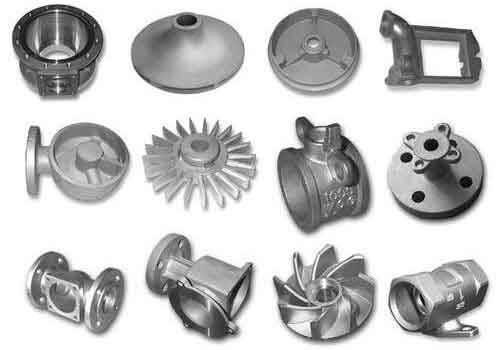
The image above illustrates a typical sand casting part, highlighting the importance of surface quality. Defects like sand sticking can mar such components, emphasizing the need for rigorous control. In our experience, implementing these measures has yielded significant improvements. We track scrap rates before and after interventions, as shown in the following comparative analysis. The reduction in defects is not linear but follows a diminishing returns curve, which we model empirically:
$$ \text{Scrap Rate}(t) = \text{Base Rate} \cdot e^{-kt} $$
where \(t\) is time in months of implementation, and \(k\) is a improvement constant derived from process adjustments. Initially, our scrap rate was 8%; after six months of targeted actions, it stabilized at 4-5%. The table below quantifies the impact on different defect types for sand casting parts:
| Defect Type | Initial Frequency (%) | Post-Optimization Frequency (%) | Reduction (%) |
|---|---|---|---|
| Sand Holes | 3.0 | 1.2 | 60.0 |
| Porosity | 2.5 | 1.0 | 60.0 |
| Sand Inclusions | 1.8 | 0.8 | 55.6 |
| Sand Sticking | 0.7 | 0.5 | 28.6 |
| Other Defects | 0.5 | 0.5 | 0.0 |
| Total Scrap | 8.0 | 4.0 | 50.0 |
This data underscores the effectiveness of our approach. Beyond defect-specific fixes, overall sand management is crucial. We regularly test sand properties using laboratory equipment, ensuring parameters like moisture, strength, and LOI are within specs. For instance, the green compressive strength (\( \sigma_g \)) is measured via standard specimens and should satisfy:
$$ \sigma_g \geq \frac{F}{A} $$
where \(F\) is the failure force and \(A\) is the cross-sectional area. We automate much of this with online sensors, but manual checks supplement for consistency. The economic benefits are substantial: reducing scrap from 8% to 4-5% translates to lower material waste, rework costs, and improved customer satisfaction for sand casting parts supplied to OEMs.
In conclusion, producing high-quality sand casting parts with green sand demands a holistic strategy. By analyzing defects root causes—such as sand holes from low strength, porosity from high moisture, sand inclusions from poor thermal resistance, and sand sticking from coarse grains—we can implement precise countermeasures. Key actions include controlling sand composition (e.g., bentonite and coal dust ratios), optimizing process parameters (e.g., CB values, pouring temperatures), and refining mold design (e.g., core drafts, venting). The integration of tables and formulas, as presented here, aids in standardizing these practices. Our journey shows that with disciplined material selection, process control, and continuous monitoring, scrap rates can be halved, delivering robust sand casting parts that meet stringent industry standards. This not only cuts costs but also bolsters our reputation as a reliable supplier in the competitive foundry market.