
In my experience as a casting engineer, producing high-quality sand casting parts with tight dimensional tolerances and complex geometries presents significant challenges. The case of a skeleton casting made from ZL205A alloy, weighing approximately 45 kg with a pouring weight of 150 kg and maximum dimensions of 1400 mm × 90 mm × 300 mm, exemplifies these difficulties. This sand casting part features thin walls of 8–13 mm, intricate internal cavities, and machined sidewalls requiring a thickness tolerance of ±1 mm after processing. It must meet stringent standards, including 100% X-ray inspection and fluorescent testing per aerospace specifications. This article details my first-person approach to optimizing low-pressure sand casting for such demanding sand casting parts, incorporating extensive technical analysis, tables, and formulas to summarize key insights.
The initial analysis revealed several critical hurdles in manufacturing this sand casting part. First, ZL205A alloy, while offering excellent mechanical properties, has poor castability due to a wide crystallization temperature range, low fluidity, and susceptibility to shrinkage porosity, hot tearing, and gas pores. Traditional gravity casting often requires large risers or pressurized systems to ensure soundness, which is inefficient. Second, the internal cavity is vast, narrow, and complex, with numerous intersecting ribs and partitions, complicating core production, venting, and cleaning. Third, the flat, plate-like geometry (1400 mm × 300 mm sidewalls) is prone to distortion during solidification and heat treatment, making the ±1 mm thickness tolerance exceptionally difficult to achieve in manual sand casting. Fourth, uneven wall thickness creates concentrated hot spots. Fifth, the non-machined internal surfaces demand high dimensional accuracy and low roughness, but small windows hinder core removal, necessitating cores with balanced strength, stability, and collapsibility. These factors collectively underscore the need for an advanced sand casting process tailored for precision sand casting parts.
To address these challenges, I selected low-pressure sand casting as the primary method, leveraging its controlled filling and feeding capabilities. The process design focused on core assembly, gating, and cooling. Resin-bonded sand cores were used with steel frame reinforcements to resist deformation. Metal core boxes ensured dimensional accuracy for critical cores, while wooden boxes sufficed for others. A core assembly diagram illustrates the layout, though I omit specific labels to avoid referencing figures. Instead, I emphasize that meticulous core inspection was implemented: after coating, cores were hand-sanded with 200-grit paper to improve surface finish, and dimensions were checked on a layout table. Deviations ≥0.3 mm mandated re-coating and sanding. This rigorous control is vital for producing consistent sand casting parts.
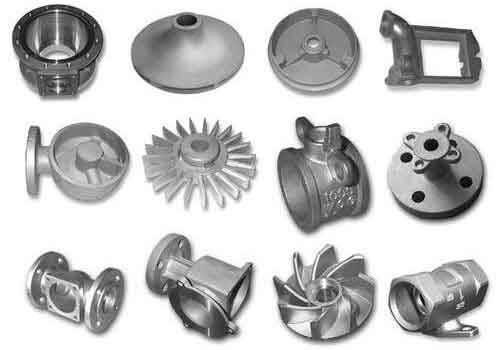
Thermal management was crucial. Given ZL205A’s tendency for surface micro-shrinkage, thin chill plates were placed on the large sidewalls to create a semi-permanent mold effect, enhancing undercooling. These chills had 20-mm-spaced vent grooves to prevent gas entrapment. Additional steel chills were used at thick sections, and vent holes were drilled elsewhere to promote exhaust. The gating system combined bottom filling with slot gates to ensure smooth filling, minimizing turbulence, oxide inclusion, and slag defects. Since low-pressure casting involves submerged feeding tubes that reduce dross, the design prioritized feeding and平稳充型 over slag trapping. Symmetric gating was adopted to mitigate elemental segregation (e.g., copper and titanium in ZL205A) and reduce residual stresses, lowering distortion risks. Feeding columns were precisely positioned via slots in core boxes to target hot spots at wall junctions. The casting and gating system layout, while not detailed here, was optimized for these sand casting parts.
To quantify process parameters, I employed casting science formulas. For instance, the solidification time \( t \) for sections of the sand casting part can be estimated using Chvorinov’s rule:
$$ t = B \left( \frac{V}{A} \right)^2 $$
where \( V \) is volume, \( A \) is surface area, and \( B \) is a mold constant dependent on material and sand properties. For ZL205A in resin sand, \( B \approx 2.5 \, \text{min/cm}^2 \) based on empirical data. This helps determine chilling requirements. The feeding distance \( L_f \) for low-pressure casting can be approximated by:
$$ L_f = k \sqrt{T_m – T_s} $$
with \( k \) as a alloy-dependent constant (around 15 for aluminum alloys), \( T_m \) the melting temperature, and \( T_s \) the solidus temperature. For ZL205A, \( T_m \approx 645^\circ\text{C} \) and \( T_s \approx 540^\circ\text{C} \), giving \( L_f \approx 15 \sqrt{105} \approx 154 \, \text{mm} \), guiding riser placement. The pressure profile in low-pressure casting follows:
$$ P(t) = P_0 + \rho g h(t) + \Delta P_{\text{applied}} $$
where \( P_0 \) is atmospheric pressure, \( \rho \) is melt density, \( g \) is gravity, \( h(t) \) is melt height, and \( \Delta P_{\text{applied}} \) is controlled pressure. Optimizing \( \Delta P_{\text{applied}} \) over time is key to fill thin sections without defects.
Initial trials involved three prototype sand casting parts, subjected to X-ray, fluorescent, and sectioning inspections. Issues identified are summarized in Table 1, which categorizes defects, likely causes, and corrective actions—a format I consistently use for refining sand casting parts production.
| Defect Type | Location | Root Cause | Corrective Action |
|---|---|---|---|
| Gas Porosity | Front “nose” area and top surfaces | Rapid filling rate; inadequate core venting | Reduce pressurization rate during filling; add vent slots (6 mm wide) and vent holes; embed straw ropes in cores for gas extraction |
| Local Wall Thickness Excess | Non-machined sidewalls | Insufficient core compaction leading to deformation | Modify core boxes with removable inserts for better ramming; screen and mix sand-resin-catalyst thoroughly |
| High Surface Roughness | Internal cavities | Irregular coating application and core finish | Implement hand-sanding post-coating; use brushing for hard-to-reach areas instead of spraying |
| Dimensional Shrinkage | Height direction of internal cavity | Underestimated contraction rate; thin coating on core bottoms | Increase pattern allowance from 1.2% to 1.3%; apply coatings via brush for uniform thickness |
| Core Deformation | During handling and storage | High humidity delaying cure; early demolding; uneven support platform | Extend demolding time by 1 hour at >70% humidity; use flat, leveled platforms; cast within 24 hours of core making |
Adjusting process parameters was critical. For low-pressure casting, the pressure-time curve was refined to extend filling time, reducing velocity and gas entrapment. The modified profile can be expressed as:
$$ \Delta P_{\text{applied}}(t) = \begin{cases}
\alpha t & \text{for } 0 \leq t \leq t_1 \\
\beta (t – t_1) + \alpha t_1 & \text{for } t_1 \leq t \leq t_2
\end{cases} $$
where \( \alpha \) and \( \beta \) are rates (kPa/s) determined experimentally. In trials, reducing \( \alpha \) from 0.5 to 0.3 kPa/s decreased porosity. Additionally, resin and catalyst amounts were lowered to 1.2% and 0.6% by weight, respectively, reducing gas generation while maintaining strength. Core sand preparation involved triple-screening to ensure homogeneity, vital for dimensional stability in sand casting parts.
Subsequent production of seven sand casting parts showed marked improvement. However, two castings exhibited minor porosity near top chills after rough machining, attributed to moisture on insufficiently dried chills. This underscores the importance of thermal management in sand casting. The solution involved reducing chill numbers, prolonging core drying, and adding extra vents. The relationship between chill effectiveness and heat extraction can be modeled via Fourier’s law:
$$ q = -k_c \frac{dT}{dx} $$
where \( q \) is heat flux, \( k_c \) is thermal conductivity of chill material, and \( dT/dx \) is temperature gradient. Using steel chills (\( k_c \approx 50 \, \text{W/m·K} \)) versus sand (\( k_c \approx 1 \, \text{W/m·K} \)) significantly accelerates cooling, but proper preheating to 150–200°C eliminates moisture-related defects.
To further optimize sand casting parts, I conducted statistical analysis of dimensional accuracy. For the critical ±1 mm wall thickness tolerance, measurements from ten castings were plotted. The process capability index \( C_pk \) was calculated to assess performance:
$$ C_pk = \min \left( \frac{USL – \mu}{3\sigma}, \frac{\mu – LSL}{3\sigma} \right) $$
where \( USL \) and \( LSL \) are upper/lower specs (±1 mm), \( \mu \) is mean deviation, and \( \sigma \) is standard deviation. Post-improvement, \( \mu \approx 0.1 \, \text{mm} \) and \( \sigma \approx 0.3 \, \text{mm} \), yielding \( C_pk \approx 1.0 \), indicating marginal but acceptable capability for sand casting parts. Further enhancements could target \( \sigma \) reduction through automated core making.
Key lessons from this project are multifaceted. First, manual sanding of coated resin sand cores dramatically improves surface finish and dimensional precision, enabling sand casting parts to achieve CT9 tolerance grades per ISO 8062. Second, environmental humidity above 70% prolongs resin sand curing; demolding delays of 1 hour prevent core weakness. Third, supporting large cores on uneven plates induces distortion—a often-overlooked aspect in sand casting. Fourth, strategic venting via slots, straw ropes, and controlled filling rates effectively eliminates gas defects in enclosed cavities. Fifth, symmetric gating and optimized low-pressure parameters prevent segregation and shrinkage, yielding sound sand casting parts. These principles are transferable to similar complex sand casting parts.
The economic and qualitative outcomes were positive. Of ten sand casting parts produced, two were sectioned for analysis, two scrapped, three passed inspection outright, and three required rework but met standards—a satisfactory trial rate for such demanding components. Internal quality via X-ray satisfied Class II requirements, demonstrating the viability of low-pressure sand casting for high-integrity sand casting parts. Future work could integrate simulation software to predict flow and solidification, reducing trial cycles.
In summary, producing high-precision skeleton sand casting parts from challenging alloys like ZL205A demands a holistic approach combining low-pressure casting, meticulous core control, and adaptive process tuning. Through iterative testing and analytical rigor, I successfully addressed defects related to gas, dimensions, and distortion, underscoring that advanced sand casting techniques can meet aerospace-grade standards. The integration of formulas—such as those for solidification time and feeding distance—alongside tabulated defect analyses provides a robust framework for replicating success in other sand casting parts projects. As sand casting evolves, these methodologies will continue to enhance the quality and precision of metal components across industries.