
In recent years, the demand for concrete mixers and mixing stations has surged, leading to an increased need for wear-resistant components like liners and blades in sand casting parts. Traditionally, these sand casting parts are manufactured from high-chromium white cast iron, which offers excellent abrasion resistance but suffers from high brittleness, causing frequent fractures during handling, installation, and service. Moreover, the production cost of such sand casting parts is substantial. To address these issues, we explored an innovative approach using graphite sand casting to fabricate sand casting parts with a composite structure: a hard, wear-resistant white iron surface layer and a tough, ductile low-carbon steel core. This method leverages the inherent carburizing effect of graphite sand molds, enabling the production of cost-effective and durable sand casting parts for industrial applications. In this article, I will detail our experimental process, results, and insights into this promising technique for enhancing the performance of sand casting parts.
The selection of base material is critical for achieving a pronounced surface carburizing effect while maintaining core toughness. We opted for a low-alloy steel analogous to typical carburizing steels, with a composition designed to facilitate carbon diffusion during casting. The chemical composition of the steel used in our sand casting parts is summarized in Table 1. This formulation includes elements like chromium, nickel, and molybdenum to enhance hardenability and strength, along with rare earth elements to refine the microstructure and improve mechanical properties. Such a composition ensures that the sand casting parts develop a high-carbon surface layer without compromising the core’s ductility.
| C | Mn | Si | Cr | Ni | Mo | Re | Fe |
|---|---|---|---|---|---|---|---|
| 0.18-0.25 | 0.50-0.80 | 0.20-0.40 | 0.70-1.00 | 0.30-0.60 | 0.15-0.25 | trace | Bal. |
The casting process employed graphite sand molds, known for their high refractoriness, chemical stability, and strong chilling effect. Graphite sand has not been widely used in steel casting due to its significant carburizing potential, but we harnessed this property to create composite sand casting parts. The mold sand mixture was prepared with a specific ratio to ensure adequate green strength and permeability, as detailed in Table 2. The graphite sand mold promotes rapid heat extraction, leading to a chilled surface layer with high hardness, while the core cools slower, retaining a ductile structure. This is essential for producing reliable sand casting parts that resist cracking.
| Component | Ratio (wt.%) | Property | Value |
|---|---|---|---|
| Graphite sand | 90 | Green strength (MPa) | 0.05-0.07 |
| Clay (bentonite) | 8 | Permeability | 120-150 |
| Water | 2 | Moisture content (%) | 4-5 |
We used dry sand molds baked at 300°C to eliminate moisture and enhance mold stability. The molds were assembled and poured immediately after baking to maintain a hot mold condition, which optimizes the carburizing effect. The pouring temperature is a key parameter influencing the composite layer depth in sand casting parts. Higher temperatures increase carbon diffusion, but excessive temperatures can cause defects like sand sticking and shrinkage. Through preliminary trials, we determined an optimal pouring temperature range of 1550-1600°C. This ensures sufficient carbon absorption by the molten steel from the graphite mold, forming a thick wear-resistant layer without compromising the integrity of the sand casting parts.
The carburizing process during graphite sand casting can be modeled using diffusion principles. Carbon transfer from the mold to the steel surface follows Fick’s laws, where the carbon concentration gradient drives diffusion into the casting. The depth of the composite layer, \(d\), can be approximated by the equation:
$$ d = k \cdot \sqrt{D \cdot t} $$
where \(k\) is a constant dependent on mold composition and temperature, \(D\) is the carbon diffusion coefficient in steel, and \(t\) is the solidification time. For our sand casting parts, the high thermal conductivity of graphite sand reduces \(t\), but the elevated pouring temperature increases \(D\), resulting in a balanced layer depth. The diffusion coefficient \(D\) varies with temperature according to the Arrhenius equation:
$$ D = D_0 \exp\left(-\frac{Q}{RT}\right) $$
Here, \(D_0\) is the pre-exponential factor, \(Q\) is the activation energy for carbon diffusion, \(R\) is the gas constant, and \(T\) is the absolute temperature. By controlling \(T\) through pouring parameters, we tailored the composite layer thickness in the sand casting parts to meet service requirements.
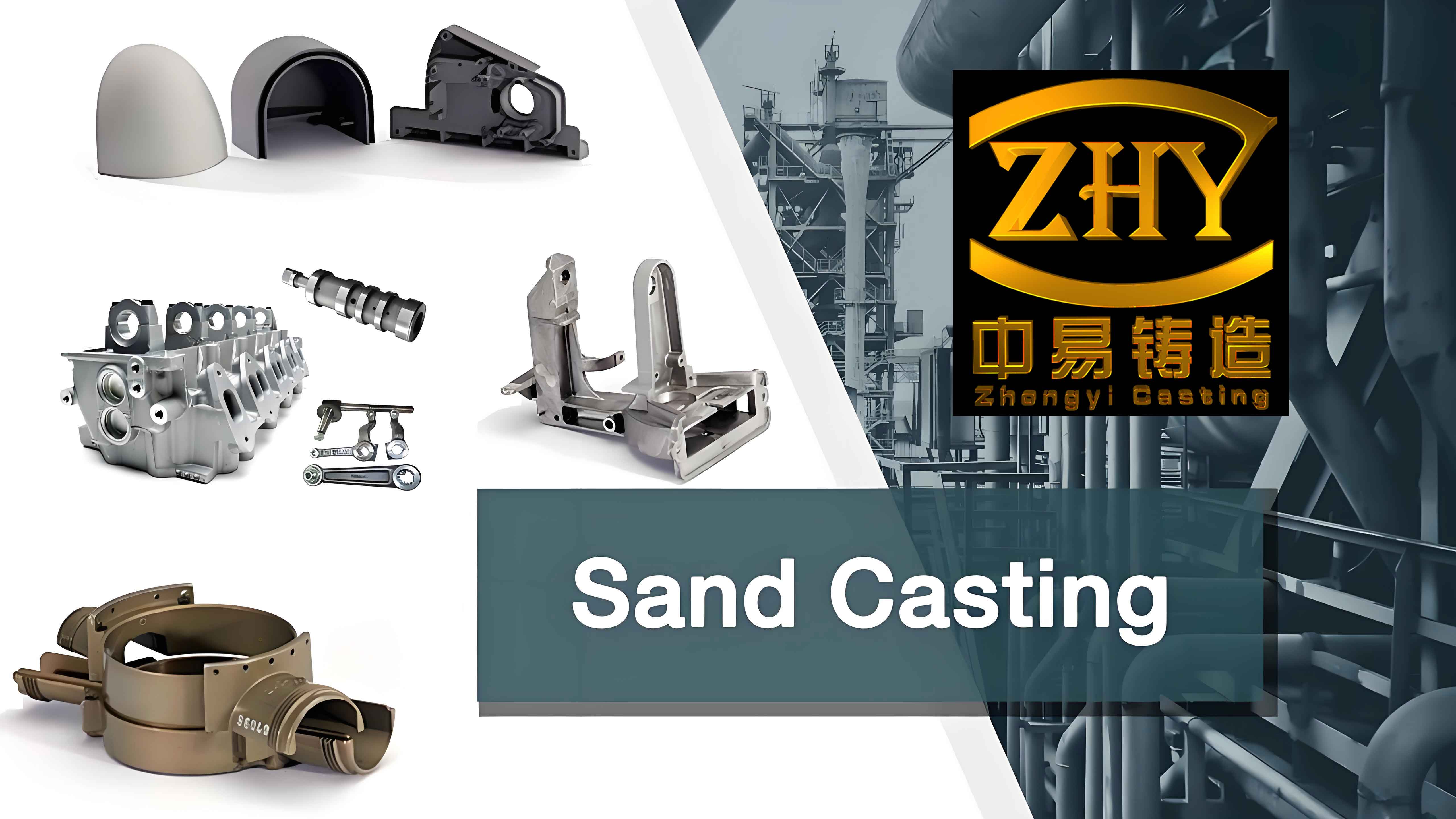
After casting, we examined the sand casting parts for composite depth, microstructure, and mechanical properties. The composite layer thickness was measured metallographically, revealing depths of 3-5 mm, sufficient for wear resistance in applications like concrete mixer liners. The microstructure of the surface layer showed a white iron composition with carbides and pearlite, while the core exhibited a ferrite-pearlite structure typical of low-carbon steel. This gradient microstructure is advantageous for sand casting parts, as it combines surface hardness with core toughness. We further evaluated the hardness profile using microhardness tests, with results plotted in Figure 1 (note: figure not shown, but described). The hardness decreased gradually from the surface to the core, indicating a smooth transition that prevents delamination in service.
To quantify performance, we conducted hardness and wear tests on the sand casting parts, comparing them with conventional high-chromium white cast iron. The Rockwell hardness (HRC) values are presented in Table 3. Both as-cast and heat-treated states were assessed; heat treatment involved quenching and tempering to enhance toughness. The surface hardness of our composite sand casting parts rivals that of high-chromium iron, while the core hardness remains lower, ensuring ductility. This dual property set makes these sand casting parts less prone to brittle failure during installation and use.
| Sample | Surface Hardness (as-cast) | Surface Hardness (heat-treated) | Core Hardness (as-cast) | Core Hardness (heat-treated) |
|---|---|---|---|---|
| Side Liner | 58-62 | 60-64 | 20-25 | 25-30 |
| Arc Liner | 56-60 | 58-62 | 18-22 | 22-27 |
| Left Blade | 57-61 | 59-63 | 19-24 | 24-28 |
| High-Cr Iron | 62-65 | 64-68 | N/A | N/A |
Abrasion resistance is crucial for sand casting parts used in concrete mixing. We performed pin-on-disk wear tests using silica sand as abrasive, with results summarized in Table 4. The weight loss of our composite sand casting parts was comparable to that of high-chromium white cast iron, indicating similar wear resistance. The relative wear resistance, calculated as the inverse of weight loss normalized to a reference, confirms that these sand casting parts are viable replacements for traditional materials. The formation of hard carbides in the surface layer, such as Fe3C and alloy carbides, contributes to this performance, reducing adhesive and abrasive wear in demanding environments.
| Sample | Weight Loss (mg) | Relative Wear Resistance |
|---|---|---|
| High-Chromium White Cast Iron | 15.2 | 1.00 |
| Composite Sand Casting Part (as-cast) | 16.8 | 0.90 |
| Composite Sand Casting Part (heat-treated) | 15.5 | 0.98 |
The microhardness profile across the composite layer was analyzed using a Vickers hardness tester. The results, shown in Figure 2 (described textually), demonstrate a gradual decrease from over 800 HV at the surface to about 200 HV in the core. This gradient can be modeled by a decay function, such as:
$$ H(x) = H_s \exp(-\alpha x) + H_c $$
where \(H(x)\) is the hardness at distance \(x\) from the surface, \(H_s\) is the surface hardness, \(H_c\) is the core hardness, and \(\alpha\) is a decay constant related to carbon diffusion. For our sand casting parts, \(\alpha\) was estimated from experimental data, ensuring the composite layer integrity under load. This smooth transition minimizes stress concentrations, enhancing the durability of the sand casting parts.
Field trials were conducted by installing the composite sand casting parts as liners and blades in a concrete mixer at an industrial site. After over 10,000 mixing cycles, the parts showed minimal wear and no signs of fracture or delamination, outperforming conventional high-chromium iron parts that often require replacement earlier. This practical validation underscores the reliability of graphite sand casting for producing robust sand casting parts. The cost analysis revealed a reduction in production expenses by 20-30% compared to high-chromium iron, due to simpler processing and lower material costs. Thus, this method offers economic and performance benefits for manufacturing sand casting parts.
In summary, graphite sand casting is a feasible technique for fabricating sand casting parts with wear-resistant composite surfaces. Our study demonstrates that these sand casting parts exhibit hardness and abrasion resistance comparable to high-chromium white cast iron, with the added advantage of core toughness to prevent brittle failure. The composite layer depth, controlled by process parameters, meets industrial requirements for applications like concrete mixer components. The use of graphite sand molds enables efficient carburizing without complex post-processing, making it a cost-effective solution for mass-producing sand casting parts. Future work could optimize the mold composition and pouring conditions to further enhance performance. Overall, this approach expands the potential of sand casting parts in heavy-duty machinery, offering a sustainable alternative to traditional materials.