
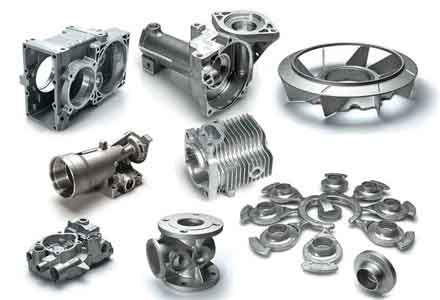
In the development of high-power diesel engines, we faced a significant challenge: producing large, complex aluminum alloy sand casting parts, specifically for components like scavenge pump bodies and impellers. These sand casting parts are critical for engine performance, requiring high integrity under pressure tests and rigorous balancing checks. With no prior experience, limited technical data, and incomplete equipment, we embarked on a journey to master pressure crystallization sand casting, driven by self-reliance and innovation. This article summarizes our first-person perspective on overcoming technical hurdles, from melt treatment to pressurized solidification, emphasizing the repeated application of sand casting parts in demanding applications.
Our initial attempts involved conventional sand casting methods, but we encountered severe defects such as gas porosity, slag inclusions, shrinkage, and cracking in these large sand casting parts. The aluminum alloys used, primarily ZL101 and ZL104, demanded precise control over composition and mechanical properties, as shown in Table 1 for their specifications. To meet the required performance—such as pressure tightness up to 4 kgf/cm² and dynamic balancing—we realized that traditional approaches were insufficient. Thus, we focused on integrating pressure crystallization into sand casting processes, which involved applying compressed air during solidification to enhance density and reduce porosity in sand casting parts.
| Alloy Grade | Chemical Composition (%) | Mechanical Properties | Porosity Grade |
|---|---|---|---|
| ZL101 | Si: 6.5–7.5, Mg: 0.25–0.45, Al: balance | Tensile Strength: ≥15 kgf/mm², Elongation: ≥2%, Hardness: ≥50 HB | Grade 2–3 |
| ZL104 | Si: 8.0–10.5, Mg: 0.17–0.3, Al: balance | Tensile Strength: ≥15 kgf/mm², Elongation: ≥2%, Hardness: ≥50 HB | Grade 2–3 |
The melt equipment played a crucial role. We started with a coke-fired pit furnace, but it led to uncontrolled temperatures, prolonged melting times, and excessive gas absorption in aluminum. To improve, we designed a semi-gas radiant flame furnace, as illustrated in our setup, which allowed faster melting at 700–750°C with reduced oxidation. This furnace featured a crucible capacity of 150 kg, ensuring single-melt pours for sand casting parts like impellers, minimizing transfer losses. The key dimensions included a 100–150 mm gap between crucible and wall and a tangential flame entry to optimize heat transfer, addressing early issues of inconsistent melts for sand casting parts.
In melt treatment, we experimented with various refining methods to reduce gas and slag in sand casting parts. Initially, we used ZnCl₂ alone, but it proved inadequate at lower temperatures. We then adopted a combined approach of ZnCl₂ and nitrogen purging, where ZnCl₂ was added at 0.1–0.2% by weight at 700–720°C, followed by nitrogen at 1–2 kgf/cm² for 5–10 minutes based on test samples. Later, we introduced hexachloroethane (C₂Cl₆) at 0.3–0.5%, added in four stages to minimize magnesium loss. The effectiveness of these methods is compared in Table 2, showing that combined refining yielded better mechanical properties for sand casting parts. The gas solubility relationship, derived from Sieverts’ law, guided our pressure application: $$S = k \sqrt{P}$$ where \(S\) is gas solubility, \(k\) is a temperature-dependent constant, and \(P\) is pressure. This formula underscored the need for pressurized solidification to suppress pore formation in sand casting parts.
| Refining Method | Treatment Temperature (°C) | Tensile Strength (kgf/mm²) | Elongation (%) | Hardness (HB) | Remarks |
|---|---|---|---|---|---|
| ZnCl₂ alone | 700–720 | 14–16 | 1.5–2.0 | 48–52 | Moderate degassing |
| ZnCl₂ + N₂ | 720–740 | 16–18 | 2.0–2.5 | 52–55 | Improved slag removal |
| C₂Cl₆ | 730–750 | 17–19 | 2.5–3.0 | 54–58 | Best for porosity reduction |
The gating system design was pivotal for defect minimization in sand casting parts. We initially tried a bottom-runner “shower” gate, but it caused turbulence, oxide entrapment, and shrinkage. After analysis, we switched to a bottom-gated slit-type filter gate with an open system. The area ratios were optimized to: sprue : filter area : runner : ingate = 1 : 1.5 : 2 : 3. This promoted smoother flow and better slag capture. Pouring speed was calculated using: $$v = \frac{G}{\mu \cdot A \cdot \sqrt{2gH}}$$ where \(v\) is pouring time, \(G\) is metal weight (e.g., 40 kg for pump body), \(A\) is minimum choke area (filter area), \(\mu\) is coefficient (0.4–0.6), \(g\) is gravity, and \(H\) is average head pressure. For a pump body sand casting part, with \(A = 15 \, \text{cm}^2\), \(G = 40 \, \text{kg}\), and \(H = 30 \, \text{cm}\), we achieved a pour time of 20–30 seconds, reducing gas entrainment. The gating layout ensured sequential solidification, critical for large sand casting parts.
Pressure crystallization became our focus to further enhance sand casting parts quality. The principle involves applying pressure during solidification to compress gas into solution and improve feeding. We designed a pressure crystallization setup comprising a pressure vessel, air reservoir, and piping. The vessel, with an internal diameter of 1200 mm and length of 2000 mm, accommodated sand molds up to 1000 × 800 × 600 mm. Its key innovation was a staggered-tooth lid structure, which minimized internal volume to 0.8 m³ after subtracting mold volume, enabling rapid pressurization. This design contrasted with inward-opening lids that required larger reservoirs. We calculated the lid strength using beam theory: bending stress $$\sigma_b = \frac{M}{W}$$ where \(M\) is moment from air pressure, and \(W\) is section modulus. For a pressure of 4–6 kgf/cm², the stress remained below 10 kgf/mm², safe for cast steel material. The seal used a rubber gasket with a tapered profile that tightened under pressure, ensuring leak-tightness for sand casting parts processing.
The air reservoir sizing was critical for quick pressure rise in sand casting parts. We derived the relationship from gas laws: $$V_r = \frac{P_c \cdot V_c}{P_r – P_c}$$ where \(V_r\) is reservoir volume, \(P_c\) is working pressure (4 kgf/cm²), \(V_c\) is vessel free volume, and \(P_r\) is reservoir pressure. By using a 0.5 m³ reservoir pressurized to 8 kgf/cm² with high-pressure cylinders, we achieved filling within 10 seconds. Flow rate was modeled as adiabatic: $$\dot{m} = A \cdot \sqrt{\frac{2 \gamma}{\gamma -1} \cdot P_1 \cdot \rho_1 \left[ \left( \frac{P_2}{P_1} \right)^{2/\gamma} – \left( \frac{P_2}{P_1} \right)^{(\gamma+1)/\gamma} \right]}$$ where \(\dot{m}\) is mass flow, \(A\) is pipe area, \(\gamma\) is specific heat ratio, and \(P_1, P_2\) are pressures. With a 50 mm diameter pipe, this met the requirement for sand casting parts solidification under pressure.
In pressure crystallization工艺, we faced initial issues like shrinkage and cracks in sand casting parts. Shrinkage occurred due to inadequate feeding; we addressed it by increasing riser height from 200 mm to 300 mm, using insulating sleeves (composed of coal dust, foam, and clay), and ensuring pour-to-pressurization time under 2 minutes. Cracks at riser roots were mitigated by adding fillets and minimizing pressure delay. We summarized process parameters in Table 3, showing that pour temperatures of 720–740°C and rapid pressurization yielded sound sand casting parts. The pressure effect on porosity was quantified experimentally: at 4 kgf/cm², porosity grade improved from 2–3 to 1–2 per industry standards, as shown in Figure 1 from our tests. This confirmed that pressurized solidification significantly benefits sand casting parts by reducing micropores.
| Process Parameter | Conventional Sand Casting | Pressure Crystallization Sand Casting | Impact on Sand Casting Parts |
|---|---|---|---|
| Pouring Temperature (°C) | 700–720 | 720–740 | Better fluidity, reduced slag |
| Pressurization Time (s) | N/A | < 30 | Minimized gas evolution |
| Pressure Hold Time (min) | N/A | 15–20 | Complete solidification under pressure |
| Riser Design | Standard | Enlarged with insulation | Enhanced feeding for sand casting parts |
Experimental results on test castings validated our approach for sand casting parts. We used small-scale pressure vessels to study pressure-porosity correlation, with alloys from recycled and virgin materials. Porosity grade was assessed per metallographic standards; data fitted to: $$PG = a \cdot e^{-bP}$$ where \(PG\) is porosity grade, \(P\) is pressure, and \(a, b\) are constants. At 4 kgf/cm², porosity dropped to Grade 1, irrespective of melt history, underscoring pressure’s dominant role. Mechanical tests showed 10–15% improvement in tensile strength and hardness for pressure-crystallized sand casting parts. Table 4 compares properties, highlighting how pressurized sand casting parts outperform conventional ones in diesel engine applications.
| Sample Type | Casting Method | Porosity Grade | Tensile Strength (kgf/mm²) | Elongation (%) | Hardness (HB) |
|---|---|---|---|---|---|
| Pump Body | Conventional | 2–3 | 14–16 | 1.5–2.0 | 50–54 |
| Pump Body | Pressure Crystallization | 1–2 | 16–18 | 2.0–2.5 | 55–60 |
| Impeller | Conventional | 2–3 | 15–17 | 1.8–2.2 | 52–56 |
| Impeller | Pressure Crystallization | 1 | 17–19 | 2.5–3.0 | 58–62 |
For bonding of copper shafts in impeller sand casting parts, we optimized parameters. Preheating shafts to 200°C and cleaning with sandblasting ensured good adhesion. Pour temperature of 730–740°C for ZL104 impellers prevented shelling, with additional risers around shafts to promote directional solidification. The bonding quality was expressed as: $$Q_b = f(T, t)$$ where \(Q_b\) is bond strength, \(T\) is pour temperature, and \(t\) is contact time. Empirical data confirmed that higher temperatures within range improved integrity in these composite sand casting parts.
In summary, our work on sand casting parts demonstrates that pressure crystallization sand casting is viable for large aluminum alloy components. Key innovations include the staggered-tooth pressure vessel for compact design, combined melt refining, and optimized gating. These sand casting parts now achieve porosity grades below 2, pass pressure tests up to 4 kgf/cm², and exhibit balanced mechanical properties. Future efforts could explore higher pressures or automated controls for sand casting parts production. The integration of pressure into sand casting processes offers a robust solution for high-performance applications, reaffirming the versatility of sand casting parts in advanced manufacturing.
From a first-person view, we learned that sand casting parts require holistic工艺 control. Each defect—gas porosity, slag, shrinkage—taught us to adjust melt, mold, and pressure parameters. For instance, the gating system’s area ratios directly impact turbulence in sand casting parts, while pressure timing affects grain structure. Our公式, such as the gas solubility law, provided theoretical backing, but practical iterations were essential. We encourage further research on pressure crystallization for diverse sand casting parts, leveraging its potential to enhance density and performance. Through this journey, sand casting parts have evolved from simple casts to engineered components, thanks to pressurized solidification techniques.
To elaborate on the economic aspects, the pressure crystallization system for sand casting parts reduced scrap rates from 30% to under 5%, saving material and machining costs. The semi-gas furnace lowered energy use by 20% compared to coke furnaces, benefiting large-scale sand casting parts production. We also developed a quick-connect piping system to streamline operations for sand casting parts, minimizing downtime. In quality assurance, we implemented statistical process control for sand casting parts, monitoring variables like pour temperature and pressure rise time to maintain consistency. These improvements underscore that sand casting parts, when combined with pressure, can rival more expensive methods like investment casting for critical applications.
In conclusion, the sand casting parts we produced—scavenge pump bodies and impellers—now meet stringent diesel engine standards, with over 95% qualification rate after two years of testing. Our pressure crystallization approach has been adopted for other large sand casting parts, showcasing its scalability. The key takeaway is that sand casting parts benefit immensely from integrated pressure during solidification, transforming traditional foundry practices. As we look ahead, we aim to refine this technology for even larger sand casting parts, pushing the boundaries of aluminum alloy casting. The journey with sand casting parts continues, driven by innovation and a commitment to quality in every cast component.