
The global push towards sustainable energy has catapulted wind power to the forefront of technological development. As a critical and highly stressed component within a wind turbine, the hub’s integrity is paramount. This complex sand casting part must withstand tremendous cyclic loads and moments transmitted from the blades. Its manufacture presents significant foundry challenges due to intricate geometry, substantial wall thickness variations, and stringent quality requirements mandating freedom from shrinkage, porosity, and inclusions. This detailed exploration chronicles the research, simulation, and successful production of a large 3.5 MW wind turbine hub using a riserless sand casting process with QT500-14 ductile iron, a material offering superior and more uniform mechanical properties.
The hub, essentially a spherical shell with multiple protruding shaft bosses, represents a classic heavy-section sand casting challenge. With major dimensions approximating 3.5 x 3.0 x 3.2 meters, a net weight of ~18,000 kg, and wall thicknesses ranging from 60 mm to a maximum of 350 mm at the boss intersections, achieving soundness through conventional feeding is difficult. The choice of material further intensifies the challenge. While QT400-18 and QT350-22 are common, QT500-14 was targeted for its better tensile strength uniformity and enhanced machinability. Achieving this grade often necessitates costly alloy additions and precise processing controls. Our research first focused on material development, evaluating high-carbon-low-silicon versus low-carbon-high-silicon compositions. The low-carbon-high-silicon approach, leveraging solid solution strengthening, was selected after successful trials on test coupons, ensuring high nodularity and ideal graphite morphology.
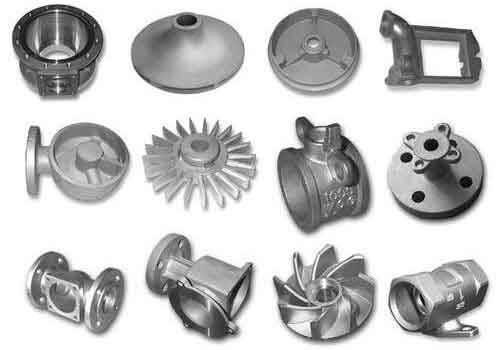
The core philosophy of the casting process design was riserless production, leveraging the unique solidification characteristics of ductile iron. Unlike white iron or steel, ductile iron undergoes a mushy, or pasty, solidification. A wide solid-liquid coexisting zone narrows the feeding channels. Crucially, the precipitation of graphite during solidification causes a volume expansion. The fundamental principle is to use this graphite expansion to counteract the liquid and solidification shrinkage of the metal. This requires a carefully balanced system defined by the following equation, where successful internal feeding is achieved when expansion compensates for shrinkage:
$$ V_{\text{graphite expansion}} \ge V_{\text{liquid shrinkage}} + V_{\text{solidification shrinkage}} $$
To satisfy this condition, three key factors were controlled: a high carbon equivalent (via the chosen low-carbon-high-silicon chemistry) to maximize graphite potential, high mold rigidity to contain the expansion pressure, and a low pouring temperature with fast filling to minimize total liquid shrinkage. The design of the entire casting system was iteratively developed and validated through numerical simulation before any metal was poured.
Comprehensive Casting Process Design for Sand Casting Parts
The design of a successful riserless process for such a massive sand casting part requires integrated solutions across multiple domains: gating, molding, and controlled cooling.
Parting Plane and Molding Method: The parting plane was selected perpendicular to the main axis, bisecting the spherical hub body. This simplified pattern and core box manufacturing, eased molding operations, and facilitated core assembly. A traditional two-part green sand molding process was employed, though with high-strength, high-rigidity sand mixtures to withstand metallostatic and expansion pressures.
Gating System Design: A bottom-gating system was adopted to ensure calm, progressive filling from the base (the thick main mounting face) upwards. This minimizes turbulence, oxide formation, and sand erosion—critical for achieving clean sand casting parts. The system was designed as open, with a proportional relationship of choke area : runner : ingates of 1 : 1.2 : 3 to maintain a non-pressurized flow. Ceramic filter tubes were integrated into the ingates to further filter the metal stream.
Chills and Feed Aids: Achieving directional solidification towards isolated hot spots is impossible in a riserless scheme; therefore, the goal shifts towards promoting simultaneous solidification. Strategically placed external chills are essential for this. The major thermal centers were identified at the junctions of the blade boss cylinders and the main spherical body, and at various reinforcing ribs and pads. Custom-shaped, massive steel chills were designed to match the contour of these hot spots. Their sizing is critical; insufficient chill mass fails to extract enough heat, while excessive chilling can create premature hard spots or thermal stress. The chill design parameters for key locations are summarized below:
| Location | Chill Type | Approx. Dimensions (mm) | Primary Function |
|---|---|---|---|
| Blade Boss Roots | Contour-matching | Varies, ~100-150 thick | Suppress shrinkage in critical structural junctions |
| Rib Intersections | Rectangular Plates | 200 x 150 x 75 | Accelerate cooling in isolated thermal masses |
| Top Pads | Rectangular Plates | 150 x 100 x 50 | Control solidification sequence of top sections |
Additionally, the three top pads were intentionally designed with extra height (acting as small riser heads). Their primary purpose was not liquid feeding but to serve as “dirt traps” or slag collectors, ensuring any floating oxides or slag are captured away from the functional hub body—a common practice for high-integrity sand casting parts.
Numerical Simulation: Predicting and Optimizing Solidification
Prior to tooling manufacture, the entire process was subjected to a rigorous numerical analysis using MAGMASOFT simulation software. The 3D CAD models of the hub, cores, gating, and chills were imported, meshed (~15 million cells), and assigned appropriate material properties and boundary conditions.
Solidification Sequence and Thermal Analysis: The simulation of the temperature field over time is crucial. The goal, as visualized in the thermal contours, is to avoid large, isolated liquid pools in the final stages. The initial temperature field immediately after filling shows the chilling effect, with regions in contact with chills exhibiting a steep temperature gradient. As solidification progresses, the chills act as efficient heat sinks, continually promoting heat extraction from the thickest sections. The final stages of solidification showed a near-simultaneous progression across the entire casting body, confirming the effectiveness of the chill design in mitigating the natural tendency for hot spots to lag. The local solidification time, $ t_f $, at any point can be related to the local modulus, $ m $ (Volume/Surface Area ratio), and the chilling effect. The use of chills effectively reduces the effective modulus of the hot spot, bringing its $ t_f $ closer to that of the surrounding thinner sections:
$$ t_f \propto m^n $$
where $ n $ is a constant typically around 1.5-2 for sand molds. Chills increase the effective surface area for cooling, thereby reducing $ m $ and $ t_f $.
Shrinkage Defect Prediction: The software’s porosity prediction modules, based on thermal and pressure criteria, were used to assess the risk of macro- and micro-shrinkage. The Niyama criterion, a reliable indicator for microporosity in sand casting parts, was calculated throughout the casting volume. The Niyama value, $ N_y $, is given by:
$$ N_y = \frac{G}{\sqrt{\dot{T}}} $$
where $ G $ is the temperature gradient (°C/m) and $ \dot{T} $ is the cooling rate (°C/s). Regions with $ N_y $ values below a critical threshold (specific to the alloy) are prone to shrinkage porosity. The simulation results were highly encouraging. They indicated no macro-shrinkage (shrinkage cavities) within the main body of the hub. Minor porosity indications were isolated to the very tops of the intentionally heightened feeder pads. This validated the riserless concept, showing that the combination of controlled chemistry, fast pouring, high mold rigidity, and strategic chilling successfully harnessed graphite expansion for internal feeding. The predicted defect distribution gave high confidence that the sand casting parts would be sound in critical areas.
Metallurgical Foundation of QT500-14 for Demanding Sand Casting Parts
The successful production of such a large, sound sand casting part in QT500-14 is a metallurgical achievement. The mechanical properties of ductile iron are a function of its matrix structure, which is controlled by composition and cooling rate. The target properties, especially the 14% minimum elongation, require a predominantly ferritic matrix with a small amount of pearlite. The challenges in achieving this in heavy sections are twofold: avoiding carbide formation during solidification (chill) and promoting ferrite formation during solid-state transformation.
The low-carbon-high-silicon approach is key. Silicon is a powerful ferrite stabilizer and solid solution strengthener. It increases the temperature range for stable ferrite formation and suppresses pearlite. However, excessive silicon can embrittle the ferrite. Our target composition range was carefully balanced, as shown in the comparison below:
| Element / Approach | High-Carbon-Low-Si | Low-Carbon-High-Si (Chosen) | Rationale for Choice |
|---|---|---|---|
| Carbon (C) | ~3.8% | ~3.5% | Lower carbon reduces graphite volume, lowering expansion potential but improving strength uniformity and reducing shaking tendency. |
| Silicon (Si) | ~1.8% | ~2.6% | Higher Si strongly promotes ferrite, provides solid solution strengthening to reach 500 MPa, and improves castability. |
| Carbon Equivalent (CE) | ~4.57% | ~4.47% | CE = %C + (%Si/3). Both are hypereutectic (>4.3%), ensuring good fluidity and graphite precipitation behavior. |
| Expected Matrix | Higher Pearlite | Predominantly Ferrite | High-Si matrix resists pearlite formation even at moderate cooling rates of heavy sections, securing ductility. |
Furthermore, an optimized post-inoculation practice was critical. Heavy-section sand casting parts are prone to late-stage graphitization issues (chunky graphite) and matrix variability. A potent inoculant, such as a bismuth-containing alloy, was used to ensure a fine, uniform distribution of graphite nodules throughout the massive casting walls, guaranteeing consistent properties from surface to center.
Production Execution and Quality Validation
Following the simulated and optimized plan, the mold was produced using high-rigidity furan resin sand. The chills were cleaned, coated with a refractory wash, and precisely positioned. The cores were assembled, and the mold was closed with careful alignment using定位 pins and checks.
The melt was prepared in a medium-frequency induction furnace using high-purity charge materials. After achieving the target low-carbon-high-silicon base composition, the ladle was treated with a foundry-grade magnesium-ferrosilicon alloy for nodularization, followed by intensive inoculation. The pouring was executed using a dual-ladle technique to achieve the required “low-temperature, fast-pour” protocol. The total metal weight poured was approximately 23,000 kg.
After cooling in the mold, the sand casting part was extracted, heat-treated (ferritizing annealing to ensure a fully ferritic matrix and stress relief), and subjected to extensive finishing and inspection. Visual inspection and dimensional checks confirmed the geometric integrity. Non-destructive testing was paramount. 100% ultrasonic testing (UT) of all critical areas was performed according to the stringent standards for wind power components (e.g., equivalent to GB/T25390). The hub showed excellent soundness with no reportable indications in the main body. Magnetic particle inspection (MT) of surfaces further confirmed the absence of surface defects.
The final validation came from the mechanical properties. Test coupons attached to the hub casting (per standard protocols) were machined and tested. The results exceeded the QT500-14 specification:
- Tensile Strength (Rm): 520 MPa (Spec. ≥500 MPa)
- Yield Strength (Rp0.2): 403 MPa
- Elongation (A): 18% (Spec. ≥14%)
- Hardness: 193 HB
- Nodularity: >90%, Graphite Size: 6 (per ASTM A247)
The successful production of this large, complex sand casting part demonstrates the viability of the riserless approach for heavy-section ductile iron castings when underpinned by robust process design, advanced simulation, and precise metallurgical control.
Conclusion and Technical Perspectives
This comprehensive study successfully detailed the pathway for manufacturing a large, high-integrity wind turbine hub via riserless sand casting in QT500-14 ductile iron. The integration of material science, innovative casting design, and predictive simulation proved to be a powerful methodology. Key takeaways for producing such demanding sand casting parts include:
1. System Design Synergy: Riserless casting is not merely the omission of feeders; it is a holistic system where chemistry (high graphitizing potential), mold design (maximum rigidity), pouring practice (minimized liquid shrinkage), and cooling control (strategic chilling) are all optimized to work in concert. The governing equation for volume balance must be respected in practice.
2. The Role of Simulation: Numerical tools like MAGMASOFT are indispensable for de-risking the production of expensive sand casting parts. They allow for the virtual prototyping of thermal gradients, solidification sequences, and defect formation, enabling data-driven optimization of chill placement, gating, and overall geometry long before pattern construction.
3. Material Precision: Achieving high-performance grades like QT500-14 in heavy sections requires a deliberate compositional strategy. The low-carbon-high-silicon approach, combined with effective inoculation, provides an effective route to secure both strength and ductility without relying heavily on costly pearlite-promoting alloys.
The demonstrated process is repeatable and scalable. It reduces manufacturing costs by eliminating riser-related metal and finishing labor, improves yield, and can be adapted for other large, complex ductile iron sand casting parts beyond the wind energy sector, such as in heavy machinery or marine applications. Future work may explore further optimization of chill materials (e.g., high-conductivity copper-based chills), advanced molding materials for even greater rigidity, and the application of machine learning algorithms to refine the simulation-based design process for an ever-wider range of sand casting parts.