
The production of high-integrity sand casting parts remains a cornerstone of modern manufacturing, particularly for complex components within demanding applications like automotive powertrains. Traditional casting process design, heavily reliant on empirical rules and trial-and-error methods, often leads to extended development cycles, high scrap rates, and elevated costs. The intrinsic variability of the solidification process in sand casting parts can result in defects such as shrinkage porosity, gas entrapment, and mistruns, which may only be detected during final machining or even in service, posing significant reliability risks. My research focuses on overcoming these challenges by leveraging computational numerical simulation as a predictive and optimization tool. This article details a comprehensive study, conducted from my perspective as a researcher, on the process optimization for a specific turbine rear exhaust pipe—a critical sand casting part—demonstrating how simulation can systematically eliminate defects and enhance manufacturing robustness.
The transition from experiential craftsmanship to science-based engineering in foundry operations is imperative. The development of sophisticated finite element method (FEM) and finite volume method (FVM) based simulation software has revolutionized this field. For any sand casting part, simulating the filling and solidification processes allows for the virtual prediction of defect formation, including their location, severity, and type, long before the first mold is poured. This digital prototyping capability shortens lead times, reduces material waste associated with physical trials, and fundamentally improves the quality and performance of the final sand casting parts. The core of this methodology lies in solving the governing equations of fluid flow, heat transfer, and solidification simultaneously for the complex geometry of the part and its molding system.
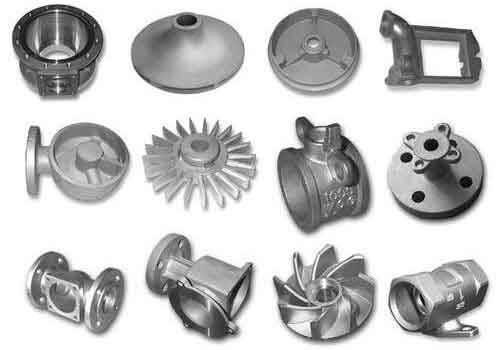
The fundamental physics governing the casting process for a sand casting part can be described by a set of coupled partial differential equations. The fluid flow during mold filling is modeled using the Navier-Stokes equations, often simplified for incompressible flow:
$$
\nabla \cdot \vec{v} = 0
$$
$$
\rho \left( \frac{\partial \vec{v}}{\partial t} + (\vec{v} \cdot \nabla) \vec{v} \right) = -\nabla p + \mu \nabla^2 \vec{v} + \rho \vec{g}
$$
where $\vec{v}$ is the velocity vector, $p$ is pressure, $\rho$ is density, $\mu$ is dynamic viscosity, and $\vec{g}$ is gravitational acceleration. The heat transfer throughout the system, crucial for predicting solidification, is governed by the energy conservation equation:
$$
\rho c_p \frac{\partial T}{\partial t} = \nabla \cdot (k \nabla T) + \dot{q}
$$
Here, $c_p$ is specific heat, $k$ is thermal conductivity, $T$ is temperature, and $\dot{q}$ is a latent heat source term accounting for the phase change from liquid to solid. For the solidification of alloys like gray iron (HT250), a fractional solidification model is often employed, where the fraction solid ($f_s$) is a function of temperature, typically derived from the alloy’s thermophysical data. The key output for defect prediction, particularly shrinkage porosity, is often related to the pressure drop and feeding capability during the final stages of solidification, which can be indicated by the Niyama criterion or similar functions based on local thermal gradients ($G$) and cooling rates ($\dot{T}$):
$$
Niyama = \frac{G}{\sqrt{\dot{T}}}
$$
Regions with a Niyama value below a critical threshold are predicted to be susceptible to shrinkage porosity, a common issue in sand casting parts.
Case Study: Turbine Rear Exhaust Pipe
The subject of this investigation is a turbine rear exhaust pipe, a geometrically complex sand casting part typically produced in gray iron (HT250). Its function within an exhaust system subjects it to thermal cycling and mechanical stress, making internal soundness critical. The initial, empirically designed process for this sand casting part involved a simple gating system without dedicated feeding or cooling aids.
1. Digital Pre-Processing and Initial Simulation
My first step was to create a precise 3D CAD model of the part and the initial running system. The assembly was designed for a two-cavity mold to improve productivity. A semi-closed (or pressurized) gating system was chosen for its favorable balance between filling stability and slag trapping capability for this class of sand casting parts. Given the self-feeding characteristics of gray iron due to graphite expansion, no feeders (risers) or chills were included in the initial design. The core for the internal passage was defined using shell sand material properties.
The digital model was then discretized into a finite element mesh. Accurate simulation requires a sufficiently fine mesh to resolve thermal gradients, especially in the casting itself. The meshing parameters I employed are summarized below:
| Component | Mesh Element Size | Element Type |
|---|---|---|
| Casting & Gating | 2.5 mm | Tetrahedral |
| Sand Mold & Core | 15.0 mm | Tetrahedral |
The material properties and boundary conditions are the foundation of a credible simulation. The parameters I defined for the system are critical for predicting the behavior of this specific sand casting part:
| Parameter | Value | Description / Material |
|---|---|---|
| $T_{pour}$ | 1350 °C | Pouring Temperature |
| $T_{sol}$ | 1100 °C | Solidus Temperature (HT250) |
| $T_{initial}^{mold}$ | 25 °C | Initial Mold Temperature |
| $h_{cast-mold}$ | 500 W/m²K | Interface Heat Transfer Coefficient (Cast/Mold) |
| $h_{cast-core}$ | 260 W/m²K | Interface Heat Transfer Coefficient (Cast/Core) |
| $v_{pour}$ | 0.25 m/s | Initial Pouring Velocity |
2. Analysis of Initial Process Deficiencies
Running the coupled filling and solidification simulation for the initial design provided clear visual and quantitative diagnostics.
Filling Analysis: The velocity field during mold filling revealed relatively smooth advancement. However, the final areas to fill were identified at the top flat sections of the castings, remote from the ingates. This indicated a potential risk for cold shuts or mistruns if the thermal conditions were marginal.
Solidification & Defect Prediction: The solidification sequence plot, showing the fraction solid over time, was most revealing. It clearly demonstrated that the sections of the casting furthest from the ingates, particularly the top flat regions and some lower corners, solidified prematurely and in isolation. These “hot spots” became isolated liquid pools with no feeding path once the connecting channels solidified. The simulation’s shrinkage prediction module flagged these exact areas with a high probability of macro- and micro-shrinkage porosity. The result confirmed that the inherent graphite expansion in HT250 was insufficient to feed these isolated thermal centers in this configuration, leading to defective sand casting parts.
Process Optimization Strategy
Based on the simulation results, the goal was to redesign the process to establish a directional solidification pattern towards a functional feeder, ensuring all parts of the casting remained feedable until solidification was complete. The strategy involved two primary modifications:
1. Addition of Feeder (Riser): A cylindrical feeder was designed and placed on the top flat surface of the casting, which was the last region to solidify and showed severe shrinkage risk. The feeder’s dimensions were calculated to remain molten longer than the casting section it was intended to feed, providing a reservoir of liquid metal. The feeding distance criterion for gray iron was applied, with a effective distance of approximately 50 mm from the feeder.
2. Application of Chills: To address the isolated hot spot at the lower corner of the sand casting part, a chill (a block of high-thermal-conductivity material, typically iron or copper) was incorporated into the mold at that location. The chill acts as a heat sink, rapidly extracting heat and accelerating solidification at that point, thereby preventing it from becoming the last-to-freeze area and enabling it to be fed from a different direction. This strategic local cooling is essential for controlling solidification in complex sand casting parts.
The modified system was remeshed and simulated with identical material properties and boundary conditions. The comparative effect of the changes is summarized below:
| Aspect | Initial Process | Optimized Process |
|---|---|---|
| Thermal Centering | Multiple isolated hot spots in the casting. | A clear, directional gradient towards the feeder. |
| Last-to-Freeze Region | Top flat surface & lower corner of the casting. | Moved safely into the feeder neck and the feeder body itself. |
| Predicted Shrinkage | Significant porosity in critical casting areas. | Porosity confined entirely to the feeder(s) and gating system. |
| Feeding Efficiency | Poor; no defined feeding path. | Excellent; established directional solidification. |
Validation of Optimized Results
The final simulation of the optimized process yielded a definitive improvement. The solidification sequence animation showed a controlled progression from the extremities of the sand casting part (aided by the chill) and from the bottom up, finally converging towards the feeder. The shrinkage prediction plot showed a complete absence of defect markers within the actual turbine rear exhaust pipe geometry. All predicted shrinkage was successfully shifted into the feeder and the top of the pouring basin, which are removed during subsequent shakeout and finishing operations. Therefore, the optimized process is capable of producing sound, defect-free sand casting parts.
Conclusion and Broader Implications
This detailed numerical investigation underscores the transformative power of simulation in the manufacturing of reliable sand casting parts. By transitioning from a trial-and-error approach to a physics-based, predictive digital workflow, I was able to:
- Accurately diagnose the root cause of potential shrinkage defects in the original process for a complex sand casting part.
- Design and virtually test an optimized solution involving a feeder and a chill with precision.
- Validate the efficacy of the new design with a high degree of confidence before any tooling was modified or metal was melted.
The methodology demonstrated here is universally applicable. For any new or problematic sand casting part, numerical simulation serves as a virtual foundry, enabling engineers to explore the consequences of design choices—such as gating location, feeder size and placement, chill application, and alloy selection—rapidly and at low cost. It fundamentally shifts quality assurance upstream in the development cycle. The ability to proactively eliminate defects like shrinkage porosity, rather than reactively inspecting for them, leads to higher yields, reduced scrap, shorter time-to-market, and ultimately, more robust and reliable sand casting parts for critical engineering applications. The future of foundry engineering lies in the deep integration of such simulation tools into standard practice, ensuring that every sand casting part is born from a digitally validated and optimized process.