
In the field of foundry engineering, the production of high manganese steel sand casting parts is crucial for industries such as mining, construction machinery, and rail transport, due to their excellent impact resistance and wear performance under severe loading conditions. These sand casting parts are commonly manufactured using sodium silicate-bonded sand molds. However, achieving high surface quality in these sand casting parts has been challenging, often leading to defects like metal penetration and rough surfaces when traditional coatings like zircon flour or magnesite powder are applied. To address these issues, we have developed an alcohol-based coating using olivine powder as the refractory aggregate, which offers superior performance in terms of suspension stability, thixotropy, ease of application, coating strength, and cost-effectiveness. This research aims to provide a comprehensive analysis of this coating system, focusing on its formulation, properties, and application in producing high-quality sand casting parts.
The development of this coating was motivated by the need to improve the surface finish and reduce defects in high manganese steel sand casting parts. Traditional coatings, such as zircon-based ones, are weakly acidic and can react with the basic high manganese steel melt, leading to severe burn-on in thick sections or hot spots of sand casting parts. Magnesite powder coatings, while alkaline, are non-sintering and tend to form porous layers that allow metal oxide penetration, resulting in fine veining and rough surfaces. Our approach utilizes olivine powder, which has a low sintering point and minimal thermal expansion, making it ideal for creating a dense, sintered barrier layer that prevents metal penetration and promotes easy peeling after casting. This is particularly beneficial for sand casting parts subjected to high temperatures during pouring.
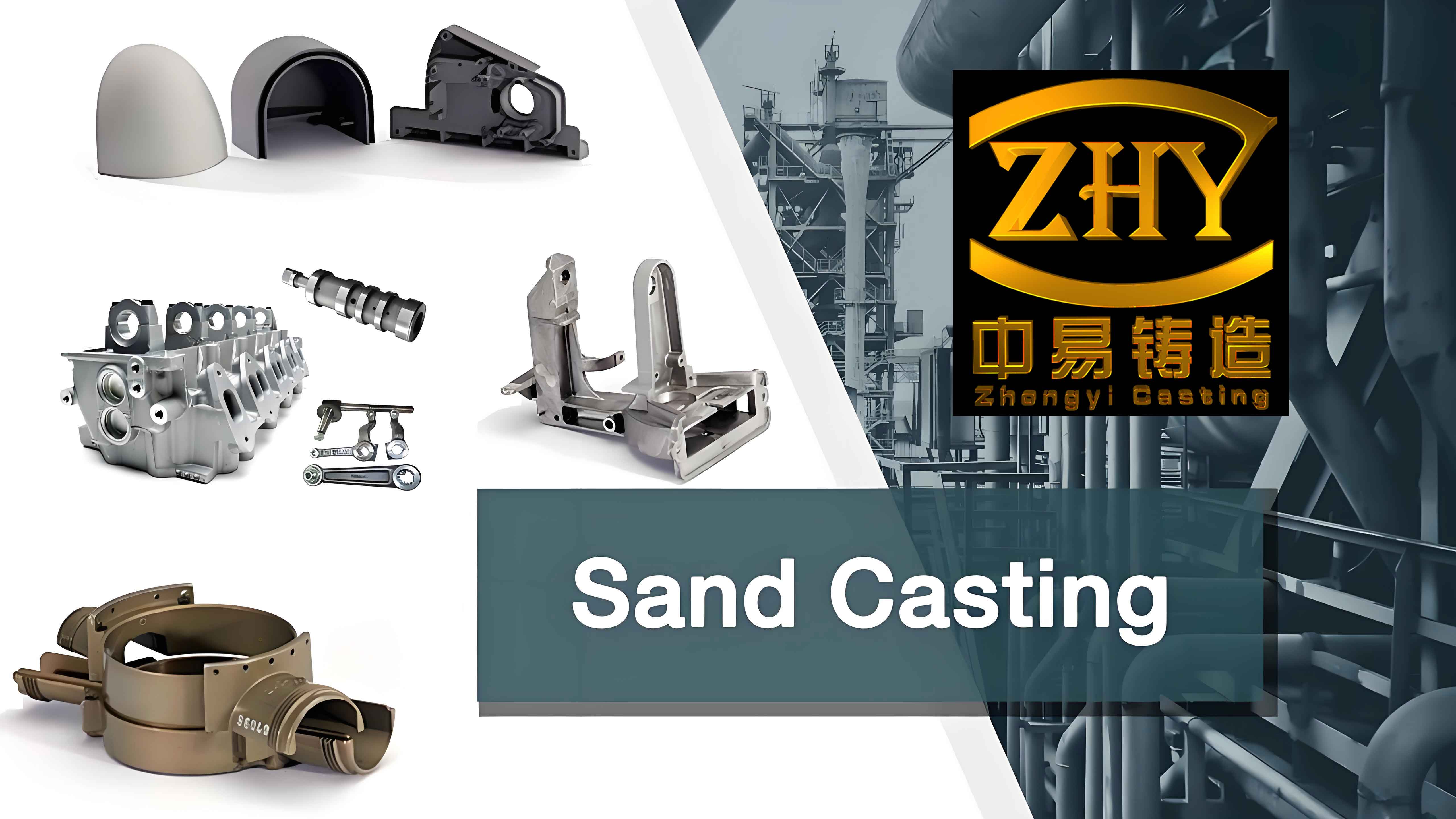
In this study, we first examined the raw materials required for the coating formulation. The refractory aggregate is olivine powder, primarily composed of forsterite (Mg₂SiO₄) and fayalite (Fe₂SiO₄), which exhibits a sintering temperature range of 1250–1350°C. This property allows it to form a glassy phase at the high pouring temperatures of high manganese steel (typically 1360–1380°C), sealing pores and preventing metal infiltration in sand casting parts. The chemical composition of the olivine powder used is summarized in Table 1, highlighting its suitability for this application.
| Chemical Component | Content (%) |
|---|---|
| SiO₂ | 39–41 |
| MgO | 47–49 |
| Fe₂O₃ | 7–9 |
| Al₂O₃ | 0.5–1.0 |
| CaO | 0.1–0.3 |
| K₂O | 0.05–0.1 |
| Cr₂O₃ | 0.01–0.05 |
| Ignition Loss | 0.5–1.0 |
The binder system includes both room-temperature and high-temperature binders. For room-temperature bonding, we used a phenolic resin (2123 type) that dissolves easily in alcohol. However, excessive addition (above 1.5%) can cause bubbling during ignition drying, leading to rough surfaces on sand casting parts. Therefore, we limited its content to below 1.5%. The high-temperature binder is a phosphate-based additive (referred to as Binder A) that polymerizes under heat to form a network structure, enhancing the coating’s strength at elevated temperatures. This is critical for withstanding the冲刷 of molten steel during the casting of sand casting parts.
Suspension agents are essential for maintaining homogeneity in the coating. We employed lithium-modified bentonite and polyvinyl butyral (PVB). Lithium-modified bentonite, derived from calcium bentonite through ion exchange, swells well in ethanol and acts as both a suspension agent and a high-temperature binder. Its addition is kept below 3.5% to avoid cracking in the coating layer. PVB serves as a dual-purpose agent, improving suspension stability and yield value while also acting as a room-temperature binder. However, adding more than 0.5% PVB can hinder gas escape during ignition, causing bubbles that affect the quality of sand casting parts. To further enhance suspension and thixotropy, we included an additive with active functional groups that interact with lithium bentonite to form a网状 structure.
The solvent for this alcohol-based coating is ethanol, chosen for its low cost, ease of use, and suitable properties such as a density of 0.7939 g/cm³ and a flame temperature of 560°C. Ethanol content should exceed 95% to ensure effective dissolution and coating performance. The final coating formulation, optimized through orthogonal experiments, is presented in Table 2. This formulation balances all components to achieve the desired properties for sand casting parts production.
| Material | Weight Ratio |
|---|---|
| Olivine Powder | 100 |
| Lithium-Modified Bentonite | 3.0–3.5 |
| Phenolic Resin | 1.0–1.5 |
| PVB | 0.2–0.5 |
| High-Temperature Binder A | 0.7–1.0 |
| Additive | Appropriate Amount |
| Ethanol | Appropriate Amount |
The preparation process involves several steps to ensure uniform dispersion and optimal performance. First, lithium-modified bentonite is mixed with a small amount of soft water and ball-milled for 5 minutes to form a paste. Then, olivine powder, PVB dissolved in ethanol, phenolic resin solution, the additive, and Binder A are added, followed by ball-milling for 1–1.5 hours. Finally, the remaining ethanol is incorporated, and the mixture is milled for an additional 15–20 minutes before discharge. This process ensures a homogeneous coating with good rheological properties, essential for applying to sand molds for sand casting parts.
We extensively tested the coating’s properties, particularly its thixotropy and rheological behavior, which are crucial for easy application and performance. Using an NDT-1 rotational viscometer with a 3# rotor at 6 rpm, we measured the apparent viscosity over time, as shown in Table 3. The data indicate a significant decrease in viscosity under constant shear, demonstrating shear-thinning behavior. The thixotropy rate, calculated using the formula:
$$ \text{Thixotropy Rate} = \frac{\eta_{0.5} – \eta_{5.0}}{\eta_{0.5}} \times 100\% $$
where $\eta_{0.5}$ and $\eta_{5.0}$ are the apparent viscosities at 0.5 and 5.0 minutes, respectively, yielded a value of 70%. This high thixotropy rate confirms that the coating is a pseudoplastic fluid with excellent shear-thinning characteristics, making it ideal for brushing or dipping onto sand molds for sand casting parts.
| Shear Time (min) | Apparent Viscosity (Pa·s) |
|---|---|
| 0.5 | 5.0 |
| 1.0 | 4.0 |
| 2.0 | 3.0 |
| 3.0 | 2.5 |
| 5.0 | 1.5 |
Further rheological analysis was conducted using an NXS-11 rotational viscometer. The shear stress was measured at increasing and decreasing shear rates, as summarized in Table 4. The flow curve, plotted from this data, exhibits a significant hysteresis loop, indicating strong thixotropic behavior. The yield stress $\tau_0$ was determined to be 5.5 Pa from the intersection of the ascending curve with the horizontal axis. The rheological equation can be approximated as:
$$ \tau = \tau_0 + k \dot{\gamma}^n $$
where $\tau$ is the shear stress (in $10^{-1}$ Pa), $\dot{\gamma}$ is the shear rate (in s⁻¹), $k$ is the consistency coefficient, and $n$ is the flow index. Substituting values from Table 4, we solved for $k$ and $n$, yielding:
$$ \tau = 5.5 + 21 \dot{\gamma}^{0.21} $$
This equation shows that the coating has a low consistency coefficient ($k = 21$) and a small flow index ($n = 0.21$), indicating it deviates significantly from Newtonian behavior and becomes much thinner under shear. This property ensures smooth application without dripping, which is vital for coating complex sand molds used in producing sand casting parts.
| Shear Rate (s⁻¹) | Shear Stress (10⁻¹ Pa) – Ascending | Shear Stress (10⁻¹ Pa) – Descending |
|---|---|---|
| 0 | 5.5 | 5.5 |
| 147.6 | 70.5 | 30.5 |
| 204.3 | 81.0 | 60.0 |
| 261.0 | 91.0 | 61.0 |
| 374.0 | 105.0 | 69.2 |
| 524.0 | 120.0 | 71.0 |
| 748.0 | 155.7 | 93.0 |
Other key properties of the coating include a pH of 7.5, density of 1.429 g/cm³, viscosity of 58 seconds as measured by a #6 standard cup, solid content of approximately 60%, suspension stability of 91% after 24 hours, gas evolution below 20 mL/g, and no cracking after急 heat treatment at 1000°C for 2 minutes. These properties ensure that the coating performs reliably under foundry conditions, contributing to the production of defect-free sand casting parts.
The anti-penetration mechanism of the olivine-based coating can be explained by the sintering-oxidation theory. During the pouring of high manganese steel sand casting parts at 1360–1380°C, the fayalite component in olivine (with a melting point of 1205°C) oxidizes to Fe₂O₃ or Fe₃O₄, forming a viscous glassy phase that fills gaps between particles. This sintering action creates a dense barrier layer that prevents metal penetration. Additionally, the high manganese steel melt is prone to oxidation, leading to an accumulation of iron oxides at the interface between the coating and the sand casting parts. This oxide layer, with a thickness exceeding 0.1 mm (the critical thickness), has poor adhesion to the steel surface. Upon cooling, the high shrinkage of high manganese steel (the largest among cast steels) generates shear stresses that cause the sintered coating shell to peel off automatically, resulting in smooth surfaces on sand casting parts. The process can be modeled using the following equation for oxide layer growth:
$$ \delta = k \sqrt{t} $$
where $\delta$ is the oxide layer thickness, $k$ is a rate constant dependent on temperature and composition, and $t$ is time. For high manganese steel sand casting parts, this leads to effective剥离 without manual intervention.
In production applications, this alcohol-based olivine coating has been successfully used in several foundries for manufacturing high manganese steel sand casting parts such as tooth plates, ladder plates, grate bars, liner plates, mill door liners, and frogs. These sand casting parts range in weight up to 730 kg and are produced using various sand mold types, including sodium silicate-bonded limestone sand CO₂-hardened molds, sodium silicate quartz sand CO₂-hardened molds, and dried molds. Feedback from operators indicates that the coating is easy to store, mix, and apply, with good suspension and no running on vertical surfaces. After casting, the coating shell peels off readily, leaving sand casting parts with clean, smooth surfaces and sharp edges. The sintered coating appears紫黑色 and is easily removed, reducing cleaning time and improving productivity for sand casting parts.
To quantify the benefits, we compared the cost and performance of olivine coating with traditional zircon-based coatings. Olivine powder is approximately 10% the cost of zircon flour, and using lithium-modified bentonite instead of organic bentonite further reduces expenses. This makes the coating economically attractive for large-scale production of sand casting parts. Additionally, the environmental impact is lower due to reduced waste and energy consumption during cleaning. A summary of the advantages is provided in Table 5, highlighting why this coating is superior for high manganese steel sand casting parts.
| Coating Type | Cost Index | Suspension Stability | Peelability | Surface Finish | Environmental Impact |
|---|---|---|---|---|---|
| Zircon-Based | High | Moderate | Poor | Rough | Moderate |
| Magnesite-Based | Moderate | Low | Fair | Fine Veining | High |
| Olivine-Based (Our Coating) | Low | High | Excellent | Smooth | Low |
In conclusion, our research demonstrates that the alcohol-based olivine coating is a highly effective solution for improving the quality of high manganese steel sand casting parts. Its pseudoplastic rheology, characterized by the equation $\tau = 5.5 + 21 \dot{\gamma}^{0.21}$, ensures easy application and good coverage on sand molds. The coating’s sintering behavior forms a dense隔离 layer that prevents metal penetration, while the oxidation mechanism promotes automatic peeling, yielding sand casting parts with excellent surface finish. Moreover, the low cost of raw materials, such as olivine powder and lithium-modified bentonite, makes this coating economically viable for industrial use. Future work could explore modifications for other alloy systems or automated application methods to further enhance the production of sand casting parts. Overall, this coating represents a significant advancement in foundry technology, offering both performance and cost benefits for manufacturers of high manganese steel sand casting parts.
We believe that the principles outlined here can be extended to other types of sand casting parts, potentially revolutionizing how coatings are designed for high-temperature applications. By focusing on material properties and rheological control, we can continue to innovate in the production of durable and precise sand casting parts for various industries.