
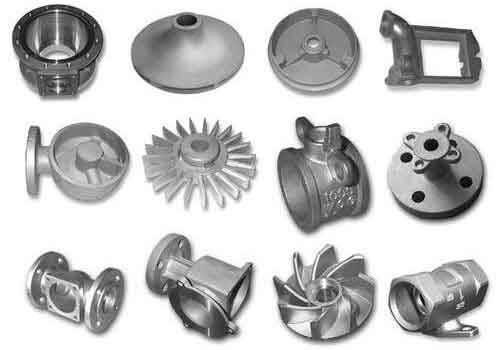
In the realm of foundry engineering, the production of large ductile iron crankshafts as critical sand casting parts has always posed significant challenges due to stringent quality requirements. Our experience over the past decade has centered on transitioning from traditional clay sand dry molds to furan resin self-hardening sand molds, aiming to enhance efficiency and quality in sand casting parts manufacturing. This shift, while promising, introduced new complexities such as shrinkage porosity, slag inclusions, and gas defects, which demanded thorough investigation and process refinement. In this article, I will share our journey in optimizing furan resin sand casting for large ductile iron crankshafts, emphasizing key strategies, comparative analyses, and empirical findings that underscore the viability of this method for high-integrity sand casting parts.
The adoption of furan resin self-hardening sand stems from its advantages: simplified operations, energy savings by eliminating mold drying, superior surface finish, high dimensional accuracy, and ease of shakeout. However, compared to clay sand dry molds, furan resin sand exhibits higher sulfur content, slower cooling rates, lower high-temperature rigidity, and greater gas evolution, which can compromise the quality of sand casting parts, especially for thick-section ductile iron components like crankshafts. Our factory initiated this transition in the early 2000s, and after encountering initial quality issues, we embarked on a dedicated攻关 (problem-solving) effort to address these drawbacks. The insights gained have not only resolved production bottlenecks but also provided a framework for applying furan resin sand to other large sand casting parts.
One of the primary concerns was shrinkage porosity, which often led to rejection during ultrasonic testing. In clay sand dry molds, we employed a horizontal pouring and vertical cooling process with top risers for feeding, leveraging the mold’s high rigidity. With furan resin sand, to mitigate its low thermal strength, we switched to a horizontal pouring and horizontal cooling process without risers, using distributed gating systems and increased chill inserts. However, this initially resulted in internal shrinkage defects. Through experimentation, we identified that the key to overcoming this lay in combining centralized and distributed feeding: most molten iron enters via a riser at one end, while smaller amounts are introduced at the flange and intermediate crank throws to optimize temperature distribution. This ensures that the riser end, with higher liquid contraction, is fed adequately, while remote areas experience reduced contraction due to temperature drop. Mathematically, the solidification time \( t \) for a casting is related to its modulus \( M \) (volume-to-surface area ratio), and for furan resin sand, the slower cooling extends \( t \), which can be expressed as:
$$ t = k \cdot M^n $$
where \( k \) is a constant dependent on mold material, and \( n \) is an exponent typically around 2 for sand molds. Our laboratory tests compared furan resin sand and clay sand dry molds for various modulus values, as summarized in Table 1. The data confirm that furan resin sand prolongs solidification, which, if managed properly, can enhance graphite expansion to counteract shrinkage in sand casting parts.
| Modulus (cm) | Clay Sand Dry Mold Solidification Time (min) | Furan Resin Sand Solidification Time (min) | Ratio (Furan/Clay) |
|---|---|---|---|
| 2.5 | 45 | 68 | 1.51 |
| 3.5 | 78 | 120 | 1.54 |
| 4.5 | 115 | 180 | 1.57 |
| 5.5 | 155 | 245 | 1.58 |
To bolster mold rigidity, we adjusted sand composition and employed manual ramming during molding to increase compactness, which prevented mold wall movement. Additionally, chill inserts were strategically enlarged and added, particularly near high-heat areas like the first and second crank throws, to accelerate surface solidification and form a robust shell. This is critical for leveraging the graphite expansion phase in ductile iron, described by the volume change model during cooling and solidification. Let \( V_l \) represent liquid volume, \( V_s \) solid volume, and \( V_g \) graphite volume; the net volume change \( \Delta V \) can be approximated as:
$$ \Delta V = (V_s – V_l) + V_g $$
where \( V_g \) is positive due to graphite precipitation. By controlling carbon equivalent (CE) between 4.2% and 4.5%, with CE defined as:
$$ CE = C + \frac{Si}{3} + \frac{P}{3} $$
we ensured sufficient graphite formation to offset base metal contraction. Inoculation treatments further promoted graphite nucleation, reducing shrinkage propensity in these sand casting parts.
Gas porosity emerged as another major issue, driven by the high and rapid gas evolution of furan resin sand. To address this, we increased the number and diameter of vent holes, added semi-vents that direct gas away from the cavity, and controlled resin addition to minimize gas generation while maintaining strength. The gas evolution volume \( G \) per unit mold volume can be modeled as:
$$ G = \rho_s \cdot \alpha \cdot e^{-\beta T} $$
where \( \rho_s \) is sand density, \( \alpha \) is a resin-dependent constant, and \( \beta \) relates to temperature \( T \). By limiting resin to 1.0-1.2% and ensuring proper coating with iron oxide-added paints, we reduced gas ingress. For cores, water-based coatings were applied and thoroughly dried. These measures eliminated “boiling” and gas-related defects, ensuring soundness in sand casting parts.
Slag inclusions were mitigated through a combination of process adjustments. We used tap-hole ladles to prevent primary slag entry, covered molten iron with cryolite powder to minimize oxidation and secondary slag formation, and optimized gating to improve temperature uniformity. The gating ratio was refined to balance flow rates, and pouring temperature was controlled at 1350-1380°C. Additionally, using foundry coke for melting and desulfurizing raw iron to below 0.02% sulfur reduced slag sources. The effectiveness of these steps is evident in the decline of rejection rates for slag-related defects in sand casting parts.
A critical aspect of our study was comparing the inherent properties of furan resin sand and clay sand dry molds, as these directly impact the quality of sand casting parts. Beyond solidification time, we examined thermal strength and sulfur content. Furan resin sand suffers from lower high-temperature rigidity due to resin decomposition around 300°C, whereas clay sand maintains strength up to 800°C. However, by enhancing mold compactness and employing horizontal cooling, we counteracted this weakness. The density measurements of crankshafts from both mold types showed no significant difference, indicating that furan resin sand can achieve dimensional stability. Table 2 summarizes key mold properties, highlighting trade-offs that must be managed in sand casting parts production.
| Property | Clay Sand Dry Mold | Furan Resin Sand Mold |
|---|---|---|
| Cooling Rate | Fast | Slow |
| High-Temperature Rigidity | High (up to 800°C) | Low (degrades above 300°C) |
| Gas Evolution (ml/g) | < 5 | 10-15 (controlled) |
| Sulfur Content | Negligible | 0.1-0.3% (from hardeners) |
| Permeability | High | Moderate (requires vents) |
The sulfur content in furan resin sand, originating from hardeners like toluene sulfonic acid, raised concerns about surface degradation in ductile iron sand casting parts. Theoretical models suggest sulfur diffusion can cause magnesium loss at the interface, leading to graphite degeneration. However, in our thick-section crankshafts, we observed no such issues, likely due to the use of zirconia-based coatings as barriers and the high magnesium content (0.04-0.06%) in our proprietary nodularizer with copper. The diffusion depth \( d \) of sulfur can be estimated using Fick’s law:
$$ d = \sqrt{D \cdot t} $$
where \( D \) is the diffusion coefficient and \( t \) is time. For large sand casting parts with extended solidification, magnesium from the bulk replenishes surface losses, preventing deterioration. This underscores the importance of alloy design for furan resin sand applications.
Mechanical performance is paramount for sand casting parts like crankshafts. We conducted extensive testing on specimens and full-scale components to compare furan resin sand and clay sand dry mold castings. Table 3 presents statistical data from production over several years, showing that with optimized processes, furan resin sand castings achieve comparable or slightly superior properties. The data include tensile strength, elongation, and hardness for crankshafts of different sizes, all subjected to normalized and tempered heat treatment. The consistency in results demonstrates that furan resin sand does not compromise the intrinsic quality of sand casting parts.
| Mold Type | Tensile Strength (MPa) Range | Tensile Strength Average (MPa) | Elongation (%) Range | Elongation Average (%) | Hardness (HB) Range | Hardness Average (HB) |
|---|---|---|---|---|---|---|
| Clay Sand Dry Mold (with foundry coke, desulfurized) | 750-850 | 805 | 3-7 | 5.2 | 240-280 | 260 |
| Furan Resin Sand Mold (with foundry coke, desulfurized) | 760-860 | 815 | 4-8 | 5.5 | 245-285 | 265 |
Furthermore, density measurements using precision scales and weight-loss methods revealed no significant differences between mold types, with average densities around 7.15 g/cm³. This aligns with the notion that proper process control can harness the benefits of furan resin sand without inducing internal flaws in sand casting parts. The improved surface finish and dimensional accuracy—often with tolerances within ±0.5 mm compared to ±1.0 mm for clay sand—have reduced machining allowances and enhanced the overall economy of producing sand casting parts.
In discussing the broader implications, it’s clear that furan resin sand casting represents a progressive step for manufacturing large, high-duty sand casting parts. The slower cooling rate, while a drawback for thin sections, can be advantageous for thick-walled sand casting parts by promoting graphite formation and reducing shrinkage tendency. The relationship between modulus \( M \) and allowable riser-less casting has been explored in literature, suggesting that for furan resin sand, the critical modulus for sound castings is lower than for clay sand. Empirically, we find that for sand casting parts with \( M > 4 \, \text{cm} \), furan resin sand can achieve riser-less designs with proper chilling, as per the modified criterion:
$$ M_{\text{critical}} = \frac{k’}{\sqrt{t}} $$
where \( k’ \) is a material constant. This enables lighter and more efficient sand casting parts designs.
Gas management remains a pivotal consideration. We developed a venting ratio formula to guide mold design for sand casting parts:
$$ A_v = \frac{G \cdot V_m}{v_g} $$
where \( A_v \) is vent area, \( V_m \) is mold volume, and \( v_g \) is gas escape velocity. By implementing this, we reduced gas defects to near zero. Additionally, the use of low-sulfur hardeners or organic alternatives could further minimize sulfur-related risks, expanding the applicability of furan resin sand for sensitive sand casting parts.
From a production standpoint, the overall rejection rate for crankshafts cast in furan resin sand dropped to below 2% from over 5% with clay sand, primarily due to fewer surface and internal defects. This economic benefit, coupled with energy savings from omitted drying, makes furan resin sand a sustainable choice for foundries focusing on high-value sand casting parts. Our success has led to extending this technology to other large components like cylinder blocks and gearboxes, reinforcing its versatility.
In conclusion, our experience demonstrates that furan resin self-hardening sand is fully capable of replacing clay sand dry molds for producing large ductile iron crankshafts and similar sand casting parts. Through systematic optimization—addressing cooling rates with chills, enhancing mold rigidity with compaction, controlling gas evolution with venting, and mitigating slag and sulfur effects—we have achieved internal quality parity with clay sand while surpassing it in surface finish and precision. The key lies in understanding the unique properties of furan resin sand and adapting processes accordingly. As the demand for high-performance sand casting parts grows, this approach offers a reliable pathway to meet stringent specifications efficiently. Future work may explore advanced binders or hybrid systems to further push the boundaries of sand casting parts manufacturing.