
In the manufacturing industry, sand casting remains a predominant method for producing metal components, particularly for sand casting parts used in automotive, machinery, and construction sectors. As a researcher focused on sustainable manufacturing, I have extensively studied the environmental impacts associated with various sand casting processes. The production of sand casting parts generates significant waste, including used sand and gaseous emissions, posing challenges for green foundry practices. This article delves into the environmental characteristics of typical sand casting methods, emphasizing gas volatiles and used sand reusability, and explores the development trends of casting binders towards cleaner production. Through this analysis, I aim to highlight pathways for reducing the ecological footprint of sand casting parts manufacturing while maintaining economic viability.
The environmental footprint of sand casting parts production is largely influenced by the type of binders used in mold and core making. Common sand casting processes include green sand (clay-bonded), no-bake furan resin sand, no-bake alkaline phenolic resin sand, CO2-cured sodium silicate sand, and ester-cured sodium silicate sand. Each method exhibits distinct environmental profiles, primarily in terms of volatile organic compounds (VOCs) and hazardous air pollutants (HAPs) emitted during pouring and cooling, as well as the recyclability of used sand. In my investigations, I have conducted experiments to compare these aspects, which are critical for advancing green sand casting parts production.
Gas Emission Characteristics in Sand Casting
During the pouring and solidification of sand casting parts, the decomposition of binders releases various gases, contributing to air pollution. To assess this, I designed a controlled experiment where sand molds were placed in a sealed chamber for gas collection, ensuring minimal contamination. The gases were analyzed using gas chromatography-mass spectrometry (GC-MS), focusing on five typical sand casting methods for steel castings (ZG35) poured at 1570–1600°C. The sand mixtures were prepared with new sand to avoid impurities from used sand, with the following formulations per 1000g of base sand (40/70 mesh):
- Green sand: 160g sodium bentonite, 4g α-starch additive.
- Alkaline phenolic resin sand: 30g resin, 6g hexamethylenetetramine hardener.
- Furan resin sand: 10g resin, 4g benzenesulfonic acid hardener.
- CO2-cured sodium silicate sand: 70g sodium silicate.
- Ester-cured sodium silicate sand: 30g sodium silicate, 3g ester.
The relative content of harmful gases in the collected emissions is summarized in Table 1. Organic gases include toxic compounds like benzene, toluene, and phenols, while inorganic gases comprise CO, CO2, and H2O. The results indicate that sodium silicate-based sands produce fewer toxic organic emissions, whereas resin-bonded sands generate higher levels of benzene-ring compounds due to binder pyrolysis. This underscores the environmental advantage of inorganic binders in sand casting parts production.
| Sand Type | Toxic Organic Gases (%) | Other Organic Gases (%) | Inorganic Gases (%) |
|---|---|---|---|
| Ester-cured Sodium Silicate Sand | 11.11 | 42.46 | 46.63 |
| CO2-cured Sodium Silicate Sand | 15.79 | 28.29 | 55.92 |
| Green Sand | 25.23 | 10.14 | 64.63 |
| Furan Resin Sand | 61.00 | 12.81 | 26.19 |
| Alkaline Phenolic Resin Sand | 78.30 | 15.08 | 6.62 |
The emission of VOCs and HAPs can be modeled using a simplified formula for total emission load during sand casting parts production:
$$ E_{total} = \sum_{i} (C_{i} \times V \times f_{i}) $$
where \( E_{total} \) is the total emission mass (g), \( C_{i} \) is the concentration of gas component i (g/m³), \( V \) is the volume of gas released (m³), and \( f_{i} \) is the emission factor for the specific sand type. For instance, resin sands have higher \( f_{i} \) values for benzene derivatives, aligning with the data in Table 1. This formula helps in quantifying the environmental impact of different binders when producing sand casting parts.
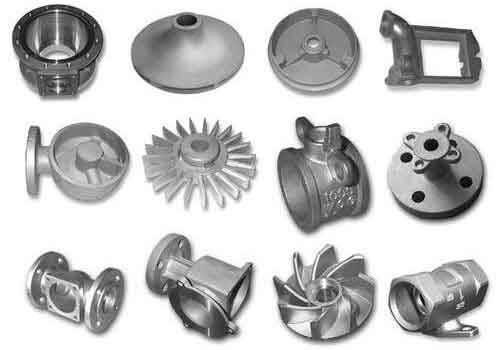
The image above illustrates typical sand casting parts, highlighting the complexity and scale of components manufactured through these processes. The environmental management of such production is crucial, as even small reductions in emissions per part can lead to significant overall benefits. For example, switching to low-emission binders for sand casting parts can decrease the release of toxic gases like benzene, which is prevalent in resin-bonded sands. My research suggests that inorganic binders, such as sodium silicate, offer a promising alternative for reducing the environmental burden of sand casting parts manufacturing.
Reusability of Used Sand in Sand Casting
Another critical environmental aspect is the reclamation of used sand from sand casting parts production. Annually, millions of tons of used sand are generated, and their disposal poses resource wastage and pollution challenges. I have evaluated the reusability of used sand from two common sources: clay-bonded green sand and resin-bonded sand. The properties of these used sands, after sieving to remove debris, are shown in Table 2. Parameters like moisture content, clay content, loss on ignition (LOI), grain size, and pH affect the regeneration efficiency.
| Parameter | Clay-Bonded Used Sand | Resin-Bonded Used Sand |
|---|---|---|
| Moisture Content (%) | 0.97 | 0.23 |
| Clay Content (%) | 13.16 | 0.88 |
| LOI (%) | 6.55 | 2.49 |
| Grain Size (mesh) | 40/70 | 50/100 |
| pH | 9.70 | 9.50 |
Traditional regeneration methods—dry, wet, and thermal—are often tailored to single-type used sand. However, in practice, foundries deal with mixed used sand, necessitating composite approaches. I developed a “wet-thermal” composite regeneration method, where clay-rich sand undergoes wet regeneration and resin-bonded sand undergoes thermal regeneration. The thermal regeneration of resin-bonded sand was tested at temperatures of 600°C, 700°C, and 800°C for 30 minutes, with results in Table 3. The LOI decreases with higher temperatures, indicating effective binder removal, which is essential for reusing sand in sand casting parts production.
| Temperature (°C) | Moisture Content (%) | Clay Content (%) | LOI (%) | Grain Size (mesh) | pH |
|---|---|---|---|---|---|
| 600 | 0 | 0.60 | 0.40 | 50/100 | 7.70 |
| 700 | 0 | 0.43 | 0.29 | 50/100 | 7.66 |
| 800 | 0 | 0.22 | 0.20 | 50/100 | 7.58 |
For clay-bonded used sand, wet regeneration was performed with varying sand-to-water ratios (1:1, 1:1.5, 1:2). The properties after four regeneration cycles are summarized in Table 4. A ratio of 1:2 yielded the best results, with low clay content and LOI, making it suitable for reuse in sand casting parts molds.
| Sand-to-Water Ratio | Clay Content (%) | LOI (%) | Grain Size (mesh) | pH |
|---|---|---|---|---|
| 1:1 | 0.28 | 0.51 | 40/70 | 9.15 |
| 1:1.5 | 0.21 | 0.45 | 40/70 | 9.10 |
| 1:2 | 0.19 | 0.40 | 40/70 | 9.06 |
The composite regeneration involved mixing thermally regenerated sand (800°C) with wet-regenerated sand at a 1:2.5 ratio. The mixed reclaimed sand met industrial standards for sand casting parts production, as shown in Table 5. The tensile strength of molds made with this reclaimed sand, using a formulation of 1000g sand, 0.6% ester hardener, and 3% alkaline phenolic resin, demonstrated adequate performance for producing high-quality sand casting parts.
| Parameter | Value |
|---|---|
| pH | 7.50 |
| Moisture Content (%) | 0.21 |
| Clay Content (%) | 0.20 |
| LOI (%) | 0.36 |
| Grain Size (mesh) | 50/100 |
| 1-hour Tensile Strength (MPa) | 0.58 |
| 4-hour Tensile Strength (MPa) | 1.12 |
| 24-hour Tensile Strength (MPa) | 2.04 |
The regeneration efficiency \( \eta \) can be expressed as:
$$ \eta = \frac{W_{reclaimed}}{W_{total}} \times 100\% $$
where \( W_{reclaimed} \) is the mass of reclaimed sand meeting quality standards, and \( W_{total} \) is the total mass of used sand input. For the composite method, \( \eta \) approaches 90–95%, enabling cost-effective and environmentally friendly recycling for sand casting parts production. This aligns with the goal of minimizing waste from sand casting parts manufacturing.
Trends in Casting Binders for Sustainable Sand Casting Parts
The development of casting binders is pivotal for enhancing the sustainability of sand casting parts production. Based on my research, three key trends are emerging: widespread adoption of low-pollution inorganic binders, advancement of low-cost zero-discharge used sand regeneration technologies, and reduction and harmless treatment of harmful gases. These trends address the environmental challenges identified in gas emissions and sand reusability for sand casting parts.
Low-Pollution Inorganic Binders
Inorganic binders, particularly sodium silicate-based systems, are gaining traction due to their minimal VOC emissions and non-toxic nature. Sodium silicate sand offers advantages such as fire resistance, high-temperature stability, and abundance of raw materials. Modified sodium silicate processes, like ester hardening, have improved collapsibility and reusability, making them suitable for high-volume sand casting parts production. The gas emissions data in Table 1 confirm that sodium silicate sands emit fewer toxic organics compared to resin bonds. For instance, ester-cured sodium silicate sand released only 11.11% toxic organic gases, whereas furan resin sand emitted 61.00%. This reduction is critical for protecting worker health and reducing the environmental impact of sand casting parts foundries.
Moreover, water-soluble animal protein binders are being explored as green alternatives. These binders are non-toxic, high-strength, and derived from renewable resources, though their commercial application in sand casting parts production is still in early stages. The adoption of such binders could further decrease the carbon footprint of sand casting parts manufacturing. The performance of inorganic binders can be modeled using a strength development equation:
$$ S(t) = S_0 \cdot e^{-k t} + S_{\infty} \cdot (1 – e^{-k t}) $$
where \( S(t) \) is the tensile strength at time \( t \), \( S_0 \) is the initial strength, \( S_{\infty} \) is the ultimate strength, and \( k \) is a curing constant. For sodium silicate sands, \( k \) is optimized through modifiers to achieve rapid hardening for efficient sand casting parts production.
Low-Cost Zero-Discharge Used Sand Regeneration
To address the solid waste from sand casting parts production, innovative regeneration technologies are essential. The composite “wet-thermal” method exemplifies a low-cost approach that minimizes secondary emissions. By integrating thermal regeneration’s heat to dry wet-regenerated sand, energy consumption is reduced, enhancing the economic viability of recycling for sand casting parts foundries. The properties in Tables 3-5 show that reclaimed sand can match new sand quality, enabling closed-loop systems. This aligns with circular economy principles for sand casting parts manufacturing.
Efficient equipment development, such as continuous wet regeneration machines and high-temperature thermal furnaces (e.g., 800°C for resin sand), is crucial. The energy efficiency of thermal regeneration can be expressed as:
$$ Q_{required} = m \cdot c \cdot \Delta T + m \cdot L $$
where \( Q_{required} \) is the heat energy (J), \( m \) is the mass of sand (kg), \( c \) is the specific heat capacity (J/kg·K), \( \Delta T \) is the temperature rise (K), and \( L \) is the latent heat for binder decomposition (J/kg). Optimizing this equation through heat recovery systems can lower costs for sand casting parts producers. Additionally, wastewater treatment in wet regeneration must be addressed to achieve zero discharge, ensuring that sand casting parts production does not contaminate water resources.
Reduction and Harmless Treatment of Harmful Gases
Minimizing gas emissions from sand casting parts production involves both binder formulation and post-treatment technologies. For resin-bonded sands, developing low-emission formulations with reduced benzene content is a priority. Additives that suppress toxic gas formation during pyrolysis can be incorporated. The emission factor \( F \) for HAPs can be defined as:
$$ F = \frac{M_{HAP}}{M_{casting}} $$
where \( M_{HAP} \) is the mass of HAPs emitted (g) and \( M_{casting} \) is the mass of sand casting parts produced (t). Data from literature suggest \( F \) ranges from 71.2–907.2 g/t for different processes, with resin sands at the higher end. By using inorganic binders, \( F \) can be reduced to below 100 g/t for sand casting parts, as seen in sodium silicate sands.
Gas treatment systems, such as scrubbers or thermal oxidizers, can render emissions harmless. For example, catalytic converters can break down VOCs into CO2 and H2O. The efficiency of such systems \( \epsilon \) is given by:
$$ \epsilon = \left(1 – \frac{C_{out}}{C_{in}}\right) \times 100\% $$
where \( C_{in} \) and \( C_{out} \) are the inlet and outlet concentrations of pollutants. Implementing these technologies in sand casting parts foundries can achieve near-zero atmospheric impact, supporting green manufacturing goals for sand casting parts.
Challenges and Future Directions for Sand Casting Parts Production
Despite progress, challenges persist in achieving fully sustainable sand casting parts production. For sodium silicate sands, issues like poor collapsibility and alkaline wastewater from regeneration need further research. Microwave curing technology shows promise by lowering sodium silicate addition, improving sand reusability for sand casting parts. The microwave energy absorption can be modeled as:
$$ P = \epsilon” \cdot f \cdot E^2 \cdot V $$
where \( P \) is the power absorbed (W), \( \epsilon” \) is the loss factor, \( f \) is the frequency (Hz), \( E \) is the electric field strength (V/m), and \( V \) is the volume (m³). This enables faster curing with less binder, enhancing the environmental profile of sand casting parts molds.
For used sand regeneration, handling mixed sands from diverse sand casting parts processes requires adaptable composite methods. Future work should focus on automated sorting and regeneration lines to scale up recycling. Additionally, lifecycle assessment (LCA) tools can quantify the overall environmental benefits of these trends for sand casting parts. The LCA impact score \( I \) can be calculated as:
$$ I = \sum_{j} w_j \cdot I_j $$
where \( w_j \) are weighting factors for categories like global warming or resource use, and \( I_j \) are inventory data. By optimizing binders and regeneration, \( I \) can be minimized for sand casting parts manufacturing.
Conclusion
In conclusion, sand casting parts production is evolving towards greener practices through improved environmental characteristics and binder developments. My research highlights that inorganic binders like sodium silicate offer low gas emissions, while composite regeneration methods enable high-quality sand reuse. The trends toward low-pollution binders, zero-discharge recycling, and gas treatment are essential for sustainable sand casting parts manufacturing. As sand casting remains dominant in the foundry industry, adopting these advancements will reduce waste, lower emissions, and enhance economic efficiency. Continued innovation in binder chemistry and regeneration technology will drive the future of eco-friendly sand casting parts, ensuring that this traditional method aligns with modern environmental standards for producing durable and complex sand casting parts.