
As a researcher in the field of foundry technology, I have long been concerned with the environmental impact of sand casting processes. Sand casting is a dominant method for producing metal components, especially for sand casting parts used in industries such as automotive, machinery, and construction. However, the environmental footprint of sand casting, including gas emissions and waste generation, poses significant challenges. In this article, I will explore the environmental characteristics of various sand casting methods, focusing on volatile organic compounds (VOCs) and hazardous air pollutants (HAPs), as well as the recyclability of used sand. I will also discuss the development trends of casting binders, emphasizing the shift toward greener alternatives. Throughout, I will use tables and formulas to summarize key data and models, and I will frequently reference sand casting parts to highlight their relevance in industrial applications.
The production of sand casting parts involves the use of molding sands bonded with different binders. Common sand casting methods include green sand (clay-bonded), no-bake furan resin sand, no-bake alkaline phenolic resin sand, CO2-cured sodium silicate sand, and ester-cured sodium silicate sand. Each method has distinct environmental features, primarily in terms of gas emissions during pouring and cooling, and the reuse potential of used sand. With global casting production exceeding millions of tons annually, the accumulation of used sand and emission of pollutants are alarming. For instance, in many foundries, the disposal of used sand and the release of VOCs contribute to environmental degradation. Therefore, understanding these aspects is crucial for advancing sustainable sand casting practices for sand casting parts.
To begin, let me delve into the gas emissions from different sand casting processes. The decomposition of binders during the pouring and solidification of sand casting parts releases various gases, including VOCs and HAPs, which can harm human health and the environment. I conducted experiments to compare the gas emissions from five typical sand casting methods used for producing steel sand casting parts. The experimental setup involved a sealed chamber to collect pure casting tail gases, which were then analyzed using GC-MS (Gas Chromatography-Mass Spectrometry). The results provide insights into the relative content of toxic organic and inorganic gases.
| Sand Type | Toxic Organic Gases (%) | Other Organic Gases (%) | Inorganic Gases (%) |
|---|---|---|---|
| Ester-cured Sodium Silicate Sand | 11.11 | 42.46 | 46.63 |
| CO2-cured Sodium Silicate Sand | 15.79 | 28.29 | 55.92 |
| Green Sand (Clay-bonded) | 25.23 | 10.14 | 64.63 |
| Furan Resin Sand | 61.00 | 12.81 | 26.19 |
| Alkaline Phenolic Resin Sand | 78.30 | 15.08 | 6.62 |
From the table, it is evident that inorganic binders like sodium silicate sands produce lower levels of toxic organic gases compared to organic binders such as furan and phenolic resins. This is significant for reducing the environmental impact of sand casting parts production. The inorganic gases primarily include CO, CO2, and H2O, with CO content typically below 5%. The toxic organic gases in resin sands often contain benzene, toluene, and xylene, which are harmful pollutants. To quantify the emission rates, I propose a simple model for gas emission during sand casting:
$$ E = \sum_{i=1}^{n} (C_i \cdot V \cdot \rho) $$
where \( E \) is the total emission of a specific gas (in grams), \( C_i \) is the concentration of gas \( i \) in the tail gas (in percentage), \( V \) is the volume of gas released per ton of sand casting parts (in cubic meters), and \( \rho \) is the density of the gas (in g/m³). For sand casting parts, typical values of \( V \) range from 100 to 500 m³ per ton, depending on the sand type and pouring conditions. This formula helps estimate the environmental load from different sand casting processes.
Further analysis shows that the emission factors for VOCs and HAPs vary widely. Based on literature, the emission factors for sand casting parts production can be summarized as follows:
| Process | VOC Emission Factor | HAP Emission Factor |
|---|---|---|
| Green Sand Casting (without cores) | 93.4 – 272.2 | 71.2 – 235.4 |
| Green Sand Casting (with resin sand cores) | 298.5 – 861.8 | 221 – 441 |
| Resin Sand Casting | 666.8 – 1864.6 | 526.2 – 907.2 |
These data underscore the higher pollution potential of resin-bonded sands, which are commonly used for complex sand casting parts. The decomposition of organic binders releases compounds like phenol, formaldehyde, and benzene, as shown in the composition of HAPs from coal dust, phenolic resin, and furan resin:
| HAP Component | Coal Dust | Phenolic Resin | Furan Resin |
|---|---|---|---|
| Benzene | 42.15 | 27.26 | 47.95 |
| Toluene | 21.63 | 5.51 | 9.28 |
| Xylene | 14.71 | 2.35 | 4.07 |
| Phenol | 2.09 | 30.19 | 18.15 |
| Formaldehyde | 0.81 | 0.31 | 1.14 |
Such emissions necessitate the development of low-emission binders for sand casting parts. In addition to gas emissions, the recyclability of used sand is a critical environmental aspect. Used sand from sand casting processes often contains residual binders and additives, making its reuse challenging. I investigated the regeneration of mixed used sand, combining clay-bonded and resin-bonded sands, which is common in foundries producing diverse sand casting parts. The performance of used sand before and after regeneration was evaluated through parameters like moisture content, clay content, loss on ignition, grain size distribution, and pH value.
Initial tests on used sand samples revealed significant differences:
| Parameter | Clay-bonded Used Sand | Resin-bonded Used Sand |
|---|---|---|
| Moisture Content (%) | 0.97 | 0.23 |
| Clay Content (%) | 13.16 | 0.88 |
| Loss on Ignition (%) | 6.55 | 2.49 |
| Grain Size Distribution (mesh) | 40/70 | 50/100 |
| pH Value | 9.70 | 9.50 |
To regenerate these sands, I applied a combined wet-thermal regeneration method. For resin-bonded sand, thermal regeneration at temperatures of 600°C, 700°C, and 800°C for 30 minutes was performed. The results showed improved properties:
| Temperature | Clay Content (%) | Loss on Ignition (%) | pH Value |
|---|---|---|---|
| 600°C | 0.60 | 0.40 | 7.70 |
| 700°C | 0.43 | 0.29 | 7.66 |
| 800°C | 0.22 | 0.20 | 7.58 |
For clay-bonded sand, wet regeneration with different sand-to-water ratios was tested. After four cycles of wet regeneration, the properties changed as follows:
| Sand-to-Water Ratio | Clay Content (%) | Loss on Ignition (%) | pH Value |
|---|---|---|---|
| 1:1 | 0.28 | 0.51 | 9.15 |
| 1:1.5 | 0.21 | 0.45 | 9.10 |
| 1:2 | 0.19 | 0.40 | 9.06 |
The combined regeneration approach involved mixing thermally regenerated resin sand (at 800°C) with wet-regenerated clay sand in a ratio of 1:2.5. The mixed regenerated sand exhibited properties suitable for reuse in producing sand casting parts:
| Parameter | Value |
|---|---|
| pH Value | 7.50 |
| Moisture Content (%) | 0.21 |
| Clay Content (%) | 0.20 |
| Loss on Ignition (%) | 0.36 |
| Grain Size Distribution (mesh) | 50/100 |
| 1-hour Tensile Strength (MPa) | 0.58 |
| 4-hour Tensile Strength (MPa) | 1.12 |
| 24-hour Tensile Strength (MPa) | 2.04 |
This demonstrates that mixed used sand can be effectively regenerated for producing high-quality sand casting parts. The regeneration efficiency \( R \) can be expressed as:
$$ R = \frac{Q_r}{Q_u} \times 100\% $$
where \( Q_r \) is the quantity of regenerated sand meeting specifications (in tons), and \( Q_u \) is the quantity of used sand input (in tons). For the combined method, \( R \) often exceeds 90%, making it a cost-effective solution for foundries.
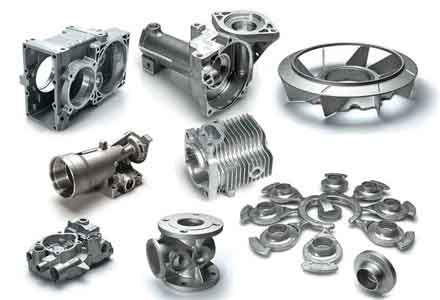
The image above illustrates a typical sand casting part, highlighting the complexity and precision achievable with sand casting processes. Such parts are integral to various industries, and their production must align with environmental goals. Moving forward, the development of casting binders is pivotal for reducing the ecological impact of sand casting parts manufacturing. The trends in casting binders are shifting toward less-polluting inorganic binders, low-cost and emission-free sand regeneration technologies, and the minimization and harmless discharge of harmful gases.
Inorganic binders, particularly sodium silicate (water glass), offer significant environmental advantages. They are non-combustible, heat-resistant, abundant, and low-cost, and they do not emit toxic gases during the production of sand casting parts. Modified sodium silicate binders, such as those developed for ester-cured and microwave-cured processes, have improved collapsibility and reusability. For example, the use of ester-cured sodium silicate sand reduces binder addition to 3-4%, enhancing sand flowability and reducing waste. The bonding strength \( S \) of sodium silicate binders can be modeled as:
$$ S = k \cdot B \cdot e^{-t/\tau} $$
where \( S \) is the tensile strength (in MPa), \( k \) is a material constant, \( B \) is the binder content (in percentage), \( t \) is the curing time (in hours), and \( \tau \) is a time constant dependent on the hardening agent. This formula helps optimize binder usage for sand casting parts, minimizing environmental impact while maintaining quality.
Another promising area is the use of water-soluble animal protein binders. These binders are non-toxic, high-strength, and derived from renewable resources, making them suitable for green sand casting parts production. Although still in research stages, they show potential for reducing costs and emissions. The adhesion force \( F_a \) of protein binders can be expressed as:
$$ F_a = \alpha \cdot \sigma \cdot A $$
where \( F_a \) is the adhesive force (in Newtons), \( \alpha \) is a coefficient related to protein concentration, \( \sigma \) is the surface tension (in N/m), and \( A \) is the contact area (in m²). Such binders could revolutionize the production of sand casting parts by aligning with circular economy principles.
However, challenges remain. For sodium silicate sands, issues like poor collapsibility and alkaline wastewater from wet regeneration need addressing. Advances in microwave hardening technology reduce binder addition to 2-3%, improving sand reusability. Similarly, for used sand regeneration, the development of efficient equipment is crucial. Wet regeneration machines, thermal regeneration furnaces, and combined systems can achieve high regeneration rates with low energy consumption. The energy efficiency \( \eta \) of a thermal regeneration furnace can be calculated as:
$$ \eta = \frac{Q_s}{Q_i} \times 100\% $$
where \( Q_s \) is the heat used for sand regeneration (in Joules), and \( Q_i \) is the total heat input (in Joules). Modern furnaces achieve \( \eta \) values of 70-80%, reducing carbon footprints for sand casting parts production.
Furthermore, the harmless discharge of gases is essential. Techniques like catalytic converters, scrubbers, and biofilters can treat casting emissions. The removal efficiency \( \epsilon \) for a gas treatment system is given by:
$$ \epsilon = \left(1 – \frac{C_o}{C_i}\right) \times 100\% $$
where \( C_o \) is the outlet concentration (in mg/m³), and \( C_i \) is the inlet concentration (in mg/m³). For benzene emissions from resin sands, \( \epsilon \) can exceed 95% with proper systems, ensuring safer production environments for sand casting parts.
In conclusion, sand casting will remain a primary method for manufacturing metal components, including complex sand casting parts, for the foreseeable future. The adoption of less-polluting inorganic binders, coupled with cost-effective and emission-free used sand regeneration technologies, is vital for sustainable development. By minimizing harmful gas emissions and maximizing sand recyclability, the foundry industry can reduce its environmental impact while meeting the demand for high-quality sand casting parts. Continuous research and innovation in binder chemistry and regeneration processes will drive the transition toward green sand casting, ensuring that sand casting parts production aligns with global environmental standards. As I reflect on these trends, I am optimistic that collaborative efforts across academia and industry will yield breakthroughs, making sand casting a model for sustainable manufacturing.
To summarize key points, I have presented data on gas emissions and sand regeneration, using tables and formulas to elucidate the environmental characteristics of sand casting. The frequent mention of sand casting parts underscores their central role in this discourse. As the industry evolves, the integration of advanced binders and regeneration techniques will be crucial for producing sand casting parts efficiently and responsibly. This journey toward sustainability is not just a technical challenge but a collective responsibility for all stakeholders involved in sand casting.