
As someone deeply involved in the foundry industry, I have witnessed firsthand the challenges and transformations in sand casting. Sand casting parts are fundamental to numerous sectors, from automotive to aerospace, but traditional methods are increasingly strained by modern demands. In this analysis, I explore how 3D printing technology is revolutionizing sand casting, offering solutions to long-standing issues while unlocking new potentials for sand casting parts production. The integration of additive manufacturing not only addresses environmental and economic concerns but also enhances design flexibility and efficiency, making it a game-changer for sand casting parts manufacturing.
Sand casting, a process where molten metal is poured into a sand mold to create parts, has been the backbone of manufacturing for centuries. However, the industry faces critical hurdles: labor-intensive operations, high costs for small batches, and stringent environmental regulations. These challenges are particularly acute for sand casting parts that require complex geometries or are produced in limited quantities. Traditional methods rely on pattern-making, which involves crafting physical molds—a time-consuming and expensive endeavor, especially for custom sand casting parts. The rise of customization and rapid prototyping demands a shift, and 3D printing, or additive manufacturing, emerges as a pivotal technology to transform sand casting parts production.
The core issues in sand casting can be summarized into three areas: self-development limitations, product structure complexities, and environmental policy pressures. Firstly, the labor shortage in foundries stems from harsh working conditions; manual molding and core-making are dusty and physically demanding, deterring younger workers. Secondly, market trends toward多品种、小批量 (multi-variety, small-batch) production, as seen in industries like automotive and machinery, increase the need for agile manufacturing. Traditional mold-making for such sand casting parts becomes economically unviable due to high upfront costs and low reuse potential. Thirdly, environmental regulations compel foundries to reduce emissions and waste, challenging conventional sand casting processes that involve binders and disposal. These factors collectively urge the adoption of innovative technologies like 3D printing for sand casting parts.
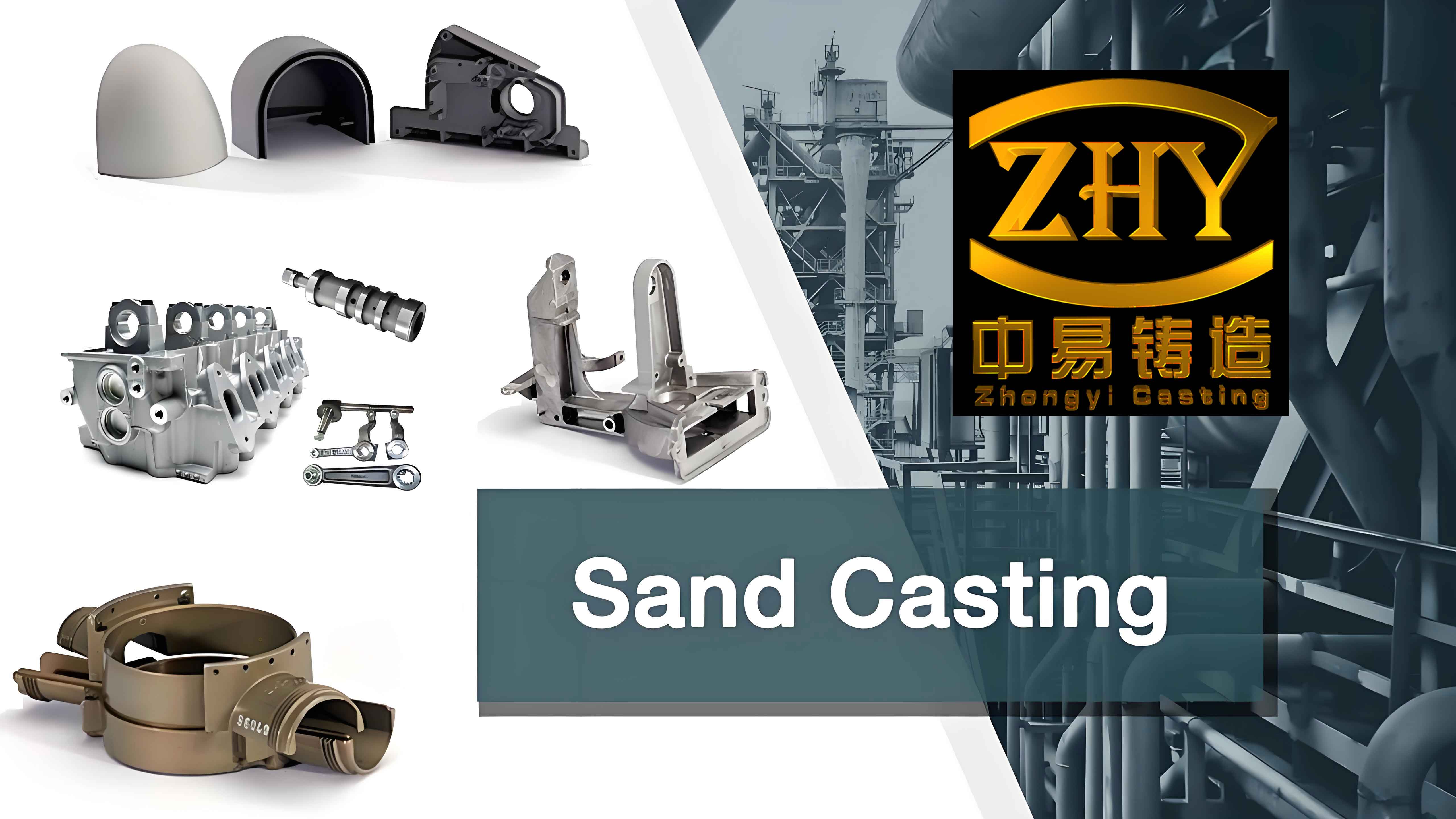
3D printing technology, specifically binder jetting or 3DP for sand molds, offers a paradigm shift for sand casting parts. By building molds layer by layer from digital files, it eliminates the need for physical patterns, reducing lead times and costs. The advantages are manifold: it improves working conditions by enclosing the process, minimizes material waste, and enhances precision for intricate sand casting parts. For instance, in sand casting parts with complex internal channels or thin walls, 3D printing allows direct fabrication without mold assembly errors. This technology aligns with sustainable goals by using recyclable sand and reducing energy consumption compared to traditional methods.
To quantify the benefits, consider the following table comparing traditional sand casting and 3D printing for sand casting parts:
| Aspect | Traditional Sand Casting | 3D Printing Sand Casting |
|---|---|---|
| Lead Time for Mold Making | Weeks to months | Hours to days |
| Cost for Small Batches | High (due to pattern costs) | Low (no pattern needed) |
| Design Flexibility | Limited by mold constraints | High (digital modifications) |
| Environmental Impact | High waste and emissions | Reduced waste and emissions |
| Labor Intensity | High manual work | Automated process |
| Precision for Complex sand casting parts | Moderate, with potential errors | High, with accurate replication |
The mathematical modeling of cost savings further illustrates the impact. For sand casting parts produced in small batches, the total cost \( C \) can be expressed as:
$$ C = C_m + C_l + C_e $$
where \( C_m \) is the mold cost, \( C_l \) is labor cost, and \( C_e \) is environmental compliance cost. In traditional casting, \( C_m \) is significant due to pattern fabrication, whereas in 3D printing, \( C_m \approx 0 \) for digital molds. Labor cost \( C_l \) decreases as automation reduces manual intervention. Environmental cost \( C_e \) is lowered through efficient material usage. For a batch of \( n \) sand casting parts, the cost per part \( c_p \) is:
$$ c_p = \frac{C}{n} $$
With 3D printing, \( c_p \) decreases substantially for small \( n \), making it ideal for custom sand casting parts. Additionally, the production cycle time \( T \) can be modeled as:
$$ T = T_d + T_p + T_c $$
where \( T_d \) is design time, \( T_p \) is printing time, and \( T_c \) is cooling and post-processing time. 3D printing reduces \( T_d \) by enabling rapid digital tweaks and eliminates pattern-making time, often shortening \( T \) by over 50% for sand casting parts.
In practical applications, 3D printing excels in producing complex sand casting parts. Take automotive components: a car steering gear part, weighing 34 kg, traditionally made via investment casting with multiple steps like wax patterning and shell building. With 3D printing, the process simplifies to digital design, sand mold printing, and metal pouring. This cuts lead time from weeks to days, crucial for prototyping sand casting parts. The ability to iterate designs digitally without physical molds accelerates R&D, reducing costs for such sand casting parts by up to 30% based on industry cases.
Another example is engine components, which demand high precision and lightweight structures. Traditional methods use metal patterns and core boxes, costing $20,000 to $50,000 and taking months to produce. For sand casting parts in development phases, 3D printing allows quick validation—printing molds directly from CAD files ensures dimensional accuracy and facilitates design changes. This is invaluable for sand casting parts like cylinder heads or blocks, where weight reduction and complex cooling channels are critical. The table below summarizes key applications:
| Application Sector | Example sand casting parts | Traditional Method | 3D Printing Benefit |
|---|---|---|---|
| Automotive | Steering gears, engine blocks | Investment casting, metal molds | Faster prototyping, lower cost for small batches |
| Aerospace | Turbine housings, structural parts | Complex core assembly | Improved precision, reduced assembly errors |
| Industrial Machinery | Pump housings, valve bodies | Sand molding with patterns | Design flexibility for custom sand casting parts |
| Energy | Wind turbine components | Large-scale pattern making | Scalability without pattern storage |
For motor housing sand casting parts, which feature numerous散热片 (cooling fins) with thin walls and deep gaps, traditional casting struggles due to the need for multiple removable modules. Each fin requires a separate pattern piece, leading to assembly challenges and potential damage. 3D printing consolidates these into a single mold, printing all fins simultaneously without draft angles. This enhances structural integrity and surface finish for such sand casting parts. The geometric complexity can be described using a fin density parameter \( \rho_f \):
$$ \rho_f = \frac{N_f \cdot A_f}{V_m} $$
where \( N_f \) is the number of fins, \( A_f \) is the average fin area, and \( V_m \) is the mold volume. 3D printing handles high \( \rho_f \) values effortlessly, whereas traditional methods face limitations due to pattern extraction forces. This capability is vital for sand casting parts in cooling applications, ensuring efficient heat dissipation.
The environmental advantages of 3D printing for sand casting parts are significant. Traditional sand casting often uses organic binders that emit volatile organic compounds (VOCs) during pouring. 3D printing employs inorganic binders or thermal processes that reduce emissions. The waste reduction can be quantified as:
$$ W_r = W_t – W_a $$
where \( W_t \) is waste in traditional casting (e.g., unused sand, pattern materials), and \( W_a \) is waste in additive manufacturing (typically minimal unused sand). For sand casting parts production, \( W_r \) can be as high as 40%, aligning with circular economy goals. Moreover, the enclosed printing chamber minimizes dust exposure, improving workplace safety—a key factor in attracting skilled labor to produce sand casting parts.
Looking ahead, the scalability of 3D printing in sand casting is promising. As technology advances, printing speeds and material options expand, enabling mass customization of sand casting parts. Hybrid approaches combining 3D-printed cores with traditional molds may optimize costs for large batches. The integration of AI and IoT can further enhance process control, predicting defects in sand casting parts through real-time monitoring. For instance, machine learning algorithms can analyze print parameters to optimize strength and surface quality for sand casting parts.
In conclusion, 3D printing technology is set to redefine the future of sand casting parts manufacturing. By addressing labor, cost, and environmental challenges, it offers a sustainable pathway for producing complex, high-quality sand casting parts in small to medium batches. The technology’s flexibility supports innovation across industries, from automotive to energy, making it a cornerstone of modern foundries. As adoption grows, we can expect broader standardization and cost reductions, further cementing 3D printing’s role in the evolution of sand casting parts production. For any foundry looking to thrive in the era of customization, embracing this digital transformation is not just an option but a necessity for sand casting parts excellence.