
In the manufacturing of high-performance sand casting parts, such as those used in aerospace and automotive industries, hypoeutectic Al-Si alloys are widely favored due to their excellent castability, low density, and good mechanical properties. These sand casting parts, including engine blocks, cylinder heads, and missile mounts, require precise microstructural control to ensure durability and performance. One common method to enhance the properties of Al-Si alloys is through modification of the eutectic Si phase, and antimony (Sb) has been recognized as an effective modifier. However, the mechanisms by which Sb influences the microstructure, particularly under gravity sand casting conditions, remain debated. In this study, I investigate the effects of Sb on the primary α-Al grains and eutectic Si in a hypoeutectic Al-7Si alloy, focusing on the implications for improving sand casting parts. Through thermal analysis, microscopy, and diffraction techniques, I aim to clarify the modification mechanisms and provide insights for industrial applications in sand casting parts production.
The importance of sand casting parts in modern engineering cannot be overstated, as they offer cost-effective and versatile solutions for complex geometries. Under gravity sand casting conditions, the cooling rates are relatively slow, leading to distinct microstructural features that impact the final properties of sand casting parts. For Al-Si alloys, the morphology of primary α-Al grains and eutectic Si plays a critical role in determining strength, ductility, and fatigue resistance. Modification with elements like Sb is often employed to refine the eutectic Si, but its effects on primary α-Al grains are less understood. This study addresses this gap by examining both aspects in detail, with an emphasis on practical relevance for sand casting parts.
To conduct this investigation, I prepared two hypoeutectic Al-Si alloys: one without Sb and another with 0.09 wt% Sb addition, as shown in Table 1. The alloys were melted using high-purity materials, stirred, and cast under gravity sand casting conditions to simulate industrial production of sand casting parts. The chemical compositions were verified using optical emission spectroscopy, ensuring consistency for comparison. Thermal analysis was performed during solidification using data loggers and K-type thermocouples to record temperature-time curves, which are crucial for understanding nucleation events in sand casting parts. Microstructural characterization involved polarized light microscopy (PLM) for primary α-Al grains, scanning electron microscopy (SEM) for eutectic Si after selective etching, electron backscattered diffraction (EBSD) for nucleation core analysis, and transmission electron microscopy (TEM) with energy-dispersive spectroscopy (EDS) for twin and chemical analysis. These methods allowed a comprehensive evaluation of how Sb alters the microstructure in sand casting parts.
| Alloy ID | Si | Mg | Ti | Fe | B | Sb | Al |
|---|---|---|---|---|---|---|---|
| Alloy 1 (Without Sb) | 6.80 | 0.48 | 0.12 | <0.05 | <0.05 | 0 | Balance |
| Alloy 2 (With Sb) | 6.90 | 0.50 | 0.14 | <0.05 | <0.05 | 0.09 | Balance |
The solidification behavior under gravity sand casting conditions was first analyzed through temperature-time curves, as illustrated in Figure 1. For Alloy 1 (without Sb), the nucleation temperature of primary α-Al grains, denoted as $T_{Al}^N$, was 619.5°C, and the eutectic reaction start temperature, or eutectic Si nucleation temperature $T_{Si}^N$, was 578.1°C. In contrast, for Alloy 2 (with Sb), $T_{Al}^N$ decreased to 611.8°C, and $T_{Si}^N$ decreased to 572.6°C. This reduction in nucleation temperatures indicates that Sb increases the undercooling required for both primary α-Al and eutectic Si nucleation in sand casting parts. The undercooling $\Delta T$ can be expressed as:
$$\Delta T = T_{theoretical} – T_{actual}$$
where $T_{theoretical}$ is the equilibrium nucleation temperature from phase diagrams, and $T_{actual}$ is the measured nucleation temperature. For primary α-Al grains, the lower $T_{Al}^N$ implies greater undercooling, making nucleation more difficult. This has direct consequences for the grain size in sand casting parts, as summarized in Table 2.
| Alloy | $T_{Al}^N$ (°C) | $T_{Si}^N$ (°C) | Average Grain Size (µm) | Grain Morphology |
|---|---|---|---|---|
| Alloy 1 (Without Sb) | 619.5 | 578.1 | 319 | Mostly dendritic, some equiaxed |
| Alloy 2 (With Sb) | 611.8 | 572.6 | 353 | Similar, but coarser |
As shown in Table 2, the addition of Sb resulted in an increase in the average primary α-Al grain size from 319 µm to 353 µm under gravity sand casting conditions. This coarsening effect is attributed to the reduced nucleation temperature, which elevates the undercooling $\Delta T_{Al}$ for primary α-Al. According to classical nucleation theory, the critical radius $r^*$ for nucleation is given by:
$$r^* = \frac{2\gamma}{\Delta G_v}$$
where $\gamma$ is the interfacial energy and $\Delta G_v$ is the volumetric Gibbs free energy change. With higher undercooling, $\Delta G_v$ increases, but the nucleation rate $I$ is also affected by kinetic barriers. In sand casting parts, the slower cooling rates in gravity sand casting may amplify this effect, leading to fewer nuclei and larger grains. This coarsening could influence the mechanical properties of sand casting parts, as larger grains often reduce strength and ductility.
Turning to the eutectic Si phase, Sb modification significantly altered its morphology, as quantified in Table 3. For Alloy 1, the eutectic Si exhibited a plate-like structure with an average length of 19.7 µm and width of 8.1 µm. In Alloy 2, with Sb addition, the eutectic Si became shorter and narrower, with average dimensions of 13.3 µm in length and 5.4 µm in width. This refinement is beneficial for sand casting parts, as it enhances mechanical properties by reducing stress concentrations. The mechanism behind this modification can be explained through thermodynamic and kinetic considerations.
| Alloy | Average Length (µm) | Average Width (µm) | Morphology |
|---|---|---|---|
| Alloy 1 (Without Sb) | 19.7 | 8.1 | Plate-like |
| Alloy 2 (With Sb) | 13.3 | 5.4 | Shortened and narrowed |
The reduction in $T_{Si}^N$ due to Sb addition lowers the solid solubility of Si in α-Al, as per the Al-Si phase diagram. At a lower temperature, the equilibrium solubility $C_{eq}$ decreases, increasing the chemical potential $\mu_{Si}$ of Si atoms in the α-Al matrix. The chemical potential difference drives the expulsion of Si atoms from α-Al to the solid-liquid interface, accelerating the growth of eutectic Si. This can be expressed as:
$$\mu_{Si} = \mu_{Si}^0 + RT \ln a_{Si}$$
where $\mu_{Si}^0$ is the standard chemical potential, $R$ is the gas constant, $T$ is temperature, and $a_{Si}$ is the activity of Si. With Sb, $a_{Si}$ increases due to reduced solubility, leading to a higher $\mu_{Si}$. The flux $J$ of Si atoms from α-Al can be described by Fick’s law with a chemical potential gradient:
$$J = -D \frac{\partial C}{\partial x} + \frac{D C}{RT} \frac{\partial \mu_{Si}}{\partial x}$$
where $D$ is the diffusion coefficient, $C$ is concentration, and $x$ is distance. The enhanced flux promotes faster eutectic Si growth, resulting in shorter and narrower structures. This mechanism is particularly relevant in sand casting parts, where controlled solidification is key to achieving desired microstructures.
To further elucidate the modification mechanism, I examined the nucleation cores and twin density of eutectic Si using EBSD and TEM. In Alloy 1, EBSD maps showed multiple colors in eutectic Si regions, indicating diverse nucleation cores. In Alloy 2, with Sb, the color variety did not increase significantly, suggesting that Sb does not act by providing additional nucleation sites. This contradicts some literature proposing that Sb forms compounds like AlSb to serve as nucleation cores. Instead, my findings indicate that Sb’s role is through altering growth kinetics rather than nucleation in sand casting parts. TEM analysis of Alloy 2 revealed no twins in eutectic Si, and EDS confirmed no Sb enrichment at potential twin boundaries. The atomic size ratio of Sb to Si is approximately 1.32, which is far from the ideal value of 1.65 for twin induction. Thus, Sb modification does not involve twinning mechanisms, emphasizing its unique effect on growth dynamics in sand casting parts.
The implications of these findings for sand casting parts are substantial. In gravity sand casting, where cooling rates are moderate, Sb addition can refine eutectic Si but may coarsen primary α-Al grains. This trade-off must be considered in alloy design for sand casting parts. For instance, in applications requiring high strength and toughness, such as engine components, a balanced approach might involve combining Sb with grain refiners like TiB2 to counteract grain coarsening. The chemical potential-driven growth acceleration of eutectic Si offers a pathway to tailor microstructures without relying on nucleation agents, which can be beneficial for reducing costs in sand casting parts production.
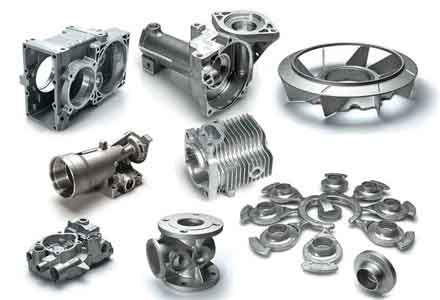
This image exemplifies a typical sand casting part, highlighting the complexity and surface finish achievable with Al-Si alloys. In such components, microstructural uniformity is critical for performance, and Sb modification can enhance eutectic Si morphology. However, as my study shows, the coarsening of primary α-Al grains under gravity sand casting conditions necessitates careful process control. For sand casting parts, optimizing pouring temperatures, mold materials, and cooling rates can mitigate grain growth while leveraging Sb’s benefits. Additionally, the thermodynamic principles discussed here can be applied to other modifier elements, expanding the toolkit for engineering sand casting parts.
To quantify the effects further, I derived a model linking Sb concentration to eutectic Si dimensions. Based on the data, the average length $L$ and width $W$ of eutectic Si can be expressed as functions of Sb content $C_{Sb}$ and undercooling $\Delta T_{Si}$:
$$L = L_0 – k_L \cdot C_{Sb} \cdot \Delta T_{Si}$$
$$W = W_0 – k_W \cdot C_{Sb} \cdot \Delta T_{Si}$$
where $L_0$ and $W_0$ are the dimensions without Sb, and $k_L$ and $k_W$ are constants dependent on alloy composition and casting conditions. For sand casting parts, this model can guide Sb addition levels to achieve target microstructures. Similarly, the primary α-Al grain size $d$ can be related to $T_{Al}^N$ through an Arrhenius-type equation:
$$d = A \exp\left(\frac{Q}{RT_{Al}^N}\right)$$
where $A$ is a pre-exponential factor and $Q$ is an activation energy. These equations provide a framework for predicting microstructural evolution in sand casting parts, aiding in quality assurance.
In summary, my investigation reveals that Sb modifies hypoeutectic Al-Si alloy under gravity sand casting conditions by lowering nucleation temperatures for both primary α-Al and eutectic Si. This leads to grain coarsening but refines eutectic Si through a chemical potential-driven growth acceleration mechanism. Sb does not act on nucleation cores or twins, distinguishing it from other modifiers like Sr or Na. For sand casting parts, these insights underscore the importance of holistic microstructural control, where Sb can be a valuable tool if combined with appropriate processing strategies. Future work should explore synergistic effects with other elements and advanced casting techniques to further optimize sand casting parts for demanding applications.
The role of sand casting parts in industrial sectors continues to grow, and advancements in alloy modification are key to meeting evolving performance standards. By understanding the fundamental mechanisms of Sb in Al-Si alloys, manufacturers can enhance the reliability and efficiency of sand casting parts. This study contributes to that knowledge base, offering practical recommendations for gravity sand casting processes. As sand casting parts become more integral to sustainable engineering, such research will drive innovations in material science and casting technology.