
In my extensive experience in foundry operations, producing high-integrity copper alloy components has always been a significant challenge. The shrinkage tube, a critical part in steam turbine auxiliary exhaust systems, exemplifies this difficulty. For years, our facility relied on conventional dry sand casting methods to manufacture these sand casting parts. The material, a ZCuAl9Mn2 aluminum-manganese bronze, demands an internal cavity completely free from defects and capable of withstanding hydrostatic testing without any leakage. However, the pronounced tendencies of this alloy towards shrinkage, oxidation, and gas absorption made consistent success elusive. Despite employing meticulous practices like bottom-pouring gating systems with filters, chills, and risers, along with rigorous degassing and refining during melting, we faced persistent rejection rates averaging around 30% due to porosity and inclusion defects. These sand casting parts became a notorious production bottleneck.
The quest for a definitive solution led us to re-evaluate our process fundamentally. We turned our attention to centrifugal casting, but with a crucial adaptation: using sand molds within the centrifugal machine. This hybrid approach, which we call sand mold centrifugal casting, leverages the rotational force to improve metal feeding and density while retaining the flexibility of sand molds for complex shapes. For sand casting parts like the shrinkage tube with flanges on both ends, a permanent metal mold would pose severe demolding challenges. Our innovation was to use the existing wooden pattern to create a sand mold inside a standard cylindrical centrifugal drum. After coating and drying, this assembly becomes the mold for casting. This method has not only solved our quality crisis but has also opened a new, versatile pathway for manufacturing demanding sand casting parts.
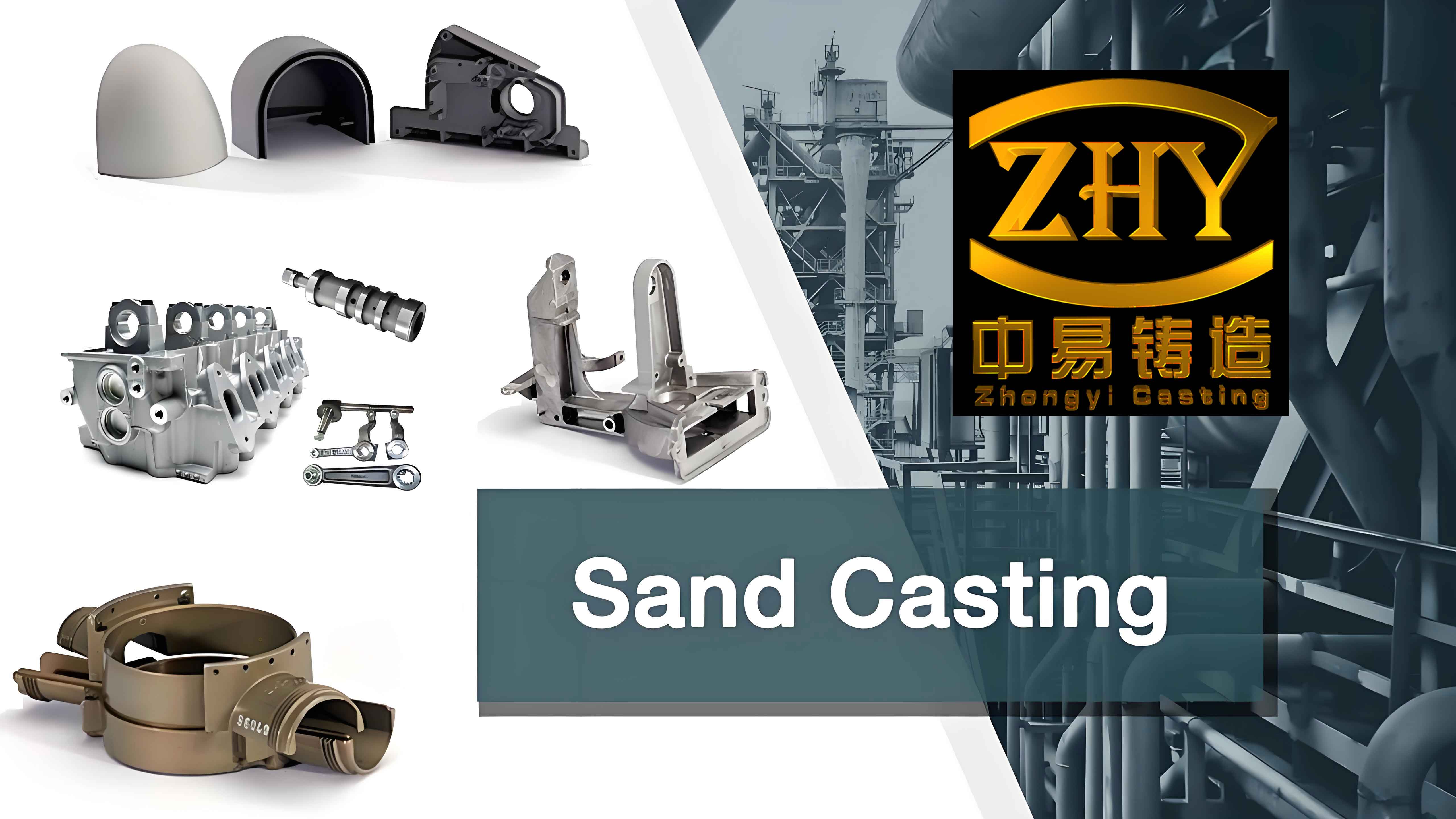
The core of this success lies in a meticulously developed and optimized process. I will now detail every aspect, from initial design to final pouring, emphasizing how each parameter contributes to producing flawless sand casting parts.
Determination of the Process Scheme
The geometry of the shrinkage tube dictates the process layout. The component has a larger flange at one end and a smaller flange at the other, connected by a conical收缩管 section. To ensure uniform wall thickness in the喇叭-shaped internal cavity of the large flange and to minimize machining stock, we oriented the casting with the large flange facing inward (toward the closed end of the centrifugal drum) and the small flange facing outward. A specially designed conical base plate was manufactured to support this orientation and to aid in directional solidification. Because the existing centrifugal machine’s drum length was insufficient, the small flange extended into the cover plate area, necessitating a custom concave-convex cover plate. The entire mold assembly is illustrated conceptually in the following description: a cylindrical drum contains the sand mold, which is formed around a pattern replicating the part’s external shape. The conical base plate sits at the closed end, and the cover plate seals the open end, with the entire assembly rotating during pouring. This configuration is fundamental for all similar sand casting parts produced via this method.
Machining Allowances
Machining allowances for sand mold centrifugal casting must be more generous than those for static sand casting or typical centrifugal casting due to potential minor distortions and the need to ensure complete removal of any surface imperfections. Based on our trials, we established the following allowances, which are now standard for such sand casting parts.
| Feature | Allowance (mm) | Remarks |
|---|---|---|
| Flange End Faces | 8 – 10 | Applied to both flanges. |
| Small Flange End Face (Outward-facing) | 10 (Upper Limit) | Increased to compensate for potential secondary oxide slag formation. |
| Flange Outer Diameter (Per Side) | 5 – 7 | |
| Internal Bore (Minimum Diameter, Per Side) | Approx. 4 | |
| Conical Base Plate Region | 10 – 12 | Increased to enhance feeding for soundness. |
These allowances have proven effective in delivering machinable, sound sand casting parts consistently.
Critical Mold Component Design: The Conical Base Plate
The conical base plate is not merely a positioning tool; it is a critical thermal element influencing solidification. Its primary functions are to promote uniform wall thickness in the large flange’s internal喇叭 and to create a favorable thermal gradient for feeding. The increased allowance in this area, as noted in the table, facilitates this feeding. The plate’s own wall thickness is a key design parameter. Our empirical finding is that it should be 1.5 to 2 times the nominal wall thickness of the main casting body. For a shrinkage tube with a wall thickness of $$ t_{cast} $$, the base plate thickness $$ t_{base} $$ is determined by:
$$ t_{base} = k \cdot t_{cast} $$
where the factor $$ k $$ ranges from 1.5 to 2.0. This mass ensures it does not chill the metal prematurely yet provides adequate structural support during rotation.
Selection and Formulation of Molding Materials
The sand mold must withstand significant centrifugal pressure without erosion or deformation. We selected a high dry-strength core sand mixture, originally used for steel ingot molds. Its composition and properties are detailed below. This formulation is crucial for the integrity of the mold and, consequently, the surface quality of the final sand casting parts.
| Material | Percentage (%) | Specification/Notes |
|---|---|---|
| Coarse Sand | 40 | 20/40 mesh |
| Reclaimed Sand | 40 | |
| Bentonite (Clay) | 7 | |
| Fireclay | 5 | |
| Dextrin | 3 | |
| Water | 4 – 4.5 |
The resulting physical properties of the mixed sand are:
– Green Compression Strength: 0.7 – 0.9 kgf/cm²
– Dry Shear Strength: > 6.0 kgf/cm²
– Green Permeability: > 150
This combination provides the necessary strength to resist metallostatic and centrifugal forces while maintaining sufficient permeability to allow gases to escape, which is vital for producing pore-free sand casting parts.
Mold Making and Preparation Process
The molding process requires precision to ensure rotational balance. The pattern is placed on a flat plate with a central locator to minimize eccentricity. The goal is to keep the offset of the mold’s center of mass from the rotational axis to less than 1 mm. After ramming the sand, the mold is left to condition slightly. To prevent cracking of the sand mold during drying and subsequent heating—which could lead to rough casting surfaces—a specific coating and drying schedule is followed. A carbon black wash is applied every two hours, for a total of three coats. The entire assembly is then dried in an oven for at least 24 hours. This careful preparation ensures a robust, stable mold capable of producing high-quality sand casting parts.
Centrifugal Casting Parameters and Rotational Speed Calculation
The rotational speed ($$ n $$) is the most critical parameter in centrifugal casting. It must generate enough centrifugal force to ensure proper feeding and density but not so much as to cause segregation or excessive pressure on the mold. For a shape like the shrinkage tube, where the outer radius at the large flange ($$ R_{large} $$) and the inner radius at the smallest bore ($$ r_{small} $$) differ significantly, the speed must be a compromise. We use the standard formula for centrifugal casting speed, which relates speed to the alloy density ($$ \rho $$) and the inner radius of the casting ($$ r $$).
The generalized formula is:
$$ G = \frac{r \omega^2}{g} $$
where $$ G $$ is the G-factor (ratio of centrifugal to gravitational acceleration), $$ \omega $$ is the angular velocity in rad/s, and $$ g $$ is acceleration due to gravity. A common empirical formula for non-ferrous alloys is:
$$ n = \frac{29900}{\sqrt{\rho \cdot r}} $$
where:
– $$ n $$ is the rotational speed in revolutions per minute (RPM),
– $$ \rho $$ is the alloy density in g/cm³,
– $$ r $$ is the inner radius of the casting in centimeters.
For our aluminum-manganese bronze, $$ \rho \approx 7.5 \, \text{g/cm}^3 $$. The critical section is the smallest inner radius, approximately $$ r = 7 \, \text{cm} $$. Substituting these values:
$$ n = \frac{29900}{\sqrt{7.5 \times 7}} = \frac{29900}{\sqrt{52.5}} \approx \frac{29900}{7.246} \approx 4125 \, \text{RPM} $$
However, due to equipment limitations, we operated at a lower speed of approximately 3800 RPM. At this speed, we calculated the linear velocities:
– At the large flange outer diameter (say, ~20 cm radius): $$ v_{large} = \frac{2 \pi R n}{60} \approx \frac{2 \pi \times 0.2 \times 3800}{60} \approx 79.6 \, \text{m/s} $$
– At the small inner bore (7 cm radius): $$ v_{small} = \frac{2 \pi r n}{60} \approx \frac{2 \pi \times 0.07 \times 3800}{60} \approx 27.9 \, \text{m/s} $$
While the inner bore velocity is on the lower side for centrifugal casting, practical results showed no defects like mistruns or excessive porosity, proving the adequacy of this speed for these sand casting parts. The relationship between speed, geometry, and soundness can be summarized for future applications with different sand casting parts:
| Parameter | Symbol | Value/Range | Consideration for Sand Casting Parts |
|---|---|---|---|
| Alloy Density | $$ \rho $$ | 7.5 g/cm³ (for this bronze) | Higher density allows lower speeds for same G-factor. |
| Critical Inner Radius | $$ r $$ | 7 cm | Smallest flow path dictates minimum pressure. |
| Calculated Speed (Theoretical) | $$ n_{calc} $$ | ~4125 RPM | Ideal target based on formula. |
| Operational Speed | $$ n_{op} $$ | 3800 RPM | Adjusted for equipment and geometry. |
| G-Factor at Inner Radius | $$ G_{small} $$ | $$ \frac{r \omega^2}{g} \approx 80 $$ | Adequate for bronze alloys. |
Pouring Practice and Metallurgical Control
The pouring phase is where process control culminates. We adhere to a “fast start, slow finish” principle to initially fill the mold quickly and avoid cold shuts, then reduce the rate to minimize turbulence. For a casting weighing approximately 45 kg, the total pouring time is controlled within 15 seconds. Mold temperature is critical: the main sand mold must be thoroughly preheated, and we practice hot-mold pouring. The cover plate does not require coating. However, the temperature of the conical base plate needs precise control. We maintain it between 150°C and 200°C. If the base plate temperature exceeds this range, especially during consecutive pours, it can lead to shrinkage porosity in the large flange junction, as the increased local heat impedes directional solidification. This thermal management is a subtle but key factor for sound sand casting parts.
Metal quality is non-negotiable. The melt undergoes standard degassing and refining procedures—using phosphorus copper for deoxidation and argon purging for degassing—before being deemed suitable for casting. The pouring temperature is maintained at the upper end of the conventional range for this alloy, around 1150°C to 1180°C, to ensure adequate fluidity under centrifugal force. The interaction of these parameters ensures the production of dense, defect-free sand casting parts.
Results, Analysis, and Discussion of the Process
The adoption of sand mold centrifugal casting transformed our production outcomes. The rejection rate for the shrinkage tube plummeted from the historical 30% average to near zero. Internal inspections and hydrostatic tests confirmed the absence of gas porosity and macro-inclusions. The centrifugal force effectively feeds shrinkage throughout solidification and pushes lighter impurities and gases toward the bore’s center, which is subsequently machined away. This process demonstrates remarkable adaptability. For low-volume or complex sand casting parts where designing and manufacturing permanent metal molds is economically or technically unfeasible, this method offers an excellent alternative. It combines the pattern flexibility of sand casting with the quality benefits of centrifugal casting.
The economic and qualitative advantages can be quantified. Let’s define a quality index $$ Q $$ as the ratio of acceptable castings to total castings produced. For the traditional method, $$ Q_{traditional} \approx 0.70 $$. For the new sand mold centrifugal method, $$ Q_{new} \approx 0.99 $$. The improvement $$ \Delta Q $$ is significant. Furthermore, the reduction in machining time due to more predictable and sound castings adds to the cost savings, even considering the slightly higher machining allowances.
The process’s robustness can be analyzed through the lens of solidification under a centrifugal field. The pressure ($$ P $$) at any point within the molten metal at a radius $$ x $$ from the axis is given by:
$$ P(x) = \frac{1}{2} \rho \omega^2 (x^2 – r^2) $$
where $$ r $$ is the inner radius. This pressure gradient actively counteracts shrinkage porosity by forcing liquid metal into developing voids. For sand casting parts with varying sections, this dynamic feeding is superior to static riser-based feeding.
Extended Applications and Future Potential
The success with the shrinkage tube is not an isolated case. We have since applied this sand mold centrifugal casting technique to other challenging components. The methodology is particularly suited for:
1. Cylindrical or conical sand casting parts with flanges or external profiles that are difficult to eject from metal dies.
2. Medium to large sand casting parts where the cost of a permanent centrifugal mold is prohibitive for small batches.
3. Alloys with high shrinkage and gas absorption tendencies, such as certain bronzes and aluminum alloys.
The process flowchart for implementing this for any new sand casting part involves:
1. Feasibility Analysis: Assess part geometry for rotational symmetry and feeding paths.
2. Mold Design: Design base plates and cover plates based on orientation and thermal needs.
3. Parameter Calculation: Determine rotational speed using the formula $$ n = \frac{C}{\sqrt{\rho \cdot r_{eff}}} $$, where $$ C $$ is an empirical constant (often ~29900 for many alloys) and $$ r_{eff} $$ is an effective inner radius.
4. Sand and Process Specification: Select appropriate sand mix and drying cycle.
5. Prototyping and Validation.
This approach has fundamentally expanded the scope of centrifugal casting, making it accessible for jobbing foundries and specialized component manufacturers. The ability to use wood or plastic patterns drastically reduces tooling lead time and cost for sand casting parts.
Conclusion
In conclusion, the development and implementation of the sand mold centrifugal casting process have been a resounding success in our foundry. It effectively solved a long-standing quality problem with copper alloy shrinkage tubes, transforming a high-rejection-rate component into a reliably produced item. The process is characterized by its strong adaptability, relatively simple tooling requirements, and most importantly, its dependable and high-quality output. The key lies in the integrated control of mold design, material selection, rotational dynamics, and pouring practice. This technique has proven that the benefits of centrifugal casting—superior density and feeding—can be successfully harnessed for complex shapes traditionally made by static sand casting, simply by using a sand mold within the centrifugal machine. It represents a versatile and powerful addition to the foundry’s arsenal for producing critical, high-integrity sand casting parts. The principles and parameters detailed here provide a comprehensive framework that can be adapted and optimized for a wide range of alloys and component geometries, promising broader application and continued innovation in the field of specialized casting manufacturing.