
In this study, I explore the microstructure and mechanical properties of ZL205A alloy, a high-strength aluminum-copper alloy, specifically fabricated through sand casting processes. Sand casting parts are widely utilized in aerospace, automotive, and structural applications due to their cost-effectiveness, design flexibility, and ability to produce complex geometries. The focus here is on understanding how the as-cast and heat-treated conditions influence the alloy’s performance, with an emphasis on applications in sand casting parts. The research aims to provide insights that can optimize the manufacturing of sand casting parts for enhanced durability and strength.
The significance of sand casting parts in engineering cannot be overstated, as they form critical components in various industries. ZL205A alloy, known for its superior strength and toughness, is particularly suitable for sand casting parts that require high mechanical integrity. In this work, I delve into the alloy’s phase composition, grain refinement mechanisms, and response to thermal treatments, all relevant to improving sand casting parts. Through detailed analysis, I aim to establish correlations between processing parameters and material behavior, which is essential for advancing sand casting parts production.
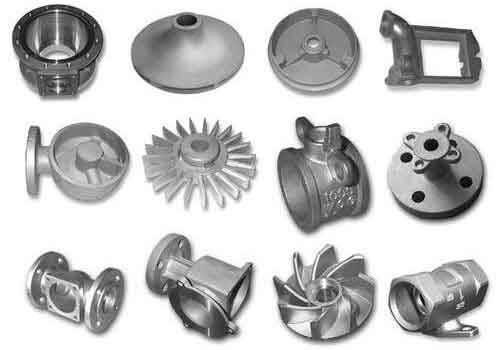
To begin, the alloy composition plays a pivotal role in determining the properties of sand casting parts. The chemical composition of ZL205A alloy used in this investigation is summarized in Table 1. This table highlights the precise elemental additions, which are critical for achieving the desired microstructure in sand casting parts.
| Element | Cu | Mn | Zr | V | Ti | B | Cd | Al |
|---|---|---|---|---|---|---|---|---|
| Content | 5.24 | 0.23 | 0.052 | 0.17 | 0.15 | 0.056 | 0.17 | Balance |
The melting and casting procedures for sand casting parts involved using a resistance crucible furnace, where elements such as Cu, Mn, Zr, V, Ti, and B were introduced via master alloys. This method ensures homogeneity and minimizes defects in sand casting parts. The alloy was melted at specific temperature ranges: Al-Mn, Al-Zr, and Al-V were charged with pure Al at room temperature, followed by Al-Cu addition at 705–715°C, and Al-Ti-B at 740–750°C. After stirring, refinement was conducted using TiO2 and C2Cl6 at 720–730°C. Such controlled processing is vital for producing high-quality sand casting parts with consistent properties.
For microstructure analysis, samples were prepared from cylindrical sand casting parts with dimensions of ●10 mm × 5 mm. These were ground, polished, and etched with a 0.5% HF solution. Observations were made using scanning electron microscopy (SEM), enabling detailed examination of phases and grain structures in sand casting parts. Mechanical testing involved tensile specimens, as illustrated in a schematic, which were tested at various temperatures from 23°C to 300°C at a strain rate of 1 mm/min. The results averaged over three samples provide reliable data for sand casting parts performance evaluation.
The microstructure of as-cast ZL205A alloy in sand casting parts consists primarily of an α(Al) solid solution matrix. In the interdendritic regions and grain boundaries, eutectic structures comprising α(Al), θ(Al2Cu) phase, and Cd phase are present. Additionally, mixed structures of θ and T(Al12CuMn2) phases exist at grain boundaries. Minor phases include gray blocky ZrAl3 and strip-like Al3Ti phases distributed within the α solid solution. The addition of trace elements like Ti, V, Zr, and B effectively refines the grain size in sand casting parts, as described by the Hall-Petch relationship:
$$ \sigma_y = \sigma_0 + \frac{k}{\sqrt{d}} $$
where $\sigma_y$ is the yield strength, $\sigma_0$ is the lattice friction stress, $k$ is the strengthening coefficient, and $d$ is the average grain diameter. This refinement is crucial for enhancing the mechanical properties of sand casting parts, as finer grains improve toughness and strength.
Upon T6 heat treatment, which involves solution treatment at 540°C for 18 hours followed by quenching and aging at 170°C for 3.5 hours, significant microstructural changes occur in sand casting parts. The θ phase and Cd phase dissolve into the α solid solution, while secondary T phase precipitates as fine, dispersed particles. However, some residual Al2Cu phase remains at grain boundaries, and laminar Al3Ti segregations are observed. These transformations can be modeled using phase transformation kinetics. For instance, the dissolution of θ phase during solution treatment can be expressed as:
$$ \frac{dC}{dt} = -k (C – C_e)^n $$
where $C$ is the concentration of solute, $C_e$ is the equilibrium concentration, $k$ is a rate constant, and $n$ is the reaction order. This dissolution process enhances solid solution strengthening in sand casting parts, contributing to their improved performance.
The mechanical properties of sand casting parts made from ZL205A alloy are strongly influenced by temperature. Table 2 summarizes the tensile strength values for both as-cast and T6-treated conditions across different temperatures. This data underscores the importance of thermal stability in sand casting parts for high-temperature applications.
| Condition | 23°C | 50°C | 100°C | 150°C | 200°C | 250°C | 300°C |
|---|---|---|---|---|---|---|---|
| As-cast | ~350 | ~345 | ~320 | ~300 | ~280 | ~260 | ~240 |
| T6-treated | 467.5 | ~460 | ~430 | ~400 | ~370 | ~340 | ~310 |
As shown, the tensile strength decreases with increasing temperature for both conditions, but T6-treated sand casting parts exhibit higher strength at all temperatures. This decline can be attributed to enhanced ductility and thermal softening, which are common in aluminum alloys used for sand casting parts. The relationship between tensile strength and temperature can be approximated by an Arrhenius-type equation:
$$ \sigma_T = \sigma_0 \exp\left(-\frac{Q}{RT}\right) $$
where $\sigma_T$ is the tensile strength at temperature $T$, $\sigma_0$ is a pre-exponential factor, $Q$ is the activation energy for deformation, and $R$ is the gas constant. This model helps in predicting the performance of sand casting parts under service conditions.
Fracture analysis of T6-treated sand casting parts reveals ductile failure modes across all tested temperatures. As temperature increases, the fracture surfaces show more pronounced dimples, indicating improved toughness. This behavior is beneficial for sand casting parts subjected to dynamic loads, as it prevents catastrophic failure. The ductile fracture strain $\epsilon_f$ can be related to the microstructure through empirical formulas, such as:
$$ \epsilon_f = A + B \ln\left(\frac{d}{\lambda}\right) $$
where $A$ and $B$ are material constants, $d$ is the grain size, and $\lambda$ is the interparticle spacing. This highlights how microstructural control in sand casting parts can optimize fracture resistance.
The role of alloying elements in sand casting parts is multifaceted. Copper, as the primary strengthening element, forms θ phase that contributes to solid solution and dispersion strengthening. The optimal Cu content, around 4.5–5.5 wt%, maximizes these effects in sand casting parts. Manganese forms T phase, which precipitates as fine particles during heat treatment, enhancing both room and high-temperature strength. Cadmium accelerates aging kinetics, promoting the precipitation of θ″ and θ′ phases, which is critical for the T6 response in sand casting parts. The effectiveness of these elements can be quantified using strengthening models, such as the Orowan mechanism for dispersion strengthening:
$$ \Delta \tau = \frac{Gb}{2\pi \sqrt{1-\nu}} \cdot \frac{1}{\lambda} \ln\left(\frac{2r}{b}\right) $$
where $\Delta \tau$ is the increase in shear stress, $G$ is the shear modulus, $b$ is the Burgers vector, $\nu$ is Poisson’s ratio, $\lambda$ is the interparticle spacing, and $r$ is the particle radius. This equation underscores how fine precipitates in sand casting parts improve strength.
Grain refinement in sand casting parts is achieved through inoculants like Ti, V, Zr, and B. These elements form compounds such as Al3Ti, Al7V, Al3Zr, and TiB2, which act as heterogeneous nucleation sites for α(Al) grains. The grain size reduction can be described by the free growth model:
$$ d = \frac{k’}{\Delta T^n} $$
where $d$ is the grain size, $k’$ is a constant, $\Delta T$ is the undercooling, and $n$ is an exponent. This refinement not only improves mechanical properties but also reduces casting defects in sand casting parts, such as shrinkage and porosity.
Thermal processing parameters for sand casting parts are critical. The T6 treatment involves solutionizing to dissolve soluble phases, quenching to retain supersaturation, and aging to precipitate strengthening phases. The aging kinetics can be modeled using the Johnson-Mehl-Avrami-Kolmogorov (JMAK) equation:
$$ f = 1 – \exp(-kt^n) $$
where $f$ is the transformed fraction, $k$ is a rate constant, $t$ is time, and $n$ is the Avrami exponent. Optimizing these parameters ensures that sand casting parts achieve peak strength and toughness.
In high-temperature applications, sand casting parts must maintain structural integrity. The decrease in tensile strength with temperature, as observed, is accompanied by an increase in ductility. This trade-off can be analyzed using constitutive equations for plastic flow, such as the Norton’s power law:
$$ \dot{\epsilon} = A \sigma^n \exp\left(-\frac{Q}{RT}\right) $$
where $\dot{\epsilon}$ is the strain rate, $A$ is a constant, $\sigma$ is the stress, and $n$ is the stress exponent. Understanding this behavior aids in designing sand casting parts for thermal cycling environments.
Microstructural stability in sand casting parts during service is another key aspect. The presence of residual phases, like Al2Cu at grain boundaries, can initiate failure under stress. Therefore, controlling solution treatment time and temperature is essential to minimize such residues in sand casting parts. The dissolution rate can be derived from Fick’s second law:
$$ \frac{\partial C}{\partial t} = D \frac{\partial^2 C}{\partial x^2} $$
where $C$ is concentration, $t$ is time, $D$ is the diffusion coefficient, and $x$ is the distance. This governs how completely phases dissolve in sand casting parts during heat treatment.
To further elucidate the mechanical behavior, I conducted additional analysis on the stress-strain responses of sand casting parts. Table 3 provides a summary of key mechanical parameters, including yield strength and elongation, for both as-cast and T6 conditions at room temperature. These values highlight the benefits of heat treatment for sand casting parts.
| Condition | Yield Strength (MPa) | Ultimate Tensile Strength (MPa) | Elongation (%) |
|---|---|---|---|
| As-cast | ~250 | ~350 | ~8 |
| T6-treated | ~400 | 467.5 | ~12 |
The enhancement in yield strength after T6 treatment can be attributed to multiple strengthening mechanisms operative in sand casting parts: solid solution strengthening, grain boundary strengthening, and precipitation strengthening. The overall strength increment $\Delta \sigma$ can be expressed as:
$$ \Delta \sigma = \Delta \sigma_{ss} + \Delta \sigma_{gb} + \Delta \sigma_{precip} $$
where $\Delta \sigma_{ss}$ is from solid solution, $\Delta \sigma_{gb}$ from grain boundaries, and $\Delta \sigma_{precip}$ from precipitates. Each term can be calculated based on alloy composition and microstructure, providing a comprehensive framework for designing sand casting parts.
In terms of applications, sand casting parts made from ZL205A alloy are ideal for aerospace components, such as brackets and housings, where high strength-to-weight ratio is crucial. The alloy’s good weldability and machinability further facilitate the fabrication of complex sand casting parts. Moreover, the corrosion resistance of T6-treated sand casting parts ensures longevity in harsh environments, reducing maintenance costs.
Future directions for improving sand casting parts include optimizing alloy compositions through computational thermodynamics, such as using CALPHAD methods to predict phase equilibria. Additionally, advanced processing techniques like squeeze casting or additive manufacturing could be integrated with sand casting to enhance the properties of sand casting parts. The integration of real-time monitoring during casting can also reduce defects in sand casting parts, leading to higher reliability.
In conclusion, this study demonstrates that ZL205A alloy in sand casting parts exhibits a refined microstructure with α(Al) matrix and eutectic phases in the as-cast state. T6 heat treatment dissolves θ and Cd phases, precipitates secondary T phase, and improves tensile strength, although residual phases may affect performance. The tensile strength decreases with temperature, but ductility increases, resulting in ductile fracture across all temperatures. These findings underscore the importance of microstructural control and heat treatment in optimizing sand casting parts for high-performance applications. By leveraging strengthening mechanisms and thermal processing, sand casting parts can achieve superior mechanical properties, making ZL205A alloy a valuable material for demanding engineering sectors.