
The development of high-integrity, thin-walled sand casting parts for aerospace applications presents a significant challenge, demanding precise control over material properties, dimensional accuracy, and internal soundness. This document details a comprehensive study from a first-person research perspective, focusing on the process development for a large, structural hatch door with a nominal wall thickness of only 2 mm. The goal was to establish a reliable sand casting process capable of meeting stringent aerospace specifications.
The primary subject was a hatch door with overall dimensions of 667 mm x 335 mm x 208 mm and a projected area exceeding 10,700 cm². The defining characteristic was its uniform 2 mm wall thickness, making it an exceptionally thin-walled sand casting part for its size. Key technical challenges included:
1. Achieving complete mold filling without defects.
2. Controlling dimensional tolerances within -0.5 to +0.7 mm.
3. Meeting high mechanical property requirements in critical sections (Ultimate Tensile Strength, Rm ≥ 345 MPa; Yield Strength, Rp0.2 ≥ 276 MPa; Elongation, A ≥ 5%).
4. Ensuring internal quality exceeding standard Grade I radiographic inspection levels, with minimal allowable porosity and shrinkage.
5. Managing difficult-to-feed sections at intersecting ribs and sudden changes in geometry.
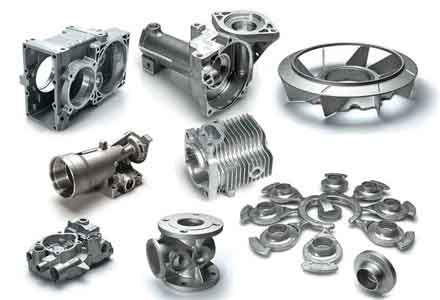
1. Material Development: Melting and Treatment of D357 Alloy
The alloy specified was D357, an Al-Si-Mg casting alloy with a very tight composition window, particularly for magnesium (0.55-0.60 wt.%) and low impurity limits (total ≤ 0.15 wt.%). This posed a challenge as domestic equivalents like ZL114A have wider tolerances. The primary objective was to achieve high melt purity and precise chemistry control.
The melting practice was meticulously designed. To minimize hydrogen pickup and oxide formation, silicon was introduced at a lower bath temperature compared to standard practice. A combined treatment approach was adopted where grain refinement (using Al-Ti-B), eutectic modification (using Sr), and degassing were performed in a coordinated sequence. This integrated treatment helps reduce the total processing time and temperature exposure.
For degassing, a rotary impeller system was employed to inject high-purity argon gas. The shear force from the rotating impeller creates a fine dispersion of bubbles, significantly increasing the gas-liquid interfacial area for efficient hydrogen removal. The flotation of these bubbles also aids in the removal of non-metallic inclusions. The efficiency of hydrogen removal can be related to the bubble surface area flux ($Q$) and treatment time ($t$):
$$ \frac{dC}{dt} = -k \cdot A \cdot (C – C_{eq}) $$
where $C$ is the instantaneous hydrogen concentration, $C_{eq}$ is the equilibrium concentration at the melt temperature and pressure, $k$ is the mass transfer coefficient, and $A$ is the total bubble surface area, which is a function of the gas flow rate and impeller design. The refined and degassed melt was then subjected to chemical analysis, with magnesium content carefully adjusted through controlled additions based on real-time spectroscopy results.
The table below summarizes the critical compositional differences between the target D357 specification and a common domestic alloy, highlighting the challenge in impurity control for such high-performance sand casting parts.
| Element | D357 Specification (wt.%) | Typical ZL114A (wt.%) | Significance for Thin-Wall Casting |
|---|---|---|---|
| Si | 6.5 – 7.5 | 6.5 – 7.5 | Provides fluidity. Critical for filling thin sections. |
| Mg | 0.55 – 0.60 | 0.45 – 0.60 | Primary strengthening element via heat treatment. Tight control is vital for consistent mechanical properties. |
| Fe (Max) | 0.12 | 0.20 | Forms brittle intermetallics (e.g., β-Al5FeSi). Lower limits improve ductility and fatigue resistance. |
| Total Impurities | 0.15 | 0.75 | Directly impacts fracture toughness and internal soundness of the final sand casting part. |
2. Mold Filling Studies for Thin-Wall Sections
Given the extreme thinness of the wall, gravity sand casting was deemed insufficient for complete filling and adequate metallurgical quality. Therefore, counter-gravity casting methods, where molten metal is pushed upward into the mold cavity under controlled pressure, were investigated. These methods offer superior control over fill velocity and provide solidification under pressure.
Initial research involved a comparative study using a multi-cavity test mold producing six 2-mm thick plates. Three counter-gravity techniques were evaluated under consistent conditions: Low-Pressure Casting (LPC), Counter-Pressure (or Differential Pressure) Casting (CPC), and Vacuum-Assisted Pressure Casting (often called Adjustable Pressure Casting, APC). The objective was to assess fill capability and preliminary internal quality.
| Process Parameter | Low-Pressure (LPC) | Counter-Pressure (CPC) | Adjustable Pressure (APC) |
|---|---|---|---|
| Furnace Pressure | Atmospheric | ~500 kPa (Overpressure) | Atmospheric |
| Mold Chamber Pressure | Atmospheric | Atmospheric | ~-90 kPa (Vacuum) | Effective Fill Pressure Differential ($\Delta P_f$) | ~40 kPa (from pump) | ~40 kPa | ~40 kPa + Vacuum Assist |
| Fill Velocity Target | 100 mm/s | 100 mm/s | 100 mm/s |
| Intended Benefit | Controlled fill, some feeding pressure. | High-pressure solidification for denseness. | Enhanced fill from vacuum, improved feeding from riser tube. |
All three processes successfully filled the 2-mm test plates when adequate gating and venting (using exothermic vent cords) were provided. However, radiographic inspection revealed distinct defect patterns critical for aerospace sand casting parts:
- APC: Exhibited significant gas porosity (Grade 3). The vacuum application during filling likely promoted hydrogen degassing from the melt, but the subsequent rapid solidification of the thin section trapped the gas as fine pores.
- LPC & CPC: Showed shrinkage porosity at the isolated thermal centers of the plates (Grade 3 for LPC, Grade 2 for CPC). The lack of a feeding path was the primary cause.
- CPC Advantage: The higher overall pressure during solidification in CPC marginally reduced the shrinkage severity and, more importantly, completely suppressed gas porosity, yielding a cleaner matrix.
The impact on mechanical properties was decisive. When a proper feeding system was designed for the test plates, the resulting tensile properties differed markedly:
| Property | LPC Test Plate | CPC Test Plate | Hatch Door Requirement |
|---|---|---|---|
| Rm (MPa) | 335 | 365 | ≥ 345 |
| Rp0.2 (MPa) | 250 | 285 | ≥ 276 |
| Elongation, A (%) | 8 | 9 | ≥ 5 |
Only the CPC sample met all mechanical property targets. The enhanced properties are attributed to the increased pressure ($P$) during solidification, which directly affects the feeding efficiency and reduces microporosity formation. The relationship can be simplified by considering the pressure needed to suppress pore formation, related to the gas content and surface tension ($\gamma$):
$$ P_{applied} > \frac{2\gamma}{r} + P_{gas} $$
where $r$ is the pore radius and $P_{gas}$ is the internal gas pressure. CPC’s higher $P_{applied}$ effectively increases the critical pore radius for nucleation, leading to a denser microstructure. Consequently, Counter-Pressure Casting was selected as the primary method for producing this demanding thin-walled sand casting part.
Initial full-scale hatch door castings using CPC parameters derived from the plate tests (745°C fill, 100 mm/s) resulted in misruns. Analysis indicated excessive heat loss in the thin sections during filling. The process was optimized by:
1. Increasing fill temperature to 750±5°C and fill speed to 120 mm/s.
2. Applying an insulating refractory coating to the mold cavity surfaces.
3. Redesigning the gating to a clustered pencil gate system. This design uses multiple small-diameter ingates distributed along the part’s length, which helps distribute the hot metal more evenly, reduces turbulence, and maintains thermal gradients favorable for directional solidification towards feeders. The fill time ($t_f$) for a thin section can be approximated by:
$$ t_f \approx \frac{L}{v} + \frac{\rho C_p (T_{pour} – T_{liquidus}) \cdot t}{h (T_{mold} – T_{ambient})} $$
where $L$ is flow length, $v$ is fill velocity, $\rho$, $C_p$ are density and specific heat, and $h$ is the heat transfer coefficient. Increasing $v$ and $T_{pour}$ directly reduces the risk of premature freezing. These modifications successfully eliminated misruns.
3. Dimensional Accuracy Control in Sand Molding
Maintaining a 2 mm wall thickness with a tolerance of ±0.6 mm over a large sand casting part is exceptionally difficult with traditional wooden patterns and loose assembly methods. Dimensional drift from pattern wear, core shift, and mold assembly inaccuracies is unacceptable.
The solution involved a precision tooling and assembly strategy:
1. CNC-Machined Metal Tooling: The pattern for the mold cope/drag (the “skin”) and the core boxes were machined from metal (e.g., aluminum or cast iron) based on 3D CAD models. This ensures the initial geometry of the sand mold components is highly accurate and repeatable.
2. Interlocking Locator System: During the core and mold making process, precision locator sleeves were embedded into the sand at predefined positions on both the core and the mold cavity. During mold assembly, matching hardened steel locator pins were used to guide the core into its exact position within the mold. This pin-and-sleeve system mechanically eliminates translational and rotational errors during closing.
The resultant dimensional capability for the critical wall thickness can be described statistically. If the process variation follows a normal distribution, the probability of a dimension being within tolerance is given by the process capability index ($C_{pk}$):
$$ C_{pk} = \min\left( \frac{USL – \mu}{3\sigma}, \frac{\mu – LSL}{3\sigma} \right) $$
where $USL$ and $LSL$ are the upper and lower specification limits (2.7 mm and 1.5 mm respectively), $\mu$ is the process mean, and $\sigma$ is the process standard deviation. The precision tooling and assembly method directly reduces $\sigma$, thereby increasing $C_{pk}$ and the yield of conforming sand casting parts. Coordinate Measuring Machine (CMM) verification confirmed all critical dimensions were within the specified range.
4. Internal Soundness and Feeding System Design
Despite the general feeding pressure provided by CPC, specific geometric features of the hatch door—such as intersecting ribs and the central regions of long, thin panels—remained prone to shrinkage porosity and micro-shrinkage, as revealed by full-section radiographic inspection of initial castings.
Root Cause Analysis:
– Rib Intersections: These are natural hot spots (thermal nodes) where solidification is delayed. The feeding path from the thinner, faster-solidifying surrounding walls is cut off early, leaving isolated liquid pools that shrink without compensation.
– Panel Centers: In a long, thin plate cooled from both edges, the centerline is the thermal center. It solidifies last and, without a dedicated feeder, forms centerline shrinkage or porosity. The solidification time ($t_s$) according to Chvorinov’s rule is:
$$ t_s = B \cdot \left( \frac{V}{A} \right)^n $$
where $V$ is volume, $A$ is cooling surface area, $B$ is the mold constant, and $n$ is an exponent (typically ~2). For the panel center, the effective $V/A$ ratio is higher than at the edges, leading to a longer $t_s$.
Corrective Action – Hybrid Feeding/Chilling: A combined approach of targeted feeding and accelerated cooling was implemented:
1. Small, Top-Rated Feeders (Risers): Strategically placed over major rib intersections and at the end of long panels. Their design ensures they remain liquid longer than the casting section they feed (Modulus, $M_{riser} > M_{casting}$). The required feeder volume can be estimated from the alloy’s volumetric shrinkage ($\alpha$):
$$ V_{riser} \geq \frac{\alpha \cdot V_{casting}}{ \eta } $$
where $\eta$ is the feeding efficiency.
2. Interstitial Chills: High thermal conductivity metal chills (e.g., cast iron) were embedded in the sand mold between the feeders. Their function is to extract heat rapidly from the region, creating a steep thermal gradient towards the feeder. This promotes directional solidification and extends the effective feeding range of each riser. The heat extraction rate ($Q_{chill}$) is governed by:
$$ Q_{chill} = h_{interface} \cdot A_{chill} \cdot (T_{melt} – T_{chill}) $$
where $h_{interface}$ is the interfacial heat transfer coefficient, highly dependent on contact quality.
This combination—feeder to supply liquid metal and adjacent chills to control the solidification direction—effectively eliminated the shrinkage defects in these problematic areas. Subsequent castings exhibited internal quality compliant with the most stringent aerospace radiographic standards, proving the robustness of the developed process for such complex, thin-walled sand casting parts.
5. Summary and Process Synergy
The successful production of this large, thin-walled aluminium alloy hatch door was not due to a single innovation but the synergistic integration of several advanced foundry techniques specifically tailored for high-performance sand casting parts:
- Material Purity: The tailored melting and treatment practice for D357 alloy ensured a clean, consistent melt with precise chemistry, forming the foundation for high mechanical properties.
- Controlled Filling & Solidification: Counter-Pressure Casting was identified as the optimal method, providing the necessary fill control while applying significant pressure during solidification to enhance density and mechanical performance, a critical advantage over Low-Pressure or vacuum-assisted methods for this application.
- Precision Mold Engineering: The use of CNC-machined metal tooling combined with a pin-and-sleeve location system transformed sand casting from a “loose-tolerance” process into one capable of holding tight dimensional tolerances on thin walls.
- Advanced Feeding Strategy: The hybrid use of small, calculated feeders paired with strategic chills addressed the inherent solidification challenges of thin-walled geometries with thick junctions, ensuring internal soundness.
This holistic approach demonstrates that through systematic research and integration of modern process controls, sand casting can reliably produce large, complex, and structurally demanding thin-walled components that meet the extreme requirements of the aerospace industry. The principles established here—precision tooling, controlled counter-gravity filling, pressurized solidification, and synergistic feeding design—form a validated framework for developing other challenging thin-walled sand casting parts.