
As a researcher in the field of metal casting, I have always been fascinated by the challenges involved in producing high-quality sand casting parts. Among these, engine blocks stand out due to their large size, intricate geometries, and stringent technical requirements. The quality of such sand casting parts not only reflects the technological prowess of a foundry but also its management efficiency and workforce skills. In recent years, with advancements in computer technology, numerical simulation has emerged as a powerful predictive tool for casting processes, transitioning from research to industrial applications and becoming indispensable for the foundry industry. Specifically, the casting of engine blocks remains a significant难点, but simulating this process using numerical software allows for a clear visualization of the entire casting sequence, providing invaluable insights for practical production.
In this work, I employed the casting simulation software AnyCasting to analyze the mold-filling process for a specific engine block model produced via sand casting. My primary focus was on examining the flow and temperature fields during filling, tracking the advancement of the liquid metal front, and predicting the root cause of leakage defects in the tappet hole side water jacket. The simulation successfully identified the confluence point of two metal streams as the potential defect location, which aligned perfectly with actual production data. This validated model served as a reliable foundation for further defect prediction and practical process guidance. Subsequently, I simulated and analyzed two modified gating system designs to provide actionable recommendations for process improvement.
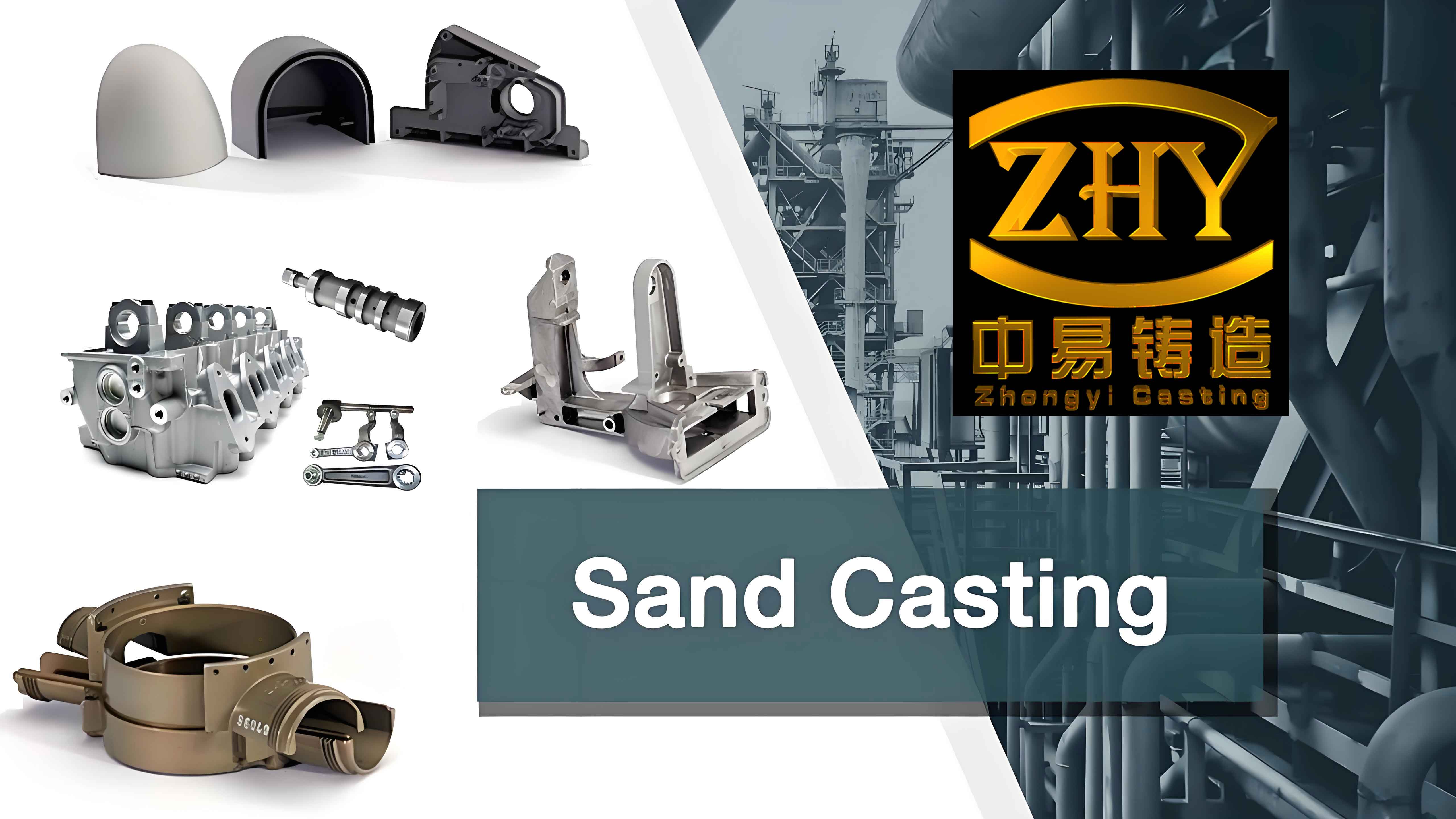
The production of complex sand casting parts like engine blocks demands meticulous control over the molten metal flow and solidification. Defects such as cold shuts, misruns, and inclusions often originate during the filling stage. Therefore, a deep understanding of the underlying physics is crucial. The governing equations for fluid flow during mold filling are derived from the fundamental laws of conservation.
Fundamental Governing Equations for Mold Filling Simulation
The flow of molten metal during the filling of a sand mold is typically modeled as a viscous, incompressible, non-steady state flow with a free surface. This process involves coupled momentum and energy transfer. A complete mathematical description must satisfy the laws of mass, momentum, and energy conservation. The core set of equations, often referred to as the Navier-Stokes equations along with the continuity and energy equations, forms the basis for numerical simulation of this transient phenomenon.
The general form of these equations is as follows:
1. Continuity Equation (Conservation of Mass):
$$ \frac{\partial \rho}{\partial t} + \nabla \cdot (\rho \mathbf{v}) = 0 $$
For an incompressible fluid, which is a reasonable assumption for liquid metals, this simplifies to:
$$ \nabla \cdot \mathbf{v} = 0 $$
where \( \rho \) is the density, \( t \) is time, and \( \mathbf{v} \) is the velocity vector.
2. Momentum Equation (Conservation of Momentum – Navier-Stokes):
$$ \rho \left( \frac{\partial \mathbf{v}}{\partial t} + (\mathbf{v} \cdot \nabla) \mathbf{v} \right) = -\nabla p + \mu \nabla^2 \mathbf{v} + \rho \mathbf{g} + \mathbf{S} $$
where \( p \) is the pressure, \( \mu \) is the dynamic viscosity, \( \mathbf{g} \) is the gravitational acceleration vector, and \( \mathbf{S} \) represents any additional source terms (e.g., momentum sinks for porous media like sand).
3. Energy Equation (Conservation of Energy):
$$ \rho C_p \left( \frac{\partial T}{\partial t} + (\mathbf{v} \cdot \nabla) T \right) = \nabla \cdot (k \nabla T) + Q $$
where \( C_p \) is the specific heat capacity, \( T \) is the temperature, \( k \) is the thermal conductivity, and \( Q \) represents heat sources or sinks.
These equations, when solved numerically with appropriate boundary and initial conditions, describe the velocity, pressure, and temperature distribution throughout the mold cavity during filling and subsequent cooling. The successful simulation of sand casting parts hinges on the accurate implementation and solution of this coupled system.
Pre-Simulation Preparation and Model Setup
Before initiating the simulation, comprehensive preparation is essential. For this study on engine block sand casting parts, the 3D CAD model assembly—including the casting, gating system (sprue, runners, ingates), and risers—was created and assembled in Pro/ENGINEER. To ensure accurate meshing, especially given the significant variation in wall thickness of the block and to prevent artificial separation at the junctions between the casting and the gating elements, the entire assembly was treated as a single contiguous volume. This unified model was exported in STL format and imported into the AnyCasting simulation environment, where it was defined as the casting cavity.
The next critical step was mesh generation. The complexity of engine block sand casting parts requires a fine mesh to capture thin sections and complex geometries adequately. After several iterations of partitioning and refinement, a computational mesh comprising approximately 27.6 million cells was generated. A summary of the key material properties and process parameters used in the simulation is presented in the table below.
| Parameter | Value / Specification | Remarks |
|---|---|---|
| Casting Material | GG250 (Gray Cast Iron) | Common material for engine blocks |
| Mold Material | Conventional Silica Sand | Standard sand casting process |
| Pouring Temperature | 1400 °C | Initial temperature of molten iron |
| Pouring Height | 0.2 m | Height from ladle to pouring cup |
| Gravity Acceleration | 9.80 m/s² | Standard gravitational constant |
| Heat Transfer Coefficients | Temperature-dependent | Defined for metal-mold, metal-air, and air-mold interfaces |
| Numerical Solver | Flow Model with SOR (Successive Over-Relaxation) | Iterative method for solving discretized equations |
| Total Mesh Cells | ~27.6 million | Final mesh size after optimization |
The heat transfer coefficients between different phases (metal-sand, metal-air, air-sand) were defined as functions of temperature to mimic real-world conditions more accurately. The flow model was activated, and the solver calculated the time steps adaptively. The primary outputs sought were the evolving flow field (velocity vectors) and temperature field during the entire filling process.
Analysis and Discussion of Simulation Results
Original Gating System: Flow and Temperature Field Analysis
The original casting process for these engine block sand casting parts employed a step-gating system. In an ideal step-gating system, molten metal should enter the mold cavity sequentially from the bottom ingates upward, preventing turbulence and ensuring smooth filling. However, the simulation revealed a deviation from this ideal behavior.
From the very beginning of pouring, metal entered the cavity simultaneously from multiple ingates at different levels. This resulted in two distinct advancing fronts of molten iron within the mold. The confluence of these two streams was located precisely on the inner wall of the tappet hole region. At this meeting point, the simulation temperature field indicated a significantly lower temperature compared to the surrounding areas. This temperature drop, combined with the potential for oxide film entrapment at the merging front, creates a perfect condition for the formation of a cold shut or a weak bonding line, leading to leakage defects. This simulated defect location showed excellent correlation with the actual leakage points observed in production, thereby validating the accuracy of the numerical model for these specific sand casting parts.
The key parameters characterizing the flow at the defect location can be summarized by the following relationship, which highlights the conditions favoring defect formation:
$$ \text{Defect Susceptibility} \propto \frac{|\mathbf{v}_1 – \mathbf{v}_2| \cdot \Delta T_{\text{interface}}}{\tau_{\text{contact}}} $$
where \( \mathbf{v}_1 \) and \( \mathbf{v}_2 \) are the velocity vectors of the two meeting streams, \( \Delta T_{\text{interface}} \) is the temperature difference at the interface, and \( \tau_{\text{contact}} \) is the effective contact time under pressure. A high relative velocity, low interface temperature, and short contact time increase the risk of a weak joint.
| Stream | Estimated Front Velocity (m/s) | Temperature at Confluence (°C) | Flow Direction Relative to Wall |
|---|---|---|---|
| Primary Stream (Lower) | ~0.45 | ~1280 | Oblique Impingement |
| Secondary Stream (Upper) | ~0.38 | ~1265 | Oblique Impingement |
| Confluence Zone | Near Zero | ~1240 – 1250 | Stagnation |
Simulation of Improved Gating System Designs
Based on the findings from the original process simulation, two modified gating system designs were proposed and simulated with the objective of achieving true sequential filling and relocating or eliminating the detrimental stream confluence. The goal was to enhance the integrity of these critical sand casting parts.
Improved Process Design 1: This design involved adding additional ingates (30mm x 6mm in cross-section) at the central positions of cylinders 1, 3, 4, and 6. The simulation results demonstrated a marked improvement. The filling sequence became much more controlled, approximating the intended bottom-up progression. The upper-level ingates did not participate actively until the metal level in the cavity rose sufficiently. Consequently, the formation of distinct, cold-stream fronts meeting in the tappet hole area was largely mitigated.
Improved Process Design 2: This design started with the modifications from Design 1 but additionally removed the ingates at the bearing cap (瓦口) locations for cylinders 3 and 5. Surprisingly, the simulation showed that this alteration caused a regression in filling behavior. The upper ingates became active prematurely, recreating a filling pattern similar to the original, problematic process. Two major streams again converged in the tappet hole region, with a noticeable cold spot at the junction. Furthermore, the removal of those ingates led to inconsistent filling of the corresponding bearing cap sections compared to others, potentially introducing new dimensional or quality issues in these sand casting parts.
The thermal dynamics of the filling process can be further analyzed by considering the local energy balance at any point in the fluid domain. The rate of temperature change for a fluid particle is governed by:
$$ \frac{DT}{Dt} = \frac{\partial T}{\partial t} + (\mathbf{v} \cdot \nabla)T = \alpha \nabla^2 T $$
where \( \alpha = k/(\rho C_p) \) is the thermal diffusivity. A low value of \( \alpha \) for cast iron means temperature gradients persist, making the flow pattern critically important for thermal homogeneity.
| Process Design | Primary Filling Characteristic | Stream Confluence in Tappet Area? | Temperature at Critical Zone (°C) | Predicted Defect Risk |
|---|---|---|---|---|
| Original Design | Simultaneous filling from multiple levels | Yes, pronounced | 1240 – 1250 | Very High |
| Improved Design 1 | Near-sequential, bottom-up filling | No, significantly reduced | > 1300 (in that region) | Low |
| Improved Design 2 | Premature upper ingate activation | Yes, similar to original | ~1255 – 1265 | High |
The effectiveness of a gating system for complex sand casting parts can be qualitatively assessed by a dimensionless number comparing the filling momentum to the thermal diffusion rate, which I define for this context as:
$$ \Pi = \frac{v \cdot L}{\alpha} \cdot \frac{\Delta T_{pour}}{T_{liquidus}} $$
where \( v \) is a characteristic filling velocity, \( L \) a characteristic length (e.g., wall thickness), \( \alpha \) is thermal diffusivity, \( \Delta T_{pour} \) is the superheat, and \( T_{liquidus} \) is the liquidus temperature. A lower \( \Pi \) value generally indicates a filling process less prone to premature heat loss and cold shut formation. Design 1 yielded a lower effective \( \Pi \) value in the critical sections compared to the Original and Design 2.
Industrial Validation and Concluding Remarks
The numerical simulation provided clear, physics-based guidance for process optimization. The validated model confirmed that the leakage defect in these engine block sand casting parts originated from a cold shut formed by the confluence of two inadequately fused metal streams during filling, pinpointed by the simulated temperature and flow fields.
Based on the simulation results, Improved Process Design 1 was recommended and implemented in production. The practical outcome was a substantial reduction in the leakage defect rate for the engine blocks. The leakage rate dropped from an initial level of around 2% to below 0.73%, demonstrating the direct industrial value of simulation-driven design for sand casting parts.
In conclusion, this work underscores the critical role of numerical simulation in the modern foundry. By applying software like AnyCasting, engineers can peer into the otherwise invisible process of mold filling, diagnose potential defects before they occur, and test design modifications virtually. This capability is especially vital for demanding sand casting parts such as engine blocks, where quality requirements are extreme. The use of fundamental fluid dynamics and heat transfer equations, coupled with accurate meshing and material data, creates a powerful digital twin of the casting process. The successful correlation between simulation predictions and real-world defects, followed by the successful implementation of a simulated solution, provides a compelling blueprint for the continued integration of computational tools in the manufacture of high-integrity sand casting parts. Future work will involve extending this methodology to simulate the solidification and stress development phases to predict other defects like shrinkage porosity and distortion, further enhancing the quality and yield of complex sand casting parts.