
As a practitioner in the foundry industry, I have witnessed the evolution of sand casting processes, particularly in the production of high-quality sand casting parts. The journey from traditional methods to advanced automation and smart technologies has been transformative. In this article, I will share insights into key areas such as cleaning and finishing equipment, pouring systems, and inspection technologies, all critical for enhancing the efficiency and quality of sand casting parts. I will use tables and formulas to summarize key points, ensuring a comprehensive overview that meets the industry’s future demands.
The production of sand casting parts involves multiple stages, each with its own challenges. Cleaning and finishing, for instance, is often a bottleneck due to reliance on manual labor. With the implementation of initiatives like “Made in China 2025,” there is a push toward intelligent foundry workshops, where advanced equipment and real-time monitoring play pivotal roles. Throughout this discussion, I will emphasize the importance of sand casting parts as the end-product, driving innovation across the board.
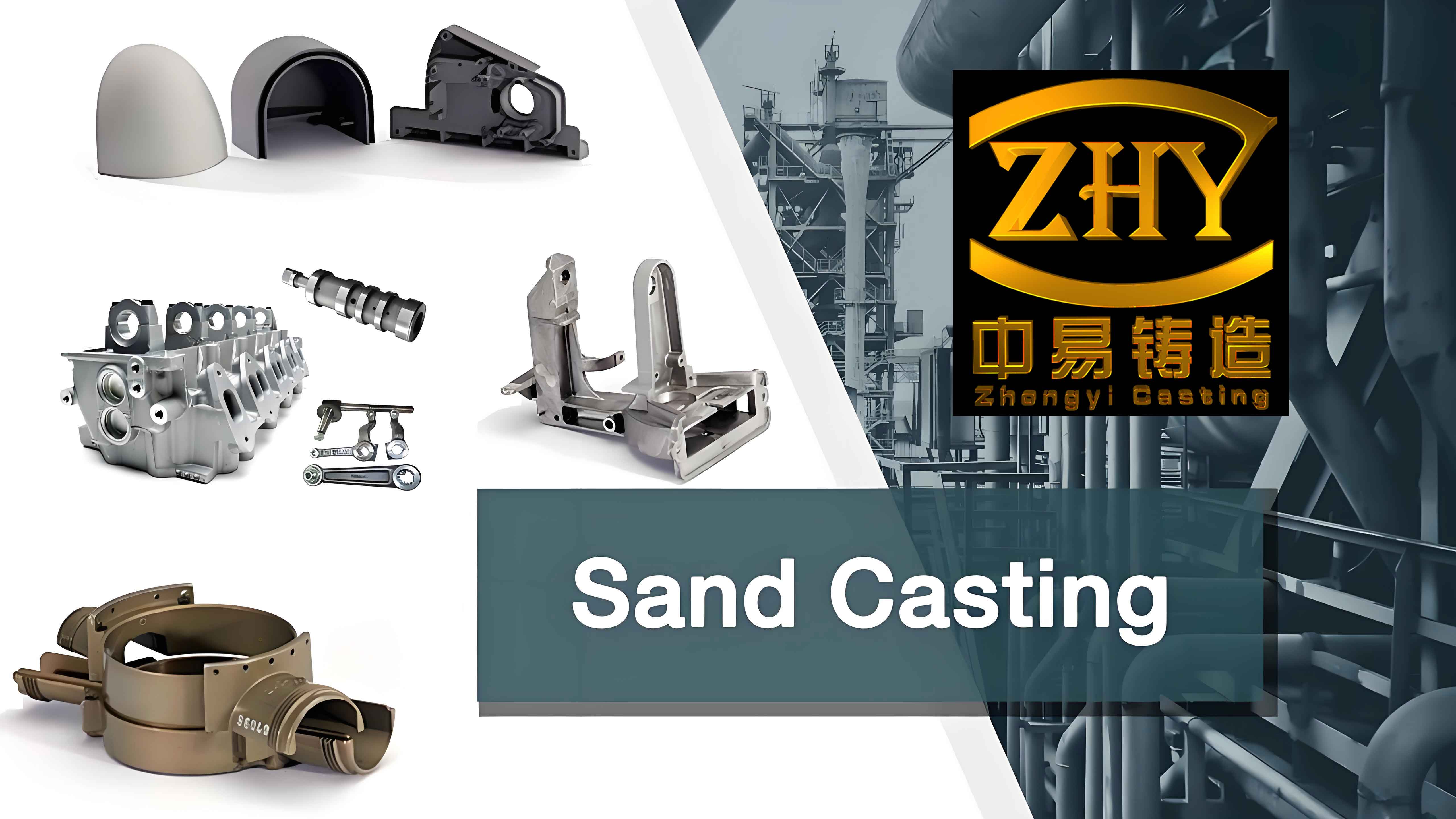
In my experience, the cleaning and finishing of sand casting parts is a process that removes excess material, such as sand residues, gates, risers, and flashes, to achieve a smooth surface. Currently, many foundries use single-shot shot blasting machines and manual grinding, leading to low productivity and poor working conditions. The development of efficient online shot blasting technology is crucial for streamlining this stage. For example, the efficiency of shot blasting can be modeled using a formula that relates the cleaning rate to equipment parameters: $$E_b = \frac{A_c \cdot v_b}{t_b}$$ where \(E_b\) is the blasting efficiency, \(A_c\) is the surface area of sand casting parts, \(v_b\) is the blasting velocity, and \(t_b\) is the time required. This highlights the need for high-speed systems to handle large volumes of sand casting parts.
To address the challenges in cleaning, I have observed that perceptual near-net shape processing technology is gaining traction. This involves using machine vision and tactile sensors to guide automated grinding systems, mimicking human dexterity. For complex sand casting parts, this technology adjusts grinding parameters based on real-time feedback. The force control during grinding can be expressed as: $$F_g = k \cdot \Delta d$$ where \(F_g\) is the grinding force, \(k\) is a material constant, and \(\Delta d\) is the deviation from the target dimension. This ensures precision while accommodating variations in sand casting parts.
Integration technology is another area where I see significant potential. By combining various cleaning and finishing machines into automated lines, foundries can improve workflow for sand casting parts. Below is a table summarizing the current state, challenges, and goals for cleaning equipment:
| Technology | Current Status | Challenges | Goals by 2020 | Goals by 2030 |
|---|---|---|---|---|
| Efficient Online Shot Blasting | Predominantly offline single machines; low efficiency | High wear, pollution, and discrete layout | Develop domestic advantages in online systems | Cultivate internationally competitive manufacturers |
| Perceptual Near-Net Shape Processing | Limited automation; reliance on manual work for sand casting parts | Integration of vision, tactile sensing, and intelligent coordination | Implement CNC positioning for multi-part grinding | Achieve intelligent grinding with adaptive parameters |
| Complete Integration | Discrete operations with manual handling | Automation of logistics and flexible production lines | Provide holistic process solutions for target sand casting parts | Automate material handling and classification systems |
Moving to pouring equipment, the pouring stage is critical for ensuring the integrity of sand casting parts. Traditional methods involve manual ladles, but automated pouring machines, such as induction pouring furnaces, offer better control. One innovation I have explored is the independent single-coil design for induction pouring furnaces. Unlike conventional systems with a single circular coil, this design uses multiple independent coils, each with its own cooling and control. The heating uniformity can be calculated using: $$T_u = \frac{\sum_{i=1}^{n} T_i}{n}$$ where \(T_u\) is the average temperature uniformity, \(T_i\) is the temperature at coil \(i\), and \(n\) is the number of coils. This design reduces slag formation and improves efficiency for sand casting parts production.
Intelligent control systems for pouring processes are also essential. By integrating optical monitoring and float detection, these systems maintain constant metal level in the pouring cup, crucial for consistent quality in sand casting parts. The control algorithm can be represented as: $$P_f = K_p \cdot e + K_i \int e \, dt$$ where \(P_f\) is the furnace pressure, \(e\) is the error in liquid level, and \(K_p\) and \(K_i\) are control gains. This ensures precise pouring for each mold of sand casting parts.
Inspection technologies play a vital role in quality assurance for sand casting parts. From melt quality evaluation to defect detection, real-time monitoring systems are becoming indispensable. For melt quality, a comprehensive approach includes thermal analysis and spectroscopy. The carbon equivalent (CE) for iron-based sand casting parts can be determined using: $$CE = C + \frac{Si + P}{3}$$ where C, Si, and P are weight percentages. This formula helps in predicting casting properties and optimizing melt treatment.
Online monitoring of molding sand quality is another focus area. Parameters like moisture content and compactability affect the final sand casting parts. I have developed systems that measure these in real-time, using formulas such as: $$C_s = \frac{W_w – W_d}{W_d} \times 100\%$$ where \(C_s\) is the moisture content, \(W_w\) is the wet weight, and \(W_d\) is the dry weight of sand. Below is a table outlining inspection technologies:
| Inspection Area | Current Status | Challenges | Goals by 2020 | Goals by 2030 |
|---|---|---|---|---|
| Melt Quality Evaluation | Fragmented techniques; lack of systematic monitoring for sand casting parts | Inconsistent raw materials and adaptive model development | Design integrated evaluation systems and devices | Build dynamic adjustment systems for melts |
| Molding Sand Quality | Basic online monitoring; limited parameters for sand casting parts | Development of multi-parameter sensors and systems | Develop online monitoring for sand composition and properties | Implement comprehensive monitoring systems |
| Pouring and Solidification Monitoring | Rarely used in sand casting parts production | Difficulty in tracking dynamic parameters and defect formation | Develop online monitoring for pouring processes | Create through-type solidification monitoring devices |
| Defect Inspection | Reliance on sampling and offline methods for sand casting parts | High-temperature inspection and variability in defects | Research new nondestructive testing methods | Develop group technologies for online defect detection |
| Laboratory Systems | Limited equipment; outdated analysis for sand casting parts | Need for advanced instruments and integrated systems | Develop smart analyzers for thermal and physical properties | Build intelligent evaluation systems for melts and sands |
For laboratory use, comprehensive systems are needed to evaluate sand casting parts quality. This includes thermal analysis devices that measure cooling curves, expressed as: $$\frac{dT}{dt} = f(T, t)$$ where \(T\) is temperature and \(t\) is time. Such data helps in predicting microstructure and mechanical properties of sand casting parts. Additionally, nondestructive testing like ultrasonic inspection uses wave propagation formulas: $$v_u = \sqrt{\frac{E}{\rho}}$$ where \(v_u\) is the ultrasonic velocity, \(E\) is Young’s modulus, and \(\rho\) is density, aiding in defect detection in sand casting parts.
The integration of these technologies into a cohesive roadmap is essential for the future of sand casting parts production. Based on my observations, the industry is moving toward smart foundries where equipment communicates via IoT platforms. For example, the overall equipment effectiveness (OEE) for a sand casting line can be optimized using: $$OEE = A \times P \times Q$$ where \(A\) is availability, \(P\) is performance, and \(Q\) is quality rate. This metric drives continuous improvement in producing sand casting parts.
In conclusion, the advancement of sand casting equipment and inspection technologies is pivotal for meeting global demands for high-quality sand casting parts. From automated cleaning systems to intelligent pouring controls and real-time monitoring, each innovation contributes to efficiency and sustainability. As I reflect on these developments, it is clear that collaboration across research and industry will accelerate progress. By leveraging formulas for process optimization and tables for strategic planning, foundries can navigate challenges and achieve the goals set for 2020 and 2030. The journey toward intelligent manufacturing for sand casting parts is ongoing, and I am confident that these technologies will redefine the landscape of metal casting.